Bhagavad Gita 7.12: meaning and translation
Chapter 7: Jnana Vijnana Yoga. Krishna says
All states of being that are sāttvic (calm and clear), rājasic (active and restless) or tāmasic (dull and heavy) come from him alone, Krishna says.
Click or tap a word for its meaning and its dictionary page.
Text and layers
Text and layers
These choices stay in this browser.
Bhagavad Gita 7.12
ये चैव सात्त्विका भावा राजसास्तामसाश्च ये ।मत्त एवेति तान्विद्धि न त्वहं तेषु ते मयि ॥
Ye chaiva sattvika bhava rajasastamasashcha yeMatta eveti tanviddhi na tvaham teshu te mayi
ye caiva sāttvikā bhāvā rājasāstāmasāśca ye |matta eveti tānviddhi na tvahaṃ teṣu te mayi ||
Our explanation All states of being that are sāttvic (calm and clear), rājasic (active and restless) or tāmasic (dull and heavy) come from him alone, Krishna says. Yet he is not in them; they are in him.
हिंदी अर्थ कृष्ण कहते हैं कि सात्त्विक (शांत और निर्मल), राजस (सक्रिय और चंचल) और तामस (जड़ और भारी) जितने भी भाव हैं, सब उन्हीं से हैं। फिर भी वे उन भावों में नहीं हैं; वे भाव उनमें हैं।
Word by word
Every word, with its dictionary page
Word by word
- ये ye · which (pronoun (masculine), nominative plural) Dictionary: yad, Monier-Williams 1899, p. 844, col. 2 “who, which, what, whichever, whatever, that”
- च ca · and (indeclinable) Dictionary: 2. ca, Monier-Williams 1899, p. 380, col. 1 “and, both, also, moreover, as well as”
- एव eva · indeed (indeclinable) Dictionary: 1. eva, Monier-Williams 1899, p. 232, col. 2 “just, exactly, very, same, only, even, alone, merely”
- सात्त्विकाः sāttvikāḥ · of sattva (calm, clear) (adjective (masculine), nominative plural) Dictionary: sāttvika, Monier-Williams 1899, p. 1200, col. 1 “relating to or endowed with the quality Sattva (i.e. 'purity' or 'goodness')”
- भावाः bhāvāḥ · states of being (noun (masculine), nominative plural) Dictionary: bhāva, Monier-Williams 1899, p. 754, col. 2 “manner of being, nature, temperament, character”
- राजसाः rājasāḥ · of rajas (active, restless) (adjective (masculine), nominative plural) Dictionary: rājasa, Monier-Williams 1899, p. 875, col. 2 “belonging or relating to the quality rajas”
- तामसाः tāmasāḥ · of tamas (dull, heavy) (adjective (masculine), nominative plural) Dictionary: tāmasa, Monier-Williams 1899, p. 442, col. 3 “appertaining to or affected by the quality tamas”
- च ca · and (indeclinable) Dictionary: 2. ca, Monier-Williams 1899, p. 380, col. 1 “and, both, also, moreover, as well as”
- ये ye · which (pronoun (masculine), nominative plural) Dictionary: yad, Monier-Williams 1899, p. 844, col. 2 “who, which, what, whichever, whatever, that”
- मत्तः mattaḥ · from "me" (Krishna) (pronoun, ablative singular) Dictionary: 1. mad, Monier-Williams 1899, p. 777, col. 2 “base of the first pers. pron. in the sg. number (esp. in comp.)”
- एव eva · alone (indeclinable) Dictionary: 1. eva, Monier-Williams 1899, p. 232, col. 2 “just, exactly, very, same, only, even, alone, merely”
- इति iti · thus (indeclinable) Dictionary: 2. iti, Monier-Williams 1899, p. 165, col. 1 “in this manner, thus”
- तान् tān · them (pronoun (masculine), accusative plural) Dictionary: tad, Monier-Williams 1899, p. 434, col. 1 “m. he, f. she, n. it, that, this”
- विद्धि viddhi · know (imperative, 2nd person singular) Dictionary: 1. vid, Monier-Williams 1899, p. 963, col. 2 “to know, understand, perceive, learn”
- न na · not (indeclinable) Dictionary: 2. na, Monier-Williams 1899, p. 523, col. 1 “not, no, nor, neither”
- तु tu · but (indeclinable) Dictionary: 2. tu, Monier-Williams 1899, p. 449, col. 3 “but”
- अहम् aham · "I" (Krishna) (pronoun, nominative singular) Dictionary: aham, Monier-Williams 1899, p. 124, col. 2 “nom. sg. ‘I,’”
- तेषु teṣu · in them (pronoun (masculine), locative plural) Dictionary: tad, Monier-Williams 1899, p. 434, col. 1 “m. he, f. she, n. it, that, this”
- ते te · they (pronoun (masculine), nominative plural) Dictionary: tad, Monier-Williams 1899, p. 434, col. 1 “m. he, f. she, n. it, that, this”
- मयि mayi · in "me" (Krishna) (pronoun, locative singular) Dictionary: 1. mad, Monier-Williams 1899, p. 777, col. 2 “base of the first pers. pron. in the sg. number (esp. in comp.)”
Old translations
Kashinath Trimbak Telang, 1882. Public domain. Page 75.
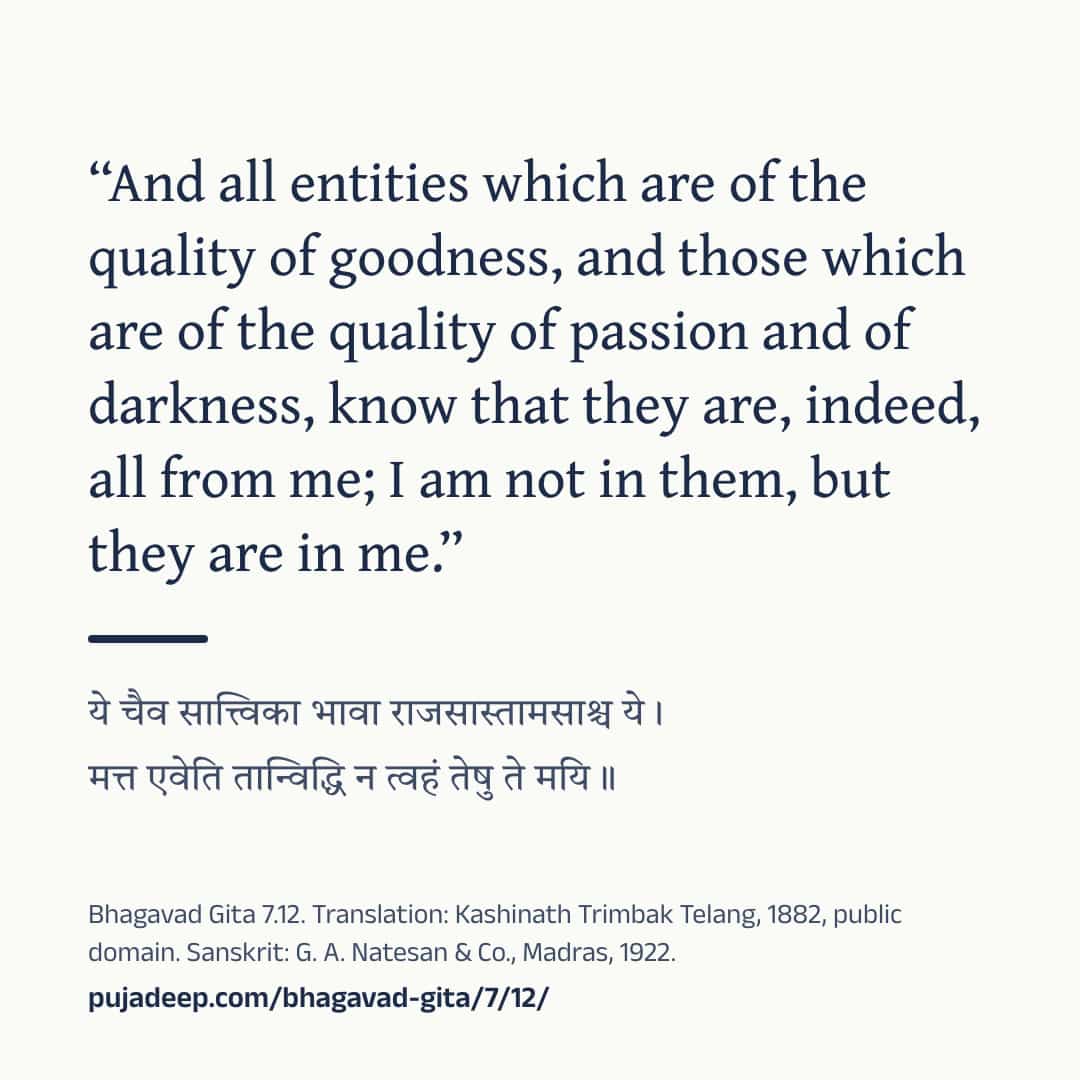
And all entities which are of the quality of goodness, and those which are of the quality of passion and of darkness, know that they are, indeed, all from me; I am not in them, but they are in me1.
Footnotes (the translator’s own) - They do not dominate over me, I rule them. ↩
Compare 3 translations
Kashinath Trimbak Telang, 1882. Public domain. Page 75.
And all entities which are of the quality of goodness, and those which are of the quality of passion and of darkness, know that they are, indeed, all from me; I am not in them, but they are in me1.
Footnotes (the translator’s own) - They do not dominate over me, I rule them. ↩
You are reading this one
Annie Besant, 1895. Public domain. Page 77.
The natures that are Sâttvic, Râjasic, Tâmasic, these know as from Me; not I in them, but they in Me.
You are reading this one
Swami Swarupananda, 1909 (first printed 1907). Public domain. Page 150.
And whatever states pertaining to Sattva, and those pertaining to Rajas, and Tamas, know them to proceed from Me alone; still I am not in them, but they are in Me.
You are reading this one
Cite this verse
The translation: K. T. Telang, The Bhagavadgîtâ (The Sacred Books of the East, vol. VIII, Oxford: Clarendon Press, 1882), p. 75. Bhagavad Gita 7.12.
The translation: Annie Besant, The Bhagavad Gîtâ, or The Lord's Song (London: Theosophical Publishing Society, 1895), p. 77. Bhagavad Gita 7.12.
The translation: Swami Swarupananda, Srimad-Bhagavad-Gita (Mayavati: Prabuddha Bharata Press, 1909; first printed in Prabuddha Bharata, 1907–1909), p. 150. Bhagavad Gita 7.12.
Our explanation: “Bhagavad Gita 7.12: meaning and translation.” Pujadeep. Updated October 27, 2026. https://pujadeep.com/bhagavad-gita/7/12/
Pujadeep’s explanations are free to quote with credit: name Pujadeep and link to the page. How to credit
Classical readings, by school
No readings by school on this verse yet.
Share
Show the ways to share
Send one picture or the text to one chat. The picture names its source and the address of this page.
Drawing the picture
See the words
Bhagavad Gita 7.12

ये चैव सात्त्विका भावा राजसास्तामसाश्च ये ।
मत्त एवेति तान्विद्धि न त्वहं तेषु ते मयि ॥

“And all entities which are of the quality of goodness, and those which are of the quality of passion and of darkness, know that they are, indeed, all from me; I am not in them, but they are in me.”
(K. T. Telang, The Bhagavadgîtâ (The Sacred Books of the East, vol. VIII, Oxford: Clarendon Press, 1882), p. 75, public domain)

“The natures that are Sâttvic, Râjasic, Tâmasic, these know as from Me; not I in them, but they in Me.”
(Annie Besant, The Bhagavad Gîtâ, or The Lord's Song (London: Theosophical Publishing Society, 1895), p. 77, public domain)

“And whatever states pertaining to Sattva, and those pertaining to Rajas, and Tamas, know them to proceed from Me alone; still I am not in them, but they are in Me.”
(Swami Swarupananda, Srimad-Bhagavad-Gita (Mayavati: Prabuddha Bharata Press, 1909; first printed in Prabuddha Bharata, 1907–1909), p. 150, public domain)

Sanskrit: G. A. Natesan & Co., Madras, 1922.
https://pujadeep.com/bhagavad-gita/7/12/ Nothing is sent from this site. Your own app sends it, to the chat you choose. The picture quotes the translation you chose on this page, with its name and year.
Sanskrit text: The Bhagavad-Gita, or The Lord's Song, with the text in Devanagari and an English translation, 1922. Meanings: written for Pujadeep and checked against the cited edition. Source and changes
Questions families ask
Who speaks Bhagavad Gita 7.12?
Krishna speaks this verse, in chapter 7 (Jnana Vijnana Yoga).
Where does the Sanskrit text come from?
Sanskrit text: The Bhagavad-Gita, or The Lord's Song, with the text in Devanagari and an English translation, 1922. Meanings: written for Pujadeep and checked against the cited edition. See the source
Is the meaning on this page a translation?
Explanation written for this site from the sources listed here, and checked against the cited edition. It is not a translation and not the only way to read the text. Free to quote with credit.
Source and licence
- Sanskrit text
- The Bhagavad-Gita, or The Lord's Song, with the text in Devanagari and an English translation (Annie Besant, G. A. Natesan & Co., Madras, 1922). Public domain. The Sanskrit on these pages was read from this printing’s page images.
- Translation
- The Bhagavadgîtâ with the Sanatsugâtîya and the Anugîtâ, translated by Kâshinâth Trimbak Telang (The Sacred Books of the East, vol. VIII, ed. F. Max Müller) (Kashinath Trimbak Telang, F. Max Müller, Clarendon Press, Oxford, 1882). Public domain. Shown verbatim, as printed.
- Translation
- The Bhagavad Gîtâ, or The Lord's Song, translated by Annie Besant (Annie Besant, Theosophical Publishing Society, London, 1895). Public domain. Shown verbatim, as printed.
- Translation
- Srimad-Bhagavad-Gita, with Sanskrit Text; Paraphrase with Word-by-word Literal Translation; English Rendering and Comments, Index, &c., by the Swami Swarupananda (Himalayan Series, No. XX) (Swami Swarupananda, The Editors and Publishers, Advaita Ashrama, Mayavati, Prabuddha Bharata Press, Mayavati, Almora, Himalayas, 1909). Public domain. Shown verbatim, as printed.
- Common wording
- In this text, 32 words follow today's common wording, checked against sanskritdocuments.org; Sanskrit Wikisource; Gita Press, Gorakhpur; GRETIL, Göttingen and Bhaktivedanta Book Trust.
- Our explanation
- Explanation written for this site from the sources listed here, and checked against the cited edition. It is not a translation and not the only way to read the text. Free to quote with credit.
- Checked
- Checked against the cited edition, October 15, 2026.
- Updated
- October 27, 2026