Bhagavad Gita 7.13: meaning and translation
Chapter 7: Jnana Vijnana Yoga. Krishna says
Krishna says that, deluded by these three kinds of states, made of the three guṇas (sattva, rajas and tamas), the whole world does not recognise him, who is beyond them and does not change.
Click or tap a word for its meaning and its dictionary page.
Text and layers
Text and layers
These choices stay in this browser.
Bhagavad Gita 7.13
त्रिभिर्गुणमयैर्भावैरेभिः सर्वमिदं जगत् ।मोहितं नाभिजानाति मामेभ्यः परमव्ययम् ॥
Tribhirgunamayairbhavairebhih sarvamidam jagatMohitam nabhijanati mamebhyah paramavyayam
tribhirguṇamayairbhāvairebhiḥ sarvamidaṃ jagat |mohitaṃ nābhijānāti māmebhyaḥ paramavyayam ||
Our explanation Krishna says that, deluded by these three kinds of states, made of the three guṇas (sattva, rajas and tamas), the whole world does not recognise him, who is beyond them and does not change.
हिंदी अर्थ कृष्ण कहते हैं कि तीन गुणों (सत्त्व, रज और तम) से बने इन तीन तरह के भावों से मोहित होकर सारा जगत उन्हें नहीं पहचानता, जो इनसे परे और अविनाशी हैं।
Word by word
Every word, with its dictionary page
Word by word
- त्रिभिः tribhiḥ · by three (numeral (masculine), instrumental plural) Dictionary: tri, Monier-Williams 1899, p. 457, col. 3
- गुणमयैः guṇamayaiḥ · made of the guṇas (adjective (masculine), instrumental plural) Dictionary: guṇa-maya, Monier-Williams 1899, p. 357, col. 2 “produced by or consisting of the three constituent properties of Prakṛiti”
- भावैः bhāvaiḥ · by states of being (noun (masculine), instrumental plural) Dictionary: bhāva, Monier-Williams 1899, p. 754, col. 2 “manner of being, nature, temperament, character”
- एभिः ebhiḥ · by these (pronoun (masculine), instrumental plural) Dictionary: 1. idam, Monier-Williams 1899, p. 165, col. 2 “this, this here, referring to something near the speaker”
- सर्वम् sarvam · whole (adjective (neuter), nominative singular) Dictionary: sarva, Monier-Williams 1899, p. 1184, col. 3 “whole, entire, all, every”
- इदम् idam · this (pronoun (neuter), nominative singular) Dictionary: 1. idam, Monier-Williams 1899, p. 165, col. 2 “this, this here, referring to something near the speaker”
- जगत् jagat · world (noun (neuter), nominative singular) Dictionary: jagat, Monier-Williams 1899, p. 408, col. 1 “the world, esp. this world, earth”
- मोहितम् mohitam · deluded (past participle (neuter), nominative singular) Dictionary: mohita, Monier-Williams 1899, p. 836, col. 2 “stupefied, bewildered, infatuated, deluded”
- न na · not (indeclinable) Dictionary: 2. na, Monier-Williams 1899, p. 523, col. 1 “not, no, nor, neither”
- अभिजानाति abhijānāti · recognises (present, 3rd person singular) Dictionary: abhi-jñā, Monier-Williams 1899, p. 62, col. 2 “to recognize, perceive, know, be or become aware of”
- माम् mām · "me" (Krishna) (pronoun, accusative singular) Dictionary: 1. mad, Monier-Williams 1899, p. 777, col. 2 “base of the first pers. pron. in the sg. number (esp. in comp.)”
- एभ्यः ebhyaḥ · than these, beyond these (pronoun (masculine), ablative plural) Dictionary: 1. idam, Monier-Williams 1899, p. 165, col. 2 “this, this here, referring to something near the speaker”
- परम् param · beyond, higher (adjective (masculine), accusative singular) Dictionary: 1. para, Monier-Williams 1899, p. 586, col. 1 “highest, supreme, chief”
- अव्ययम् avyayam · unchanging (adjective (masculine), accusative singular) Dictionary: 2. a-vyaya, Monier-Williams 1899, p. 111, col. 3 “not liable to change, imperishable, undecaying”
Old translations
Kashinath Trimbak Telang, 1882. Public domain. Page 75.
The whole universe deluded by these three states of mind, developed from the qualities, does not know me, who am beyond them and inexhaustible;
This sentence goes on in 7.14.
Compare 3 translations
Kashinath Trimbak Telang, 1882. Public domain. Page 75.
The whole universe deluded by these three states of mind, developed from the qualities, does not know me, who am beyond them and inexhaustible;
This sentence goes on in 7.14.
You are reading this one
Annie Besant, 1895. Public domain. Page 77.
All this world, deluded by these natures made by the three Gunas, knoweth not Me, above these, imperishable.
You are reading this one
Swami Swarupananda, 1909 (first printed 1907). Public domain. Page 150–151.
Deluded by these states, the modifications of the three Gunas (of Prakriti), all this world does not know Me, beyond them, and immutable.
You are reading this one
Cite this verse
The translation: K. T. Telang, The Bhagavadgîtâ (The Sacred Books of the East, vol. VIII, Oxford: Clarendon Press, 1882), p. 75. Bhagavad Gita 7.13.
The translation: Annie Besant, The Bhagavad Gîtâ, or The Lord's Song (London: Theosophical Publishing Society, 1895), p. 77. Bhagavad Gita 7.13.
The translation: Swami Swarupananda, Srimad-Bhagavad-Gita (Mayavati: Prabuddha Bharata Press, 1909; first printed in Prabuddha Bharata, 1907–1909), pp. 150–151. Bhagavad Gita 7.13.
Our explanation: “Bhagavad Gita 7.13: meaning and translation.” Pujadeep. Updated October 27, 2026. https://pujadeep.com/bhagavad-gita/7/13/
Pujadeep’s explanations are free to quote with credit: name Pujadeep and link to the page. How to credit
Classical readings, by school
No readings by school on this verse yet.
Share
Show the ways to share
Send one picture or the text to one chat. The picture names its source and the address of this page.
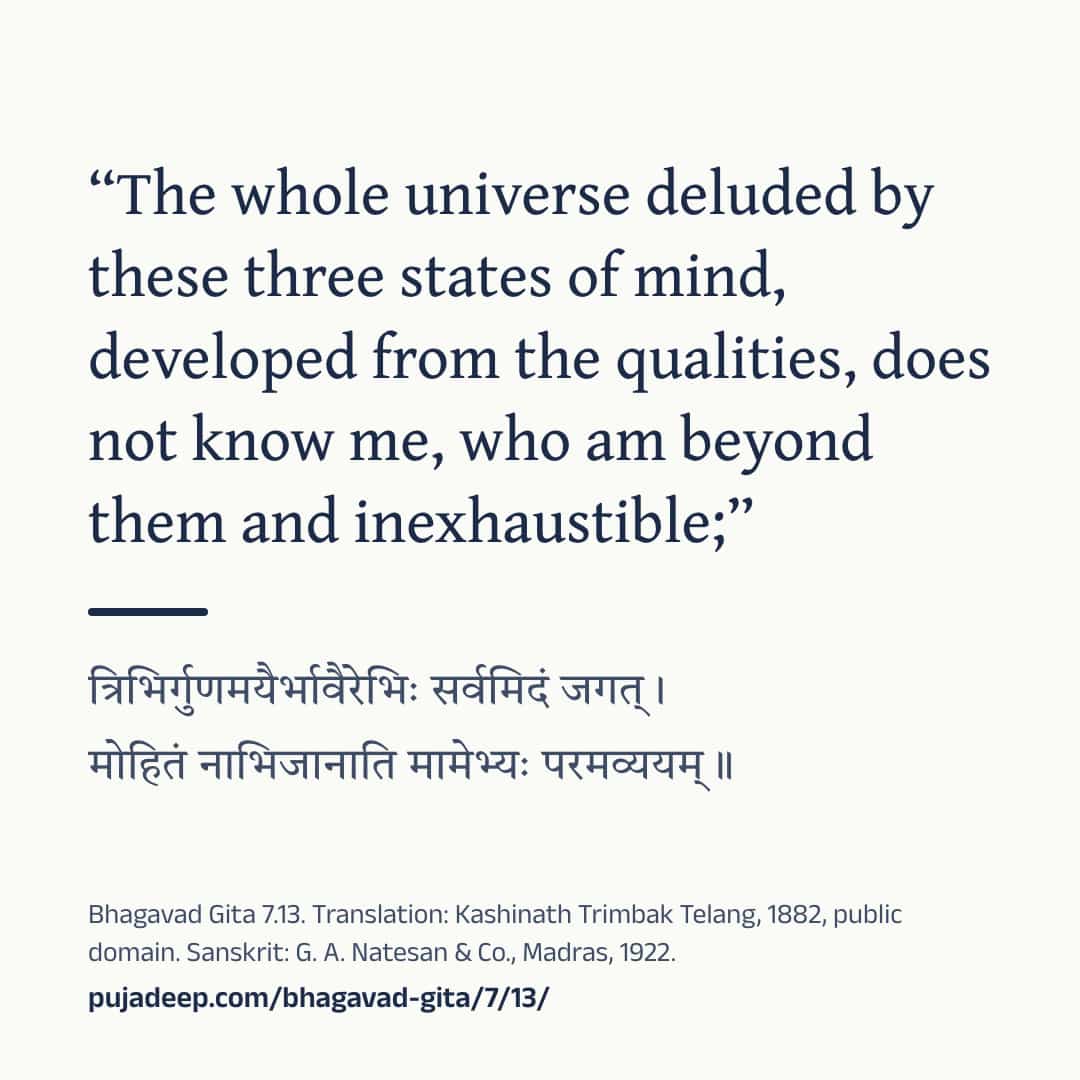
Drawing the picture
See the words
Bhagavad Gita 7.13

त्रिभिर्गुणमयैर्भावैरेभिः सर्वमिदं जगत् ।
मोहितं नाभिजानाति मामेभ्यः परमव्ययम् ॥

“The whole universe deluded by these three states of mind, developed from the qualities, does not know me, who am beyond them and inexhaustible;”
(K. T. Telang, The Bhagavadgîtâ (The Sacred Books of the East, vol. VIII, Oxford: Clarendon Press, 1882), p. 75, public domain)
This sentence goes on in 7.14.

“All this world, deluded by these natures made by the three Gunas, knoweth not Me, above these, imperishable.”
(Annie Besant, The Bhagavad Gîtâ, or The Lord's Song (London: Theosophical Publishing Society, 1895), p. 77, public domain)

“Deluded by these states, the modifications of the three Gunas (of Prakriti), all this world does not know Me, beyond them, and immutable.”
(Swami Swarupananda, Srimad-Bhagavad-Gita (Mayavati: Prabuddha Bharata Press, 1909; first printed in Prabuddha Bharata, 1907–1909), pp. 150–151, public domain)

Sanskrit: G. A. Natesan & Co., Madras, 1922.
https://pujadeep.com/bhagavad-gita/7/13/ Nothing is sent from this site. Your own app sends it, to the chat you choose. The picture quotes the translation you chose on this page, with its name and year.
Sanskrit text: The Bhagavad-Gita, or The Lord's Song, with the text in Devanagari and an English translation, 1922. Meanings: written for Pujadeep and checked against the cited edition. Source and changes
Questions families ask
Who speaks Bhagavad Gita 7.13?
Krishna speaks this verse, in chapter 7 (Jnana Vijnana Yoga).
Where does the Sanskrit text come from?
Sanskrit text: The Bhagavad-Gita, or The Lord's Song, with the text in Devanagari and an English translation, 1922. Meanings: written for Pujadeep and checked against the cited edition. See the source
Is the meaning on this page a translation?
Explanation written for this site from the sources listed here, and checked against the cited edition. It is not a translation and not the only way to read the text. Free to quote with credit.
Source and licence
- Sanskrit text
- The Bhagavad-Gita, or The Lord's Song, with the text in Devanagari and an English translation (Annie Besant, G. A. Natesan & Co., Madras, 1922). Public domain. The Sanskrit on these pages was read from this printing’s page images.
- Translation
- The Bhagavadgîtâ with the Sanatsugâtîya and the Anugîtâ, translated by Kâshinâth Trimbak Telang (The Sacred Books of the East, vol. VIII, ed. F. Max Müller) (Kashinath Trimbak Telang, F. Max Müller, Clarendon Press, Oxford, 1882). Public domain. Shown verbatim, as printed.
- Translation
- The Bhagavad Gîtâ, or The Lord's Song, translated by Annie Besant (Annie Besant, Theosophical Publishing Society, London, 1895). Public domain. Shown verbatim, as printed.
- Translation
- Srimad-Bhagavad-Gita, with Sanskrit Text; Paraphrase with Word-by-word Literal Translation; English Rendering and Comments, Index, &c., by the Swami Swarupananda (Himalayan Series, No. XX) (Swami Swarupananda, The Editors and Publishers, Advaita Ashrama, Mayavati, Prabuddha Bharata Press, Mayavati, Almora, Himalayas, 1909). Public domain. Shown verbatim, as printed.
- Common wording
- In this text, 32 words follow today's common wording, checked against sanskritdocuments.org; Sanskrit Wikisource; Gita Press, Gorakhpur; GRETIL, Göttingen and Bhaktivedanta Book Trust.
- Our explanation
- Explanation written for this site from the sources listed here, and checked against the cited edition. It is not a translation and not the only way to read the text. Free to quote with credit.
- Checked
- Checked against the cited edition, October 15, 2026.
- Updated
- October 27, 2026