Bhagavad Gita 7.8: meaning and translation
Chapter 7: Jnana Vijnana Yoga. Krishna says
Krishna begins to name what he is in the world: the taste in water, the light of the moon and the sun, the syllable Om (praṇava) in all the Vedas, sound in space, and strength in human beings.
Click or tap a word for its meaning and its dictionary page.
Text and layers
Text and layers
These choices stay in this browser.
Bhagavad Gita 7.8
रसोऽहमप्सु कौन्तेय प्रभाऽस्मि शशिसूर्ययोः ।प्रणवः सर्ववेदेषु शब्दः खे पौरुषं नृषु ॥
Rasohamapsu kaunteya prabhasmi shashisuryayohPranavah sarvavedeshu shabdah khe paurusham nrishu
raso’hamapsu kaunteya prabhā’smi śaśisūryayoḥ |praṇavaḥ sarvavedeṣu śabdaḥ khe pauruṣaṃ nṛṣu ||
Our explanation Krishna begins to name what he is in the world: the taste in water, the light of the moon and the sun, the syllable Om (praṇava) in all the Vedas, sound in space, and strength in human beings.
हिंदी अर्थ कृष्ण बताने लगते हैं कि संसार में वे क्या हैं: जल में रस, चंद्रमा और सूर्य में प्रकाश, सब वेदों में प्रणव (ॐ), आकाश में शब्द, और मनुष्यों में पौरुष (सामर्थ्य)।
Word by word
Every word, with its dictionary page
Word by word
- रसः rasaḥ · taste (noun (masculine), nominative singular) Dictionary: rasa, Monier-Williams 1899, p. 869, col. 3 “taste, flavour”
- अहम् aham · "I" (Krishna) (pronoun, nominative singular) Dictionary: aham, Monier-Williams 1899, p. 124, col. 2 “nom. sg. ‘I,’”
- अप्सु apsu · in water (noun (feminine), locative plural) Dictionary: 2. ap, Monier-Williams 1899, p. 47, col. 3 “water”
- कौन्तेय kaunteya · O son of Kunti (noun (masculine), vocative singular) Dictionary: kaunteya, Monier-Williams 1899, p. 316, col. 2 “metron. fr. Kuntī”
- प्रभा prabhā · light, radiance (noun (feminine), nominative singular) Dictionary: prabhā, Monier-Williams 1899, p. 683, col. 3 “light, splendour, radiance, beautiful appearance”
- अस्मि asmi · "I am" (present, 1st person singular) Dictionary: 1. as, Monier-Williams 1899, p. 117, col. 2 “to be, live, exist, be present”
- शशिसूर्ययोः śaśisūryayoḥ · of the moon and the sun (compound (masculine), genitive dual) Dictionary: śaśin, Monier-Williams 1899, p. 1060, col. 2 “the moon”; sūrya, Monier-Williams 1899, p. 1243, col. 1 “the sun or its deity”
- प्रणवः praṇavaḥ · the syllable Om (noun (masculine), nominative singular) Dictionary: pra-ṇava, Monier-Williams 1899, p. 660, col. 3 “the mystical or sacred syllable Om”
- सर्ववेदेषु sarvavedeṣu · in all the Vedas (compound (masculine), locative plural) Dictionary: sarva, Monier-Williams 1899, p. 1184, col. 3 “whole, entire, all, every”; 1. veda, Monier-Williams 1899, p. 1015, col. 1 “knowledge, true or sacred knowledge or lore”
- शब्दः śabdaḥ · sound (noun (masculine), nominative singular) Dictionary: śabda, Monier-Williams 1899, p. 1052, col. 2 “sound, noise, voice, tone, note”
- खे khe · in space (noun (neuter), locative singular) Dictionary: 3. kha, Monier-Williams 1899, p. 334, col. 2 “vacuity, empty space, air, ether, sky”
- पौरुषम् pauruṣam · manliness, strength (noun (neuter), nominative singular) Dictionary: 1. pauruṣa, Monier-Williams 1899, p. 651, col. 2 “manliness, manly strength or courage or deed, valour, heroism”
- नृषु nṛṣu · in human beings (noun (masculine), locative plural) Dictionary: nṛ, Monier-Williams 1899, p. 567, col. 3 “a man, hero (used also of gods), person; mankind, people (mostly pl.)”
1 printing differs
Edition differences. Another printing or text reads this place differently.
- Spelling A digital text reads Same words. The 1922 edition marks the merged vowel with an avagraha (ऽ); this e-text does not. Edition: प्रभाऽस्मि.
Old translations
Kashinath Trimbak Telang, 1882. Public domain. Page 74.
I am the taste in water, O son of Kuntî! I am the light of the sun and moon. I am 'Om1' in all the Vedas, sound2 in space, and manliness in human beings;
This sentence goes on in 7.9.
Footnotes (the translator’s own) Compare 3 translations
Kashinath Trimbak Telang, 1882. Public domain. Page 74.
I am the taste in water, O son of Kuntî! I am the light of the sun and moon. I am 'Om1' in all the Vedas, sound2 in space, and manliness in human beings;
This sentence goes on in 7.9.
Footnotes (the translator’s own) You are reading this one
Annie Besant, 1895. Public domain. Page 76.
I the sapidity in waters, O son of Kuntî; I the radiance in moon and sun; Pranava1 in all the Vedas, sound in ether, and virility in men;
This sentence goes on in 7.9.
Footnotes (the translator’s own) - The sacred word, Om. ↩
You are reading this one
Swami Swarupananda, 1909 (first printed 1907). Public domain. Page 148.
I am the sapidity in waters, O sun of Kunti; I, the radiance in moon and sun; I am the syllable Om in all the Vedas, sound in Akàsha, and the Indwelling in mankind.
You are reading this one
Cite this verse
The translation: K. T. Telang, The Bhagavadgîtâ (The Sacred Books of the East, vol. VIII, Oxford: Clarendon Press, 1882), p. 74. Bhagavad Gita 7.8.
The translation: Annie Besant, The Bhagavad Gîtâ, or The Lord's Song (London: Theosophical Publishing Society, 1895), p. 76. Bhagavad Gita 7.8.
The translation: Swami Swarupananda, Srimad-Bhagavad-Gita (Mayavati: Prabuddha Bharata Press, 1909; first printed in Prabuddha Bharata, 1907–1909), p. 148. Bhagavad Gita 7.8.
Our explanation: “Bhagavad Gita 7.8: meaning and translation.” Pujadeep. Updated October 27, 2026. https://pujadeep.com/bhagavad-gita/7/8/
Pujadeep’s explanations are free to quote with credit: name Pujadeep and link to the page. How to credit
Classical readings, by school
No readings by school on this verse yet.
Share
Show the ways to share
Send one picture or the text to one chat. The picture names its source and the address of this page.
Drawing the picture
See the words
Bhagavad Gita 7.8

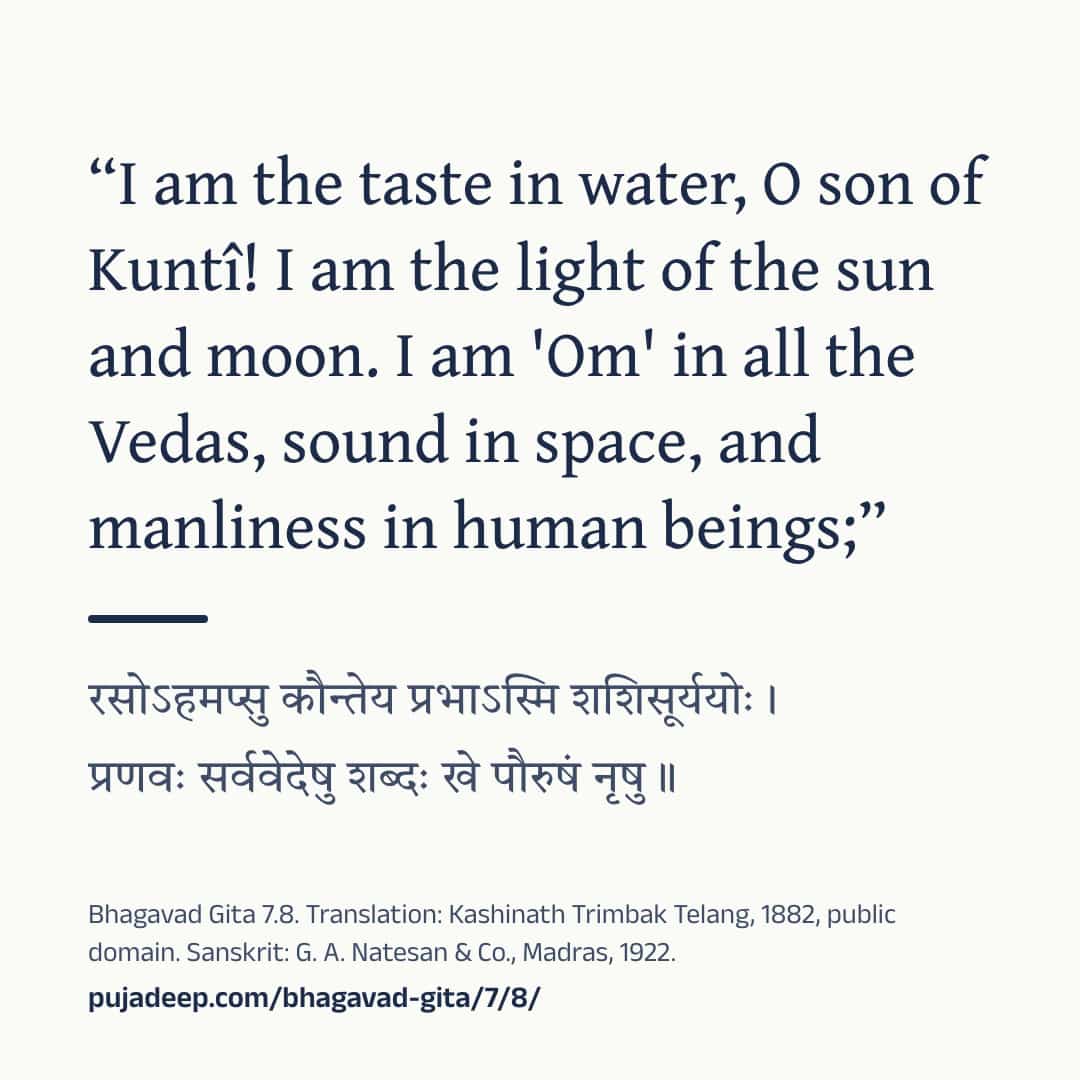
रसोऽहमप्सु कौन्तेय प्रभाऽस्मि शशिसूर्ययोः ।
प्रणवः सर्ववेदेषु शब्दः खे पौरुषं नृषु ॥

“I am the taste in water, O son of Kuntî! I am the light of the sun and moon. I am 'Om' in all the Vedas, sound in space, and manliness in human beings;”
(K. T. Telang, The Bhagavadgîtâ (The Sacred Books of the East, vol. VIII, Oxford: Clarendon Press, 1882), p. 74, public domain)
This sentence goes on in 7.9.

“I the sapidity in waters, O son of Kuntî; I the radiance in moon and sun; Pranava in all the Vedas, sound in ether, and virility in men;”
(Annie Besant, The Bhagavad Gîtâ, or The Lord's Song (London: Theosophical Publishing Society, 1895), p. 76, public domain)
This sentence goes on in 7.9.

“I am the sapidity in waters, O sun of Kunti; I, the radiance in moon and sun; I am the syllable Om in all the Vedas, sound in Akàsha, and the Indwelling in mankind.”
(Swami Swarupananda, Srimad-Bhagavad-Gita (Mayavati: Prabuddha Bharata Press, 1909; first printed in Prabuddha Bharata, 1907–1909), p. 148, public domain)

Sanskrit: G. A. Natesan & Co., Madras, 1922.
https://pujadeep.com/bhagavad-gita/7/8/ Nothing is sent from this site. Your own app sends it, to the chat you choose. The picture quotes the translation you chose on this page, with its name and year.
Sanskrit text: The Bhagavad-Gita, or The Lord's Song, with the text in Devanagari and an English translation, 1922. Meanings: written for Pujadeep and checked against the cited edition. Source and changes
Questions families ask
Who speaks Bhagavad Gita 7.8?
Krishna speaks this verse, in chapter 7 (Jnana Vijnana Yoga).
Where does the Sanskrit text come from?
Sanskrit text: The Bhagavad-Gita, or The Lord's Song, with the text in Devanagari and an English translation, 1922. Meanings: written for Pujadeep and checked against the cited edition. See the source
Is the meaning on this page a translation?
Explanation written for this site from the sources listed here, and checked against the cited edition. It is not a translation and not the only way to read the text. Free to quote with credit.
Source and licence
- Sanskrit text
- The Bhagavad-Gita, or The Lord's Song, with the text in Devanagari and an English translation (Annie Besant, G. A. Natesan & Co., Madras, 1922). Public domain. The Sanskrit on these pages was read from this printing’s page images.
- Translation
- The Bhagavadgîtâ with the Sanatsugâtîya and the Anugîtâ, translated by Kâshinâth Trimbak Telang (The Sacred Books of the East, vol. VIII, ed. F. Max Müller) (Kashinath Trimbak Telang, F. Max Müller, Clarendon Press, Oxford, 1882). Public domain. Shown verbatim, as printed.
- Translation
- The Bhagavad Gîtâ, or The Lord's Song, translated by Annie Besant (Annie Besant, Theosophical Publishing Society, London, 1895). Public domain. Shown verbatim, as printed.
- Translation
- Srimad-Bhagavad-Gita, with Sanskrit Text; Paraphrase with Word-by-word Literal Translation; English Rendering and Comments, Index, &c., by the Swami Swarupananda (Himalayan Series, No. XX) (Swami Swarupananda, The Editors and Publishers, Advaita Ashrama, Mayavati, Prabuddha Bharata Press, Mayavati, Almora, Himalayas, 1909). Public domain. Shown verbatim, as printed.
- Common wording
- In this text, 32 words follow today's common wording, checked against sanskritdocuments.org; Sanskrit Wikisource; Gita Press, Gorakhpur; GRETIL, Göttingen and Bhaktivedanta Book Trust.
- Our explanation
- Explanation written for this site from the sources listed here, and checked against the cited edition. It is not a translation and not the only way to read the text. Free to quote with credit.
- Checked
- Checked against the cited edition, October 15, 2026.
- Updated
- October 27, 2026