Bhagavad Gita 7.3: meaning and translation
Chapter 7: Jnana Vijnana Yoga. Krishna says
Among thousands of people, Krishna says, hardly one strives for perfection; and even among those who strive and succeed, hardly one knows him as he truly is.
Click or tap a word for its meaning and its dictionary page.
Text and layers
Text and layers
These choices stay in this browser.
Bhagavad Gita 7.3
मनुष्याणां सहस्रेषु कश्चिद्यतति सिद्धये ।यततामपि सिद्धानां कश्चिन्मां वेत्ति तत्त्वतः ॥
Manushyanam sahasreshu kashchidyatati siddhayeYatatamapi siddhanam kashchinmam vetti tattvatah
manuṣyāṇāṃ sahasreṣu kaścidyatati siddhaye |yatatāmapi siddhānāṃ kaścinmāṃ vetti tattvataḥ ||
Our explanation Among thousands of people, Krishna says, hardly one strives for perfection; and even among those who strive and succeed, hardly one knows him as he truly is.
हिंदी अर्थ कृष्ण कहते हैं कि हज़ारों मनुष्यों में कोई एक ही सिद्धि के लिए प्रयत्न करता है, और प्रयत्न करने वाले सिद्धों में भी कोई एक ही उन्हें तत्त्व से (ठीक-ठीक) जानता है।
Word by word
Every word, with its dictionary page
Word by word
- मनुष्याणाम् manuṣyāṇām · of people (noun (masculine), genitive plural) Dictionary: manuṣya, Monier-Williams 1899, p. 784, col. 3 “a man, human being”
- सहस्रेषु sahasreṣu · among thousands (noun (neuter), locative plural) Dictionary: sahasra, Monier-Williams 1899, p. 1195, col. 2 “a thousand”
- कश्चित् kaścit · hardly one, someone (pronoun (masculine), nominative singular) Dictionary: kim, Monier-Williams 1899, p. 282, col. 2 “what? how? whence? wherefore? why?”; 2. cid, Monier-Williams 1899, p. 398, col. 1 “even, indeed, also”
- यतति yatati · strives (present, 3rd person singular) Dictionary: 2. yat, Monier-Williams 1899, p. 840, col. 3 “to exert one's self, take pains, endeavour, make effort”
- सिद्धये siddhaye · for perfection (noun (feminine), dative singular) Dictionary: 2. siddhi, Monier-Williams 1899, p. 1216, col. 2 “accomplishment, performance, fulfilment, complete attainment (of any object), success”
- यतताम् yatatām · of those who strive (present participle (masculine), genitive plural) Dictionary: 2. yat, Monier-Williams 1899, p. 840, col. 3 “to exert one's self, take pains, endeavour, make effort”
- अपि api · even (indeclinable) Dictionary: api, Monier-Williams 1899, p. 55, col. 1 “in the sense of even, also, very”
- सिद्धानाम् siddhānām · of those who succeed (past participle (masculine), genitive plural) Dictionary: 2. siddha, Monier-Williams 1899, p. 1215, col. 1 “perfected, become perfect, beatified”
- कश्चित् kaścit · hardly one (pronoun (masculine), nominative singular) Dictionary: kim, Monier-Williams 1899, p. 282, col. 2 “what? how? whence? wherefore? why?”; 2. cid, Monier-Williams 1899, p. 398, col. 1 “even, indeed, also”
- माम् mām · "me" (Krishna) (pronoun, accusative singular) Dictionary: 1. mad, Monier-Williams 1899, p. 777, col. 2 “base of the first pers. pron. in the sg. number (esp. in comp.)”
- वेत्ति vetti · knows (present, 3rd person singular) Dictionary: 1. vid, Monier-Williams 1899, p. 963, col. 2 “to know, understand, perceive, learn”
- तत्त्वतः tattvataḥ · truly, as he really is (indeclinable) Dictionary: tat-tva-tas, Monier-Williams 1899, p. 433, col. 1; tat-tva, Monier-Williams 1899, p. 432, col. 3 “true or real state, truth, reality”
Old translations
Kashinath Trimbak Telang, 1882. Public domain. Page 73.
Among thousands of men, only some1 work for perfection2; and even of those who have reached perfection, and who are assiduous, only some know me truly.
Footnotes (the translator’s own) Compare 3 translations
Kashinath Trimbak Telang, 1882. Public domain. Page 73.
Among thousands of men, only some1 work for perfection2; and even of those who have reached perfection, and who are assiduous, only some know me truly.
Footnotes (the translator’s own) You are reading this one
Annie Besant, 1895. Public domain. Page 75.
Among thousands of men scarce one striveth for perfection; of the successful strivers scarce one knoweth Me in essence.
You are reading this one
Swami Swarupananda, 1909 (first printed 1907). Public domain. Page 145.
One, perchance, in thousands of men, strives for perfection; and one, perchance, among the blessed ones, striving thus, knows Me in reality.
You are reading this one
Cite this verse
The translation: K. T. Telang, The Bhagavadgîtâ (The Sacred Books of the East, vol. VIII, Oxford: Clarendon Press, 1882), p. 73. Bhagavad Gita 7.3.
The translation: Annie Besant, The Bhagavad Gîtâ, or The Lord's Song (London: Theosophical Publishing Society, 1895), p. 75. Bhagavad Gita 7.3.
The translation: Swami Swarupananda, Srimad-Bhagavad-Gita (Mayavati: Prabuddha Bharata Press, 1909; first printed in Prabuddha Bharata, 1907–1909), p. 145. Bhagavad Gita 7.3.
Our explanation: “Bhagavad Gita 7.3: meaning and translation.” Pujadeep. Updated October 27, 2026. https://pujadeep.com/bhagavad-gita/7/3/
Pujadeep’s explanations are free to quote with credit: name Pujadeep and link to the page. How to credit
Classical readings, by school
No readings by school on this verse yet.
Share
Show the ways to share
Send one picture or the text to one chat. The picture names its source and the address of this page.
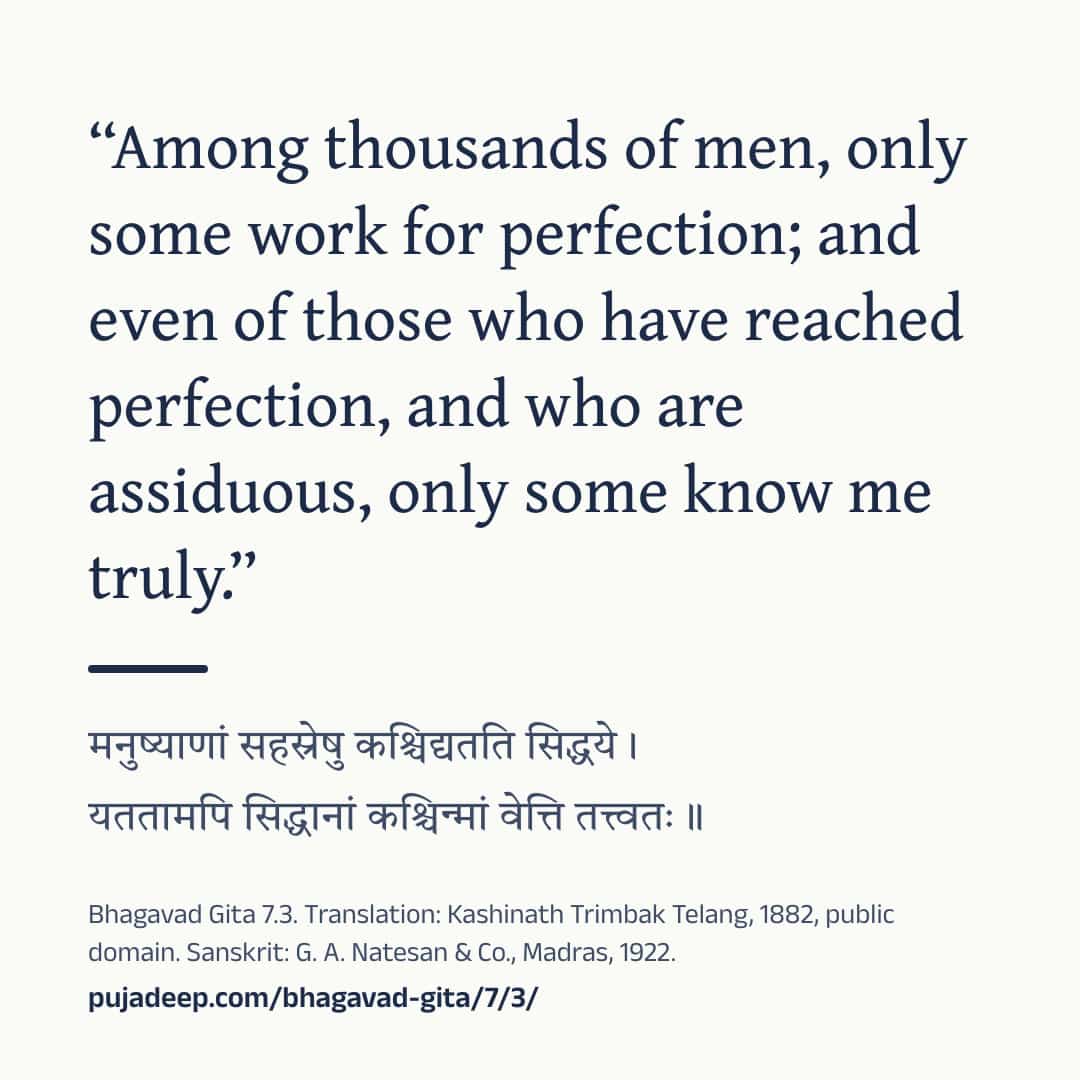
Drawing the picture
See the words
Bhagavad Gita 7.3

मनुष्याणां सहस्रेषु कश्चिद्यतति सिद्धये ।
यततामपि सिद्धानां कश्चिन्मां वेत्ति तत्त्वतः ॥

“Among thousands of men, only some work for perfection; and even of those who have reached perfection, and who are assiduous, only some know me truly.”
(K. T. Telang, The Bhagavadgîtâ (The Sacred Books of the East, vol. VIII, Oxford: Clarendon Press, 1882), p. 73, public domain)

“Among thousands of men scarce one striveth for perfection; of the successful strivers scarce one knoweth Me in essence.”
(Annie Besant, The Bhagavad Gîtâ, or The Lord's Song (London: Theosophical Publishing Society, 1895), p. 75, public domain)

“One, perchance, in thousands of men, strives for perfection; and one, perchance, among the blessed ones, striving thus, knows Me in reality.”
(Swami Swarupananda, Srimad-Bhagavad-Gita (Mayavati: Prabuddha Bharata Press, 1909; first printed in Prabuddha Bharata, 1907–1909), p. 145, public domain)

Sanskrit: G. A. Natesan & Co., Madras, 1922.
https://pujadeep.com/bhagavad-gita/7/3/ Nothing is sent from this site. Your own app sends it, to the chat you choose. The picture quotes the translation you chose on this page, with its name and year.
Sanskrit text: The Bhagavad-Gita, or The Lord's Song, with the text in Devanagari and an English translation, 1922. Meanings: written for Pujadeep and checked against the cited edition. Source and changes
Questions families ask
Who speaks Bhagavad Gita 7.3?
Krishna speaks this verse, in chapter 7 (Jnana Vijnana Yoga).
Where does the Sanskrit text come from?
Sanskrit text: The Bhagavad-Gita, or The Lord's Song, with the text in Devanagari and an English translation, 1922. Meanings: written for Pujadeep and checked against the cited edition. See the source
Is the meaning on this page a translation?
Explanation written for this site from the sources listed here, and checked against the cited edition. It is not a translation and not the only way to read the text. Free to quote with credit.
Source and licence
- Sanskrit text
- The Bhagavad-Gita, or The Lord's Song, with the text in Devanagari and an English translation (Annie Besant, G. A. Natesan & Co., Madras, 1922). Public domain. The Sanskrit on these pages was read from this printing’s page images.
- Translation
- The Bhagavadgîtâ with the Sanatsugâtîya and the Anugîtâ, translated by Kâshinâth Trimbak Telang (The Sacred Books of the East, vol. VIII, ed. F. Max Müller) (Kashinath Trimbak Telang, F. Max Müller, Clarendon Press, Oxford, 1882). Public domain. Shown verbatim, as printed.
- Translation
- The Bhagavad Gîtâ, or The Lord's Song, translated by Annie Besant (Annie Besant, Theosophical Publishing Society, London, 1895). Public domain. Shown verbatim, as printed.
- Translation
- Srimad-Bhagavad-Gita, with Sanskrit Text; Paraphrase with Word-by-word Literal Translation; English Rendering and Comments, Index, &c., by the Swami Swarupananda (Himalayan Series, No. XX) (Swami Swarupananda, The Editors and Publishers, Advaita Ashrama, Mayavati, Prabuddha Bharata Press, Mayavati, Almora, Himalayas, 1909). Public domain. Shown verbatim, as printed.
- Common wording
- In this text, 32 words follow today's common wording, checked against sanskritdocuments.org; Sanskrit Wikisource; Gita Press, Gorakhpur; GRETIL, Göttingen and Bhaktivedanta Book Trust.
- Our explanation
- Explanation written for this site from the sources listed here, and checked against the cited edition. It is not a translation and not the only way to read the text. Free to quote with credit.
- Checked
- Checked against the cited edition, October 15, 2026.
- Updated
- October 27, 2026