Bhagavad Gita 7.2: meaning and translation
Chapter 7: Jnana Vijnana Yoga. Krishna says
Krishna promises to explain fully both knowledge (jñāna) and its realisation in experience (vijñāna).
Click or tap a word for its meaning and its dictionary page.
Text and layers
Text and layers
These choices stay in this browser.
Bhagavad Gita 7.2
ज्ञानं तेऽहं सविज्ञानमिदं वक्ष्याम्यशेषतः ।यज्ज्ञात्वा नेह भूयोऽन्यज्ज्ञातव्यमवशिष्यते ॥
Jnanam teham savijnanamidam vakshyamyasheshatahYajjnatva neha bhuyonyajjnatavyamavashishyate
jñānaṃ te’haṃ savijñānamidaṃ vakṣyāmyaśeṣataḥ |yajjñātvā neha bhūyo’nyajjñātavyamavaśiṣyate ||
Our explanation Krishna promises to explain fully both knowledge (jñāna) and its realisation in experience (vijñāna). Once this is known, he says, nothing else remains to be known here. These two words give the chapter its name.
हिंदी अर्थ कृष्ण वचन देते हैं कि वे ज्ञान और विज्ञान (अनुभव से जाना हुआ ज्ञान) दोनों पूरी तरह समझाएँगे। वे कहते हैं कि इसे जान लेने पर यहाँ जानने को और कुछ शेष नहीं रहता। इन्हीं दो शब्दों से अध्याय का नाम बना है।
Word by word
Every word, with its dictionary page
Word by word
- ज्ञानम् jñānam · knowledge (noun (neuter), accusative singular) Dictionary: jñāna, Monier-Williams 1899, p. 426, col. 1 “knowing, becoming acquainted with, knowledge”
- ते te · to you (pronoun, dative singular) Dictionary: 2. tva, Monier-Williams 1899, p. 463, col. 2 “base of the 2nd personal pron.”
- अहम् aham · "I" (Krishna) (pronoun, nominative singular) Dictionary: aham, Monier-Williams 1899, p. 124, col. 2 “nom. sg. ‘I,’”
- सविज्ञानम् savijñānam · together with realised knowledge (adjective (neuter), accusative singular) Dictionary: 7. sa, Monier-Williams 1899, p. 1111, col. 2 “together or along with”; vi-jñāna, Monier-Williams 1899, p. 961, col. 2 “understanding, comprehending, recognizing, intelligence, knowledge”
- इदम् idam · this (pronoun (neuter), accusative singular) Dictionary: 1. idam, Monier-Williams 1899, p. 165, col. 2 “this, this here, referring to something near the speaker”
- वक्ष्यामि vakṣyāmi · will explain (future, 1st person singular) Dictionary: vac, Monier-Williams 1899, p. 912, col. 1 “to speak, say, tell, utter, announce”
- अशेषतः aśeṣataḥ · fully, leaving nothing out (indeclinable) Dictionary: a-śeṣa, Monier-Williams 1899, p. 113, col. 3 “without remainder, entire, perfect, all”
- यत् yat · which (pronoun (neuter), accusative singular) Dictionary: yad, Monier-Williams 1899, p. 844, col. 2 “who, which, what, whichever, whatever, that”
- ज्ञात्वा jñātvā · having known (absolutive (having done)) Dictionary: 1. jñā, Monier-Williams 1899, p. 425, col. 3 “to know, have knowledge, become acquainted with”
- न na · not (indeclinable) Dictionary: 2. na, Monier-Williams 1899, p. 523, col. 1 “not, no, nor, neither”
- इह iha · here, in this world (indeclinable) Dictionary: iha, Monier-Williams 1899, p. 169, col. 3 “in this place, here”
- भूयः bhūyaḥ · further, more (indeclinable) Dictionary: bhūyas, Monier-Williams 1899, p. 763, col. 3 “more, more numerous or abundant”
- अन्यत् anyat · anything else (pronoun (neuter), nominative singular) Dictionary: 2. anya, Monier-Williams 1899, p. 45, col. 2 “other, different”
- ज्ञातव्यम् jñātavyam · to be known (gerundive (to be done) (neuter), nominative singular) Dictionary: jñātavya, Monier-Williams 1899, p. 425, col. 3 “to be known or understood or investigated or inquired after”
- अवशिष्यते avaśiṣyate · remains (present passive, 3rd person singular) Dictionary: ava-śiṣ, Monier-Williams 1899, p. 104, col. 2 “to be left as a remnant, remain”
Old translations
Kashinath Trimbak Telang, 1882. Public domain. Page 73.
I will now tell you exhaustively about knowledge together with experience; that being known, there is nothing further left in this world to know.
Compare 3 translations
Kashinath Trimbak Telang, 1882. Public domain. Page 73.
I will now tell you exhaustively about knowledge together with experience; that being known, there is nothing further left in this world to know.
You are reading this one
Annie Besant, 1895. Public domain. Page 75.
I will declare to thee wholly this knowledge and wisdom, which, having known, there is nothing more here remaineth to be known.
You are reading this one
Swami Swarupananda, 1909 (first printed 1907). Public domain. Page 145.
I shall tell you in full, of knowledge, speculative and practical, knowing which, nothing more here remains to be known.
You are reading this one
Cite this verse
The translation: K. T. Telang, The Bhagavadgîtâ (The Sacred Books of the East, vol. VIII, Oxford: Clarendon Press, 1882), p. 73. Bhagavad Gita 7.2.
The translation: Annie Besant, The Bhagavad Gîtâ, or The Lord's Song (London: Theosophical Publishing Society, 1895), p. 75. Bhagavad Gita 7.2.
The translation: Swami Swarupananda, Srimad-Bhagavad-Gita (Mayavati: Prabuddha Bharata Press, 1909; first printed in Prabuddha Bharata, 1907–1909), p. 145. Bhagavad Gita 7.2.
Our explanation: “Bhagavad Gita 7.2: meaning and translation.” Pujadeep. Updated October 27, 2026. https://pujadeep.com/bhagavad-gita/7/2/
Pujadeep’s explanations are free to quote with credit: name Pujadeep and link to the page. How to credit
Classical readings, by school
No readings by school on this verse yet.
Share
Show the ways to share
Send one picture or the text to one chat. The picture names its source and the address of this page.
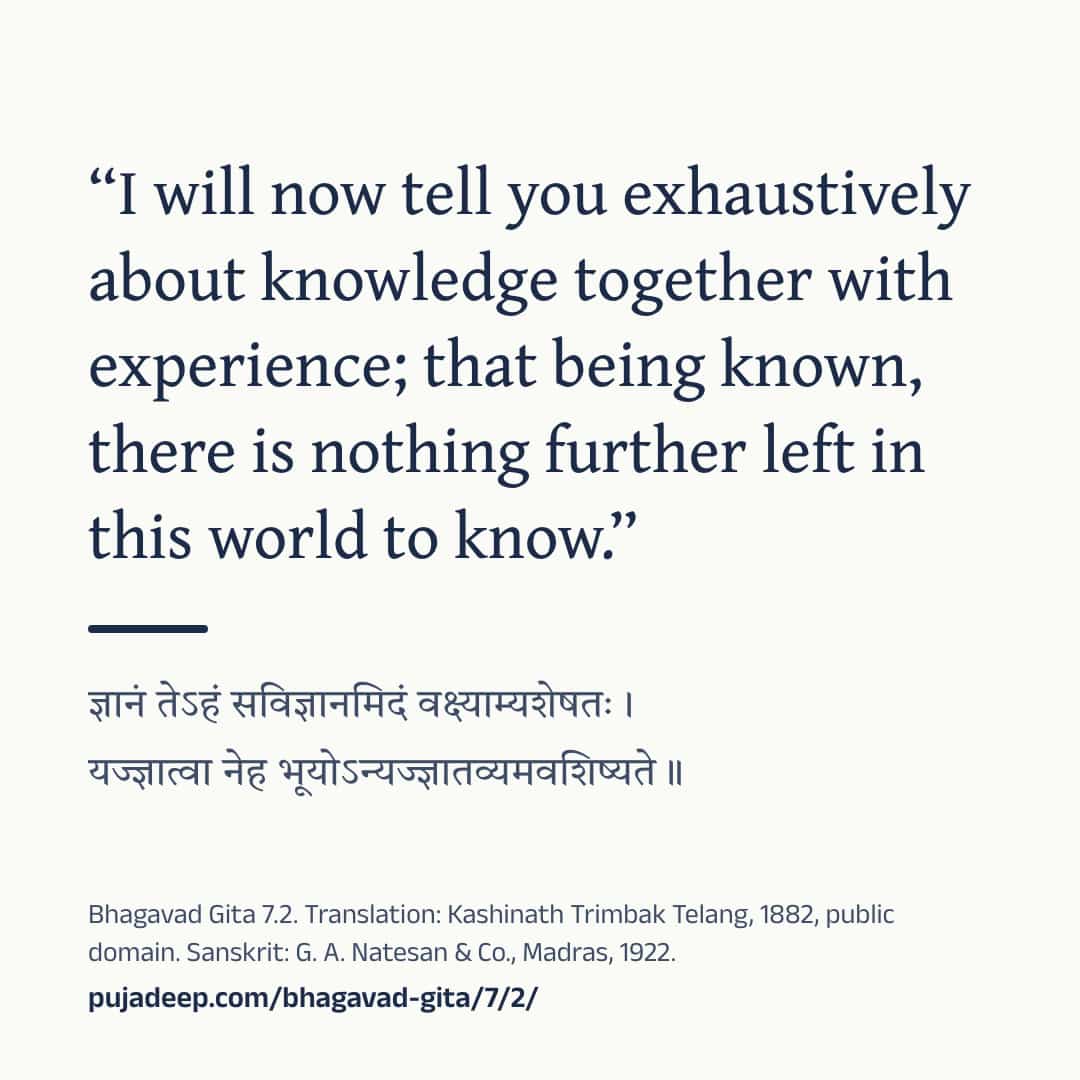
Drawing the picture
See the words
Bhagavad Gita 7.2

ज्ञानं तेऽहं सविज्ञानमिदं वक्ष्याम्यशेषतः ।
यज्ज्ञात्वा नेह भूयोऽन्यज्ज्ञातव्यमवशिष्यते ॥

“I will now tell you exhaustively about knowledge together with experience; that being known, there is nothing further left in this world to know.”
(K. T. Telang, The Bhagavadgîtâ (The Sacred Books of the East, vol. VIII, Oxford: Clarendon Press, 1882), p. 73, public domain)

“I will declare to thee wholly this knowledge and wisdom, which, having known, there is nothing more here remaineth to be known.”
(Annie Besant, The Bhagavad Gîtâ, or The Lord's Song (London: Theosophical Publishing Society, 1895), p. 75, public domain)

“I shall tell you in full, of knowledge, speculative and practical, knowing which, nothing more here remains to be known.”
(Swami Swarupananda, Srimad-Bhagavad-Gita (Mayavati: Prabuddha Bharata Press, 1909; first printed in Prabuddha Bharata, 1907–1909), p. 145, public domain)

Sanskrit: G. A. Natesan & Co., Madras, 1922.
https://pujadeep.com/bhagavad-gita/7/2/ Nothing is sent from this site. Your own app sends it, to the chat you choose. The picture quotes the translation you chose on this page, with its name and year.
Sanskrit text: The Bhagavad-Gita, or The Lord's Song, with the text in Devanagari and an English translation, 1922. Meanings: written for Pujadeep and checked against the cited edition. Source and changes
Questions families ask
Who speaks Bhagavad Gita 7.2?
Krishna speaks this verse, in chapter 7 (Jnana Vijnana Yoga).
Where does the Sanskrit text come from?
Sanskrit text: The Bhagavad-Gita, or The Lord's Song, with the text in Devanagari and an English translation, 1922. Meanings: written for Pujadeep and checked against the cited edition. See the source
Is the meaning on this page a translation?
Explanation written for this site from the sources listed here, and checked against the cited edition. It is not a translation and not the only way to read the text. Free to quote with credit.
Source and licence
- Sanskrit text
- The Bhagavad-Gita, or The Lord's Song, with the text in Devanagari and an English translation (Annie Besant, G. A. Natesan & Co., Madras, 1922). Public domain. The Sanskrit on these pages was read from this printing’s page images.
- Translation
- The Bhagavadgîtâ with the Sanatsugâtîya and the Anugîtâ, translated by Kâshinâth Trimbak Telang (The Sacred Books of the East, vol. VIII, ed. F. Max Müller) (Kashinath Trimbak Telang, F. Max Müller, Clarendon Press, Oxford, 1882). Public domain. Shown verbatim, as printed.
- Translation
- The Bhagavad Gîtâ, or The Lord's Song, translated by Annie Besant (Annie Besant, Theosophical Publishing Society, London, 1895). Public domain. Shown verbatim, as printed.
- Translation
- Srimad-Bhagavad-Gita, with Sanskrit Text; Paraphrase with Word-by-word Literal Translation; English Rendering and Comments, Index, &c., by the Swami Swarupananda (Himalayan Series, No. XX) (Swami Swarupananda, The Editors and Publishers, Advaita Ashrama, Mayavati, Prabuddha Bharata Press, Mayavati, Almora, Himalayas, 1909). Public domain. Shown verbatim, as printed.
- Common wording
- In this text, 32 words follow today's common wording, checked against sanskritdocuments.org; Sanskrit Wikisource; Gita Press, Gorakhpur; GRETIL, Göttingen and Bhaktivedanta Book Trust.
- Our explanation
- Explanation written for this site from the sources listed here, and checked against the cited edition. It is not a translation and not the only way to read the text. Free to quote with credit.
- Checked
- Checked against the cited edition, October 15, 2026.
- Updated
- October 27, 2026