Bhagavad Gita 7.10: meaning and translation
Chapter 7: Jnana Vijnana Yoga. Krishna says
Krishna tells Arjuna to know him as the eternal seed of all beings.
Click or tap a word for its meaning and its dictionary page.
Text and layers
Text and layers
These choices stay in this browser.
Bhagavad Gita 7.10
बीजं मां सर्वभूतानां विद्धि पार्थ सनातनम् ।बुद्धिर्बुद्धिमतामस्मि तेजस्तेजस्विनामहम् ॥
Bijam mam sarvabhutanam viddhi partha sanatanamBuddhirbuddhimatamasmi tejastejasvinamaham
bījaṃ māṃ sarvabhūtānāṃ viddhi pārtha sanātanam |buddhirbuddhimatāmasmi tejastejasvināmaham ||
Our explanation Krishna tells Arjuna to know him as the eternal seed of all beings. He is the understanding of those who understand and the brilliance of the brilliant.
हिंदी अर्थ कृष्ण अर्जुन से कहते हैं कि अर्जुन कृष्ण को सब प्राणियों का सनातन बीज जानें। कृष्ण बुद्धिमानों की बुद्धि और तेजस्वियों का तेज हैं।
Word by word
Every word, with its dictionary page
Word by word
- बीजम् bījam · seed (noun (neuter), accusative singular) Dictionary: bīja, Monier-Williams 1899, p. 732, col. 2 “seed (of plants), semen (of men and animals)”
- माम् mām · "me" (Krishna) (pronoun, accusative singular) Dictionary: 1. mad, Monier-Williams 1899, p. 777, col. 2 “base of the first pers. pron. in the sg. number (esp. in comp.)”
- सर्वभूतानाम् sarvabhūtānām · of all beings (compound (neuter), genitive plural) Dictionary: sarva, Monier-Williams 1899, p. 1184, col. 3 “whole, entire, all, every”; bhūta, Monier-Williams 1899, p. 761, col. 3 “that which is or exists, any living being”
- विद्धि viddhi · know (imperative, 2nd person singular) Dictionary: 1. vid, Monier-Williams 1899, p. 963, col. 2 “to know, understand, perceive, learn”
- पार्थ pārtha · O Partha (son of Pritha) (noun (masculine), vocative singular) Dictionary: 2. pārtha, Monier-Williams 1899, p. 621, col. 3 “metron. of Yudhi-shṭhira or Bhīma-sena or Arjuna”
- सनातनम् sanātanam · eternal (adjective (neuter), accusative singular) Dictionary: sanātana, Monier-Williams 1899, p. 1141, col. 1 “eternal, perpetual, permanent, everlasting, primeval, ancient”
- बुद्धिः buddhiḥ · understanding (noun (feminine), nominative singular) Dictionary: buddhi, Monier-Williams 1899, p. 733, col. 3 “intelligence, reason, intellect, mind, discernment, judgment”
- बुद्धिमताम् buddhimatām · of those who understand (noun (masculine), genitive plural) Dictionary: buddhi-mat, Monier-Williams 1899, p. 734, col. 1 “endowed with understanding, intelligent, learned, wise”
- अस्मि asmi · "I am" (present, 1st person singular) Dictionary: 1. as, Monier-Williams 1899, p. 117, col. 2 “to be, live, exist, be present”
- तेजः tejaḥ · brilliance (noun (neuter), nominative singular) Dictionary: tejas, Monier-Williams 1899, p. 454, col. 2 “glow, glare, splendour, brilliance, light, fire”
- तेजस्विनाम् tejasvinām · of the brilliant (noun (masculine), genitive plural) Dictionary: tejas-vin, Monier-Williams 1899, p. 454, col. 3 “brilliant, splendid, bright, powerful, energetic”
- अहम् aham · "I" (Krishna) (pronoun, nominative singular) Dictionary: aham, Monier-Williams 1899, p. 124, col. 2 “nom. sg. ‘I,’”
Old translations
Kashinath Trimbak Telang, 1882. Public domain. Page 74.
Know me, O son of Prithâ! to be the eternal seed of all beings; I am the discernment of the discerning ones, and I the glory of the glorious1.
Footnotes (the translator’s own) - Glory here seems to mean dignity, greatness. ↩
Compare 3 translations
Kashinath Trimbak Telang, 1882. Public domain. Page 74.
Know me, O son of Prithâ! to be the eternal seed of all beings; I am the discernment of the discerning ones, and I the glory of the glorious1.
Footnotes (the translator’s own) - Glory here seems to mean dignity, greatness. ↩
You are reading this one
Annie Besant, 1895. Public domain. Page 76.
Know Me, O Pârtha! as the eternal seed of all beings. I am the Buddhi of the Buddhi-endowed, the splendour of splendid things am I.
You are reading this one
Swami Swarupananda, 1909 (first printed 1907). Public domain. Page 149.
Know Me, O son of Prithâ, as the eternal seed of all beings. I am the intellect of the intelligent, and the heroism of the heroic.
You are reading this one
Cite this verse
The translation: K. T. Telang, The Bhagavadgîtâ (The Sacred Books of the East, vol. VIII, Oxford: Clarendon Press, 1882), p. 74. Bhagavad Gita 7.10.
The translation: Annie Besant, The Bhagavad Gîtâ, or The Lord's Song (London: Theosophical Publishing Society, 1895), p. 76. Bhagavad Gita 7.10.
The translation: Swami Swarupananda, Srimad-Bhagavad-Gita (Mayavati: Prabuddha Bharata Press, 1909; first printed in Prabuddha Bharata, 1907–1909), p. 149. Bhagavad Gita 7.10.
Our explanation: “Bhagavad Gita 7.10: meaning and translation.” Pujadeep. Updated October 27, 2026. https://pujadeep.com/bhagavad-gita/7/10/
Pujadeep’s explanations are free to quote with credit: name Pujadeep and link to the page. How to credit
Classical readings, by school
No readings by school on this verse yet.
Share
Show the ways to share
Send one picture or the text to one chat. The picture names its source and the address of this page.
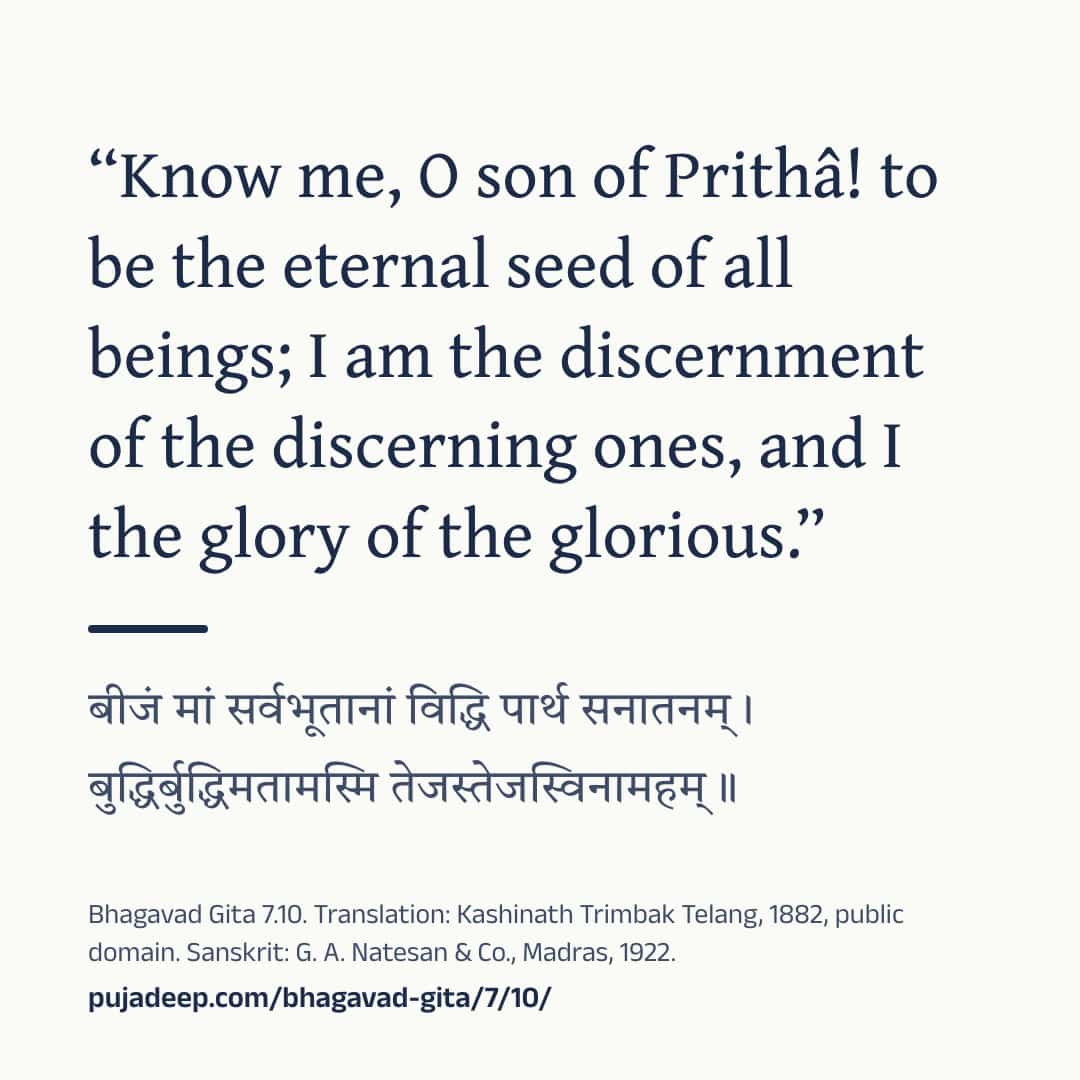
Drawing the picture
See the words
Bhagavad Gita 7.10

बीजं मां सर्वभूतानां विद्धि पार्थ सनातनम् ।
बुद्धिर्बुद्धिमतामस्मि तेजस्तेजस्विनामहम् ॥

“Know me, O son of Prithâ! to be the eternal seed of all beings; I am the discernment of the discerning ones, and I the glory of the glorious.”
(K. T. Telang, The Bhagavadgîtâ (The Sacred Books of the East, vol. VIII, Oxford: Clarendon Press, 1882), p. 74, public domain)

“Know Me, O Pârtha! as the eternal seed of all beings. I am the Buddhi of the Buddhi-endowed, the splendour of splendid things am I.”
(Annie Besant, The Bhagavad Gîtâ, or The Lord's Song (London: Theosophical Publishing Society, 1895), p. 76, public domain)

“Know Me, O son of Prithâ, as the eternal seed of all beings. I am the intellect of the intelligent, and the heroism of the heroic.”
(Swami Swarupananda, Srimad-Bhagavad-Gita (Mayavati: Prabuddha Bharata Press, 1909; first printed in Prabuddha Bharata, 1907–1909), p. 149, public domain)

Sanskrit: G. A. Natesan & Co., Madras, 1922.
https://pujadeep.com/bhagavad-gita/7/10/ Nothing is sent from this site. Your own app sends it, to the chat you choose. The picture quotes the translation you chose on this page, with its name and year.
Sanskrit text: The Bhagavad-Gita, or The Lord's Song, with the text in Devanagari and an English translation, 1922. Meanings: written for Pujadeep and checked against the cited edition. Source and changes
Questions families ask
Who speaks Bhagavad Gita 7.10?
Krishna speaks this verse, in chapter 7 (Jnana Vijnana Yoga).
Where does the Sanskrit text come from?
Sanskrit text: The Bhagavad-Gita, or The Lord's Song, with the text in Devanagari and an English translation, 1922. Meanings: written for Pujadeep and checked against the cited edition. See the source
Is the meaning on this page a translation?
Explanation written for this site from the sources listed here, and checked against the cited edition. It is not a translation and not the only way to read the text. Free to quote with credit.
Source and licence
- Sanskrit text
- The Bhagavad-Gita, or The Lord's Song, with the text in Devanagari and an English translation (Annie Besant, G. A. Natesan & Co., Madras, 1922). Public domain. The Sanskrit on these pages was read from this printing’s page images.
- Translation
- The Bhagavadgîtâ with the Sanatsugâtîya and the Anugîtâ, translated by Kâshinâth Trimbak Telang (The Sacred Books of the East, vol. VIII, ed. F. Max Müller) (Kashinath Trimbak Telang, F. Max Müller, Clarendon Press, Oxford, 1882). Public domain. Shown verbatim, as printed.
- Translation
- The Bhagavad Gîtâ, or The Lord's Song, translated by Annie Besant (Annie Besant, Theosophical Publishing Society, London, 1895). Public domain. Shown verbatim, as printed.
- Translation
- Srimad-Bhagavad-Gita, with Sanskrit Text; Paraphrase with Word-by-word Literal Translation; English Rendering and Comments, Index, &c., by the Swami Swarupananda (Himalayan Series, No. XX) (Swami Swarupananda, The Editors and Publishers, Advaita Ashrama, Mayavati, Prabuddha Bharata Press, Mayavati, Almora, Himalayas, 1909). Public domain. Shown verbatim, as printed.
- Common wording
- In this text, 32 words follow today's common wording, checked against sanskritdocuments.org; Sanskrit Wikisource; Gita Press, Gorakhpur; GRETIL, Göttingen and Bhaktivedanta Book Trust.
- Our explanation
- Explanation written for this site from the sources listed here, and checked against the cited edition. It is not a translation and not the only way to read the text. Free to quote with credit.
- Checked
- Checked against the cited edition, October 15, 2026.
- Updated
- October 27, 2026