Bhagavad Gita 7.19: meaning and translation
Chapter 7: Jnana Vijnana Yoga. Krishna says
At the end of many births, Krishna says, the person who has knowledge comes to him, knowing that "Vasudeva is all".
Click or tap a word for its meaning and its dictionary page.
Text and layers
Text and layers
These choices stay in this browser.
Bhagavad Gita 7.19
बहूनां जन्मनामन्ते ज्ञानवान्मां प्रपद्यते ।वासुदेवः सर्वमिति स महात्मा सुदुर्लभः ॥
Bahunam janmanamante jnanavanmam prapadyateVasudevah sarvamiti sa mahatma sudurlabhah
bahūnāṃ janmanāmante jñānavānmāṃ prapadyate |vāsudevaḥ sarvamiti sa mahātmā sudurlabhaḥ ||
Our explanation At the end of many births, Krishna says, the person who has knowledge comes to him, knowing that "Vasudeva is all". Vasudeva is a name of Krishna, the son of Vasudeva. Such a great soul (mahātmā) is very rare.
हिंदी अर्थ कृष्ण कहते हैं कि बहुत-से जन्मों के अंत में ज्ञानवान व्यक्ति “वासुदेव ही सब कुछ है” यह जानकर उनकी शरण में आता है। वासुदेव कृष्ण का नाम है, वसुदेव के पुत्र होने के कारण। ऐसा महात्मा अत्यंत दुर्लभ है।
Word by word
Every word, with its dictionary page
Word by word
- बहूनाम् bahūnām · of many (adjective (neuter), genitive plural) Dictionary: bahu, Monier-Williams 1899, p. 724, col. 2 “much, many, frequent, abundant, numerous”
- जन्मनाम् janmanām · of births (noun (neuter), genitive plural) Dictionary: janman, Monier-Williams 1899, p. 411, col. 3 “birth, production”
- अन्ते ante · at the end (noun (masculine), locative singular) Dictionary: anta, Monier-Williams 1899, p. 42, col. 3 “end, limit, boundary, term”
- ज्ञानवान् jñānavān · one who has knowledge (adjective (masculine), nominative singular) Dictionary: jñāna-vat, Monier-Williams 1899, p. 426, col. 2 “endowed with knowledge or science, intelligent, wise, having spiritual knowledge”
- माम् mām · "me" (Krishna) (pronoun, accusative singular) Dictionary: 1. mad, Monier-Williams 1899, p. 777, col. 2 “base of the first pers. pron. in the sg. number (esp. in comp.)”
- प्रपद्यते prapadyate · comes to, takes refuge in (present, 3rd person singular) Dictionary: 1. pra-pad, Monier-Williams 1899, p. 682, col. 1 “to fly to for succour, take refuge with”
- वासुदेवः vāsudevaḥ · Vasudeva (Krishna) (noun (masculine), nominative singular) Dictionary: vāsudeva, Monier-Williams 1899, p. 948, col. 2 “patr. of Kṛishṇa”
- सर्वम् sarvam · all (adjective (neuter), nominative singular) Dictionary: sarva, Monier-Williams 1899, p. 1184, col. 3 “whole, entire, all, every”
- इति iti · thus (closing the quote) (indeclinable) Dictionary: 2. iti, Monier-Williams 1899, p. 165, col. 1 “in this manner, thus”
- सः saḥ · such a one (pronoun (masculine), nominative singular) Dictionary: tad, Monier-Williams 1899, p. 434, col. 1 “m. he, f. she, n. it, that, this”
- महात्मा mahātmā · great soul (noun (masculine), nominative singular) Dictionary: mahātman, Monier-Williams 1899, p. 796, col. 1 “‘high-souled,’ magnanimous, having a gr° or noble nature, high-minded, noble”
- सुदुर्लभः sudurlabhaḥ · very rare (adjective (masculine), nominative singular) Dictionary: 5. su, Monier-Williams 1899, p. 1219, col. 3 “good, excellent, right, virtuous, beautiful, easy, well, rightly, much, greatly, very”; dur-labha, Monier-Williams 1899, p. 486, col. 3 “d° to be obtained or found, hard, scarce, rare”
Old translations
Kashinath Trimbak Telang, 1882. Public domain. Page 75.
At the end of many lives, the man possessed of knowledge approaches me, (believing) that Vâsudeva is everything. Such a high-souled man is very hard to find.
Compare 3 translations
Kashinath Trimbak Telang, 1882. Public domain. Page 75.
At the end of many lives, the man possessed of knowledge approaches me, (believing) that Vâsudeva is everything. Such a high-souled man is very hard to find.
You are reading this one
Annie Besant, 1895. Public domain. Page 78.
At the close of many births the man full of wisdom cometh unto Me: "Vâsudeva1 is all," saith he, the Mahâtmâ, very difficult to find.
Footnotes (the translator’s own) - A name for Krishna, as the son of Vasudeva, ↩
You are reading this one
Swami Swarupananda, 1909 (first printed 1907). Public domain. Page 153.
At the end of many births, the man of wisdom takes refuge in Me, realising that all this is Vàsudeva, (the innermost Self). Very rare is that great soul.
You are reading this one
Cite this verse
The translation: K. T. Telang, The Bhagavadgîtâ (The Sacred Books of the East, vol. VIII, Oxford: Clarendon Press, 1882), p. 75. Bhagavad Gita 7.19.
The translation: Annie Besant, The Bhagavad Gîtâ, or The Lord's Song (London: Theosophical Publishing Society, 1895), p. 78. Bhagavad Gita 7.19.
The translation: Swami Swarupananda, Srimad-Bhagavad-Gita (Mayavati: Prabuddha Bharata Press, 1909; first printed in Prabuddha Bharata, 1907–1909), p. 153. Bhagavad Gita 7.19.
Our explanation: “Bhagavad Gita 7.19: meaning and translation.” Pujadeep. Updated October 27, 2026. https://pujadeep.com/bhagavad-gita/7/19/
Pujadeep’s explanations are free to quote with credit: name Pujadeep and link to the page. How to credit
Classical readings, by school
Each reading is named by its school. None is presented as the only meaning.
What Advaita, Vishishtadvaita and Dvaita teach, in short
Shankara Advaita
Shankara says that after many births of preparation, the person of mature wisdom comes to Vasudeva as the innermost Self of all, realising that Vasudeva is the All. No one is equal to or above such a person, and so such a person is very rare.
Source: The Bhagavad-Gita, with the commentary of Sri Sankaracharya, translated by A. Mahadeva Sastri (2nd ed., Mysore: G. T. A. Printing Works, 1901), commentary on 7.19, pp. 195–196. Summarised in our own words; none of its text is reproduced.
Ramanuja Vishishtadvaita
Ramanuja says it takes many births for a person to know that the self is by nature the servant (śeṣa) of the Lord. For such a person 'Vasudeva is all' means that Vasudeva is the goal, the way and everything the heart longs for.
Source: Sri Bhagavad-Gita with Sri Ramanujacharya's Visishtadvaita commentary, translated by A. Govindacharya (Madras, 1898), commentary on 7.19, p. 246. Summarised in our own words; none of its text is reproduced.
Share
Show the ways to share
Send one picture or the text to one chat. The picture names its source and the address of this page.
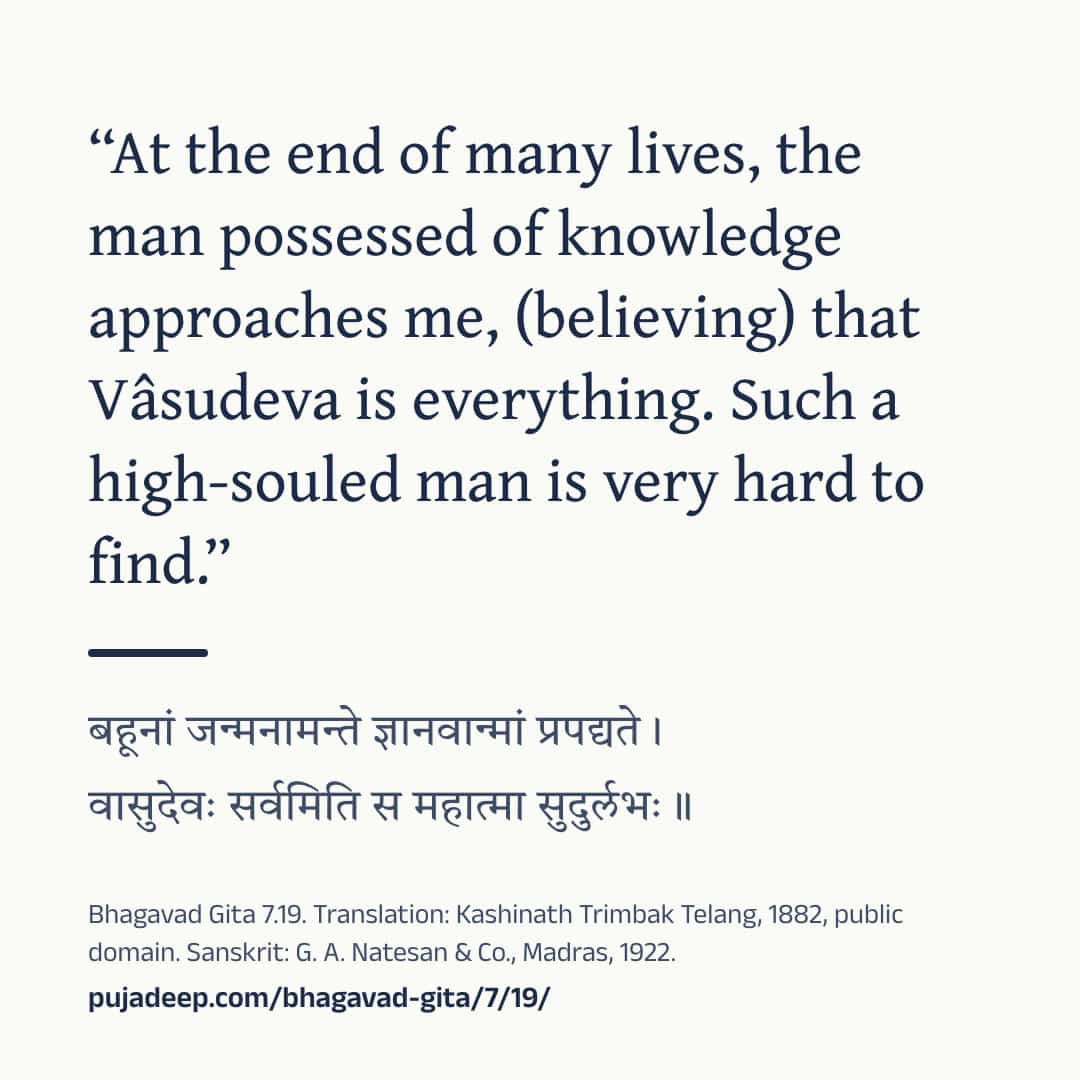
Drawing the picture
See the words
Bhagavad Gita 7.19

बहूनां जन्मनामन्ते ज्ञानवान्मां प्रपद्यते ।
वासुदेवः सर्वमिति स महात्मा सुदुर्लभः ॥

“At the end of many lives, the man possessed of knowledge approaches me, (believing) that Vâsudeva is everything. Such a high-souled man is very hard to find.”
(K. T. Telang, The Bhagavadgîtâ (The Sacred Books of the East, vol. VIII, Oxford: Clarendon Press, 1882), p. 75, public domain)

“At the close of many births the man full of wisdom cometh unto Me: "Vâsudeva is all," saith he, the Mahâtmâ, very difficult to find.”
(Annie Besant, The Bhagavad Gîtâ, or The Lord's Song (London: Theosophical Publishing Society, 1895), p. 78, public domain)

“At the end of many births, the man of wisdom takes refuge in Me, realising that all this is Vàsudeva, (the innermost Self). Very rare is that great soul.”
(Swami Swarupananda, Srimad-Bhagavad-Gita (Mayavati: Prabuddha Bharata Press, 1909; first printed in Prabuddha Bharata, 1907–1909), p. 153, public domain)

Sanskrit: G. A. Natesan & Co., Madras, 1922.
https://pujadeep.com/bhagavad-gita/7/19/ Nothing is sent from this site. Your own app sends it, to the chat you choose. The picture quotes the translation you chose on this page, with its name and year.
Sanskrit text: The Bhagavad-Gita, or The Lord's Song, with the text in Devanagari and an English translation, 1922. Meanings: written for Pujadeep and checked against the cited edition. Source and changes
Questions families ask
Who speaks Bhagavad Gita 7.19?
Krishna speaks this verse, in chapter 7 (Jnana Vijnana Yoga).
Where does the Sanskrit text come from?
Sanskrit text: The Bhagavad-Gita, or The Lord's Song, with the text in Devanagari and an English translation, 1922. Meanings: written for Pujadeep and checked against the cited edition. See the source
Is the meaning on this page a translation?
Explanation written for this site from the sources listed here, and checked against the cited edition. It is not a translation and not the only way to read the text. Free to quote with credit.
Source and licence
- Sanskrit text
- The Bhagavad-Gita, or The Lord's Song, with the text in Devanagari and an English translation (Annie Besant, G. A. Natesan & Co., Madras, 1922). Public domain. The Sanskrit on these pages was read from this printing’s page images.
- Translation
- The Bhagavadgîtâ with the Sanatsugâtîya and the Anugîtâ, translated by Kâshinâth Trimbak Telang (The Sacred Books of the East, vol. VIII, ed. F. Max Müller) (Kashinath Trimbak Telang, F. Max Müller, Clarendon Press, Oxford, 1882). Public domain. Shown verbatim, as printed.
- Translation
- The Bhagavad Gîtâ, or The Lord's Song, translated by Annie Besant (Annie Besant, Theosophical Publishing Society, London, 1895). Public domain. Shown verbatim, as printed.
- Translation
- Srimad-Bhagavad-Gita, with Sanskrit Text; Paraphrase with Word-by-word Literal Translation; English Rendering and Comments, Index, &c., by the Swami Swarupananda (Himalayan Series, No. XX) (Swami Swarupananda, The Editors and Publishers, Advaita Ashrama, Mayavati, Prabuddha Bharata Press, Mayavati, Almora, Himalayas, 1909). Public domain. Shown verbatim, as printed.
- Commentary
- The Bhagavad-Gita, with the commentary of Sri Sankaracharya, translated by A. Mahadeva Sastri (2nd ed., Mysore: G. T. A. Printing Works, 1901) (Public-domain scan, University of California Libraries). Summarised in our own words; none of its text is reproduced.
- Commentary
- Sri Bhagavad-Gita with Sri Ramanujacharya's Visishtadvaita commentary, translated by A. Govindacharya (Madras, 1898) (Scan uploaded to archive.org (folkscanomy collection)). Summarised in our own words; none of its text is reproduced.
- Common wording
- In this text, 32 words follow today's common wording, checked against sanskritdocuments.org; Sanskrit Wikisource; Gita Press, Gorakhpur; GRETIL, Göttingen and Bhaktivedanta Book Trust.
- Our explanation
- Explanation written for this site from the sources listed here, and checked against the cited edition. It is not a translation and not the only way to read the text. Free to quote with credit.
- Checked
- Checked against the cited edition, October 15, 2026.
- Updated
- October 27, 2026