Bhagavad Gita 7.20: meaning and translation
Chapter 7: Jnana Vijnana Yoga. Krishna says
People whose understanding is carried away by this or that desire turn to other deities, Krishna says, following various rules and practices, as their own nature leads them.
Click or tap a word for its meaning and its dictionary page.
Text and layers
Text and layers
These choices stay in this browser.
Bhagavad Gita 7.20
कामैस्तैस्तैर्हृतज्ञानाः प्रपद्यन्तेऽन्यदेवताः ।तं तं नियममास्थाय प्रकृत्या नियताः स्वया ॥
Kamaistaistairhritajnanah prapadyantenyadevatahTam tam niyamamasthaya prakritya niyatah svaya
kāmaistaistairhṛtajñānāḥ prapadyante’nyadevatāḥ |taṃ taṃ niyamamāsthāya prakṛtyā niyatāḥ svayā ||
Our explanation People whose understanding is carried away by this or that desire turn to other deities, Krishna says, following various rules and practices, as their own nature leads them.
हिंदी अर्थ कृष्ण कहते हैं कि जिनका ज्ञान तरह-तरह की कामनाओं ने हर लिया है, वे अपने स्वभाव के अनुसार अलग-अलग नियमों का पालन करते हुए दूसरे देवताओं की शरण लेते हैं।
Word by word
Every word, with its dictionary page
Word by word
- कामैः kāmaiḥ · by desires (noun (masculine), instrumental plural) Dictionary: kāma, Monier-Williams 1899, p. 271, col. 3 “wish, desire, longing”
- तैः taiḥ · by this (pronoun (masculine), instrumental plural) Dictionary: tad, Monier-Williams 1899, p. 434, col. 1 “m. he, f. she, n. it, that, this”
- तैः taiḥ · (or) that (pronoun (masculine), instrumental plural) Dictionary: tad, Monier-Williams 1899, p. 434, col. 1 “m. he, f. she, n. it, that, this”
- हृतज्ञानाः hṛtajñānāḥ · whose understanding is carried away (compound (masculine), nominative plural) Dictionary: hṛta, Monier-Williams 1899, p. 1302, col. 1 “taken, taken away, seized”; jñāna, Monier-Williams 1899, p. 426, col. 1 “knowing, becoming acquainted with, knowledge”
- प्रपद्यन्ते prapadyante · turn to (present, 3rd person plural) Dictionary: 1. pra-pad, Monier-Williams 1899, p. 682, col. 1 “to fly to for succour, take refuge with”
- अन्यदेवताः anyadevatāḥ · other deities (compound (feminine), accusative plural) Dictionary: 2. anya, Monier-Williams 1899, p. 45, col. 2 “other, different”; devatā, Monier-Williams 1899, p. 495, col. 3 “godhead, divinity (abstr. & concr.)”
- तम् tam · this (pronoun (masculine), accusative singular) Dictionary: tad, Monier-Williams 1899, p. 434, col. 1 “m. he, f. she, n. it, that, this”
- तम् tam · (or) that (pronoun (masculine), accusative singular) Dictionary: tad, Monier-Williams 1899, p. 434, col. 1 “m. he, f. she, n. it, that, this”
- नियमम् niyamam · rule, observance (noun (masculine), accusative singular) Dictionary: ni-yama, Monier-Williams 1899, p. 552, col. 1 “any fixed rule or law, necessity, obligation”
- आस्थाय āsthāya · following (absolutive (having done)) Dictionary: 1. ā-sthā, Monier-Williams 1899, p. 161, col. 2 “to undertake, perform, do, carry out, practise, use”
- प्रकृत्या prakṛtyā · by nature (noun (feminine), instrumental singular) Dictionary: pra-kṛti, Monier-Williams 1899, p. 654, col. 1 “the original or natural form or condition of anything, original or primary substance”
- नियताः niyatāḥ · led, held (past participle (masculine), nominative plural) Dictionary: ni-yata, Monier-Williams 1899, p. 552, col. 1 “restrained, checked, curbed, suppressed, restricted, controlled”
- स्वया svayā · by their own (adjective (feminine), instrumental singular) Dictionary: 1. sva, Monier-Williams 1899, p. 1275, col. 1 “own, one's own, my own, thy own, his own, her own, our own, their own &c.”
Old translations
Kashinath Trimbak Telang, 1882. Public domain. Page 75–76.
Those who are deprived of knowledge by various desires approach other divinities, observing various regulations1, and controlled by their own natures2.
Footnotes (the translator’s own) Compare 3 translations
Kashinath Trimbak Telang, 1882. Public domain. Page 75–76.
Those who are deprived of knowledge by various desires approach other divinities, observing various regulations1, and controlled by their own natures2.
Footnotes (the translator’s own) You are reading this one
Annie Besant, 1895. Public domain. Page 78.
They whose wisdom hath been rent away by desires go forth to other Gods, resorting to various external observances, according to their own natures.
You are reading this one
Swami Swarupananda, 1909 (first printed 1907). Public domain. Page 154.
Others again, deprived of discrimination by this and that desire, following this or that rite, devote themselves to other gods, led by their own natures.
You are reading this one
Cite this verse
The translation: K. T. Telang, The Bhagavadgîtâ (The Sacred Books of the East, vol. VIII, Oxford: Clarendon Press, 1882), pp. 75–76. Bhagavad Gita 7.20.
The translation: Annie Besant, The Bhagavad Gîtâ, or The Lord's Song (London: Theosophical Publishing Society, 1895), p. 78. Bhagavad Gita 7.20.
The translation: Swami Swarupananda, Srimad-Bhagavad-Gita (Mayavati: Prabuddha Bharata Press, 1909; first printed in Prabuddha Bharata, 1907–1909), p. 154. Bhagavad Gita 7.20.
Our explanation: “Bhagavad Gita 7.20: meaning and translation.” Pujadeep. Updated October 27, 2026. https://pujadeep.com/bhagavad-gita/7/20/
Pujadeep’s explanations are free to quote with credit: name Pujadeep and link to the page. How to credit
Classical readings, by school
No readings by school on this verse yet.
Share
Show the ways to share
Send one picture or the text to one chat. The picture names its source and the address of this page.
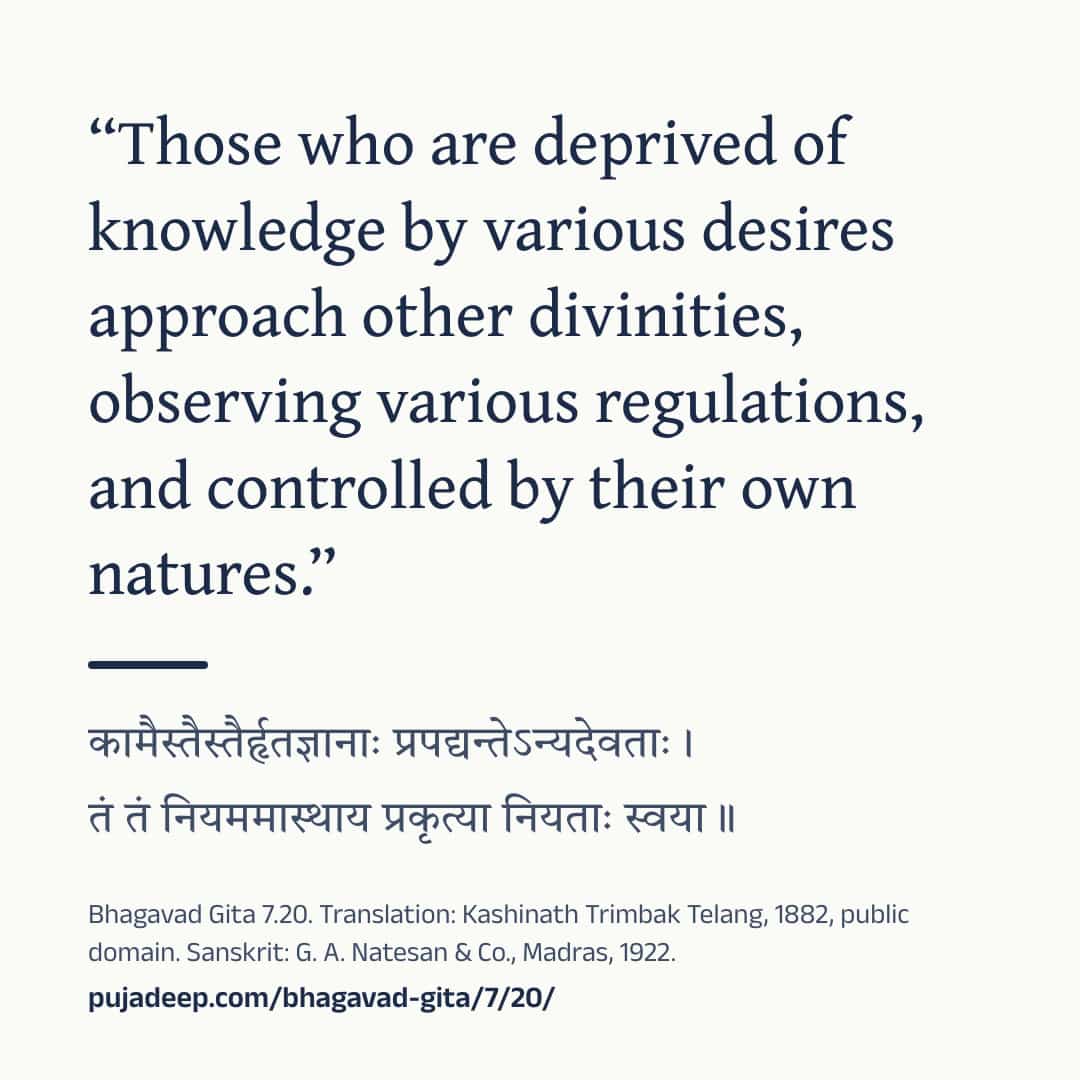
Drawing the picture
See the words
Bhagavad Gita 7.20

कामैस्तैस्तैर्हृतज्ञानाः प्रपद्यन्तेऽन्यदेवताः ।
तं तं नियममास्थाय प्रकृत्या नियताः स्वया ॥

“Those who are deprived of knowledge by various desires approach other divinities, observing various regulations, and controlled by their own natures.”
(K. T. Telang, The Bhagavadgîtâ (The Sacred Books of the East, vol. VIII, Oxford: Clarendon Press, 1882), pp. 75–76, public domain)

“They whose wisdom hath been rent away by desires go forth to other Gods, resorting to various external observances, according to their own natures.”
(Annie Besant, The Bhagavad Gîtâ, or The Lord's Song (London: Theosophical Publishing Society, 1895), p. 78, public domain)

“Others again, deprived of discrimination by this and that desire, following this or that rite, devote themselves to other gods, led by their own natures.”
(Swami Swarupananda, Srimad-Bhagavad-Gita (Mayavati: Prabuddha Bharata Press, 1909; first printed in Prabuddha Bharata, 1907–1909), p. 154, public domain)

Sanskrit: G. A. Natesan & Co., Madras, 1922.
https://pujadeep.com/bhagavad-gita/7/20/ Nothing is sent from this site. Your own app sends it, to the chat you choose. The picture quotes the translation you chose on this page, with its name and year.
Sanskrit text: The Bhagavad-Gita, or The Lord's Song, with the text in Devanagari and an English translation, 1922. Meanings: written for Pujadeep and checked against the cited edition. Source and changes
Questions families ask
Who speaks Bhagavad Gita 7.20?
Krishna speaks this verse, in chapter 7 (Jnana Vijnana Yoga).
Where does the Sanskrit text come from?
Sanskrit text: The Bhagavad-Gita, or The Lord's Song, with the text in Devanagari and an English translation, 1922. Meanings: written for Pujadeep and checked against the cited edition. See the source
Is the meaning on this page a translation?
Explanation written for this site from the sources listed here, and checked against the cited edition. It is not a translation and not the only way to read the text. Free to quote with credit.
Source and licence
- Sanskrit text
- The Bhagavad-Gita, or The Lord's Song, with the text in Devanagari and an English translation (Annie Besant, G. A. Natesan & Co., Madras, 1922). Public domain. The Sanskrit on these pages was read from this printing’s page images.
- Translation
- The Bhagavadgîtâ with the Sanatsugâtîya and the Anugîtâ, translated by Kâshinâth Trimbak Telang (The Sacred Books of the East, vol. VIII, ed. F. Max Müller) (Kashinath Trimbak Telang, F. Max Müller, Clarendon Press, Oxford, 1882). Public domain. Shown verbatim, as printed.
- Translation
- The Bhagavad Gîtâ, or The Lord's Song, translated by Annie Besant (Annie Besant, Theosophical Publishing Society, London, 1895). Public domain. Shown verbatim, as printed.
- Translation
- Srimad-Bhagavad-Gita, with Sanskrit Text; Paraphrase with Word-by-word Literal Translation; English Rendering and Comments, Index, &c., by the Swami Swarupananda (Himalayan Series, No. XX) (Swami Swarupananda, The Editors and Publishers, Advaita Ashrama, Mayavati, Prabuddha Bharata Press, Mayavati, Almora, Himalayas, 1909). Public domain. Shown verbatim, as printed.
- Common wording
- In this text, 32 words follow today's common wording, checked against sanskritdocuments.org; Sanskrit Wikisource; Gita Press, Gorakhpur; GRETIL, Göttingen and Bhaktivedanta Book Trust.
- Our explanation
- Explanation written for this site from the sources listed here, and checked against the cited edition. It is not a translation and not the only way to read the text. Free to quote with credit.
- Checked
- Checked against the cited edition, October 15, 2026.
- Updated
- October 27, 2026