Bhagavad Gita 7.18: meaning and translation
Chapter 7: Jnana Vijnana Yoga. Krishna says
All four are noble, Krishna says, but he holds the wise one to be his very self, because the wise one, with mind steady in yoga, has taken him as the highest goal.
Click or tap a word for its meaning and its dictionary page.
Text and layers
Text and layers
These choices stay in this browser.
Bhagavad Gita 7.18
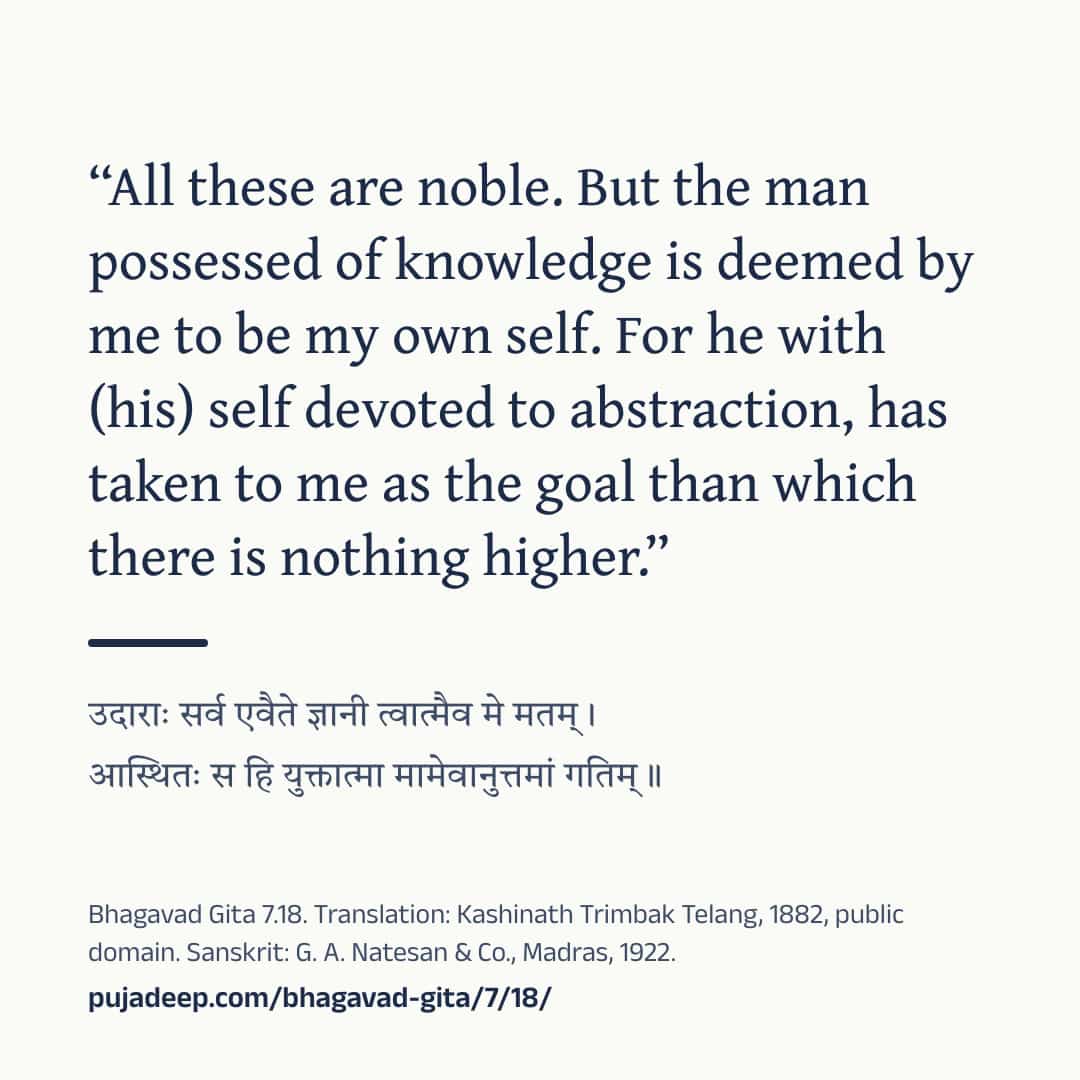
उदाराः सर्व एवैते ज्ञानी त्वात्मैव मे मतम् ।आस्थितः स हि युक्तात्मा मामेवानुत्तमां गतिम् ॥
Udarah sarva evaite jnani tvatmaiva me matamAsthitah sa hi yuktatma mamevanuttamam gatim
udārāḥ sarva evaite jñānī tvātmaiva me matam |āsthitaḥ sa hi yuktātmā māmevānuttamāṃ gatim ||
Our explanation All four are noble, Krishna says, but he holds the wise one to be his very self, because the wise one, with mind steady in yoga, has taken him as the highest goal.
हिंदी अर्थ कृष्ण कहते हैं कि ये चारों ही उदार (श्रेष्ठ) हैं, पर ज्ञानी को वे अपना ही आत्मा मानते हैं, क्योंकि ज्ञानी योग में स्थिर मन से उन्हीं को सबसे ऊँची गति मानकर उनमें स्थित है।
Word by word
Every word, with its dictionary page
Word by word
- उदाराः udārāḥ · noble (adjective (masculine), nominative plural) Dictionary: ud-āra, Monier-Williams 1899, p. 185, col. 2 “noble, illustrious, generous”
- सर्वे sarve · all (adjective (masculine), nominative plural) Dictionary: sarva, Monier-Williams 1899, p. 1184, col. 3 “whole, entire, all, every”
- एव eva · indeed (indeclinable) Dictionary: 1. eva, Monier-Williams 1899, p. 232, col. 2 “just, exactly, very, same, only, even, alone, merely”
- एते ete · these (pronoun (masculine), nominative plural) Dictionary: etad, Monier-Williams 1899, p. 231, col. 2 “this, this here, here”
- ज्ञानी jñānī · the wise one (noun (masculine), nominative singular) Dictionary: jñānin, Monier-Williams 1899, p. 426, col. 2 “knowing, endowed with knowledge or intelligence, wise”
- तु tu · but (indeclinable) Dictionary: 2. tu, Monier-Williams 1899, p. 449, col. 3 “but”
- आत्मा ātmā · self (noun (masculine), nominative singular) Dictionary: ātman, Monier-Williams 1899, p. 135, col. 1 “the individual soul, self”
- एव eva · very (indeclinable) Dictionary: 1. eva, Monier-Williams 1899, p. 232, col. 2 “just, exactly, very, same, only, even, alone, merely”
- मे me · in "my" view (Krishna's) (pronoun, genitive singular) Dictionary: 1. mad, Monier-Williams 1899, p. 777, col. 2 “base of the first pers. pron. in the sg. number (esp. in comp.)”
- मतम् matam · view, opinion (past participle (neuter), nominative singular) Dictionary: mata, Monier-Williams 1899, p. 783, col. 1 “a thought, idea, opinion, sentiment, view, belief, doctrine”
- आस्थितः āsthitaḥ · has taken to (past participle (masculine), nominative singular) Dictionary: ā-sthita, Monier-Williams 1899, p. 161, col. 2 “one who has undertaken or performed”
- सः saḥ · he (pronoun (masculine), nominative singular) Dictionary: tad, Monier-Williams 1899, p. 434, col. 1 “m. he, f. she, n. it, that, this”
- हि hi · for (indeclinable) Dictionary: 2. hi, Monier-Williams 1899, p. 1297, col. 3 “for, because, on account of”
- युक्तात्मा yuktātmā · with mind steady in yoga (compound (masculine), nominative singular) Dictionary: yuktātman, Monier-Williams 1899, p. 853, col. 3 “concentrated in mind”
- माम् mām · "me" (Krishna) (pronoun, accusative singular) Dictionary: 1. mad, Monier-Williams 1899, p. 777, col. 2 “base of the first pers. pron. in the sg. number (esp. in comp.)”
- एव eva · alone (indeclinable) Dictionary: 1. eva, Monier-Williams 1899, p. 232, col. 2 “just, exactly, very, same, only, even, alone, merely”
- अनुत्तमाम् anuttamām · highest, unsurpassed (adjective (feminine), accusative singular) Dictionary: an-uttama, Monier-Williams 1899, p. 33, col. 1 “unsurpassed, incomparably the best or chief, excellent”
- गतिम् gatim · goal (noun (feminine), accusative singular) Dictionary: gati, Monier-Williams 1899, p. 347, col. 3 “path, way, course”
2 printings differ
Edition differences. Another printing or text reads this place differently.
- The printed edition reads: उदाराः सर्व एवैते ज्ञानी त्वात्मैव मे मतम् ।
आस्थितः स हि युक्तात्मा मावेवानुत्तमां गतिम् ॥ The print reads मावेवानुत्तमां (leaf n117), with व for म; read as a printing flaw and shown as मामेवानुत्तमां (mām eva, 'to Me alone'), as both proofreading references read. - Spelling The 1922 Madras printing reads: आस्थितः स हि युक्तात्मा मावेवानुत्तमां गतिम् The 1922 base printing (leaf n117) reads मावेवानुत्तमां, a printing flaw (व for म); see normalisations.
Old translations
Kashinath Trimbak Telang, 1882. Public domain. Page 75.
All these are noble. But the man possessed of knowledge is deemed by me to be my own self. For he with (his) self devoted to abstraction, has taken to me as the goal than which there is nothing higher.
Compare 3 translations
Kashinath Trimbak Telang, 1882. Public domain. Page 75.
All these are noble. But the man possessed of knowledge is deemed by me to be my own self. For he with (his) self devoted to abstraction, has taken to me as the goal than which there is nothing higher.
You are reading this one
Annie Besant, 1895. Public domain. Page 78.
Noble are all these, but I hold the wise as verily Myself; he, SELF-united, is fixed on Me, the highest Path.
You are reading this one
Swami Swarupananda, 1909 (first printed 1907). Public domain. Page 153.
Noble indeed are they all, but the wise man I regard as my very Self; for with the mind steadfast, he is established in Me alone, as the supreme goal.
You are reading this one
Cite this verse
The translation: K. T. Telang, The Bhagavadgîtâ (The Sacred Books of the East, vol. VIII, Oxford: Clarendon Press, 1882), p. 75. Bhagavad Gita 7.18.
The translation: Annie Besant, The Bhagavad Gîtâ, or The Lord's Song (London: Theosophical Publishing Society, 1895), p. 78. Bhagavad Gita 7.18.
The translation: Swami Swarupananda, Srimad-Bhagavad-Gita (Mayavati: Prabuddha Bharata Press, 1909; first printed in Prabuddha Bharata, 1907–1909), p. 153. Bhagavad Gita 7.18.
Our explanation: “Bhagavad Gita 7.18: meaning and translation.” Pujadeep. Updated October 27, 2026. https://pujadeep.com/bhagavad-gita/7/18/
Pujadeep’s explanations are free to quote with credit: name Pujadeep and link to the page. How to credit
Classical readings, by school
Each reading is named by its school. None is presented as the only meaning.
What Advaita, Vishishtadvaita and Dvaita teach, in short
Shankara Advaita
Shankara says all the Lord's devotees are dear to him, but the wise one is the very Self, not different from the Lord: firm in the knowledge that he himself is Vasudeva and no other, he seeks the Supreme Brahman as the highest goal.
Source: The Bhagavad-Gita, with the commentary of Sri Sankaracharya, translated by A. Mahadeva Sastri (2nd ed., Mysore: G. T. A. Printing Works, 1901), commentary on 7.18, p. 195. Summarised in our own words; none of its text is reproduced.
Ramanuja Vishishtadvaita
Ramanuja says all four are noble because they come to the Lord. The wise one is called the Lord's very self in the sense that, just as the wise one cannot live without the Lord, his highest goal, the Lord cannot live without him.
Source: Sri Bhagavad-Gita with Sri Ramanujacharya's Visishtadvaita commentary, translated by A. Govindacharya (Madras, 1898), commentary on 7.18, pp. 245–246. Summarised in our own words; none of its text is reproduced.
Share
Show the ways to share
Send one picture or the text to one chat. The picture names its source and the address of this page.
Drawing the picture
See the words
Bhagavad Gita 7.18

उदाराः सर्व एवैते ज्ञानी त्वात्मैव मे मतम् ।
आस्थितः स हि युक्तात्मा मामेवानुत्तमां गतिम् ॥

“All these are noble. But the man possessed of knowledge is deemed by me to be my own self. For he with (his) self devoted to abstraction, has taken to me as the goal than which there is nothing higher.”
(K. T. Telang, The Bhagavadgîtâ (The Sacred Books of the East, vol. VIII, Oxford: Clarendon Press, 1882), p. 75, public domain)

“Noble are all these, but I hold the wise as verily Myself; he, SELF-united, is fixed on Me, the highest Path.”
(Annie Besant, The Bhagavad Gîtâ, or The Lord's Song (London: Theosophical Publishing Society, 1895), p. 78, public domain)

“Noble indeed are they all, but the wise man I regard as my very Self; for with the mind steadfast, he is established in Me alone, as the supreme goal.”
(Swami Swarupananda, Srimad-Bhagavad-Gita (Mayavati: Prabuddha Bharata Press, 1909; first printed in Prabuddha Bharata, 1907–1909), p. 153, public domain)

Sanskrit: G. A. Natesan & Co., Madras, 1922.
https://pujadeep.com/bhagavad-gita/7/18/ Nothing is sent from this site. Your own app sends it, to the chat you choose. The picture quotes the translation you chose on this page, with its name and year.
Sanskrit text: The Bhagavad-Gita, or The Lord's Song, with the text in Devanagari and an English translation, 1922. Meanings: written for Pujadeep and checked against the cited edition. Source and changes
Questions families ask
Who speaks Bhagavad Gita 7.18?
Krishna speaks this verse, in chapter 7 (Jnana Vijnana Yoga).
Where does the Sanskrit text come from?
Sanskrit text: The Bhagavad-Gita, or The Lord's Song, with the text in Devanagari and an English translation, 1922. Meanings: written for Pujadeep and checked against the cited edition. See the source
Is the meaning on this page a translation?
Explanation written for this site from the sources listed here, and checked against the cited edition. It is not a translation and not the only way to read the text. Free to quote with credit.
Source and licence
- Sanskrit text
- The Bhagavad-Gita, or The Lord's Song, with the text in Devanagari and an English translation (Annie Besant, G. A. Natesan & Co., Madras, 1922). Public domain. The Sanskrit on these pages was read from this printing’s page images.
- Translation
- The Bhagavadgîtâ with the Sanatsugâtîya and the Anugîtâ, translated by Kâshinâth Trimbak Telang (The Sacred Books of the East, vol. VIII, ed. F. Max Müller) (Kashinath Trimbak Telang, F. Max Müller, Clarendon Press, Oxford, 1882). Public domain. Shown verbatim, as printed.
- Translation
- The Bhagavad Gîtâ, or The Lord's Song, translated by Annie Besant (Annie Besant, Theosophical Publishing Society, London, 1895). Public domain. Shown verbatim, as printed.
- Translation
- Srimad-Bhagavad-Gita, with Sanskrit Text; Paraphrase with Word-by-word Literal Translation; English Rendering and Comments, Index, &c., by the Swami Swarupananda (Himalayan Series, No. XX) (Swami Swarupananda, The Editors and Publishers, Advaita Ashrama, Mayavati, Prabuddha Bharata Press, Mayavati, Almora, Himalayas, 1909). Public domain. Shown verbatim, as printed.
- Commentary
- The Bhagavad-Gita, with the commentary of Sri Sankaracharya, translated by A. Mahadeva Sastri (2nd ed., Mysore: G. T. A. Printing Works, 1901) (Public-domain scan, University of California Libraries). Summarised in our own words; none of its text is reproduced.
- Commentary
- Sri Bhagavad-Gita with Sri Ramanujacharya's Visishtadvaita commentary, translated by A. Govindacharya (Madras, 1898) (Scan uploaded to archive.org (folkscanomy collection)). Summarised in our own words; none of its text is reproduced.
- Common wording
- In this text, 32 words follow today's common wording, checked against sanskritdocuments.org; Sanskrit Wikisource; Gita Press, Gorakhpur; GRETIL, Göttingen and Bhaktivedanta Book Trust.
- Our explanation
- Explanation written for this site from the sources listed here, and checked against the cited edition. It is not a translation and not the only way to read the text. Free to quote with credit.
- Checked
- Checked against the cited edition, October 15, 2026.
- Updated
- October 27, 2026