Bhagavad Gita 7.9: meaning and translation
Chapter 7: Jnana Vijnana Yoga. Krishna says
Krishna says he is the pure fragrance of the earth and the brightness of fire, the life in all beings, and the discipline (tapas) of those who practise discipline.
Click or tap a word for its meaning and its dictionary page.
Text and layers
Text and layers
These choices stay in this browser.
Bhagavad Gita 7.9
पुण्यो गन्धः पृथिव्यां च तेजश्चास्मि विभावसौ ।जीवनं सर्वभूतेषु तपश्चास्मि तपस्विषु ॥
Punyo gandhah prithivyam cha tejashchasmi vibhavasauJivanam sarvabhuteshu tapashchasmi tapasvishu
puṇyo gandhaḥ pṛthivyāṃ ca tejaścāsmi vibhāvasau |jīvanaṃ sarvabhūteṣu tapaścāsmi tapasviṣu ||
Our explanation Krishna says he is the pure fragrance of the earth and the brightness of fire, the life in all beings, and the discipline (tapas) of those who practise discipline.
हिंदी अर्थ कृष्ण कहते हैं कि वे पृथ्वी की पवित्र सुगंध और अग्नि का तेज हैं, सब प्राणियों में जीवन हैं, और तपस्वियों में तप हैं।
Word by word
Every word, with its dictionary page
Word by word
- पुण्यः puṇyaḥ · pure, sweet (adjective (masculine), nominative singular) Dictionary: puṇya, Monier-Williams 1899, p. 632, col. 1 “good, right, virtuous, meritorious, pure, holy, sacred”
- गन्धः gandhaḥ · fragrance, smell (noun (masculine), nominative singular) Dictionary: gandha, Monier-Williams 1899, p. 345, col. 1 “smell, odour”
- पृथिव्याम् pṛthivyām · in the earth (noun (feminine), locative singular) Dictionary: pṛthivī, Monier-Williams 1899, p. 646, col. 1 “the earth or wide world”
- च ca · and (indeclinable) Dictionary: 2. ca, Monier-Williams 1899, p. 380, col. 1 “and, both, also, moreover, as well as”
- तेजः tejaḥ · brightness (noun (neuter), nominative singular) Dictionary: tejas, Monier-Williams 1899, p. 454, col. 2 “glow, glare, splendour, brilliance, light, fire”
- च ca · and (indeclinable) Dictionary: 2. ca, Monier-Williams 1899, p. 380, col. 1 “and, both, also, moreover, as well as”
- अस्मि asmi · "I am" (present, 1st person singular) Dictionary: 1. as, Monier-Williams 1899, p. 117, col. 2 “to be, live, exist, be present”
- विभावसौ vibhāvasau · in fire (noun (masculine), locative singular) Dictionary: vi-bhā-vasu, Monier-Williams 1899, p. 977, col. 3 “fire or the god of fire”
- जीवनम् jīvanam · life (noun (neuter), nominative singular) Dictionary: jīvana, Monier-Williams 1899, p. 423, col. 2 “life”
- सर्वभूतेषु sarvabhūteṣu · in all beings (compound (neuter), locative plural) Dictionary: sarva, Monier-Williams 1899, p. 1184, col. 3 “whole, entire, all, every”; bhūta, Monier-Williams 1899, p. 761, col. 3 “that which is or exists, any living being”
- तपः tapaḥ · discipline, austerity (noun (neuter), nominative singular) Dictionary: tapas, Monier-Williams 1899, p. 437, col. 1 “religious austerity, bodily mortification, penance, severe meditation”
- च ca · and (indeclinable) Dictionary: 2. ca, Monier-Williams 1899, p. 380, col. 1 “and, both, also, moreover, as well as”
- अस्मि asmi · "I am" (present, 1st person singular) Dictionary: 1. as, Monier-Williams 1899, p. 117, col. 2 “to be, live, exist, be present”
- तपस्विषु tapasviṣu · in those who practise tapas (noun (masculine), locative plural) Dictionary: tapas-vin, Monier-Williams 1899, p. 437, col. 2 “practising austerities, (m.) an ascetic”
Old translations
Kashinath Trimbak Telang, 1882. Public domain. Page 74.
I am the fragrant smell in the earth, refulgence in the fire; I am life in all beings, and penance1 in those who perform penance.
This sentence begins in 7.8.
Footnotes (the translator’s own) - I. e. power to bear the pairs of opposites. ↩
Compare 3 translations
Kashinath Trimbak Telang, 1882. Public domain. Page 74.
I am the fragrant smell in the earth, refulgence in the fire; I am life in all beings, and penance1 in those who perform penance.
This sentence begins in 7.8.
Footnotes (the translator’s own) - I. e. power to bear the pairs of opposites. ↩
You are reading this one
Annie Besant, 1895. Public domain. Page 76.
The pure fragrance of earths and the brilliance in fire am I; the life in all beings, and I am the austerity in ascetics.
This sentence begins in 7.8.
You are reading this one
Swami Swarupananda, 1909 (first printed 1907). Public domain. Page 148–149.
I am the sacred fragrance in earth, and the brilliance in fire am I; the life in all beings, and the austerity am I in ascetics.
You are reading this one
Cite this verse
The translation: K. T. Telang, The Bhagavadgîtâ (The Sacred Books of the East, vol. VIII, Oxford: Clarendon Press, 1882), p. 74. Bhagavad Gita 7.9.
The translation: Annie Besant, The Bhagavad Gîtâ, or The Lord's Song (London: Theosophical Publishing Society, 1895), p. 76. Bhagavad Gita 7.9.
The translation: Swami Swarupananda, Srimad-Bhagavad-Gita (Mayavati: Prabuddha Bharata Press, 1909; first printed in Prabuddha Bharata, 1907–1909), pp. 148–149. Bhagavad Gita 7.9.
Our explanation: “Bhagavad Gita 7.9: meaning and translation.” Pujadeep. Updated October 27, 2026. https://pujadeep.com/bhagavad-gita/7/9/
Pujadeep’s explanations are free to quote with credit: name Pujadeep and link to the page. How to credit
Classical readings, by school
No readings by school on this verse yet.
Share
Show the ways to share
Send one picture or the text to one chat. The picture names its source and the address of this page.
Drawing the picture
See the words
Bhagavad Gita 7.9

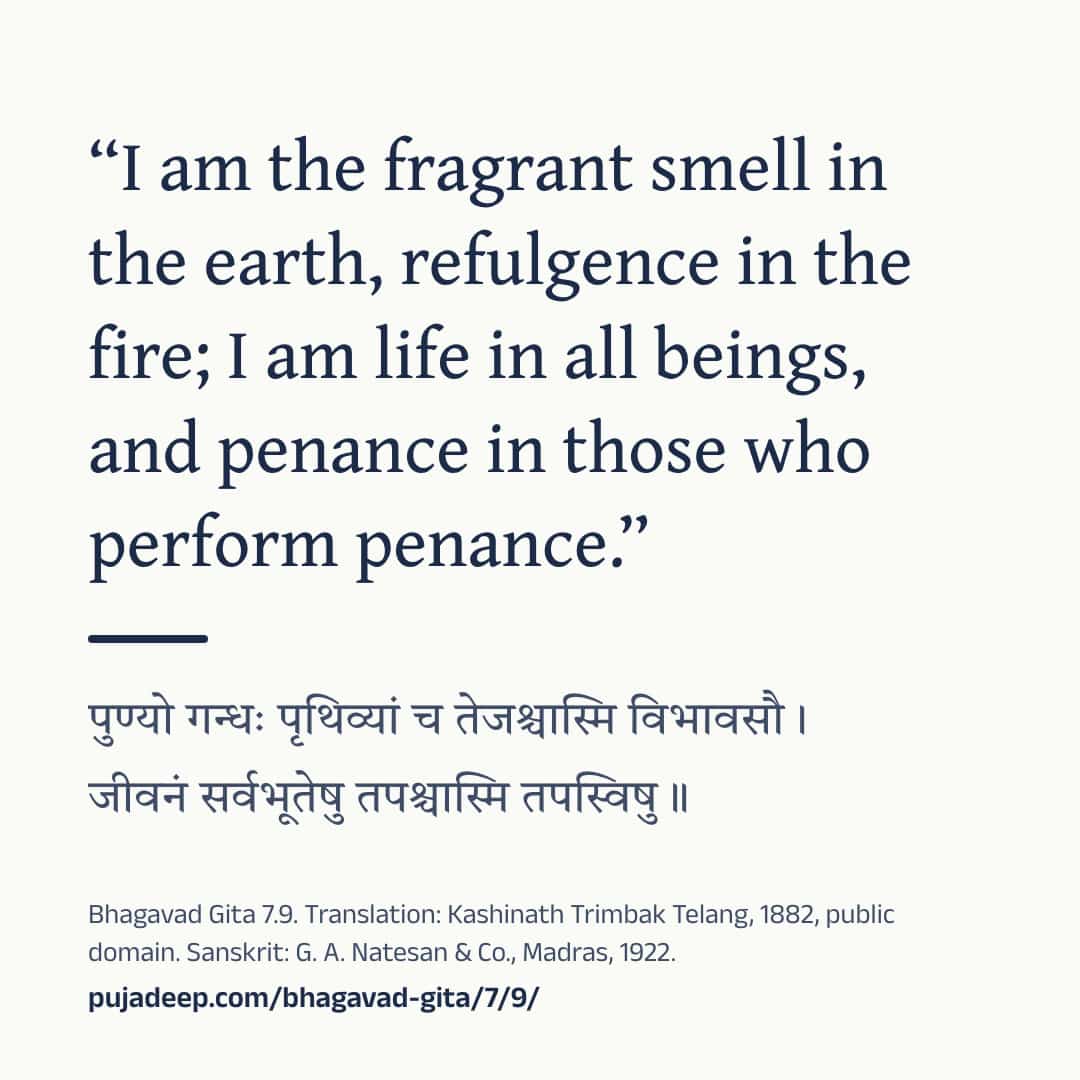
पुण्यो गन्धः पृथिव्यां च तेजश्चास्मि विभावसौ ।
जीवनं सर्वभूतेषु तपश्चास्मि तपस्विषु ॥

“I am the fragrant smell in the earth, refulgence in the fire; I am life in all beings, and penance in those who perform penance.”
(K. T. Telang, The Bhagavadgîtâ (The Sacred Books of the East, vol. VIII, Oxford: Clarendon Press, 1882), p. 74, public domain)
This sentence begins in 7.8.

“The pure fragrance of earths and the brilliance in fire am I; the life in all beings, and I am the austerity in ascetics.”
(Annie Besant, The Bhagavad Gîtâ, or The Lord's Song (London: Theosophical Publishing Society, 1895), p. 76, public domain)
This sentence begins in 7.8.

“I am the sacred fragrance in earth, and the brilliance in fire am I; the life in all beings, and the austerity am I in ascetics.”
(Swami Swarupananda, Srimad-Bhagavad-Gita (Mayavati: Prabuddha Bharata Press, 1909; first printed in Prabuddha Bharata, 1907–1909), pp. 148–149, public domain)

Sanskrit: G. A. Natesan & Co., Madras, 1922.
https://pujadeep.com/bhagavad-gita/7/9/ Nothing is sent from this site. Your own app sends it, to the chat you choose. The picture quotes the translation you chose on this page, with its name and year.
Sanskrit text: The Bhagavad-Gita, or The Lord's Song, with the text in Devanagari and an English translation, 1922. Meanings: written for Pujadeep and checked against the cited edition. Source and changes
Questions families ask
Who speaks Bhagavad Gita 7.9?
Krishna speaks this verse, in chapter 7 (Jnana Vijnana Yoga).
Where does the Sanskrit text come from?
Sanskrit text: The Bhagavad-Gita, or The Lord's Song, with the text in Devanagari and an English translation, 1922. Meanings: written for Pujadeep and checked against the cited edition. See the source
Is the meaning on this page a translation?
Explanation written for this site from the sources listed here, and checked against the cited edition. It is not a translation and not the only way to read the text. Free to quote with credit.
Source and licence
- Sanskrit text
- The Bhagavad-Gita, or The Lord's Song, with the text in Devanagari and an English translation (Annie Besant, G. A. Natesan & Co., Madras, 1922). Public domain. The Sanskrit on these pages was read from this printing’s page images.
- Translation
- The Bhagavadgîtâ with the Sanatsugâtîya and the Anugîtâ, translated by Kâshinâth Trimbak Telang (The Sacred Books of the East, vol. VIII, ed. F. Max Müller) (Kashinath Trimbak Telang, F. Max Müller, Clarendon Press, Oxford, 1882). Public domain. Shown verbatim, as printed.
- Translation
- The Bhagavad Gîtâ, or The Lord's Song, translated by Annie Besant (Annie Besant, Theosophical Publishing Society, London, 1895). Public domain. Shown verbatim, as printed.
- Translation
- Srimad-Bhagavad-Gita, with Sanskrit Text; Paraphrase with Word-by-word Literal Translation; English Rendering and Comments, Index, &c., by the Swami Swarupananda (Himalayan Series, No. XX) (Swami Swarupananda, The Editors and Publishers, Advaita Ashrama, Mayavati, Prabuddha Bharata Press, Mayavati, Almora, Himalayas, 1909). Public domain. Shown verbatim, as printed.
- Common wording
- In this text, 32 words follow today's common wording, checked against sanskritdocuments.org; Sanskrit Wikisource; Gita Press, Gorakhpur; GRETIL, Göttingen and Bhaktivedanta Book Trust.
- Our explanation
- Explanation written for this site from the sources listed here, and checked against the cited edition. It is not a translation and not the only way to read the text. Free to quote with credit.
- Checked
- Checked against the cited edition, October 15, 2026.
- Updated
- October 27, 2026