Bhagavad Gita 7.6: meaning and translation
Chapter 7: Jnana Vijnana Yoga. Krishna says
All beings come from these two natures, Krishna says.
Click or tap a word for its meaning and its dictionary page.
Text and layers
Text and layers
These choices stay in this browser.
Bhagavad Gita 7.6
एतद्योनीनि भूतानि सर्वाणीत्युपधारय ।अहं कृत्स्नस्य जगतः प्रभवः प्रलयस्तथा ॥
Etadyonini bhutani sarvanityupadharayaAham kritsnasya jagatah prabhavah pralayastatha
etadyonīni bhūtāni sarvāṇītyupadhāraya |ahaṃ kṛtsnasya jagataḥ prabhavaḥ pralayastathā ||
Our explanation All beings come from these two natures, Krishna says. He himself is the origin of the whole world and also its dissolution.
हिंदी अर्थ कृष्ण कहते हैं कि सब प्राणी इन्हीं दो प्रकृतियों से उत्पन्न होते हैं। वे स्वयं पूरे जगत की उत्पत्ति भी हैं और प्रलय (विलय) भी।
Word by word
Every word, with its dictionary page
Word by word
- एतद्योनीनि etadyonīni · having these as their source (compound (neuter), nominative plural) Dictionary: etad, Monier-Williams 1899, p. 231, col. 2 “this, this here, here”; yoni, Monier-Williams 1899, p. 858, col. 2 “place of birth, source, origin, spring, fountain”
- भूतानि bhūtāni · beings (noun (neuter), nominative plural) Dictionary: bhūta, Monier-Williams 1899, p. 761, col. 3 “that which is or exists, any living being”
- सर्वाणि sarvāṇi · all (adjective (neuter), nominative plural) Dictionary: sarva, Monier-Williams 1899, p. 1184, col. 3 “whole, entire, all, every”
- इति iti · thus (indeclinable) Dictionary: 2. iti, Monier-Williams 1899, p. 165, col. 1 “in this manner, thus”
- उपधारय upadhāraya · understand, know (causative imperative, 2nd person singular) Dictionary: upa-dhṛ, Monier-Williams 1899, p. 200, col. 1 “to hold as, consider as, regard, think”
- अहम् aham · "I" (Krishna) (pronoun, nominative singular) Dictionary: aham, Monier-Williams 1899, p. 124, col. 2 “nom. sg. ‘I,’”
- कृत्स्नस्य kṛtsnasya · of the whole (adjective (neuter), genitive singular) Dictionary: kṛtsna, Monier-Williams 1899, p. 304, col. 3 “all, whole, entire”
- जगतः jagataḥ · of the world (noun (neuter), genitive singular) Dictionary: jagat, Monier-Williams 1899, p. 408, col. 1 “the world, esp. this world, earth”
- प्रभवः prabhavaḥ · origin (noun (masculine), nominative singular) Dictionary: pra-bhava, Monier-Williams 1899, p. 684, col. 2 “production, source, origin, cause of existence”
- प्रलयः pralayaḥ · dissolution (noun (masculine), nominative singular) Dictionary: pra-laya, Monier-Williams 1899, p. 689, col. 3 “dissolution, reabsorption, destruction, annihilation”
- तथा tathā · and also (indeclinable) Dictionary: tathā, Monier-Williams 1899, p. 433, col. 3 “in that manner, so, thus”
Old translations
Kashinath Trimbak Telang, 1882. Public domain. Page 74.
Know that all things have these (for their) source1. I am the producer and the destroyer of the whole universe.
Footnotes (the translator’s own) - Cf. infra, p. 105. ↩
Compare 3 translations
Kashinath Trimbak Telang, 1882. Public domain. Page 74.
Know that all things have these (for their) source1. I am the producer and the destroyer of the whole universe.
Footnotes (the translator’s own) - Cf. infra, p. 105. ↩
You are reading this one
Annie Besant, 1895. Public domain. Page 76.
This the treasuring womb verily of all beings. I am the going forth of the whole universe and likewise its dissolving.
This sentence begins in 7.4.
You are reading this one
Swami Swarupananda, 1909 (first printed 1907). Public domain. Page 147.
Know that these (two Prakritis) are the womb of all beings. I am the origin and dissolution of the whole universe.
You are reading this one
Cite this verse
The translation: K. T. Telang, The Bhagavadgîtâ (The Sacred Books of the East, vol. VIII, Oxford: Clarendon Press, 1882), p. 74. Bhagavad Gita 7.6.
The translation: Annie Besant, The Bhagavad Gîtâ, or The Lord's Song (London: Theosophical Publishing Society, 1895), p. 76. Bhagavad Gita 7.6.
The translation: Swami Swarupananda, Srimad-Bhagavad-Gita (Mayavati: Prabuddha Bharata Press, 1909; first printed in Prabuddha Bharata, 1907–1909), p. 147. Bhagavad Gita 7.6.
Our explanation: “Bhagavad Gita 7.6: meaning and translation.” Pujadeep. Updated October 27, 2026. https://pujadeep.com/bhagavad-gita/7/6/
Pujadeep’s explanations are free to quote with credit: name Pujadeep and link to the page. How to credit
Classical readings, by school
No readings by school on this verse yet.
Share
Show the ways to share
Send one picture or the text to one chat. The picture names its source and the address of this page.
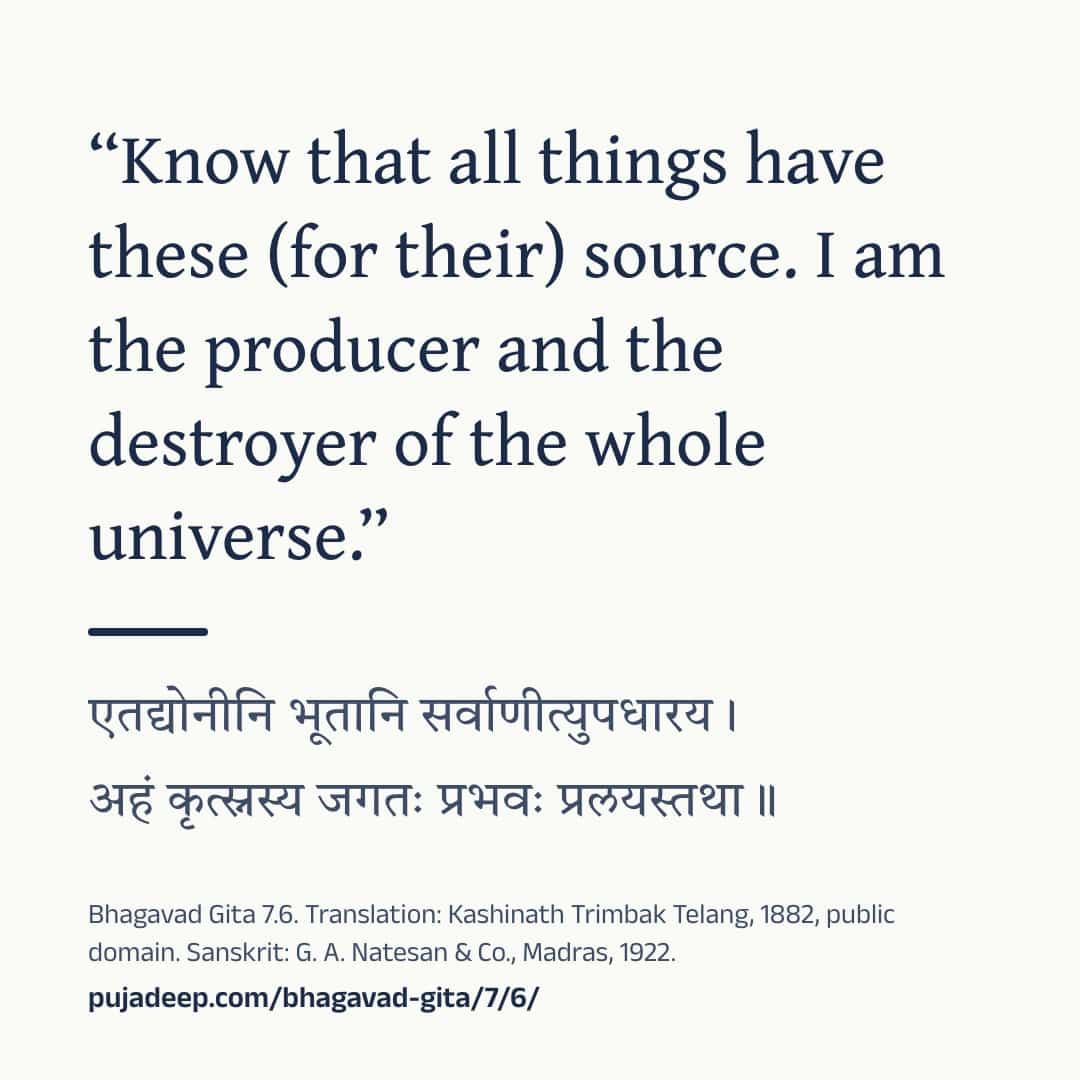
Drawing the picture
See the words
Bhagavad Gita 7.6

एतद्योनीनि भूतानि सर्वाणीत्युपधारय ।
अहं कृत्स्नस्य जगतः प्रभवः प्रलयस्तथा ॥

“Know that all things have these (for their) source. I am the producer and the destroyer of the whole universe.”
(K. T. Telang, The Bhagavadgîtâ (The Sacred Books of the East, vol. VIII, Oxford: Clarendon Press, 1882), p. 74, public domain)

“This the treasuring womb verily of all beings. I am the going forth of the whole universe and likewise its dissolving.”
(Annie Besant, The Bhagavad Gîtâ, or The Lord's Song (London: Theosophical Publishing Society, 1895), p. 76, public domain)
This sentence begins in 7.4.

“Know that these (two Prakritis) are the womb of all beings. I am the origin and dissolution of the whole universe.”
(Swami Swarupananda, Srimad-Bhagavad-Gita (Mayavati: Prabuddha Bharata Press, 1909; first printed in Prabuddha Bharata, 1907–1909), p. 147, public domain)

Sanskrit: G. A. Natesan & Co., Madras, 1922.
https://pujadeep.com/bhagavad-gita/7/6/ Nothing is sent from this site. Your own app sends it, to the chat you choose. The picture quotes the translation you chose on this page, with its name and year.
Sanskrit text: The Bhagavad-Gita, or The Lord's Song, with the text in Devanagari and an English translation, 1922. Meanings: written for Pujadeep and checked against the cited edition. Source and changes
Questions families ask
Who speaks Bhagavad Gita 7.6?
Krishna speaks this verse, in chapter 7 (Jnana Vijnana Yoga).
Where does the Sanskrit text come from?
Sanskrit text: The Bhagavad-Gita, or The Lord's Song, with the text in Devanagari and an English translation, 1922. Meanings: written for Pujadeep and checked against the cited edition. See the source
Is the meaning on this page a translation?
Explanation written for this site from the sources listed here, and checked against the cited edition. It is not a translation and not the only way to read the text. Free to quote with credit.
Source and licence
- Sanskrit text
- The Bhagavad-Gita, or The Lord's Song, with the text in Devanagari and an English translation (Annie Besant, G. A. Natesan & Co., Madras, 1922). Public domain. The Sanskrit on these pages was read from this printing’s page images.
- Translation
- The Bhagavadgîtâ with the Sanatsugâtîya and the Anugîtâ, translated by Kâshinâth Trimbak Telang (The Sacred Books of the East, vol. VIII, ed. F. Max Müller) (Kashinath Trimbak Telang, F. Max Müller, Clarendon Press, Oxford, 1882). Public domain. Shown verbatim, as printed.
- Translation
- The Bhagavad Gîtâ, or The Lord's Song, translated by Annie Besant (Annie Besant, Theosophical Publishing Society, London, 1895). Public domain. Shown verbatim, as printed.
- Translation
- Srimad-Bhagavad-Gita, with Sanskrit Text; Paraphrase with Word-by-word Literal Translation; English Rendering and Comments, Index, &c., by the Swami Swarupananda (Himalayan Series, No. XX) (Swami Swarupananda, The Editors and Publishers, Advaita Ashrama, Mayavati, Prabuddha Bharata Press, Mayavati, Almora, Himalayas, 1909). Public domain. Shown verbatim, as printed.
- Common wording
- In this text, 32 words follow today's common wording, checked against sanskritdocuments.org; Sanskrit Wikisource; Gita Press, Gorakhpur; GRETIL, Göttingen and Bhaktivedanta Book Trust.
- Our explanation
- Explanation written for this site from the sources listed here, and checked against the cited edition. It is not a translation and not the only way to read the text. Free to quote with credit.
- Checked
- Checked against the cited edition, October 15, 2026.
- Updated
- October 27, 2026