Bhagavad Gita 7.5: meaning and translation
Chapter 7: Jnana Vijnana Yoga. Krishna says
This eightfold nature, Krishna says, is the lower one.
Click or tap a word for its meaning and its dictionary page.
Text and layers
Text and layers
These choices stay in this browser.
Bhagavad Gita 7.5
अपरेयमितस्त्वन्यां प्रकृतिं विद्धि मे पराम् ।जीवभूतां महाबाहो ययेदं धार्यते जगत् ॥
Apareyamitastvanyam prakritim viddhi me paramJivabhutam mahabaho yayedam dharyate jagat
apareyamitastvanyāṃ prakṛtiṃ viddhi me parām |jīvabhūtāṃ mahābāho yayedaṃ dhāryate jagat ||
Our explanation This eightfold nature, Krishna says, is the lower one. He has another, higher nature, which is life itself (jīva-bhūtā), and by which this whole world is held up. The two schools read this higher nature differently (see the views).
हिंदी अर्थ कृष्ण कहते हैं कि यह आठ प्रकार की प्रकृति निम्न (अपरा) है। उनकी एक दूसरी, ऊँची (परा) प्रकृति भी है, जो जीव रूप है, और जिससे यह पूरा जगत धारण किया जाता है। दोनों परंपराएँ इस परा प्रकृति को अलग ढंग से समझती हैं।
Word by word
Every word, with its dictionary page
Word by word
- अपरा aparā · lower (adjective (feminine), nominative singular) Dictionary: 2. apara, Monier-Williams 1899, p. 50, col. 3 “inferior, lower (opposed to pára)”
- इयम् iyam · this (pronoun (feminine), nominative singular) Dictionary: 1. idam, Monier-Williams 1899, p. 165, col. 2 “this, this here, referring to something near the speaker”
- इतः itaḥ · from this, other than this (indeclinable) Dictionary: i-tas, Monier-Williams 1899, p. 165, col. 1 “from hence, hence, here”
- तु tu · but (indeclinable) Dictionary: 2. tu, Monier-Williams 1899, p. 449, col. 3 “but”
- अन्याम् anyām · another (pronoun (feminine), accusative singular) Dictionary: 2. anya, Monier-Williams 1899, p. 45, col. 2 “other, different”
- प्रकृतिम् prakṛtim · nature (prakṛti) (noun (feminine), accusative singular) Dictionary: pra-kṛti, Monier-Williams 1899, p. 654, col. 1 “the original or natural form or condition of anything, original or primary substance”
- विद्धि viddhi · know (imperative, 2nd person singular) Dictionary: 1. vid, Monier-Williams 1899, p. 963, col. 2 “to know, understand, perceive, learn”
- मे me · "my" (Krishna's) (pronoun, genitive singular) Dictionary: 1. mad, Monier-Williams 1899, p. 777, col. 2 “base of the first pers. pron. in the sg. number (esp. in comp.)”
- पराम् parām · higher (adjective (feminine), accusative singular) Dictionary: 1. para, Monier-Williams 1899, p. 586, col. 1 “highest, supreme, chief”
- जीवभूताम् jīvabhūtām · which is life itself (compound (feminine), accusative singular) Dictionary: jīva-bhūta, Monier-Williams 1899, p. 422, col. 3 “forming the life of (gen.)”
- महाबाहो mahābāho · O mighty-armed one (noun (masculine), vocative singular) Dictionary: mahā-bāhu, Monier-Williams 1899, p. 798, col. 1 “long-armed”
- यया yayā · by which (pronoun (feminine), instrumental singular) Dictionary: yad, Monier-Williams 1899, p. 844, col. 2 “who, which, what, whichever, whatever, that”
- इदम् idam · this (pronoun (neuter), nominative singular) Dictionary: 1. idam, Monier-Williams 1899, p. 165, col. 2 “this, this here, referring to something near the speaker”
- धार्यते dhāryate · is held up, is sustained (causative passive, present, 3rd person singular) Dictionary: dhṛ, Monier-Williams 1899, p. 519, col. 1 “to hold, bear (also = bring forth), carry, maintain, preserve”
- जगत् jagat · the world (noun (neuter), nominative singular) Dictionary: jagat, Monier-Williams 1899, p. 408, col. 1 “the world, esp. this world, earth”
Old translations
Kashinath Trimbak Telang, 1882. Public domain. Page 74.
But this is a lower (form of my) nature. Know (that there is) another (form of my) nature, and higher than this, which is animate, O you of mighty arms! and by which this universe is upheld.
Compare 3 translations
Kashinath Trimbak Telang, 1882. Public domain. Page 74.
But this is a lower (form of my) nature. Know (that there is) another (form of my) nature, and higher than this, which is animate, O you of mighty arms! and by which this universe is upheld.
You are reading this one
Annie Besant, 1895. Public domain. Page 76.
This the inferior. Know My other Prakriti, the higher, the Life-Element, O mighty-armed, by which the universe is upheld—
You are reading this one
Swami Swarupananda, 1909 (first printed 1907). Public domain. Page 147.
This is the lower (Prakriti). But different from it, know thou, O mighty-armed, My higher Prakriti—the principle of self-consciousness, by which this universe is sustained.
You are reading this one
Cite this verse
The translation: K. T. Telang, The Bhagavadgîtâ (The Sacred Books of the East, vol. VIII, Oxford: Clarendon Press, 1882), p. 74. Bhagavad Gita 7.5.
The translation: Annie Besant, The Bhagavad Gîtâ, or The Lord's Song (London: Theosophical Publishing Society, 1895), p. 76. Bhagavad Gita 7.5.
The translation: Swami Swarupananda, Srimad-Bhagavad-Gita (Mayavati: Prabuddha Bharata Press, 1909; first printed in Prabuddha Bharata, 1907–1909), p. 147. Bhagavad Gita 7.5.
Our explanation: “Bhagavad Gita 7.5: meaning and translation.” Pujadeep. Updated October 27, 2026. https://pujadeep.com/bhagavad-gita/7/5/
Pujadeep’s explanations are free to quote with credit: name Pujadeep and link to the page. How to credit
Classical readings, by school
Each reading is named by its school. None is presented as the only meaning.
What Advaita, Vishishtadvaita and Dvaita teach, in short
Shankara Advaita
Shankara calls the lower prakṛti impure and the bondage of saṃsāra. The higher is pure: it is the Lord's very Self, the knower of the field (kṣetrajña), which enters the whole universe and sustains it.
Source: The Bhagavad-Gita, with the commentary of Sri Sankaracharya, translated by A. Mahadeva Sastri (2nd ed., Mysore: G. T. A. Printing Works, 1901), commentary on 7.5, p. 190. Summarised in our own words; none of its text is reproduced.
Ramanuja Vishishtadvaita
Ramanuja says the higher nature is the conscious souls (jīvas), a class distinct from lifeless matter: the souls enjoy and matter is enjoyed. Both natures, matter and souls, belong to the Lord.
Source: Sri Bhagavad-Gita with Sri Ramanujacharya's Visishtadvaita commentary, translated by A. Govindacharya (Madras, 1898), commentary on 7.5, p. 233. Summarised in our own words; none of its text is reproduced.
Share
Show the ways to share
Send one picture or the text to one chat. The picture names its source and the address of this page.
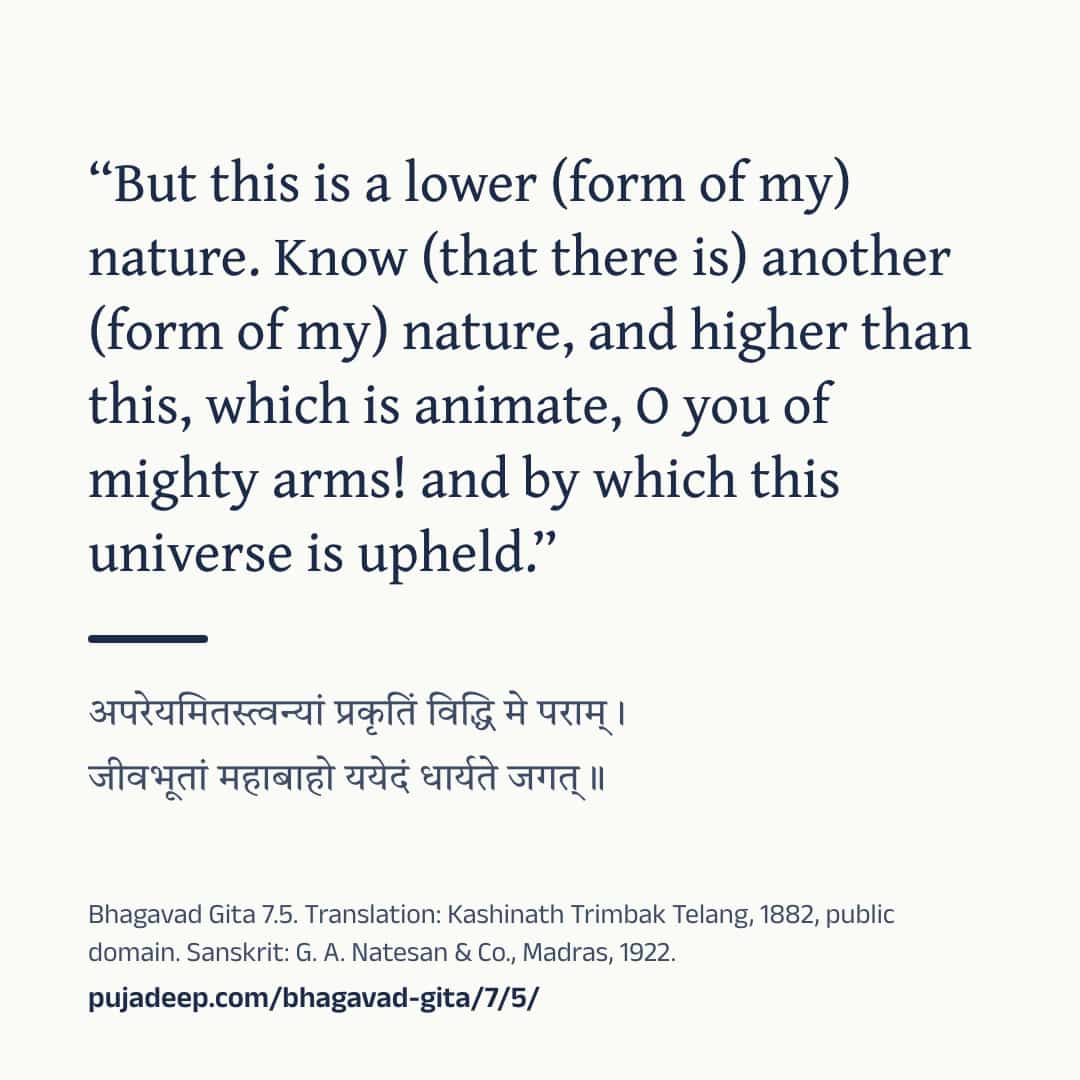
Drawing the picture
See the words
Bhagavad Gita 7.5

अपरेयमितस्त्वन्यां प्रकृतिं विद्धि मे पराम् ।
जीवभूतां महाबाहो ययेदं धार्यते जगत् ॥

“But this is a lower (form of my) nature. Know (that there is) another (form of my) nature, and higher than this, which is animate, O you of mighty arms! and by which this universe is upheld.”
(K. T. Telang, The Bhagavadgîtâ (The Sacred Books of the East, vol. VIII, Oxford: Clarendon Press, 1882), p. 74, public domain)

“This the inferior. Know My other Prakriti, the higher, the Life-Element, O mighty-armed, by which the universe is upheld—”
(Annie Besant, The Bhagavad Gîtâ, or The Lord's Song (London: Theosophical Publishing Society, 1895), p. 76, public domain)
This sentence begins in 7.4. This sentence goes on in 7.6.

“This is the lower (Prakriti). But different from it, know thou, O mighty-armed, My higher Prakriti—the principle of self-consciousness, by which this universe is sustained.”
(Swami Swarupananda, Srimad-Bhagavad-Gita (Mayavati: Prabuddha Bharata Press, 1909; first printed in Prabuddha Bharata, 1907–1909), p. 147, public domain)

Sanskrit: G. A. Natesan & Co., Madras, 1922.
https://pujadeep.com/bhagavad-gita/7/5/ Nothing is sent from this site. Your own app sends it, to the chat you choose. The picture quotes the translation you chose on this page, with its name and year.
Sanskrit text: The Bhagavad-Gita, or The Lord's Song, with the text in Devanagari and an English translation, 1922. Meanings: written for Pujadeep and checked against the cited edition. Source and changes
Questions families ask
Who speaks Bhagavad Gita 7.5?
Krishna speaks this verse, in chapter 7 (Jnana Vijnana Yoga).
Where does the Sanskrit text come from?
Sanskrit text: The Bhagavad-Gita, or The Lord's Song, with the text in Devanagari and an English translation, 1922. Meanings: written for Pujadeep and checked against the cited edition. See the source
Is the meaning on this page a translation?
Explanation written for this site from the sources listed here, and checked against the cited edition. It is not a translation and not the only way to read the text. Free to quote with credit.
Source and licence
- Sanskrit text
- The Bhagavad-Gita, or The Lord's Song, with the text in Devanagari and an English translation (Annie Besant, G. A. Natesan & Co., Madras, 1922). Public domain. The Sanskrit on these pages was read from this printing’s page images.
- Translation
- The Bhagavadgîtâ with the Sanatsugâtîya and the Anugîtâ, translated by Kâshinâth Trimbak Telang (The Sacred Books of the East, vol. VIII, ed. F. Max Müller) (Kashinath Trimbak Telang, F. Max Müller, Clarendon Press, Oxford, 1882). Public domain. Shown verbatim, as printed.
- Translation
- The Bhagavad Gîtâ, or The Lord's Song, translated by Annie Besant (Annie Besant, Theosophical Publishing Society, London, 1895). Public domain. Shown verbatim, as printed.
- Translation
- Srimad-Bhagavad-Gita, with Sanskrit Text; Paraphrase with Word-by-word Literal Translation; English Rendering and Comments, Index, &c., by the Swami Swarupananda (Himalayan Series, No. XX) (Swami Swarupananda, The Editors and Publishers, Advaita Ashrama, Mayavati, Prabuddha Bharata Press, Mayavati, Almora, Himalayas, 1909). Public domain. Shown verbatim, as printed.
- Commentary
- The Bhagavad-Gita, with the commentary of Sri Sankaracharya, translated by A. Mahadeva Sastri (2nd ed., Mysore: G. T. A. Printing Works, 1901) (Public-domain scan, University of California Libraries). Summarised in our own words; none of its text is reproduced.
- Commentary
- Sri Bhagavad-Gita with Sri Ramanujacharya's Visishtadvaita commentary, translated by A. Govindacharya (Madras, 1898) (Scan uploaded to archive.org (folkscanomy collection)). Summarised in our own words; none of its text is reproduced.
- Common wording
- In this text, 32 words follow today's common wording, checked against sanskritdocuments.org; Sanskrit Wikisource; Gita Press, Gorakhpur; GRETIL, Göttingen and Bhaktivedanta Book Trust.
- Our explanation
- Explanation written for this site from the sources listed here, and checked against the cited edition. It is not a translation and not the only way to read the text. Free to quote with credit.
- Checked
- Checked against the cited edition, October 15, 2026.
- Updated
- October 27, 2026