Bhagavad Gita 7.11: meaning and translation
Chapter 7: Jnana Vijnana Yoga. Krishna says
Krishna says he is the strength of the strong that is free of craving and attachment.
Click or tap a word for its meaning and its dictionary page.
Text and layers
Text and layers
These choices stay in this browser.
Bhagavad Gita 7.11
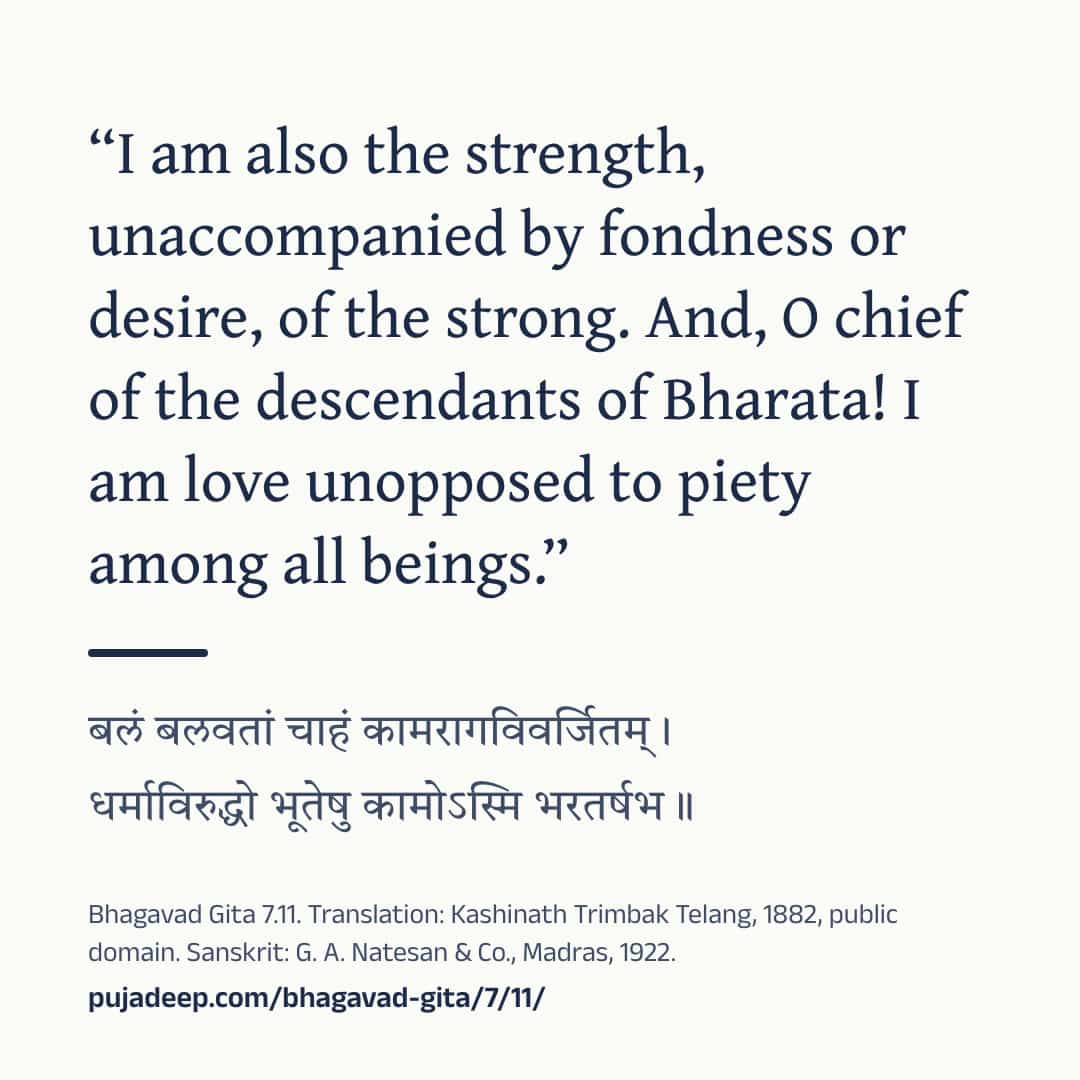
बलं बलवतां चाहं कामरागविवर्जितम् ।धर्माविरुद्धो भूतेषु कामोऽस्मि भरतर्षभ ॥
Balam balavatam chaham kamaragavivarjitamDharmaviruddho bhuteshu kamosmi bharatarshabha
balaṃ balavatāṃ cāhaṃ kāmarāgavivarjitam |dharmāviruddho bhūteṣu kāmo’smi bharatarṣabha ||
Our explanation Krishna says he is the strength of the strong that is free of craving and attachment. And in all beings, he says, he is desire (kāma) that does not go against dharma.
हिंदी अर्थ कृष्ण कहते हैं कि वे बलवानों का वह बल हैं जो कामना और आसक्ति से रहित है; और सब प्राणियों में वे वह काम (इच्छा) हैं जो धर्म के विरुद्ध नहीं है।
Word by word
Every word, with its dictionary page
Word by word
- बलम् balam · strength (noun (neuter), nominative singular) Dictionary: bala, Monier-Williams 1899, p. 722, col. 3 “power, strength, might, vigour, force”
- बलवताम् balavatām · of the strong (noun (masculine), genitive plural) Dictionary: bala-vat, Monier-Williams 1899, p. 723, col. 1 “possessing power, powerful, mighty, strong”
- च ca · and, also (indeclinable) Dictionary: 2. ca, Monier-Williams 1899, p. 380, col. 1 “and, both, also, moreover, as well as”
- अहम् aham · "I" (Krishna) (pronoun, nominative singular) Dictionary: aham, Monier-Williams 1899, p. 124, col. 2 “nom. sg. ‘I,’”
- कामरागविवर्जितम् kāmarāgavivarjitam · free from craving and attachment (compound (neuter), nominative singular) Dictionary: kāma, Monier-Williams 1899, p. 271, col. 3 “wish, desire, longing”; rāga, Monier-Williams 1899, p. 872, col. 1 “any feeling or passion, (esp.) love, affection or sympathy for”; vi-varjita, Monier-Williams 1899, p. 988, col. 3 “avoided, left, abandoned by, destitute or deprived of, free or exempt from”
- धर्माविरुद्धः dharmāviruddhaḥ · not against dharma (compound (masculine), nominative singular) Dictionary: 1. dharma, Monier-Williams 1899, p. 510, col. 3 “usage, practice, customary observance or prescribed conduct, duty”; a-viruddha, Monier-Williams 1899, p. 109, col. 3 “not incompatible with, consistent with”
- भूतेषु bhūteṣu · in beings (noun (neuter), locative plural) Dictionary: bhūta, Monier-Williams 1899, p. 761, col. 3 “that which is or exists, any living being”
- कामः kāmaḥ · desire (noun (masculine), nominative singular) Dictionary: kāma, Monier-Williams 1899, p. 271, col. 3 “wish, desire, longing”
- अस्मि asmi · "I am" (present, 1st person singular) Dictionary: 1. as, Monier-Williams 1899, p. 117, col. 2 “to be, live, exist, be present”
- भरतर्षभ bharatarṣabha · O best of the Bharatas (noun (masculine), vocative singular) Dictionary: bharata-ṛṣabha, Monier-Williams 1899, p. 747, col. 3 “the best or a prince (lit. ‘bull’) of the Bh°s”
2 printings differ
Edition differences. Another printing or text reads this place differently.
- The printed edition reads: बलं बलवतामस्मि कामरागविवर्जितम् ।
धर्माविरुद्धो भूतेषु कामोऽस्मि भरतर्षभ ॥ - Word The 1922 Madras printing reads: बलं बलवतामस्मि कामरागविवर्जितम् The 1922 base printing (leaf n115) reads बलवतामस्मि ('I am [the strength] of the strong'). Under decision 14 the display follows the common wording बलवतां चाहं ('and I [am] the strength of the strong'), printed by Gita Press (p. 92) and read in sanskritdocuments.org, GRETIL and Sanskrit Wikisource. The sense is the same.
Old translations
Kashinath Trimbak Telang, 1882. Public domain. Page 74–75.
I am also the strength, unaccompanied by fondness or desire1, of the strong. And, O chief of the descendants of Bharata! I am love unopposed to piety2 among all beings.
Footnotes (the translator’s own) - Desire is the wish to obtain new things; fondness is the anxiety to retain what has been obtained. The strength here spoken of, therefore, is that which is applied to the performance of one's own duties only. ↩
- I. e. indulged within the bounds allowed by the rules of the Sâstras, namely, for the procreation of sons &c. only. ↩
Compare 3 translations
Kashinath Trimbak Telang, 1882. Public domain. Page 74–75.
I am also the strength, unaccompanied by fondness or desire1, of the strong. And, O chief of the descendants of Bharata! I am love unopposed to piety2 among all beings.
Footnotes (the translator’s own) - Desire is the wish to obtain new things; fondness is the anxiety to retain what has been obtained. The strength here spoken of, therefore, is that which is applied to the performance of one's own duties only. ↩
- I. e. indulged within the bounds allowed by the rules of the Sâstras, namely, for the procreation of sons &c. only. ↩
You are reading this one
Annie Besant, 1895. Public domain. Page 77.
And I the strength of the strong, devoid of desire and passion. In beings I am desire not contrary to Dharma, O Lord of the Bhâratas.
You are reading this one
Swami Swarupananda, 1909 (first printed 1907). Public domain. Page 149.
Of the strong, I am the strength devoid of desire and attachment. I am, O bull among the Bhâratas, desire in beings, unopposed to Dharma.
You are reading this one
Cite this verse
The translation: K. T. Telang, The Bhagavadgîtâ (The Sacred Books of the East, vol. VIII, Oxford: Clarendon Press, 1882), pp. 74–75. Bhagavad Gita 7.11.
The translation: Annie Besant, The Bhagavad Gîtâ, or The Lord's Song (London: Theosophical Publishing Society, 1895), p. 77. Bhagavad Gita 7.11.
The translation: Swami Swarupananda, Srimad-Bhagavad-Gita (Mayavati: Prabuddha Bharata Press, 1909; first printed in Prabuddha Bharata, 1907–1909), p. 149. Bhagavad Gita 7.11.
Our explanation: “Bhagavad Gita 7.11: meaning and translation.” Pujadeep. Updated October 27, 2026. https://pujadeep.com/bhagavad-gita/7/11/
Pujadeep’s explanations are free to quote with credit: name Pujadeep and link to the page. How to credit
Classical readings, by school
No readings by school on this verse yet.
Share
Show the ways to share
Send one picture or the text to one chat. The picture names its source and the address of this page.
Drawing the picture
See the words
Bhagavad Gita 7.11

बलं बलवतां चाहं कामरागविवर्जितम् ।
धर्माविरुद्धो भूतेषु कामोऽस्मि भरतर्षभ ॥

“I am also the strength, unaccompanied by fondness or desire, of the strong. And, O chief of the descendants of Bharata! I am love unopposed to piety among all beings.”
(K. T. Telang, The Bhagavadgîtâ (The Sacred Books of the East, vol. VIII, Oxford: Clarendon Press, 1882), pp. 74–75, public domain)

“And I the strength of the strong, devoid of desire and passion. In beings I am desire not contrary to Dharma, O Lord of the Bhâratas.”
(Annie Besant, The Bhagavad Gîtâ, or The Lord's Song (London: Theosophical Publishing Society, 1895), p. 77, public domain)

“Of the strong, I am the strength devoid of desire and attachment. I am, O bull among the Bhâratas, desire in beings, unopposed to Dharma.”
(Swami Swarupananda, Srimad-Bhagavad-Gita (Mayavati: Prabuddha Bharata Press, 1909; first printed in Prabuddha Bharata, 1907–1909), p. 149, public domain)

Sanskrit: G. A. Natesan & Co., Madras, 1922.
https://pujadeep.com/bhagavad-gita/7/11/ Nothing is sent from this site. Your own app sends it, to the chat you choose. The picture quotes the translation you chose on this page, with its name and year.
Sanskrit text: The Bhagavad-Gita, or The Lord's Song, with the text in Devanagari and an English translation, 1922. Meanings: written for Pujadeep and checked against the cited edition. Source and changes
Questions families ask
Who speaks Bhagavad Gita 7.11?
Krishna speaks this verse, in chapter 7 (Jnana Vijnana Yoga).
Where does the Sanskrit text come from?
Sanskrit text: The Bhagavad-Gita, or The Lord's Song, with the text in Devanagari and an English translation, 1922. Meanings: written for Pujadeep and checked against the cited edition. See the source
Is the meaning on this page a translation?
Explanation written for this site from the sources listed here, and checked against the cited edition. It is not a translation and not the only way to read the text. Free to quote with credit.
Source and licence
- Sanskrit text
- The Bhagavad-Gita, or The Lord's Song, with the text in Devanagari and an English translation (Annie Besant, G. A. Natesan & Co., Madras, 1922). Public domain. The Sanskrit on these pages was read from this printing’s page images.
- Translation
- The Bhagavadgîtâ with the Sanatsugâtîya and the Anugîtâ, translated by Kâshinâth Trimbak Telang (The Sacred Books of the East, vol. VIII, ed. F. Max Müller) (Kashinath Trimbak Telang, F. Max Müller, Clarendon Press, Oxford, 1882). Public domain. Shown verbatim, as printed.
- Translation
- The Bhagavad Gîtâ, or The Lord's Song, translated by Annie Besant (Annie Besant, Theosophical Publishing Society, London, 1895). Public domain. Shown verbatim, as printed.
- Translation
- Srimad-Bhagavad-Gita, with Sanskrit Text; Paraphrase with Word-by-word Literal Translation; English Rendering and Comments, Index, &c., by the Swami Swarupananda (Himalayan Series, No. XX) (Swami Swarupananda, The Editors and Publishers, Advaita Ashrama, Mayavati, Prabuddha Bharata Press, Mayavati, Almora, Himalayas, 1909). Public domain. Shown verbatim, as printed.
- Common wording
- In this text, 32 words follow today's common wording, checked against sanskritdocuments.org; Sanskrit Wikisource; Gita Press, Gorakhpur; GRETIL, Göttingen and Bhaktivedanta Book Trust.
- Our explanation
- Explanation written for this site from the sources listed here, and checked against the cited edition. It is not a translation and not the only way to read the text. Free to quote with credit.
- Checked
- Checked against the cited edition, October 15, 2026.
- Updated
- October 27, 2026