Bhagavad Gita 7.22: meaning and translation
Chapter 7: Jnana Vijnana Yoga. Krishna says
With that faith, Krishna says, the devotee worships that form and gains what he wishes for.
Click or tap a word for its meaning and its dictionary page.
Text and layers
Text and layers
These choices stay in this browser.
Bhagavad Gita 7.22
स तया श्रद्धया युक्तस्तस्याराधनमीहते ।लभते च ततः कामान्मयैव विहितान्हि तान् ॥
Sa taya shraddhaya yuktastasyaradhanamihateLabhate cha tatah kamanmayaiva vihitanhi tan
sa tayā śraddhayā yuktastasyārādhanamīhate |labhate ca tataḥ kāmānmayaiva vihitānhi tān ||
Our explanation With that faith, Krishna says, the devotee worships that form and gains what he wishes for. But, he adds, those good things are in truth granted by him.
हिंदी अर्थ कृष्ण कहते हैं कि उस श्रद्धा से युक्त होकर भक्त उस रूप की आराधना करता है और अपनी इच्छित वस्तुएँ पाता है। पर वे जोड़ते हैं कि वे वस्तुएँ वास्तव में उन्हीं के द्वारा दी जाती हैं।
Word by word
Every word, with its dictionary page
Word by word
- सः saḥ · he (pronoun (masculine), nominative singular) Dictionary: tad, Monier-Williams 1899, p. 434, col. 1 “m. he, f. she, n. it, that, this”
- तया tayā · with that (pronoun (feminine), instrumental singular) Dictionary: tad, Monier-Williams 1899, p. 434, col. 1 “m. he, f. she, n. it, that, this”
- श्रद्धया śraddhayā · faith (noun (feminine), instrumental singular) Dictionary: śraddhā, Monier-Williams 1899, p. 1095, col. 3 “faith, trust, confidence, trustfulness, faithfulness, belief in”
- युक्तः yuktaḥ · joined, endowed (past participle (masculine), nominative singular) Dictionary: yukta, Monier-Williams 1899, p. 853, col. 2 “furnished or endowed or filled or supplied or provided with”
- तस्य tasya · of that (form) (pronoun, genitive singular) Dictionary: tad, Monier-Williams 1899, p. 434, col. 1 “m. he, f. she, n. it, that, this”
- आराधनम् ārādhanam · worship (noun (neuter), accusative singular) Dictionary: ā-rādhana, Monier-Williams 1899, p. 150, col. 2 “gratifying, propitiation, homage, worship, adoration”
- ईहते īhate · seeks, engages in (present, 3rd person singular) Dictionary: īh, Monier-Williams 1899, p. 171, col. 2 “to endeavour to obtain; to aim at, attempt”
- लभते labhate · gains (present, 3rd person singular) Dictionary: labh, Monier-Williams 1899, p. 896, col. 2 “to gain possession of, obtain, receive”
- च ca · and (indeclinable) Dictionary: 2. ca, Monier-Williams 1899, p. 380, col. 1 “and, both, also, moreover, as well as”
- ततः tataḥ · from that (indeclinable) Dictionary: tatas, Monier-Williams 1899, p. 432, col. 2 “used for the abl. (sg., du. & pl.) of tád”
- कामान् kāmān · wished-for things (noun (masculine), accusative plural) Dictionary: kāma, Monier-Williams 1899, p. 271, col. 3 “wish, desire, longing”
- मया mayā · by "me" (Krishna) (pronoun, instrumental singular) Dictionary: 1. mad, Monier-Williams 1899, p. 777, col. 2 “base of the first pers. pron. in the sg. number (esp. in comp.)”
- एव eva · alone (indeclinable) Dictionary: 1. eva, Monier-Williams 1899, p. 232, col. 2 “just, exactly, very, same, only, even, alone, merely”
- विहितान् vihitān · granted, ordained (past participle (masculine), accusative plural) Dictionary: 2. vi-hita, Monier-Williams 1899, p. 1003, col. 2 “prescribed, decreed, enjoined”
- हि hi · in truth (indeclinable) Dictionary: 2. hi, Monier-Williams 1899, p. 1297, col. 3 “for, because, on account of”
- तान् tān · those (pronoun (masculine), accusative plural) Dictionary: tad, Monier-Williams 1899, p. 434, col. 1 “m. he, f. she, n. it, that, this”
Old translations
Kashinath Trimbak Telang, 1882. Public domain. Page 76.
Possessed of that faith, he seeks to propitiate (the deity in) that (form), and obtains from it those beneficial things which he desires, (though they are) really given by me.
Compare 3 translations
Kashinath Trimbak Telang, 1882. Public domain. Page 76.
Possessed of that faith, he seeks to propitiate (the deity in) that (form), and obtains from it those beneficial things which he desires, (though they are) really given by me.
You are reading this one
Annie Besant, 1895. Public domain. Page 78.
He, united to that faith, seeketh the worship of such a one, and he obtaineth these desires, I verily decreeing the benefits;
This sentence goes on in 7.23.
You are reading this one
Swami Swarupananda, 1909 (first printed 1907). Public domain. Page 154.
Endued with that Shraddhâ, he engages in the worship of that, and from it, gains his desires,—those being verily dispensed by Me alone.
You are reading this one
Cite this verse
The translation: K. T. Telang, The Bhagavadgîtâ (The Sacred Books of the East, vol. VIII, Oxford: Clarendon Press, 1882), p. 76. Bhagavad Gita 7.22.
The translation: Annie Besant, The Bhagavad Gîtâ, or The Lord's Song (London: Theosophical Publishing Society, 1895), p. 78. Bhagavad Gita 7.22.
The translation: Swami Swarupananda, Srimad-Bhagavad-Gita (Mayavati: Prabuddha Bharata Press, 1909; first printed in Prabuddha Bharata, 1907–1909), p. 154. Bhagavad Gita 7.22.
Our explanation: “Bhagavad Gita 7.22: meaning and translation.” Pujadeep. Updated October 27, 2026. https://pujadeep.com/bhagavad-gita/7/22/
Pujadeep’s explanations are free to quote with credit: name Pujadeep and link to the page. How to credit
Classical readings, by school
No readings by school on this verse yet.
Share
Show the ways to share
Send one picture or the text to one chat. The picture names its source and the address of this page.
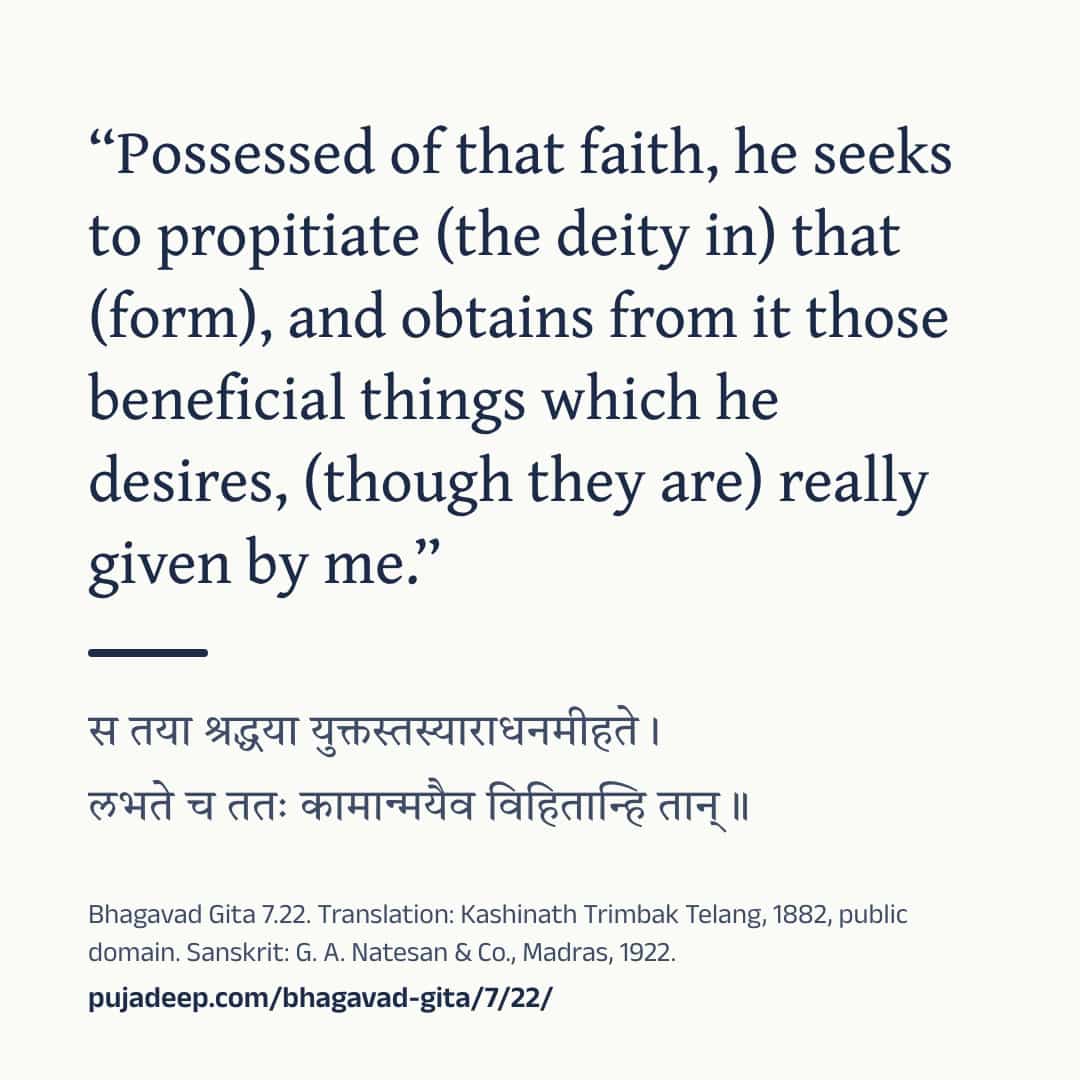
Drawing the picture
See the words
Bhagavad Gita 7.22

स तया श्रद्धया युक्तस्तस्याराधनमीहते ।
लभते च ततः कामान्मयैव विहितान्हि तान् ॥

“Possessed of that faith, he seeks to propitiate (the deity in) that (form), and obtains from it those beneficial things which he desires, (though they are) really given by me.”
(K. T. Telang, The Bhagavadgîtâ (The Sacred Books of the East, vol. VIII, Oxford: Clarendon Press, 1882), p. 76, public domain)

“He, united to that faith, seeketh the worship of such a one, and he obtaineth these desires, I verily decreeing the benefits;”
(Annie Besant, The Bhagavad Gîtâ, or The Lord's Song (London: Theosophical Publishing Society, 1895), p. 78, public domain)
This sentence goes on in 7.23.

“Endued with that Shraddhâ, he engages in the worship of that, and from it, gains his desires,—those being verily dispensed by Me alone.”
(Swami Swarupananda, Srimad-Bhagavad-Gita (Mayavati: Prabuddha Bharata Press, 1909; first printed in Prabuddha Bharata, 1907–1909), p. 154, public domain)

Sanskrit: G. A. Natesan & Co., Madras, 1922.
https://pujadeep.com/bhagavad-gita/7/22/ Nothing is sent from this site. Your own app sends it, to the chat you choose. The picture quotes the translation you chose on this page, with its name and year.
Sanskrit text: The Bhagavad-Gita, or The Lord's Song, with the text in Devanagari and an English translation, 1922. Meanings: written for Pujadeep and checked against the cited edition. Source and changes
Questions families ask
Who speaks Bhagavad Gita 7.22?
Krishna speaks this verse, in chapter 7 (Jnana Vijnana Yoga).
Where does the Sanskrit text come from?
Sanskrit text: The Bhagavad-Gita, or The Lord's Song, with the text in Devanagari and an English translation, 1922. Meanings: written for Pujadeep and checked against the cited edition. See the source
Is the meaning on this page a translation?
Explanation written for this site from the sources listed here, and checked against the cited edition. It is not a translation and not the only way to read the text. Free to quote with credit.
Source and licence
- Sanskrit text
- The Bhagavad-Gita, or The Lord's Song, with the text in Devanagari and an English translation (Annie Besant, G. A. Natesan & Co., Madras, 1922). Public domain. The Sanskrit on these pages was read from this printing’s page images.
- Translation
- The Bhagavadgîtâ with the Sanatsugâtîya and the Anugîtâ, translated by Kâshinâth Trimbak Telang (The Sacred Books of the East, vol. VIII, ed. F. Max Müller) (Kashinath Trimbak Telang, F. Max Müller, Clarendon Press, Oxford, 1882). Public domain. Shown verbatim, as printed.
- Translation
- The Bhagavad Gîtâ, or The Lord's Song, translated by Annie Besant (Annie Besant, Theosophical Publishing Society, London, 1895). Public domain. Shown verbatim, as printed.
- Translation
- Srimad-Bhagavad-Gita, with Sanskrit Text; Paraphrase with Word-by-word Literal Translation; English Rendering and Comments, Index, &c., by the Swami Swarupananda (Himalayan Series, No. XX) (Swami Swarupananda, The Editors and Publishers, Advaita Ashrama, Mayavati, Prabuddha Bharata Press, Mayavati, Almora, Himalayas, 1909). Public domain. Shown verbatim, as printed.
- Common wording
- In this text, 32 words follow today's common wording, checked against sanskritdocuments.org; Sanskrit Wikisource; Gita Press, Gorakhpur; GRETIL, Göttingen and Bhaktivedanta Book Trust.
- Our explanation
- Explanation written for this site from the sources listed here, and checked against the cited edition. It is not a translation and not the only way to read the text. Free to quote with credit.
- Checked
- Checked against the cited edition, October 15, 2026.
- Updated
- October 27, 2026