Bhagavad Gita 7.29: meaning and translation
Chapter 7: Jnana Vijnana Yoga. Krishna says
Those who take refuge in him and strive to be free from old age and death, Krishna says, come to know Brahman, the whole of adhyātma (what concerns the self) and all of karma (action).
Click or tap a word for its meaning and its dictionary page.
Text and layers
Text and layers
These choices stay in this browser.
Bhagavad Gita 7.29
जरामरणमोक्षाय मामाश्रित्य यतन्ति ये ।ते ब्रह्म तद्विदुः कृत्स्नमध्यात्मं कर्म चाखिलम् ॥
Jaramaranamokshaya mamashritya yatanti yeTe brahma tadviduh kritsnamadhyatmam karma chakhilam
jarāmaraṇamokṣāya māmāśritya yatanti ye |te brahma tadviduḥ kṛtsnamadhyātmaṃ karma cākhilam ||
Our explanation Those who take refuge in him and strive to be free from old age and death, Krishna says, come to know Brahman, the whole of adhyātma (what concerns the self) and all of karma (action). These terms are explained in chapter 8.
हिंदी अर्थ कृष्ण कहते हैं कि जो उनकी शरण लेकर बुढ़ापे और मृत्यु से छूटने का प्रयत्न करते हैं, वे ब्रह्म को, पूरे अध्यात्म (आत्मा से संबंधित तत्त्व) को और सारे कर्म को जान लेते हैं। ये शब्द अध्याय 8 में समझाए गए हैं।
Word by word
Every word, with its dictionary page
Word by word
- जरामरणमोक्षाय jarāmaraṇamokṣāya · for freedom from old age and death (compound (masculine), dative singular) Dictionary: jarā, Monier-Williams 1899, p. 413, col. 3 “the act of becoming old, old age”; maraṇa, Monier-Williams 1899, p. 789, col. 3 “the act of dying, death”; mokṣa, Monier-Williams 1899, p. 835, col. 1 “emancipation, liberation”
- माम् mām · "me" (Krishna) (pronoun, accusative singular) Dictionary: 1. mad, Monier-Williams 1899, p. 777, col. 2 “base of the first pers. pron. in the sg. number (esp. in comp.)”
- आश्रित्य āśritya · taking refuge in (absolutive (having done)) Dictionary: 1. ā-śri, Monier-Williams 1899, p. 158, col. 2 “to betake one's self to, resort to”
- यतन्ति yatanti · strive (present, 3rd person plural) Dictionary: 2. yat, Monier-Williams 1899, p. 840, col. 3 “to exert one's self, take pains, endeavour, make effort”
- ये ye · those who (pronoun (masculine), nominative plural) Dictionary: yad, Monier-Williams 1899, p. 844, col. 2 “who, which, what, whichever, whatever, that”
- ते te · they (pronoun (masculine), nominative plural) Dictionary: tad, Monier-Williams 1899, p. 434, col. 1 “m. he, f. she, n. it, that, this”
- ब्रह्म brahma · Brahman (noun (neuter), accusative singular) Dictionary: brahman, Monier-Williams 1899, p. 738, col. 1 “one self-existent impersonal Spirit, the one universal Soul”
- तत् tat · that (pronoun (neuter), accusative singular) Dictionary: tad, Monier-Williams 1899, p. 434, col. 1 “m. he, f. she, n. it, that, this”
- विदुः viduḥ · know (perfect with present sense, 3rd person plural) Dictionary: 1. vid, Monier-Williams 1899, p. 963, col. 2 “to know, understand, perceive, learn”
- कृत्स्नम् kṛtsnam · whole (adjective (neuter), accusative singular) Dictionary: kṛtsna, Monier-Williams 1899, p. 304, col. 3 “all, whole, entire”
- अध्यात्मम् adhyātmam · what concerns the self (adhyātma) (noun (neuter), accusative singular) Dictionary: adhy-ātma, Monier-Williams 1899, p. 23, col. 2 “the Supreme Spirit”
- कर्म karma · action (karma) (noun (neuter), accusative singular) Dictionary: karman, Monier-Williams 1899, p. 258, col. 2 “act, action, performance, business”
- च ca · and (indeclinable) Dictionary: 2. ca, Monier-Williams 1899, p. 380, col. 1 “and, both, also, moreover, as well as”
- अखिलम् akhilam · all, entire (adjective (neuter), accusative singular) Dictionary: a-khila, Monier-Williams 1899, p. 4, col. 2 “without a gap, complete, whole”
Old translations
Kashinath Trimbak Telang, 1882. Public domain. Page 77.
Those who, resting on me, work for release from old age and death1, know the Brahman2, the whole Adhyâtma, and all action.
Footnotes (the translator’s own) Compare 3 translations
Kashinath Trimbak Telang, 1882. Public domain. Page 77.
Those who, resting on me, work for release from old age and death1, know the Brahman2, the whole Adhyâtma, and all action.
Footnotes (the translator’s own) You are reading this one
Annie Besant, 1895. Public domain. Page 80.
They who strive for liberation from birth and death, refuged in Me, they know Brahman, that Whole, Adhyâtmâ, and all Kârma.
You are reading this one
Swami Swarupananda, 1909 (first printed 1907). Public domain. Page 158.
Those who strive for freedom from old age and death, taking refuge in Me,—they know Brahman, the whole of Adhyàtma, and Karma in its entirety.
You are reading this one
Cite this verse
The translation: K. T. Telang, The Bhagavadgîtâ (The Sacred Books of the East, vol. VIII, Oxford: Clarendon Press, 1882), p. 77. Bhagavad Gita 7.29.
The translation: Annie Besant, The Bhagavad Gîtâ, or The Lord's Song (London: Theosophical Publishing Society, 1895), p. 80. Bhagavad Gita 7.29.
The translation: Swami Swarupananda, Srimad-Bhagavad-Gita (Mayavati: Prabuddha Bharata Press, 1909; first printed in Prabuddha Bharata, 1907–1909), p. 158. Bhagavad Gita 7.29.
Our explanation: “Bhagavad Gita 7.29: meaning and translation.” Pujadeep. Updated October 27, 2026. https://pujadeep.com/bhagavad-gita/7/29/
Pujadeep’s explanations are free to quote with credit: name Pujadeep and link to the page. How to credit
Classical readings, by school
No readings by school on this verse yet.
Share
Show the ways to share
Send one picture or the text to one chat. The picture names its source and the address of this page.
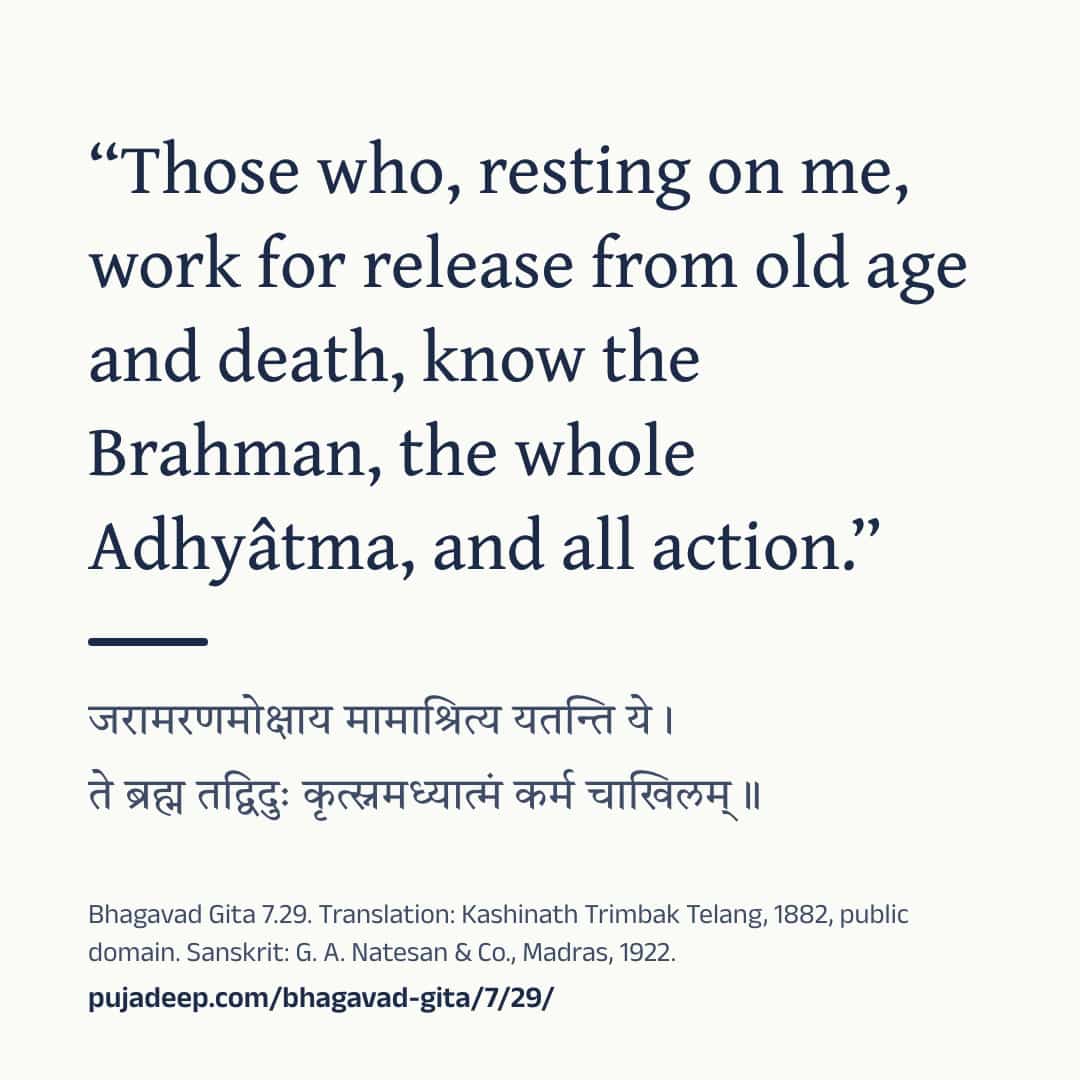
Drawing the picture
See the words
Bhagavad Gita 7.29

जरामरणमोक्षाय मामाश्रित्य यतन्ति ये ।
ते ब्रह्म तद्विदुः कृत्स्नमध्यात्मं कर्म चाखिलम् ॥

“Those who, resting on me, work for release from old age and death, know the Brahman, the whole Adhyâtma, and all action.”
(K. T. Telang, The Bhagavadgîtâ (The Sacred Books of the East, vol. VIII, Oxford: Clarendon Press, 1882), p. 77, public domain)

“They who strive for liberation from birth and death, refuged in Me, they know Brahman, that Whole, Adhyâtmâ, and all Kârma.”
(Annie Besant, The Bhagavad Gîtâ, or The Lord's Song (London: Theosophical Publishing Society, 1895), p. 80, public domain)

“Those who strive for freedom from old age and death, taking refuge in Me,—they know Brahman, the whole of Adhyàtma, and Karma in its entirety.”
(Swami Swarupananda, Srimad-Bhagavad-Gita (Mayavati: Prabuddha Bharata Press, 1909; first printed in Prabuddha Bharata, 1907–1909), p. 158, public domain)

Sanskrit: G. A. Natesan & Co., Madras, 1922.
https://pujadeep.com/bhagavad-gita/7/29/ Nothing is sent from this site. Your own app sends it, to the chat you choose. The picture quotes the translation you chose on this page, with its name and year.
Sanskrit text: The Bhagavad-Gita, or The Lord's Song, with the text in Devanagari and an English translation, 1922. Meanings: written for Pujadeep and checked against the cited edition. Source and changes
Questions families ask
Who speaks Bhagavad Gita 7.29?
Krishna speaks this verse, in chapter 7 (Jnana Vijnana Yoga).
Where does the Sanskrit text come from?
Sanskrit text: The Bhagavad-Gita, or The Lord's Song, with the text in Devanagari and an English translation, 1922. Meanings: written for Pujadeep and checked against the cited edition. See the source
Is the meaning on this page a translation?
Explanation written for this site from the sources listed here, and checked against the cited edition. It is not a translation and not the only way to read the text. Free to quote with credit.
Source and licence
- Sanskrit text
- The Bhagavad-Gita, or The Lord's Song, with the text in Devanagari and an English translation (Annie Besant, G. A. Natesan & Co., Madras, 1922). Public domain. The Sanskrit on these pages was read from this printing’s page images.
- Translation
- The Bhagavadgîtâ with the Sanatsugâtîya and the Anugîtâ, translated by Kâshinâth Trimbak Telang (The Sacred Books of the East, vol. VIII, ed. F. Max Müller) (Kashinath Trimbak Telang, F. Max Müller, Clarendon Press, Oxford, 1882). Public domain. Shown verbatim, as printed.
- Translation
- The Bhagavad Gîtâ, or The Lord's Song, translated by Annie Besant (Annie Besant, Theosophical Publishing Society, London, 1895). Public domain. Shown verbatim, as printed.
- Translation
- Srimad-Bhagavad-Gita, with Sanskrit Text; Paraphrase with Word-by-word Literal Translation; English Rendering and Comments, Index, &c., by the Swami Swarupananda (Himalayan Series, No. XX) (Swami Swarupananda, The Editors and Publishers, Advaita Ashrama, Mayavati, Prabuddha Bharata Press, Mayavati, Almora, Himalayas, 1909). Public domain. Shown verbatim, as printed.
- Common wording
- In this text, 32 words follow today's common wording, checked against sanskritdocuments.org; Sanskrit Wikisource; Gita Press, Gorakhpur; GRETIL, Göttingen and Bhaktivedanta Book Trust.
- Our explanation
- Explanation written for this site from the sources listed here, and checked against the cited edition. It is not a translation and not the only way to read the text. Free to quote with credit.
- Checked
- Checked against the cited edition, October 15, 2026.
- Updated
- October 27, 2026