Bhagavad Gita 7.28: meaning and translation
Chapter 7: Jnana Vijnana Yoga. Krishna says
But people of good deeds, whose wrongdoing has come to an end, are freed from this confusion of the opposites, Krishna says, and they worship him, firm in their vows.
Click or tap a word for its meaning and its dictionary page.
Text and layers
Text and layers
These choices stay in this browser.
Bhagavad Gita 7.28
येषां त्वन्तगतं पापं जनानां पुण्यकर्मणाम् ।ते द्वन्द्वमोहनिर्मुक्ता भजन्ते मां दृढव्रताः ॥
Yesham tvantagatam papam jananam punyakarmanamTe dvandvamohanirmukta bhajante mam dridhavratah
yeṣāṃ tvantagataṃ pāpaṃ janānāṃ puṇyakarmaṇām |te dvandvamohanirmuktā bhajante māṃ dṛḍhavratāḥ ||
Our explanation But people of good deeds, whose wrongdoing has come to an end, are freed from this confusion of the opposites, Krishna says, and they worship him, firm in their vows.
हिंदी अर्थ पर कृष्ण कहते हैं कि पुण्य कर्म करने वाले लोग, जिनके पाप समाप्त हो गए हैं, द्वंद्वों के इस मोह से मुक्त होकर, दृढ़ व्रत के साथ उन्हें भजते हैं।
Word by word
Every word, with its dictionary page
Word by word
- येषाम् yeṣām · whose (pronoun (masculine), genitive plural) Dictionary: yad, Monier-Williams 1899, p. 844, col. 2 “who, which, what, whichever, whatever, that”
- तु tu · but (indeclinable) Dictionary: 2. tu, Monier-Williams 1899, p. 449, col. 3 “but”
- अन्तगतम् antagatam · come to an end (compound (neuter), nominative singular) Dictionary: anta-gata, Monier-Williams 1899, p. 42, col. 3 “gone to the end”
- पापम् pāpam · wrongdoing (noun (neuter), nominative singular) Dictionary: pāpa, Monier-Williams 1899, p. 618, col. 2 “sin, vice, crime, guilt”
- जनानाम् janānām · of people (noun (masculine), genitive plural) Dictionary: jana, Monier-Williams 1899, p. 410, col. 1 “creature, living being, man, person, race”
- पुण्यकर्मणाम् puṇyakarmaṇām · of good deeds (compound (masculine), genitive plural) Dictionary: puṇya-karman, Monier-Williams 1899, p. 632, col. 1 “acting right, virtuous, pious”
- ते te · they (pronoun (masculine), nominative plural) Dictionary: tad, Monier-Williams 1899, p. 434, col. 1 “m. he, f. she, n. it, that, this”
- द्वन्द्वमोहनिर्मुक्ताः dvandvamohanirmuktāḥ · freed from the confusion of opposites (compound (masculine), nominative plural) Dictionary: dvaṃdva, Monier-Williams 1899, p. 503, col. 2 “a pair of opposites (e.g. heat and cold, joy and sorrow &c.)”; moha, Monier-Williams 1899, p. 836, col. 1 “loss of consciousness, bewilderment, perplexity, distraction, infatuation, delusion”; nir-mukta, Monier-Williams 1899, p. 556, col. 2 “liberated or saved or escaped or free from”
- भजन्ते bhajante · worship (present, 3rd person plural) Dictionary: bhaj, Monier-Williams 1899, p. 743, col. 1 “to serve, honour, revere, love, adore”
- माम् mām · "me" (Krishna) (pronoun, accusative singular) Dictionary: 1. mad, Monier-Williams 1899, p. 777, col. 2 “base of the first pers. pron. in the sg. number (esp. in comp.)”
- दृढव्रताः dṛḍhavratāḥ · firm in their vows (compound (masculine), nominative plural) Dictionary: dṛḍha-vrata, Monier-Williams 1899, p. 490, col. 3 “firm in austerity or resolution”
Old translations
Kashinath Trimbak Telang, 1882. Public domain. Page 76–77.
But the men of meritorious actions, whose sins have terminated, worship me, being released from the delusion (caused) by the pairs of opposites, and being firm in their beliefs1.
Footnotes (the translator’s own) - Concerning the supreme principle and the mode of worshipping it. ↩
Compare 3 translations
Kashinath Trimbak Telang, 1882. Public domain. Page 76–77.
But the men of meritorious actions, whose sins have terminated, worship me, being released from the delusion (caused) by the pairs of opposites, and being firm in their beliefs1.
Footnotes (the translator’s own) - Concerning the supreme principle and the mode of worshipping it. ↩
You are reading this one
Annie Besant, 1895. Public domain. Page 79–80.
But of those men of pure deeds, in whom sin is come to an end, they who are freed from the delusive pairs of opposites worship Me, steadfast in vows.
You are reading this one
Swami Swarupananda, 1909 (first printed 1907). Public domain. Page 157.
Those men of virtuous deeds, whose sin has come to an end,—they freed from the delusion of the pairs of opposites, worship Me with firm resolve.
You are reading this one
Cite this verse
The translation: K. T. Telang, The Bhagavadgîtâ (The Sacred Books of the East, vol. VIII, Oxford: Clarendon Press, 1882), pp. 76–77. Bhagavad Gita 7.28.
The translation: Annie Besant, The Bhagavad Gîtâ, or The Lord's Song (London: Theosophical Publishing Society, 1895), pp. 79–80. Bhagavad Gita 7.28.
The translation: Swami Swarupananda, Srimad-Bhagavad-Gita (Mayavati: Prabuddha Bharata Press, 1909; first printed in Prabuddha Bharata, 1907–1909), p. 157. Bhagavad Gita 7.28.
Our explanation: “Bhagavad Gita 7.28: meaning and translation.” Pujadeep. Updated October 27, 2026. https://pujadeep.com/bhagavad-gita/7/28/
Pujadeep’s explanations are free to quote with credit: name Pujadeep and link to the page. How to credit
Classical readings, by school
No readings by school on this verse yet.
Share
Show the ways to share
Send one picture or the text to one chat. The picture names its source and the address of this page.
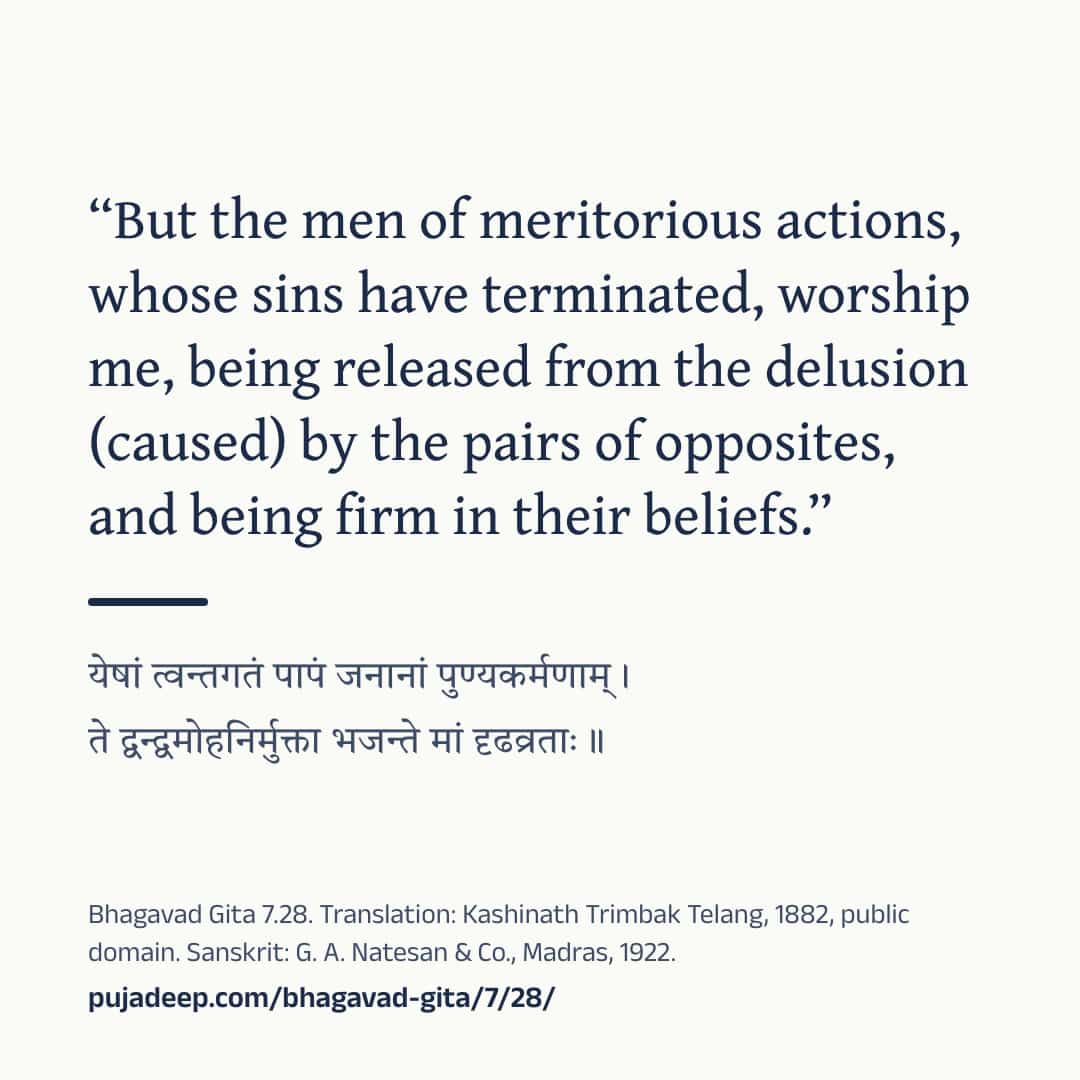
Drawing the picture
See the words
Bhagavad Gita 7.28

येषां त्वन्तगतं पापं जनानां पुण्यकर्मणाम् ।
ते द्वन्द्वमोहनिर्मुक्ता भजन्ते मां दृढव्रताः ॥

“But the men of meritorious actions, whose sins have terminated, worship me, being released from the delusion (caused) by the pairs of opposites, and being firm in their beliefs.”
(K. T. Telang, The Bhagavadgîtâ (The Sacred Books of the East, vol. VIII, Oxford: Clarendon Press, 1882), pp. 76–77, public domain)

“But of those men of pure deeds, in whom sin is come to an end, they who are freed from the delusive pairs of opposites worship Me, steadfast in vows.”
(Annie Besant, The Bhagavad Gîtâ, or The Lord's Song (London: Theosophical Publishing Society, 1895), pp. 79–80, public domain)

“Those men of virtuous deeds, whose sin has come to an end,—they freed from the delusion of the pairs of opposites, worship Me with firm resolve.”
(Swami Swarupananda, Srimad-Bhagavad-Gita (Mayavati: Prabuddha Bharata Press, 1909; first printed in Prabuddha Bharata, 1907–1909), p. 157, public domain)

Sanskrit: G. A. Natesan & Co., Madras, 1922.
https://pujadeep.com/bhagavad-gita/7/28/ Nothing is sent from this site. Your own app sends it, to the chat you choose. The picture quotes the translation you chose on this page, with its name and year.
Sanskrit text: The Bhagavad-Gita, or The Lord's Song, with the text in Devanagari and an English translation, 1922. Meanings: written for Pujadeep and checked against the cited edition. Source and changes
Questions families ask
Who speaks Bhagavad Gita 7.28?
Krishna speaks this verse, in chapter 7 (Jnana Vijnana Yoga).
Where does the Sanskrit text come from?
Sanskrit text: The Bhagavad-Gita, or The Lord's Song, with the text in Devanagari and an English translation, 1922. Meanings: written for Pujadeep and checked against the cited edition. See the source
Is the meaning on this page a translation?
Explanation written for this site from the sources listed here, and checked against the cited edition. It is not a translation and not the only way to read the text. Free to quote with credit.
Source and licence
- Sanskrit text
- The Bhagavad-Gita, or The Lord's Song, with the text in Devanagari and an English translation (Annie Besant, G. A. Natesan & Co., Madras, 1922). Public domain. The Sanskrit on these pages was read from this printing’s page images.
- Translation
- The Bhagavadgîtâ with the Sanatsugâtîya and the Anugîtâ, translated by Kâshinâth Trimbak Telang (The Sacred Books of the East, vol. VIII, ed. F. Max Müller) (Kashinath Trimbak Telang, F. Max Müller, Clarendon Press, Oxford, 1882). Public domain. Shown verbatim, as printed.
- Translation
- The Bhagavad Gîtâ, or The Lord's Song, translated by Annie Besant (Annie Besant, Theosophical Publishing Society, London, 1895). Public domain. Shown verbatim, as printed.
- Translation
- Srimad-Bhagavad-Gita, with Sanskrit Text; Paraphrase with Word-by-word Literal Translation; English Rendering and Comments, Index, &c., by the Swami Swarupananda (Himalayan Series, No. XX) (Swami Swarupananda, The Editors and Publishers, Advaita Ashrama, Mayavati, Prabuddha Bharata Press, Mayavati, Almora, Himalayas, 1909). Public domain. Shown verbatim, as printed.
- Common wording
- In this text, 32 words follow today's common wording, checked against sanskritdocuments.org; Sanskrit Wikisource; Gita Press, Gorakhpur; GRETIL, Göttingen and Bhaktivedanta Book Trust.
- Our explanation
- Explanation written for this site from the sources listed here, and checked against the cited edition. It is not a translation and not the only way to read the text. Free to quote with credit.
- Checked
- Checked against the cited edition, October 15, 2026.
- Updated
- October 27, 2026