Bhagavad Gita 7.26: meaning and translation
Chapter 7: Jnana Vijnana Yoga. Krishna says
Krishna tells Arjuna that he knows all beings, those that have been, those that are and those still to come, but no one knows him.
Click or tap a word for its meaning and its dictionary page.
Text and layers
Text and layers
These choices stay in this browser.
Bhagavad Gita 7.26
वेदाहं समतीतानि वर्तमानानि चार्जुन ।भविष्याणि च भूतानि मां तु वेद न कश्चन ॥
Vedaham samatitani vartamanani charjunaBhavishyani cha bhutani mam tu veda na kashchana
vedāhaṃ samatītāni vartamānāni cārjuna |bhaviṣyāṇi ca bhūtāni māṃ tu veda na kaścana ||
Our explanation Krishna tells Arjuna that he knows all beings, those that have been, those that are and those still to come, but no one knows him.
हिंदी अर्थ कृष्ण अर्जुन से कहते हैं कि वे सब प्राणियों को जानते हैं, जो बीत चुके, जो अभी हैं और जो आगे होंगे, पर उन्हें कोई नहीं जानता।
Word by word
Every word, with its dictionary page
Word by word
- वेद veda · know (perfect with present sense, 1st person singular) Dictionary: 1. vid, Monier-Williams 1899, p. 963, col. 2 “to know, understand, perceive, learn”
- अहम् aham · "I" (Krishna) (pronoun, nominative singular) Dictionary: aham, Monier-Williams 1899, p. 124, col. 2 “nom. sg. ‘I,’”
- समतीतानि samatītāni · that have passed (past participle (neuter), accusative plural) Dictionary: sam-atīta, Monier-Williams 1899, p. 1154, col. 1 “gone or passed by”
- वर्तमानानि vartamānāni · that are present (present participle (neuter), accusative plural) Dictionary: vartamāna, Monier-Williams 1899, p. 925, col. 2 “existing, living”
- च ca · and (indeclinable) Dictionary: 2. ca, Monier-Williams 1899, p. 380, col. 1 “and, both, also, moreover, as well as”
- अर्जुन arjuna · O Arjuna (noun (masculine), vocative singular) Dictionary: arjuna, Monier-Williams 1899, p. 90, col. 1
- भविष्याणि bhaviṣyāṇi · that are to come (adjective (neuter), accusative plural) Dictionary: bhaviṣya, Monier-Williams 1899, p. 749, col. 3 “to be about to become or come to pass, future, imminent, impending”
- च ca · and (indeclinable) Dictionary: 2. ca, Monier-Williams 1899, p. 380, col. 1 “and, both, also, moreover, as well as”
- भूतानि bhūtāni · beings (noun (neuter), accusative plural) Dictionary: bhūta, Monier-Williams 1899, p. 761, col. 3 “that which is or exists, any living being”
- माम् mām · "me" (Krishna) (pronoun, accusative singular) Dictionary: 1. mad, Monier-Williams 1899, p. 777, col. 2 “base of the first pers. pron. in the sg. number (esp. in comp.)”
- तु tu · but (indeclinable) Dictionary: 2. tu, Monier-Williams 1899, p. 449, col. 3 “but”
- वेद veda · knows (perfect with present sense, 3rd person singular) Dictionary: 1. vid, Monier-Williams 1899, p. 963, col. 2 “to know, understand, perceive, learn”
- न na · not (indeclinable) Dictionary: 2. na, Monier-Williams 1899, p. 523, col. 1 “not, no, nor, neither”
- कश्चन kaścana · anyone (pronoun (masculine), nominative singular) Dictionary: kim, Monier-Williams 1899, p. 282, col. 2 “what? how? whence? wherefore? why?”; cana, Monier-Williams 1899, p. 386, col. 2
Old translations
Kashinath Trimbak Telang, 1882. Public domain. Page 76.
I know, O Arguna! the things which have been, those which are, and those which are to be. But me nobody knows.
Compare 3 translations
Kashinath Trimbak Telang, 1882. Public domain. Page 76.
I know, O Arguna! the things which have been, those which are, and those which are to be. But me nobody knows.
You are reading this one
Annie Besant, 1895. Public domain. Page 79.
I know the beings that are past, that are present, that are to come, O Arjuna, but not one knoweth Me.
You are reading this one
Swami Swarupananda, 1909 (first printed 1907). Public domain. Page 156.
I know, O Arjuna, the beings of the whole past, and the present, and the future, but Me none knoweth.
You are reading this one
Cite this verse
The translation: K. T. Telang, The Bhagavadgîtâ (The Sacred Books of the East, vol. VIII, Oxford: Clarendon Press, 1882), p. 76. Bhagavad Gita 7.26.
The translation: Annie Besant, The Bhagavad Gîtâ, or The Lord's Song (London: Theosophical Publishing Society, 1895), p. 79. Bhagavad Gita 7.26.
The translation: Swami Swarupananda, Srimad-Bhagavad-Gita (Mayavati: Prabuddha Bharata Press, 1909; first printed in Prabuddha Bharata, 1907–1909), p. 156. Bhagavad Gita 7.26.
Our explanation: “Bhagavad Gita 7.26: meaning and translation.” Pujadeep. Updated October 27, 2026. https://pujadeep.com/bhagavad-gita/7/26/
Pujadeep’s explanations are free to quote with credit: name Pujadeep and link to the page. How to credit
Classical readings, by school
No readings by school on this verse yet.
Share
Show the ways to share
Send one picture or the text to one chat. The picture names its source and the address of this page.
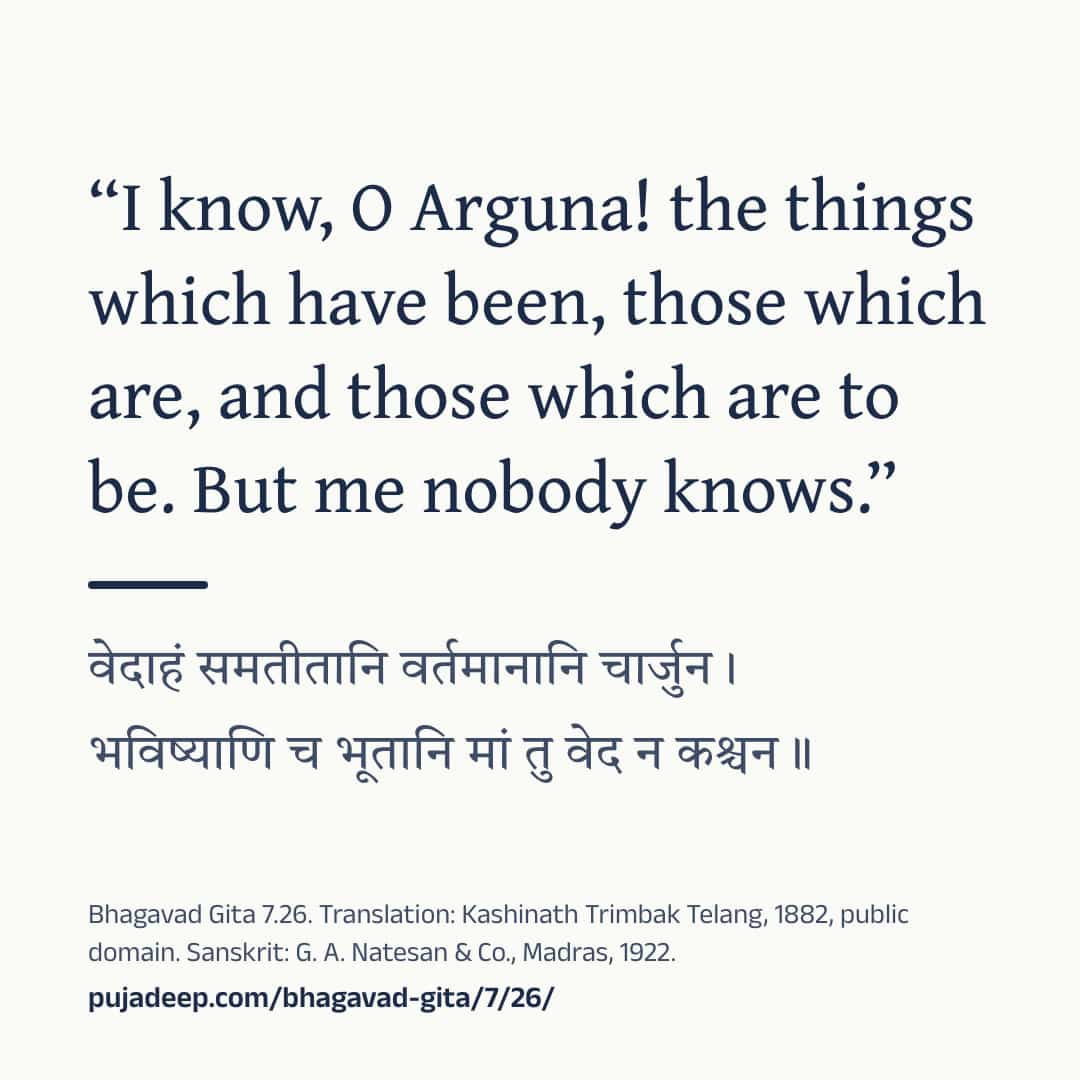
Drawing the picture
See the words
Bhagavad Gita 7.26

वेदाहं समतीतानि वर्तमानानि चार्जुन ।
भविष्याणि च भूतानि मां तु वेद न कश्चन ॥

“I know, O Arguna! the things which have been, those which are, and those which are to be. But me nobody knows.”
(K. T. Telang, The Bhagavadgîtâ (The Sacred Books of the East, vol. VIII, Oxford: Clarendon Press, 1882), p. 76, public domain)

“I know the beings that are past, that are present, that are to come, O Arjuna, but not one knoweth Me.”
(Annie Besant, The Bhagavad Gîtâ, or The Lord's Song (London: Theosophical Publishing Society, 1895), p. 79, public domain)

“I know, O Arjuna, the beings of the whole past, and the present, and the future, but Me none knoweth.”
(Swami Swarupananda, Srimad-Bhagavad-Gita (Mayavati: Prabuddha Bharata Press, 1909; first printed in Prabuddha Bharata, 1907–1909), p. 156, public domain)

Sanskrit: G. A. Natesan & Co., Madras, 1922.
https://pujadeep.com/bhagavad-gita/7/26/ Nothing is sent from this site. Your own app sends it, to the chat you choose. The picture quotes the translation you chose on this page, with its name and year.
Sanskrit text: The Bhagavad-Gita, or The Lord's Song, with the text in Devanagari and an English translation, 1922. Meanings: written for Pujadeep and checked against the cited edition. Source and changes
Questions families ask
Who speaks Bhagavad Gita 7.26?
Krishna speaks this verse, in chapter 7 (Jnana Vijnana Yoga).
Where does the Sanskrit text come from?
Sanskrit text: The Bhagavad-Gita, or The Lord's Song, with the text in Devanagari and an English translation, 1922. Meanings: written for Pujadeep and checked against the cited edition. See the source
Is the meaning on this page a translation?
Explanation written for this site from the sources listed here, and checked against the cited edition. It is not a translation and not the only way to read the text. Free to quote with credit.
Source and licence
- Sanskrit text
- The Bhagavad-Gita, or The Lord's Song, with the text in Devanagari and an English translation (Annie Besant, G. A. Natesan & Co., Madras, 1922). Public domain. The Sanskrit on these pages was read from this printing’s page images.
- Translation
- The Bhagavadgîtâ with the Sanatsugâtîya and the Anugîtâ, translated by Kâshinâth Trimbak Telang (The Sacred Books of the East, vol. VIII, ed. F. Max Müller) (Kashinath Trimbak Telang, F. Max Müller, Clarendon Press, Oxford, 1882). Public domain. Shown verbatim, as printed.
- Translation
- The Bhagavad Gîtâ, or The Lord's Song, translated by Annie Besant (Annie Besant, Theosophical Publishing Society, London, 1895). Public domain. Shown verbatim, as printed.
- Translation
- Srimad-Bhagavad-Gita, with Sanskrit Text; Paraphrase with Word-by-word Literal Translation; English Rendering and Comments, Index, &c., by the Swami Swarupananda (Himalayan Series, No. XX) (Swami Swarupananda, The Editors and Publishers, Advaita Ashrama, Mayavati, Prabuddha Bharata Press, Mayavati, Almora, Himalayas, 1909). Public domain. Shown verbatim, as printed.
- Common wording
- In this text, 32 words follow today's common wording, checked against sanskritdocuments.org; Sanskrit Wikisource; Gita Press, Gorakhpur; GRETIL, Göttingen and Bhaktivedanta Book Trust.
- Our explanation
- Explanation written for this site from the sources listed here, and checked against the cited edition. It is not a translation and not the only way to read the text. Free to quote with credit.
- Checked
- Checked against the cited edition, October 15, 2026.
- Updated
- October 27, 2026