Bhagavad Gita 7.17: meaning and translation
Chapter 7: Jnana Vijnana Yoga. Krishna says
Of these four, Krishna says, the wise one is the best: always steady in yoga and devoted to the One alone.
Click or tap a word for its meaning and its dictionary page.
Text and layers
Text and layers
These choices stay in this browser.
Bhagavad Gita 7.17
तेषां ज्ञानी नित्ययुक्त एकभक्तिर्विशिष्यते ।प्रियो हि ज्ञानिनोऽत्यर्थमहं स च मम प्रियः ॥
Tesham jnani nityayukta ekabhaktirvishishyatePriyo hi jnaninotyarthamaham sa cha mama priyah
teṣāṃ jñānī nityayukta ekabhaktirviśiṣyate |priyo hi jñānino’tyarthamahaṃ sa ca mama priyaḥ ||
Our explanation Of these four, Krishna says, the wise one is the best: always steady in yoga and devoted to the One alone. He is very dear to the wise one, and the wise one is dear to him.
हिंदी अर्थ कृष्ण कहते हैं कि इन चारों में ज्ञानी सबसे श्रेष्ठ है: वह सदा योग में स्थित रहता है और केवल एक में ही उसकी भक्ति है। ज्ञानी को कृष्ण अत्यंत प्रिय हैं, और ज्ञानी कृष्ण को प्रिय है।
Word by word
Every word, with its dictionary page
Word by word
- तेषाम् teṣām · of them (pronoun (masculine), genitive plural) Dictionary: tad, Monier-Williams 1899, p. 434, col. 1 “m. he, f. she, n. it, that, this”
- ज्ञानी jñānī · the wise one (noun (masculine), nominative singular) Dictionary: jñānin, Monier-Williams 1899, p. 426, col. 2 “knowing, endowed with knowledge or intelligence, wise”
- नित्ययुक्तः nityayuktaḥ · ever steadfast (compound (masculine), nominative singular) Dictionary: nitya-yukta, Monier-Williams 1899, p. 547, col. 3 “always busy or intent upon”
- एकभक्तिः ekabhaktiḥ · devoted to one alone (compound (masculine), nominative singular) Dictionary: eka, Monier-Williams 1899, p. 227, col. 3 “one”; bhakti, Monier-Williams 1899, p. 743, col. 2 “attachment, devotion, fondness for, devotion to”
- विशिष्यते viśiṣyate · excels, is the best (present passive, 3rd person singular) Dictionary: vi-śiṣ, Monier-Williams 1899, p. 990, col. 2 “to be pre-eminent, excel, be better than”
- प्रियः priyaḥ · dear (adjective (masculine), nominative singular) Dictionary: priya, Monier-Williams 1899, p. 710, col. 1 “beloved, dear to (gen., loc., dat. or comp.), liked, favourite”
- हि hi · for (indeclinable) Dictionary: 2. hi, Monier-Williams 1899, p. 1297, col. 3 “for, because, on account of”
- ज्ञानिनः jñāninaḥ · to the wise one (noun (masculine), genitive singular) Dictionary: jñānin, Monier-Williams 1899, p. 426, col. 2 “knowing, endowed with knowledge or intelligence, wise”
- अत्यर्थम् atyartham · exceedingly (indeclinable) Dictionary: aty-artha, Monier-Williams 1899, p. 17, col. 1 “excessively, exceedingly”
- अहम् aham · "I" (Krishna) (pronoun, nominative singular) Dictionary: aham, Monier-Williams 1899, p. 124, col. 2 “nom. sg. ‘I,’”
- सः saḥ · he (pronoun (masculine), nominative singular) Dictionary: tad, Monier-Williams 1899, p. 434, col. 1 “m. he, f. she, n. it, that, this”
- च ca · and (indeclinable) Dictionary: 2. ca, Monier-Williams 1899, p. 380, col. 1 “and, both, also, moreover, as well as”
- मम mama · to "me" (Krishna) (pronoun, genitive singular) Dictionary: 1. mad, Monier-Williams 1899, p. 777, col. 2 “base of the first pers. pron. in the sg. number (esp. in comp.)”
- प्रियः priyaḥ · dear (adjective (masculine), nominative singular) Dictionary: priya, Monier-Williams 1899, p. 710, col. 1 “beloved, dear to (gen., loc., dat. or comp.), liked, favourite”
Old translations
Kashinath Trimbak Telang, 1882. Public domain. Page 75.
Of these, he who is possessed of knowledge, who is always devoted, and whose worship is (addressed) to one (Being) only, is esteemed highest. For to the man of knowledge I am dear above all things, and he is dear to me.
Compare 3 translations
Kashinath Trimbak Telang, 1882. Public domain. Page 75.
Of these, he who is possessed of knowledge, who is always devoted, and whose worship is (addressed) to one (Being) only, is esteemed highest. For to the man of knowledge I am dear above all things, and he is dear to me.
You are reading this one
Annie Besant, 1895. Public domain. Page 77–78.
Of these, the wise, constantly harmonised, worshipping the One, is the best; I am supremely dear to the wise, and he is dear to Me.
You are reading this one
Swami Swarupananda, 1909 (first printed 1907). Public domain. Page 152.
Of them, the wise man, ever-steadfast, (and fired) with devotion to the One, excels; for supremely dear am I to the wise, and he is dear to Me.
You are reading this one
Cite this verse
The translation: K. T. Telang, The Bhagavadgîtâ (The Sacred Books of the East, vol. VIII, Oxford: Clarendon Press, 1882), p. 75. Bhagavad Gita 7.17.
The translation: Annie Besant, The Bhagavad Gîtâ, or The Lord's Song (London: Theosophical Publishing Society, 1895), pp. 77–78. Bhagavad Gita 7.17.
The translation: Swami Swarupananda, Srimad-Bhagavad-Gita (Mayavati: Prabuddha Bharata Press, 1909; first printed in Prabuddha Bharata, 1907–1909), p. 152. Bhagavad Gita 7.17.
Our explanation: “Bhagavad Gita 7.17: meaning and translation.” Pujadeep. Updated October 27, 2026. https://pujadeep.com/bhagavad-gita/7/17/
Pujadeep’s explanations are free to quote with credit: name Pujadeep and link to the page. How to credit
Classical readings, by school
Each reading is named by its school. None is presented as the only meaning.
What Advaita, Vishishtadvaita and Dvaita teach, in short
Shankara Advaita
Shankara says the wise one knows the truth and has no other object of worship. Because the Lord is the wise one's very Self, and everyone holds the Self dear, the Lord is exceedingly dear to the wise one; and the wise one is the Lord's own Self.
Source: The Bhagavad-Gita, with the commentary of Sri Sankaracharya, translated by A. Mahadeva Sastri (2nd ed., Mysore: G. T. A. Printing Works, 1901), commentary on 7.17, p. 194. Summarised in our own words; none of its text is reproduced.
Ramanuja Vishishtadvaita
Ramanuja says the wise one is always united with the Lord because the Lord is his only goal, and his love is for the Lord alone, not as a means to other ends. The others stay close only until their wishes are met. The wise one's love is beyond measure.
Source: Sri Bhagavad-Gita with Sri Ramanujacharya's Visishtadvaita commentary, translated by A. Govindacharya (Madras, 1898), commentary on 7.17, pp. 244–245. Summarised in our own words; none of its text is reproduced.
Share
Show the ways to share
Send one picture or the text to one chat. The picture names its source and the address of this page.
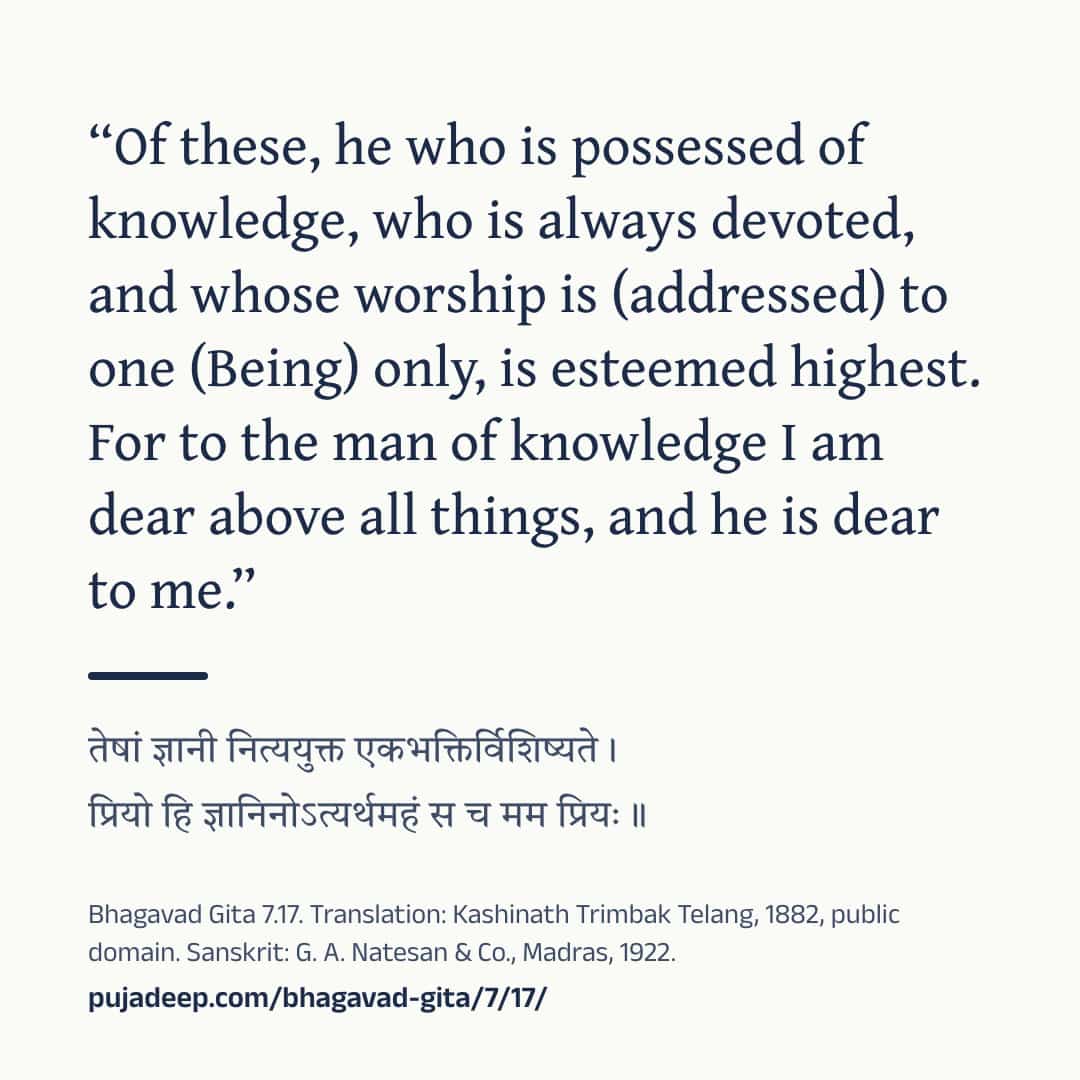
Drawing the picture
See the words
Bhagavad Gita 7.17

तेषां ज्ञानी नित्ययुक्त एकभक्तिर्विशिष्यते ।
प्रियो हि ज्ञानिनोऽत्यर्थमहं स च मम प्रियः ॥

“Of these, he who is possessed of knowledge, who is always devoted, and whose worship is (addressed) to one (Being) only, is esteemed highest. For to the man of knowledge I am dear above all things, and he is dear to me.”
(K. T. Telang, The Bhagavadgîtâ (The Sacred Books of the East, vol. VIII, Oxford: Clarendon Press, 1882), p. 75, public domain)

“Of these, the wise, constantly harmonised, worshipping the One, is the best; I am supremely dear to the wise, and he is dear to Me.”
(Annie Besant, The Bhagavad Gîtâ, or The Lord's Song (London: Theosophical Publishing Society, 1895), pp. 77–78, public domain)

“Of them, the wise man, ever-steadfast, (and fired) with devotion to the One, excels; for supremely dear am I to the wise, and he is dear to Me.”
(Swami Swarupananda, Srimad-Bhagavad-Gita (Mayavati: Prabuddha Bharata Press, 1909; first printed in Prabuddha Bharata, 1907–1909), p. 152, public domain)

Sanskrit: G. A. Natesan & Co., Madras, 1922.
https://pujadeep.com/bhagavad-gita/7/17/ Nothing is sent from this site. Your own app sends it, to the chat you choose. The picture quotes the translation you chose on this page, with its name and year.
Sanskrit text: The Bhagavad-Gita, or The Lord's Song, with the text in Devanagari and an English translation, 1922. Meanings: written for Pujadeep and checked against the cited edition. Source and changes
Questions families ask
Who speaks Bhagavad Gita 7.17?
Krishna speaks this verse, in chapter 7 (Jnana Vijnana Yoga).
Where does the Sanskrit text come from?
Sanskrit text: The Bhagavad-Gita, or The Lord's Song, with the text in Devanagari and an English translation, 1922. Meanings: written for Pujadeep and checked against the cited edition. See the source
Is the meaning on this page a translation?
Explanation written for this site from the sources listed here, and checked against the cited edition. It is not a translation and not the only way to read the text. Free to quote with credit.
Source and licence
- Sanskrit text
- The Bhagavad-Gita, or The Lord's Song, with the text in Devanagari and an English translation (Annie Besant, G. A. Natesan & Co., Madras, 1922). Public domain. The Sanskrit on these pages was read from this printing’s page images.
- Translation
- The Bhagavadgîtâ with the Sanatsugâtîya and the Anugîtâ, translated by Kâshinâth Trimbak Telang (The Sacred Books of the East, vol. VIII, ed. F. Max Müller) (Kashinath Trimbak Telang, F. Max Müller, Clarendon Press, Oxford, 1882). Public domain. Shown verbatim, as printed.
- Translation
- The Bhagavad Gîtâ, or The Lord's Song, translated by Annie Besant (Annie Besant, Theosophical Publishing Society, London, 1895). Public domain. Shown verbatim, as printed.
- Translation
- Srimad-Bhagavad-Gita, with Sanskrit Text; Paraphrase with Word-by-word Literal Translation; English Rendering and Comments, Index, &c., by the Swami Swarupananda (Himalayan Series, No. XX) (Swami Swarupananda, The Editors and Publishers, Advaita Ashrama, Mayavati, Prabuddha Bharata Press, Mayavati, Almora, Himalayas, 1909). Public domain. Shown verbatim, as printed.
- Commentary
- The Bhagavad-Gita, with the commentary of Sri Sankaracharya, translated by A. Mahadeva Sastri (2nd ed., Mysore: G. T. A. Printing Works, 1901) (Public-domain scan, University of California Libraries). Summarised in our own words; none of its text is reproduced.
- Commentary
- Sri Bhagavad-Gita with Sri Ramanujacharya's Visishtadvaita commentary, translated by A. Govindacharya (Madras, 1898) (Scan uploaded to archive.org (folkscanomy collection)). Summarised in our own words; none of its text is reproduced.
- Common wording
- In this text, 32 words follow today's common wording, checked against sanskritdocuments.org; Sanskrit Wikisource; Gita Press, Gorakhpur; GRETIL, Göttingen and Bhaktivedanta Book Trust.
- Our explanation
- Explanation written for this site from the sources listed here, and checked against the cited edition. It is not a translation and not the only way to read the text. Free to quote with credit.
- Checked
- Checked against the cited edition, October 15, 2026.
- Updated
- October 27, 2026