Bhagavad Gita 7.21: meaning and translation
Chapter 7: Jnana Vijnana Yoga. Krishna says
Whatever form a devotee wishes to worship with faith (śraddhā), Krishna says, he makes that very faith firm.
Click or tap a word for its meaning and its dictionary page.
Text and layers
Text and layers
These choices stay in this browser.
Bhagavad Gita 7.21
यो यो यां यां तनुं भक्तः श्रद्धयाऽर्चितुमिच्छति ।तस्य तस्याचलां श्रद्धां तामेव विदधाम्यहम् ॥
Yo yo yam yam tanum bhaktah shraddhayarchitumichchhatiTasya tasyachalam shraddham tameva vidadhamyaham
yo yo yāṃ yāṃ tanuṃ bhaktaḥ śraddhayā’rcitumicchati |tasya tasyācalāṃ śraddhāṃ tāmeva vidadhāmyaham ||
Our explanation Whatever form a devotee wishes to worship with faith (śraddhā), Krishna says, he makes that very faith firm.
हिंदी अर्थ कृष्ण कहते हैं कि जो भक्त जिस भी रूप की श्रद्धा से पूजा करना चाहता है, उसकी उसी श्रद्धा को वे दृढ़ कर देते हैं।
Word by word
Every word, with its dictionary page
Word by word
- यः yaḥ · whoever (pronoun (masculine), nominative singular) Dictionary: yad, Monier-Williams 1899, p. 844, col. 2 “who, which, what, whichever, whatever, that”
- यः yaḥ · (whoever) (pronoun (masculine), nominative singular) Dictionary: yad, Monier-Williams 1899, p. 844, col. 2 “who, which, what, whichever, whatever, that”
- याम् yām · whatever (pronoun (feminine), accusative singular) Dictionary: yad, Monier-Williams 1899, p. 844, col. 2 “who, which, what, whichever, whatever, that”
- याम् yām · (whatever) (pronoun (feminine), accusative singular) Dictionary: yad, Monier-Williams 1899, p. 844, col. 2 “who, which, what, whichever, whatever, that”
- तनुम् tanum · form (noun (feminine), accusative singular) Dictionary: tanu, Monier-Williams 1899, p. 435, col. 2 “the body, person, self”
- भक्तः bhaktaḥ · devotee (noun (masculine), nominative singular) Dictionary: bhakta, Monier-Williams 1899, p. 743, col. 1 “a worshipper, votary”
- श्रद्धया śraddhayā · with faith (noun (feminine), instrumental singular) Dictionary: śraddhā, Monier-Williams 1899, p. 1095, col. 3 “faith, trust, confidence, trustfulness, faithfulness, belief in”
- अर्चितुम् arcitum · to worship (infinitive (to do)) Dictionary: 1. arc, Monier-Williams 1899, p. 89, col. 3 “to honour or treat with respect”
- इच्छति icchati · wishes (present, 3rd person singular) Dictionary: 3. iṣ, Monier-Williams 1899, p. 169, col. 1 “to endeavour to obtain, strive, seek for”
- तस्य tasya · his (pronoun (masculine), genitive singular) Dictionary: tad, Monier-Williams 1899, p. 434, col. 1 “m. he, f. she, n. it, that, this”
- तस्य tasya · (each one's) (pronoun (masculine), genitive singular) Dictionary: tad, Monier-Williams 1899, p. 434, col. 1 “m. he, f. she, n. it, that, this”
- अचलाम् acalām · firm, unshaken (adjective (feminine), accusative singular) Dictionary: a-cala, Monier-Williams 1899, p. 8, col. 3 “not moving, immovable”
- श्रद्धाम् śraddhām · faith (noun (feminine), accusative singular) Dictionary: śraddhā, Monier-Williams 1899, p. 1095, col. 3 “faith, trust, confidence, trustfulness, faithfulness, belief in”
- ताम् tām · that (pronoun (feminine), accusative singular) Dictionary: tad, Monier-Williams 1899, p. 434, col. 1 “m. he, f. she, n. it, that, this”
- एव eva · very (indeclinable) Dictionary: 1. eva, Monier-Williams 1899, p. 232, col. 2 “just, exactly, very, same, only, even, alone, merely”
- विदधामि vidadhāmi · make (firm) (present, 1st person singular) Dictionary: vi-dhā, Monier-Williams 1899, p. 967, col. 2 “to form, create, build, establish, found”
- अहम् aham · "I" (Krishna) (pronoun, nominative singular) Dictionary: aham, Monier-Williams 1899, p. 124, col. 2 “nom. sg. ‘I,’”
1 printing differs
Edition differences. Another printing or text reads this place differently.
- Spelling A digital text reads Same words. The 1922 edition marks the merged vowel with an avagraha (ऽ); this e-text does not. Edition: श्रद्धयाऽर्चितुमिच्छति.
Old translations
Kashinath Trimbak Telang, 1882. Public domain. Page 76.
Whichever form (of deity) any worshipper wishes to worship with faith, to that form I render his faith steady.
Compare 3 translations
Kashinath Trimbak Telang, 1882. Public domain. Page 76.
Whichever form (of deity) any worshipper wishes to worship with faith, to that form I render his faith steady.
You are reading this one
Annie Besant, 1895. Public domain. Page 78.
Whosoever seeketh to worship with faith any such semblance, I verily bestow the unswerving faith of that man.
You are reading this one
Swami Swarupananda, 1909 (first printed 1907). Public domain. Page 154.
Whatever a devotee seeks to worship with Shraddhà, what form soever that Shraddhá of his,—that do I make unwavering.
You are reading this one
Cite this verse
The translation: K. T. Telang, The Bhagavadgîtâ (The Sacred Books of the East, vol. VIII, Oxford: Clarendon Press, 1882), p. 76. Bhagavad Gita 7.21.
The translation: Annie Besant, The Bhagavad Gîtâ, or The Lord's Song (London: Theosophical Publishing Society, 1895), p. 78. Bhagavad Gita 7.21.
The translation: Swami Swarupananda, Srimad-Bhagavad-Gita (Mayavati: Prabuddha Bharata Press, 1909; first printed in Prabuddha Bharata, 1907–1909), p. 154. Bhagavad Gita 7.21.
Our explanation: “Bhagavad Gita 7.21: meaning and translation.” Pujadeep. Updated October 27, 2026. https://pujadeep.com/bhagavad-gita/7/21/
Pujadeep’s explanations are free to quote with credit: name Pujadeep and link to the page. How to credit
Classical readings, by school
No readings by school on this verse yet.
Share
Show the ways to share
Send one picture or the text to one chat. The picture names its source and the address of this page.
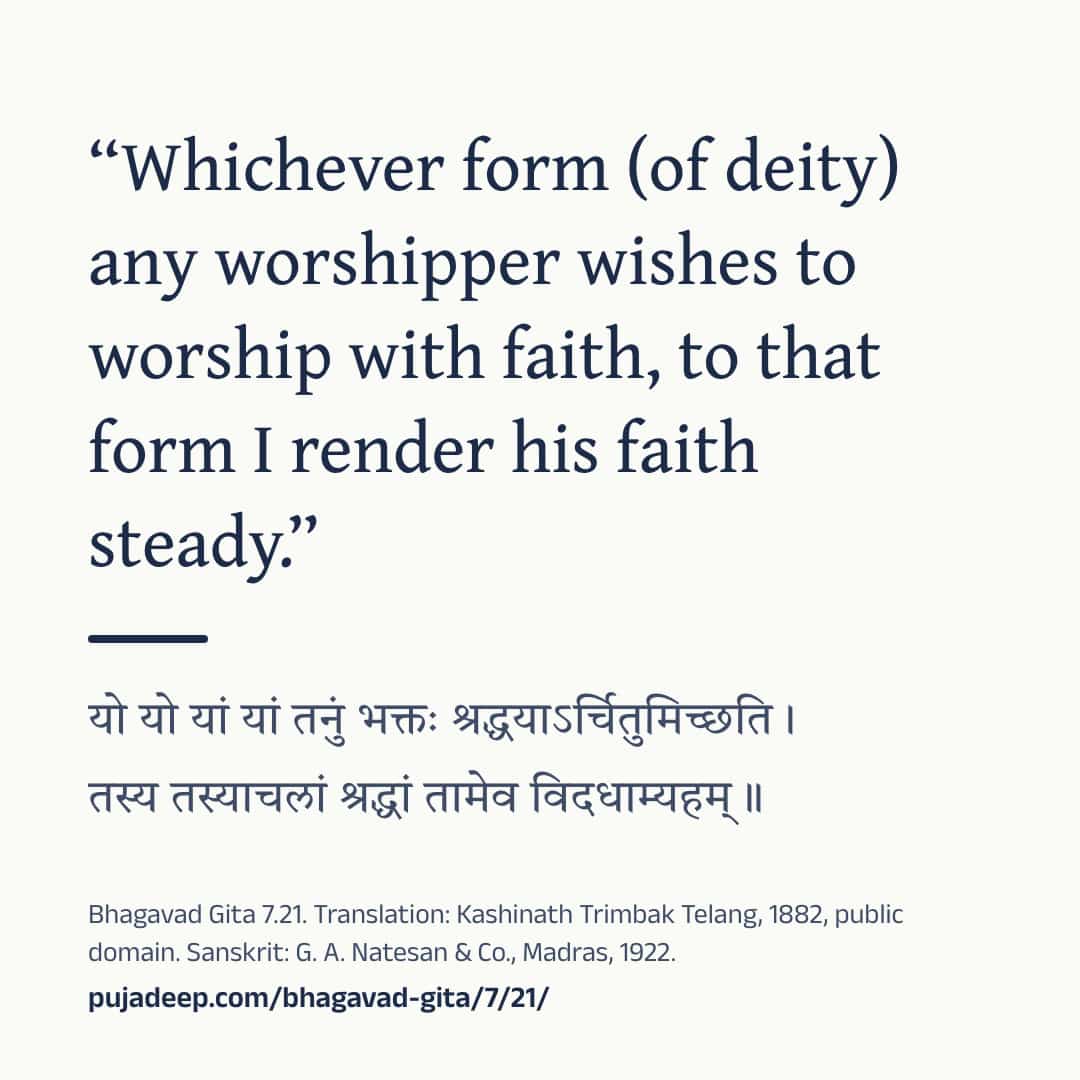
Drawing the picture
See the words
Bhagavad Gita 7.21

यो यो यां यां तनुं भक्तः श्रद्धयाऽर्चितुमिच्छति ।
तस्य तस्याचलां श्रद्धां तामेव विदधाम्यहम् ॥

“Whichever form (of deity) any worshipper wishes to worship with faith, to that form I render his faith steady.”
(K. T. Telang, The Bhagavadgîtâ (The Sacred Books of the East, vol. VIII, Oxford: Clarendon Press, 1882), p. 76, public domain)

“Whosoever seeketh to worship with faith any such semblance, I verily bestow the unswerving faith of that man.”
(Annie Besant, The Bhagavad Gîtâ, or The Lord's Song (London: Theosophical Publishing Society, 1895), p. 78, public domain)

“Whatever a devotee seeks to worship with Shraddhà, what form soever that Shraddhá of his,—that do I make unwavering.”
(Swami Swarupananda, Srimad-Bhagavad-Gita (Mayavati: Prabuddha Bharata Press, 1909; first printed in Prabuddha Bharata, 1907–1909), p. 154, public domain)

Sanskrit: G. A. Natesan & Co., Madras, 1922.
https://pujadeep.com/bhagavad-gita/7/21/ Nothing is sent from this site. Your own app sends it, to the chat you choose. The picture quotes the translation you chose on this page, with its name and year.
Sanskrit text: The Bhagavad-Gita, or The Lord's Song, with the text in Devanagari and an English translation, 1922. Meanings: written for Pujadeep and checked against the cited edition. Source and changes
Questions families ask
Who speaks Bhagavad Gita 7.21?
Krishna speaks this verse, in chapter 7 (Jnana Vijnana Yoga).
Where does the Sanskrit text come from?
Sanskrit text: The Bhagavad-Gita, or The Lord's Song, with the text in Devanagari and an English translation, 1922. Meanings: written for Pujadeep and checked against the cited edition. See the source
Is the meaning on this page a translation?
Explanation written for this site from the sources listed here, and checked against the cited edition. It is not a translation and not the only way to read the text. Free to quote with credit.
Source and licence
- Sanskrit text
- The Bhagavad-Gita, or The Lord's Song, with the text in Devanagari and an English translation (Annie Besant, G. A. Natesan & Co., Madras, 1922). Public domain. The Sanskrit on these pages was read from this printing’s page images.
- Translation
- The Bhagavadgîtâ with the Sanatsugâtîya and the Anugîtâ, translated by Kâshinâth Trimbak Telang (The Sacred Books of the East, vol. VIII, ed. F. Max Müller) (Kashinath Trimbak Telang, F. Max Müller, Clarendon Press, Oxford, 1882). Public domain. Shown verbatim, as printed.
- Translation
- The Bhagavad Gîtâ, or The Lord's Song, translated by Annie Besant (Annie Besant, Theosophical Publishing Society, London, 1895). Public domain. Shown verbatim, as printed.
- Translation
- Srimad-Bhagavad-Gita, with Sanskrit Text; Paraphrase with Word-by-word Literal Translation; English Rendering and Comments, Index, &c., by the Swami Swarupananda (Himalayan Series, No. XX) (Swami Swarupananda, The Editors and Publishers, Advaita Ashrama, Mayavati, Prabuddha Bharata Press, Mayavati, Almora, Himalayas, 1909). Public domain. Shown verbatim, as printed.
- Common wording
- In this text, 32 words follow today's common wording, checked against sanskritdocuments.org; Sanskrit Wikisource; Gita Press, Gorakhpur; GRETIL, Göttingen and Bhaktivedanta Book Trust.
- Our explanation
- Explanation written for this site from the sources listed here, and checked against the cited edition. It is not a translation and not the only way to read the text. Free to quote with credit.
- Checked
- Checked against the cited edition, October 15, 2026.
- Updated
- October 27, 2026