Bhagavad Gita 7.14: meaning and translation
Chapter 7: Jnana Vijnana Yoga. Krishna says
Krishna says that this divine māyā of his, made of the guṇas, is hard to get past.
Click or tap a word for its meaning and its dictionary page.
Text and layers
Text and layers
These choices stay in this browser.
Bhagavad Gita 7.14
दैवी ह्येषा गुणमयी मम माया दुरत्यया ।मामेव ये प्रपद्यन्ते मायामेतां तरन्ति ते ॥
Daivi hyesha gunamayi mama maya duratyayaMameva ye prapadyante mayametam taranti te
daivī hyeṣā guṇamayī mama māyā duratyayā |māmeva ye prapadyante māyāmetāṃ taranti te ||
Our explanation Krishna says that this divine māyā of his, made of the guṇas, is hard to get past. Those who take refuge in him alone cross over it. The schools understand māyā here differently (see the views).
हिंदी अर्थ कृष्ण कहते हैं कि गुणों से बनी उनकी यह दैवी माया पार करना कठिन है। जो केवल उनकी शरण लेते हैं, वे इस माया को पार कर जाते हैं। परंपराएँ यहाँ माया को अलग-अलग ढंग से समझती हैं।
Word by word
Every word, with its dictionary page
Word by word
- दैवी daivī · divine (adjective (feminine), nominative singular) Dictionary: 1. daiva, Monier-Williams 1899, p. 497, col. 2 “belonging to or coming from the gods, divine, celestial”
- हि hi · for, indeed (indeclinable) Dictionary: 2. hi, Monier-Williams 1899, p. 1297, col. 3 “for, because, on account of”
- एषा eṣā · this (pronoun (feminine), nominative singular) Dictionary: etad, Monier-Williams 1899, p. 231, col. 2 “this, this here, here”
- गुणमयी guṇamayī · made of the guṇas (adjective (feminine), nominative singular) Dictionary: guṇa-maya, Monier-Williams 1899, p. 357, col. 2 “produced by or consisting of the three constituent properties of Prakṛiti”
- मम mama · "my" (Krishna's) (pronoun, genitive singular) Dictionary: 1. mad, Monier-Williams 1899, p. 777, col. 2 “base of the first pers. pron. in the sg. number (esp. in comp.)”
- माया māyā · māyā (noun (feminine), nominative singular) Dictionary: māyā, Monier-Williams 1899, p. 811, col. 1 “art, wisdom, extraordinary or supernatural power”
- दुरत्यया duratyayā · hard to get past (adjective (feminine), nominative singular) Dictionary: dur-atyaya, Monier-Williams 1899, p. 484, col. 2; dur-atikrama, Monier-Williams 1899, p. 484, col. 2 “hard or difficult to be overcome, insurmountable”
- माम् mām · "me" (Krishna) (pronoun, accusative singular) Dictionary: 1. mad, Monier-Williams 1899, p. 777, col. 2 “base of the first pers. pron. in the sg. number (esp. in comp.)”
- एव eva · alone (indeclinable) Dictionary: 1. eva, Monier-Williams 1899, p. 232, col. 2 “just, exactly, very, same, only, even, alone, merely”
- ये ye · those who (pronoun (masculine), nominative plural) Dictionary: yad, Monier-Williams 1899, p. 844, col. 2 “who, which, what, whichever, whatever, that”
- प्रपद्यन्ते prapadyante · take refuge in (present, 3rd person plural) Dictionary: 1. pra-pad, Monier-Williams 1899, p. 682, col. 1 “to fly to for succour, take refuge with”
- मायाम् māyām · māyā (noun (feminine), accusative singular) Dictionary: māyā, Monier-Williams 1899, p. 811, col. 1 “art, wisdom, extraordinary or supernatural power”
- एताम् etām · this (pronoun (feminine), accusative singular) Dictionary: etad, Monier-Williams 1899, p. 231, col. 2 “this, this here, here”
- तरन्ति taranti · cross over (present, 3rd person plural) Dictionary: tṝ, Monier-Williams 1899, p. 454, col. 2 “to pass across or over, cross over (a river)”
- ते te · they (pronoun (masculine), nominative plural) Dictionary: tad, Monier-Williams 1899, p. 434, col. 1 “m. he, f. she, n. it, that, this”
Old translations
Kashinath Trimbak Telang, 1882. Public domain. Page 75.
for this delusion of mine, developed from the qualities, is divine and difficult to transcend. Those cross beyond this delusion who resort to me alone.
This sentence begins in 7.13.
Compare 3 translations
Kashinath Trimbak Telang, 1882. Public domain. Page 75.
for this delusion of mine, developed from the qualities, is divine and difficult to transcend. Those cross beyond this delusion who resort to me alone.
This sentence begins in 7.13.
You are reading this one
Annie Besant, 1895. Public domain. Page 77.
This divine Mâyâ of Mine, Guna-made, is hard to pierce; they who come to Me, they cross over this Mâyâ.
You are reading this one
Swami Swarupananda, 1909 (first printed 1907). Public domain. Page 151.
Verily, this divine illusion of Mine, constituted of the Gunas, is difficult to cross over; those who devote themselves to Me alone, cross over this illusion.
You are reading this one
Cite this verse
The translation: K. T. Telang, The Bhagavadgîtâ (The Sacred Books of the East, vol. VIII, Oxford: Clarendon Press, 1882), p. 75. Bhagavad Gita 7.14.
The translation: Annie Besant, The Bhagavad Gîtâ, or The Lord's Song (London: Theosophical Publishing Society, 1895), p. 77. Bhagavad Gita 7.14.
The translation: Swami Swarupananda, Srimad-Bhagavad-Gita (Mayavati: Prabuddha Bharata Press, 1909; first printed in Prabuddha Bharata, 1907–1909), p. 151. Bhagavad Gita 7.14.
Our explanation: “Bhagavad Gita 7.14: meaning and translation.” Pujadeep. Updated October 27, 2026. https://pujadeep.com/bhagavad-gita/7/14/
Pujadeep’s explanations are free to quote with credit: name Pujadeep and link to the page. How to credit
Classical readings, by school
Each reading is named by its school. None is presented as the only meaning.
What Advaita, Vishishtadvaita and Dvaita teach, in short
Shankara Advaita
Shankara calls this the divine illusion of Vishnu, made of the three guṇas, which deludes all living beings through love, hatred and attachment. Those who devote themselves wholly to the Lord, their own Self and the Lord of māyā, cross over it and are freed from saṃsāra.
Source: The Bhagavad-Gita, with the commentary of Sri Sankaracharya, translated by A. Mahadeva Sastri (2nd ed., Mysore: G. T. A. Printing Works, 1901), commentary on 7.13–7.14, p. 193. Summarised in our own words; none of its text is reproduced.
Ramanuja Vishishtadvaita
Ramanuja says māyā here never means something false. It is prakṛti, the Lord's real power to produce wonderful effects, made of the three guṇas. It hides the Lord's nature and draws people to seek pleasure in it; those who take refuge in the Lord alone cross beyond it.
Source: Sri Bhagavad-Gita with Sri Ramanujacharya's Visishtadvaita commentary, translated by A. Govindacharya (Madras, 1898), commentary on 7.14, pp. 240–242. Summarised in our own words; none of its text is reproduced.
Share
Show the ways to share
Send one picture or the text to one chat. The picture names its source and the address of this page.
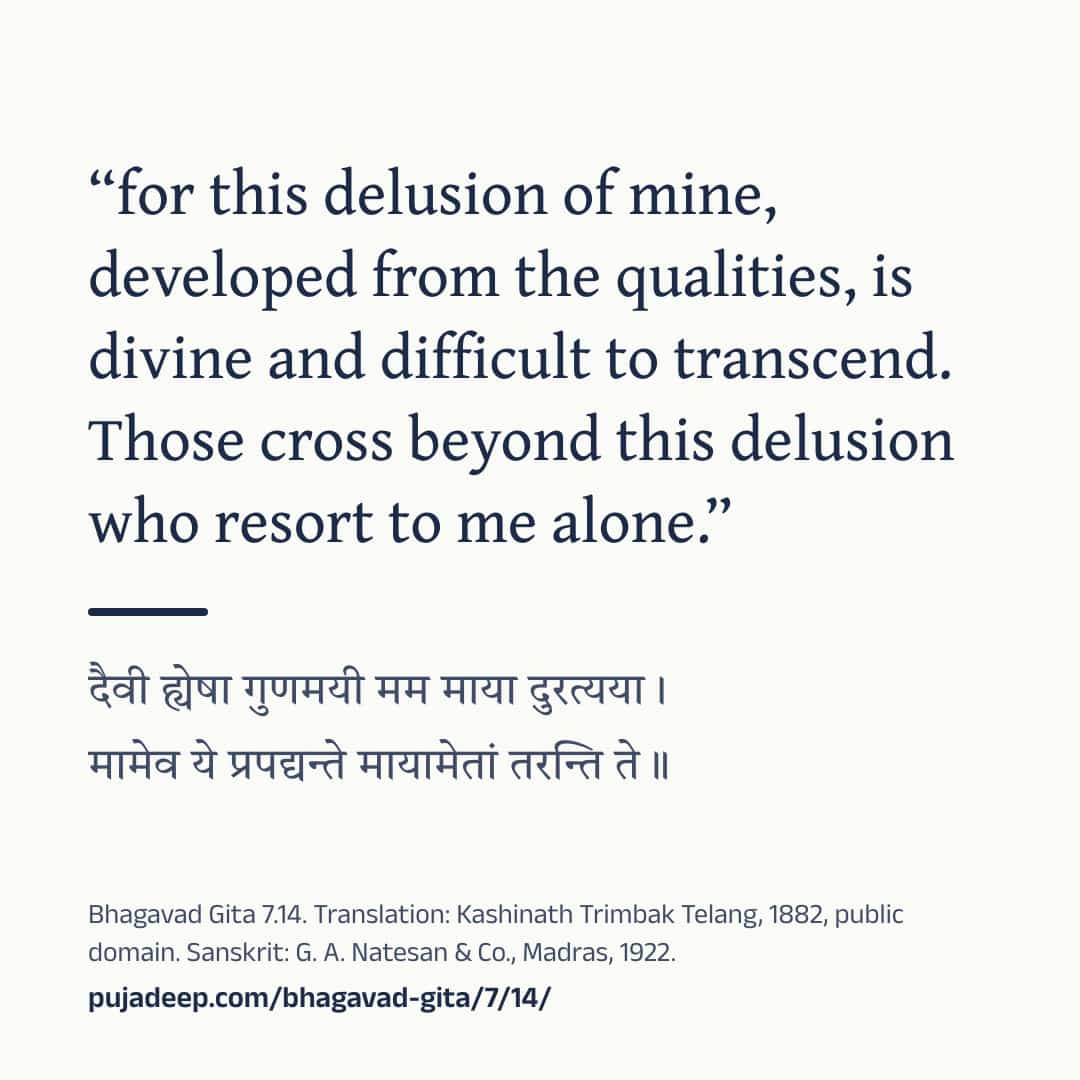
Drawing the picture
See the words
Bhagavad Gita 7.14

दैवी ह्येषा गुणमयी मम माया दुरत्यया ।
मामेव ये प्रपद्यन्ते मायामेतां तरन्ति ते ॥

“for this delusion of mine, developed from the qualities, is divine and difficult to transcend. Those cross beyond this delusion who resort to me alone.”
(K. T. Telang, The Bhagavadgîtâ (The Sacred Books of the East, vol. VIII, Oxford: Clarendon Press, 1882), p. 75, public domain)
This sentence begins in 7.13.

“This divine Mâyâ of Mine, Guna-made, is hard to pierce; they who come to Me, they cross over this Mâyâ.”
(Annie Besant, The Bhagavad Gîtâ, or The Lord's Song (London: Theosophical Publishing Society, 1895), p. 77, public domain)

“Verily, this divine illusion of Mine, constituted of the Gunas, is difficult to cross over; those who devote themselves to Me alone, cross over this illusion.”
(Swami Swarupananda, Srimad-Bhagavad-Gita (Mayavati: Prabuddha Bharata Press, 1909; first printed in Prabuddha Bharata, 1907–1909), p. 151, public domain)

Sanskrit: G. A. Natesan & Co., Madras, 1922.
https://pujadeep.com/bhagavad-gita/7/14/ Nothing is sent from this site. Your own app sends it, to the chat you choose. The picture quotes the translation you chose on this page, with its name and year.
Sanskrit text: The Bhagavad-Gita, or The Lord's Song, with the text in Devanagari and an English translation, 1922. Meanings: written for Pujadeep and checked against the cited edition. Source and changes
Questions families ask
Who speaks Bhagavad Gita 7.14?
Krishna speaks this verse, in chapter 7 (Jnana Vijnana Yoga).
Where does the Sanskrit text come from?
Sanskrit text: The Bhagavad-Gita, or The Lord's Song, with the text in Devanagari and an English translation, 1922. Meanings: written for Pujadeep and checked against the cited edition. See the source
Is the meaning on this page a translation?
Explanation written for this site from the sources listed here, and checked against the cited edition. It is not a translation and not the only way to read the text. Free to quote with credit.
Source and licence
- Sanskrit text
- The Bhagavad-Gita, or The Lord's Song, with the text in Devanagari and an English translation (Annie Besant, G. A. Natesan & Co., Madras, 1922). Public domain. The Sanskrit on these pages was read from this printing’s page images.
- Translation
- The Bhagavadgîtâ with the Sanatsugâtîya and the Anugîtâ, translated by Kâshinâth Trimbak Telang (The Sacred Books of the East, vol. VIII, ed. F. Max Müller) (Kashinath Trimbak Telang, F. Max Müller, Clarendon Press, Oxford, 1882). Public domain. Shown verbatim, as printed.
- Translation
- The Bhagavad Gîtâ, or The Lord's Song, translated by Annie Besant (Annie Besant, Theosophical Publishing Society, London, 1895). Public domain. Shown verbatim, as printed.
- Translation
- Srimad-Bhagavad-Gita, with Sanskrit Text; Paraphrase with Word-by-word Literal Translation; English Rendering and Comments, Index, &c., by the Swami Swarupananda (Himalayan Series, No. XX) (Swami Swarupananda, The Editors and Publishers, Advaita Ashrama, Mayavati, Prabuddha Bharata Press, Mayavati, Almora, Himalayas, 1909). Public domain. Shown verbatim, as printed.
- Commentary
- The Bhagavad-Gita, with the commentary of Sri Sankaracharya, translated by A. Mahadeva Sastri (2nd ed., Mysore: G. T. A. Printing Works, 1901) (Public-domain scan, University of California Libraries). Summarised in our own words; none of its text is reproduced.
- Commentary
- Sri Bhagavad-Gita with Sri Ramanujacharya's Visishtadvaita commentary, translated by A. Govindacharya (Madras, 1898) (Scan uploaded to archive.org (folkscanomy collection)). Summarised in our own words; none of its text is reproduced.
- Common wording
- In this text, 32 words follow today's common wording, checked against sanskritdocuments.org; Sanskrit Wikisource; Gita Press, Gorakhpur; GRETIL, Göttingen and Bhaktivedanta Book Trust.
- Our explanation
- Explanation written for this site from the sources listed here, and checked against the cited edition. It is not a translation and not the only way to read the text. Free to quote with credit.
- Checked
- Checked against the cited edition, October 15, 2026.
- Updated
- October 27, 2026