Bhagavad Gita 7.15: meaning and translation
Chapter 7: Jnana Vijnana Yoga. Krishna says
Krishna says that those who do wrong and are deluded, the lowest among people (narādhama), do not come to him: people whose understanding has been carried away by māyā, and who have taken on the nature of the asuras (the opponents of the gods in the old stories).
Click or tap a word for its meaning and its dictionary page.
Text and layers
Text and layers
These choices stay in this browser.
Bhagavad Gita 7.15
न मां दुष्कृतिनो मूढाः प्रपद्यन्ते नराधमाः ।माययाऽपहृतज्ञाना आसुरं भावमाश्रिताः ॥
Na mam dushkritino mudhah prapadyante naradhamahMayayapahritajnana asuram bhavamashritah
na māṃ duṣkṛtino mūḍhāḥ prapadyante narādhamāḥ |māyayā’pahṛtajñānā āsuraṃ bhāvamāśritāḥ ||
Our explanation Krishna says that those who do wrong and are deluded, the lowest among people (narādhama), do not come to him: people whose understanding has been carried away by māyā, and who have taken on the nature of the asuras (the opponents of the gods in the old stories).
हिंदी अर्थ कृष्ण कहते हैं कि जो बुरे कर्म करते हैं और मोह में पड़े हैं, वे नराधम (मनुष्यों में सबसे नीचे) उनकी शरण में नहीं आते: ऐसे लोग जिनका ज्ञान माया ने हर लिया है और जिन्होंने आसुरी (पुरानी कथाओं में देवताओं के विरोधी असुरों जैसा) स्वभाव अपना लिया है।
Word by word
Every word, with its dictionary page
Word by word
- न na · not (indeclinable) Dictionary: 2. na, Monier-Williams 1899, p. 523, col. 1 “not, no, nor, neither”
- माम् mām · "me" (Krishna) (pronoun, accusative singular) Dictionary: 1. mad, Monier-Williams 1899, p. 777, col. 2 “base of the first pers. pron. in the sg. number (esp. in comp.)”
- दुष्कृतिनः duṣkṛtinaḥ · wrongdoers (noun (masculine), nominative plural) Dictionary: duṣ-kṛtin, Monier-Williams 1899, p. 487, col. 3; duṣ-kṛti, Monier-Williams 1899, p. 487, col. 3 “acting wickedly, an evil-doer”
- मूढाः mūḍhāḥ · deluded (past participle (masculine), nominative plural) Dictionary: mūḍha, Monier-Williams 1899, p. 825, col. 2 “stupefied, bewildered, perplexed, confused”
- प्रपद्यन्ते prapadyante · come to, take refuge in (present, 3rd person plural) Dictionary: 1. pra-pad, Monier-Williams 1899, p. 682, col. 1 “to fly to for succour, take refuge with”
- नराधमाः narādhamāḥ · the lowest of people (compound (masculine), nominative plural) Dictionary: nara, Monier-Williams 1899, p. 528, col. 3 “a man, a male, a person”; adhama, Monier-Williams 1899, p. 19, col. 3 “lowest, vilest, worst; very low or vile or bad”
- मायया māyayā · by māyā (noun (feminine), instrumental singular) Dictionary: māyā, Monier-Williams 1899, p. 811, col. 1 “art, wisdom, extraordinary or supernatural power”
- अपहृतज्ञानाः apahṛtajñānāḥ · whose understanding is carried away (compound (masculine), nominative plural) Dictionary: apa-hṛta, Monier-Williams 1899, p. 53, col. 3 “taken away, carried off, stolen”; jñāna, Monier-Williams 1899, p. 426, col. 1 “knowing, becoming acquainted with, knowledge”
- आसुरम् āsuram · of the asuras (adjective (masculine), accusative singular) Dictionary: 1. āsura, Monier-Williams 1899, p. 160, col. 3 “belonging or relating to the Asuras”
- भावम् bhāvam · nature, disposition (noun (masculine), accusative singular) Dictionary: bhāva, Monier-Williams 1899, p. 754, col. 2 “manner of being, nature, temperament, character”
- आश्रिताः āśritāḥ · having taken on (past participle (masculine), nominative plural) Dictionary: ā-śrita, Monier-Williams 1899, p. 158, col. 3 “having recourse to, resorting to as a retreat or asylum”
1 printing differs
Edition differences. Another printing or text reads this place differently.
- Spelling A digital text reads Same words. The 1922 edition marks the merged vowel with an avagraha (ऽ); this e-text does not. Edition: माययाऽपहृतज्ञाना.
Old translations
Kashinath Trimbak Telang, 1882. Public domain. Page 75.
Wicked men, doers of evil (acts), who are deluded, who are deprived of their knowledge by (this) delusion, and who incline to the demoniac state of mind1, do not resort to me.
Footnotes (the translator’s own) - Infra, p. 115. ↩
Compare 3 translations
Kashinath Trimbak Telang, 1882. Public domain. Page 75.
Wicked men, doers of evil (acts), who are deluded, who are deprived of their knowledge by (this) delusion, and who incline to the demoniac state of mind1, do not resort to me.
Footnotes (the translator’s own) - Infra, p. 115. ↩
You are reading this one
Annie Besant, 1895. Public domain. Page 77.
The evil-doing, the deluded, the vilest men, they come not to Me, they whose wisdom is destroyed by Mâyâ, who have endued the nature of Asuras.
You are reading this one
Swami Swarupananda, 1909 (first printed 1907). Public domain. Page 151.
They do not devote themselves to Me,—the evil-doers, the deluded, the lowest of men, deprived of discrimination by Maya, and following the way of Asuras.
You are reading this one
Cite this verse
The translation: K. T. Telang, The Bhagavadgîtâ (The Sacred Books of the East, vol. VIII, Oxford: Clarendon Press, 1882), p. 75. Bhagavad Gita 7.15.
The translation: Annie Besant, The Bhagavad Gîtâ, or The Lord's Song (London: Theosophical Publishing Society, 1895), p. 77. Bhagavad Gita 7.15.
The translation: Swami Swarupananda, Srimad-Bhagavad-Gita (Mayavati: Prabuddha Bharata Press, 1909; first printed in Prabuddha Bharata, 1907–1909), p. 151. Bhagavad Gita 7.15.
Our explanation: “Bhagavad Gita 7.15: meaning and translation.” Pujadeep. Updated October 27, 2026. https://pujadeep.com/bhagavad-gita/7/15/
Pujadeep’s explanations are free to quote with credit: name Pujadeep and link to the page. How to credit
Classical readings, by school
No readings by school on this verse yet.
Share
Show the ways to share
Send one picture or the text to one chat. The picture names its source and the address of this page.
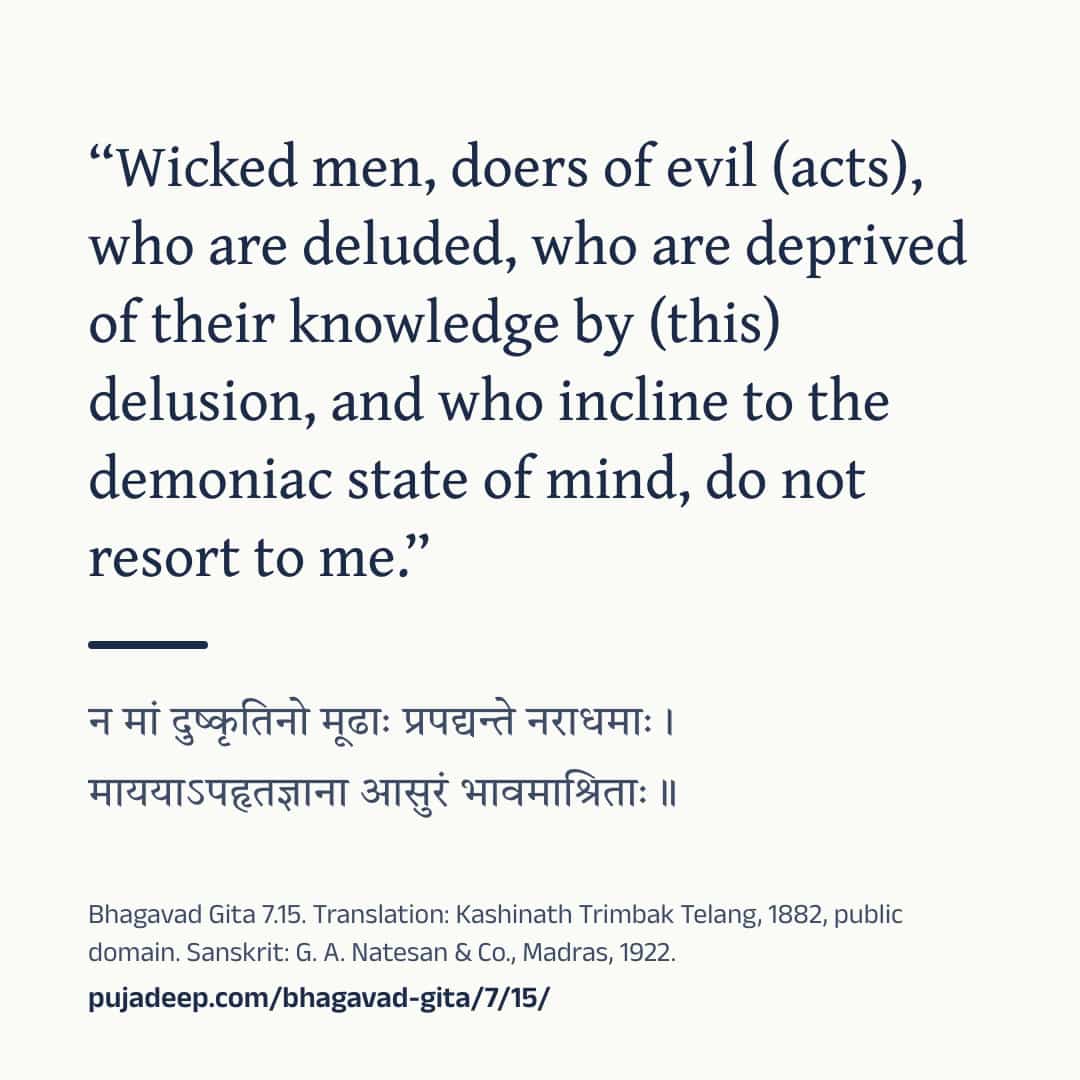
Drawing the picture
See the words
Bhagavad Gita 7.15

न मां दुष्कृतिनो मूढाः प्रपद्यन्ते नराधमाः ।
माययाऽपहृतज्ञाना आसुरं भावमाश्रिताः ॥

“Wicked men, doers of evil (acts), who are deluded, who are deprived of their knowledge by (this) delusion, and who incline to the demoniac state of mind, do not resort to me.”
(K. T. Telang, The Bhagavadgîtâ (The Sacred Books of the East, vol. VIII, Oxford: Clarendon Press, 1882), p. 75, public domain)

“The evil-doing, the deluded, the vilest men, they come not to Me, they whose wisdom is destroyed by Mâyâ, who have endued the nature of Asuras.”
(Annie Besant, The Bhagavad Gîtâ, or The Lord's Song (London: Theosophical Publishing Society, 1895), p. 77, public domain)

“They do not devote themselves to Me,—the evil-doers, the deluded, the lowest of men, deprived of discrimination by Maya, and following the way of Asuras.”
(Swami Swarupananda, Srimad-Bhagavad-Gita (Mayavati: Prabuddha Bharata Press, 1909; first printed in Prabuddha Bharata, 1907–1909), p. 151, public domain)

Sanskrit: G. A. Natesan & Co., Madras, 1922.
https://pujadeep.com/bhagavad-gita/7/15/ Nothing is sent from this site. Your own app sends it, to the chat you choose. The picture quotes the translation you chose on this page, with its name and year.
Sanskrit text: The Bhagavad-Gita, or The Lord's Song, with the text in Devanagari and an English translation, 1922. Meanings: written for Pujadeep and checked against the cited edition. Source and changes
Questions families ask
Who speaks Bhagavad Gita 7.15?
Krishna speaks this verse, in chapter 7 (Jnana Vijnana Yoga).
Where does the Sanskrit text come from?
Sanskrit text: The Bhagavad-Gita, or The Lord's Song, with the text in Devanagari and an English translation, 1922. Meanings: written for Pujadeep and checked against the cited edition. See the source
Is the meaning on this page a translation?
Explanation written for this site from the sources listed here, and checked against the cited edition. It is not a translation and not the only way to read the text. Free to quote with credit.
Source and licence
- Sanskrit text
- The Bhagavad-Gita, or The Lord's Song, with the text in Devanagari and an English translation (Annie Besant, G. A. Natesan & Co., Madras, 1922). Public domain. The Sanskrit on these pages was read from this printing’s page images.
- Translation
- The Bhagavadgîtâ with the Sanatsugâtîya and the Anugîtâ, translated by Kâshinâth Trimbak Telang (The Sacred Books of the East, vol. VIII, ed. F. Max Müller) (Kashinath Trimbak Telang, F. Max Müller, Clarendon Press, Oxford, 1882). Public domain. Shown verbatim, as printed.
- Translation
- The Bhagavad Gîtâ, or The Lord's Song, translated by Annie Besant (Annie Besant, Theosophical Publishing Society, London, 1895). Public domain. Shown verbatim, as printed.
- Translation
- Srimad-Bhagavad-Gita, with Sanskrit Text; Paraphrase with Word-by-word Literal Translation; English Rendering and Comments, Index, &c., by the Swami Swarupananda (Himalayan Series, No. XX) (Swami Swarupananda, The Editors and Publishers, Advaita Ashrama, Mayavati, Prabuddha Bharata Press, Mayavati, Almora, Himalayas, 1909). Public domain. Shown verbatim, as printed.
- Common wording
- In this text, 32 words follow today's common wording, checked against sanskritdocuments.org; Sanskrit Wikisource; Gita Press, Gorakhpur; GRETIL, Göttingen and Bhaktivedanta Book Trust.
- Our explanation
- Explanation written for this site from the sources listed here, and checked against the cited edition. It is not a translation and not the only way to read the text. Free to quote with credit.
- Checked
- Checked against the cited edition, October 15, 2026.
- Updated
- October 27, 2026