Bhagavad Gita 7.24: meaning and translation
Chapter 7: Jnana Vijnana Yoga. Krishna says
People without discernment, Krishna says, think that he, the unmanifest, has merely become manifest, because they do not know his highest nature, which never changes and has nothing above it.
Click or tap a word for its meaning and its dictionary page.
Text and layers
Text and layers
These choices stay in this browser.
Bhagavad Gita 7.24
अव्यक्तं व्यक्तिमापन्नं मन्यन्ते मामबुद्धयः ।परं भावमजानन्तो ममाव्ययमनुत्तमम् ॥
Avyaktam vyaktimapannam manyante mamabuddhayahParam bhavamajananto mamavyayamanuttamam
avyaktaṃ vyaktimāpannaṃ manyante māmabuddhayaḥ |paraṃ bhāvamajānanto mamāvyayamanuttamam ||
Our explanation People without discernment, Krishna says, think that he, the unmanifest, has merely become manifest, because they do not know his highest nature, which never changes and has nothing above it.
हिंदी अर्थ कृष्ण कहते हैं कि विवेकहीन लोग उन्हें, जो अव्यक्त हैं, केवल व्यक्त हुआ (देह वाला) मानते हैं, क्योंकि वे उनके परम भाव को नहीं जानते, जो अविनाशी है और जिससे ऊँचा कुछ नहीं।
Word by word
Every word, with its dictionary page
Word by word
- अव्यक्तम् avyaktam · the unmanifest (adjective (masculine), accusative singular) Dictionary: a-vyakta, Monier-Williams 1899, p. 111, col. 2 “undeveloped, not manifest, unapparent, indistinct, invisible”
- व्यक्तिम् vyaktim · manifest form (noun (feminine), accusative singular) Dictionary: vy-akti, Monier-Williams 1899, p. 1029, col. 3 “visible appearance or manifestation”
- आपन्नम् āpannam · come into (past participle (masculine), accusative singular) Dictionary: ā-panna, Monier-Williams 1899, p. 143, col. 1 “entered, got in”
- मन्यन्ते manyante · think (present, 3rd person plural) Dictionary: man, Monier-Williams 1899, p. 783, col. 1 “to think, believe, imagine, suppose, conjecture”
- माम् mām · "me" (Krishna) (pronoun, accusative singular) Dictionary: 1. mad, Monier-Williams 1899, p. 777, col. 2 “base of the first pers. pron. in the sg. number (esp. in comp.)”
- अबुद्धयः abuddhayaḥ · those without discernment (noun (masculine), nominative plural) Dictionary: a-buddhi, Monier-Williams 1899, p. 60, col. 1 “ignorant, stupid”
- परम् param · highest (adjective (masculine), accusative singular) Dictionary: 1. para, Monier-Williams 1899, p. 586, col. 1 “highest, supreme, chief”
- भावम् bhāvam · nature, being (noun (masculine), accusative singular) Dictionary: bhāva, Monier-Williams 1899, p. 754, col. 2 “manner of being, nature, temperament, character”
- अजानन्तः ajānantaḥ · not knowing (present participle (masculine), nominative plural) Dictionary: a-jānat, Monier-Williams 1899, p. 10, col. 1 “not knowing, unaware”
- मम mama · "my" (Krishna's) (pronoun, genitive singular) Dictionary: 1. mad, Monier-Williams 1899, p. 777, col. 2 “base of the first pers. pron. in the sg. number (esp. in comp.)”
- अव्ययम् avyayam · unchanging (adjective (masculine), accusative singular) Dictionary: 2. a-vyaya, Monier-Williams 1899, p. 111, col. 3 “not liable to change, imperishable, undecaying”
- अनुत्तमम् anuttamam · unsurpassed (adjective (masculine), accusative singular) Dictionary: an-uttama, Monier-Williams 1899, p. 33, col. 1 “unsurpassed, incomparably the best or chief, excellent”
Old translations
Kashinath Trimbak Telang, 1882. Public domain. Page 76.
The undiscerning ones, not knowing my transcendent and inexhaustible essence, than which there is nothing higher, think me, who am unperceived, to have become perceptible1.
Footnotes (the translator’s own) - The ignorant do not know the real divinity of Vishnu, thinking him to be no higher than as he is seen in the human form. This gives them an inadequate notion of the purity and eternity of the happiness to be obtained by worshipping him; cf. infra, p. 83. ↩
Compare 3 translations
Kashinath Trimbak Telang, 1882. Public domain. Page 76.
The undiscerning ones, not knowing my transcendent and inexhaustible essence, than which there is nothing higher, think me, who am unperceived, to have become perceptible1.
Footnotes (the translator’s own) - The ignorant do not know the real divinity of Vishnu, thinking him to be no higher than as he is seen in the human form. This gives them an inadequate notion of the purity and eternity of the happiness to be obtained by worshipping him; cf. infra, p. 83. ↩
You are reading this one
Annie Besant, 1895. Public domain. Page 79.
Those without Buddhi think of Me, the Unmanifest, as having manifestation; they know not My supreme nature, imperishable, most excellent.
You are reading this one
Swami Swarupananda, 1909 (first printed 1907). Public domain. Page 155.
The foolish regard Me as (only) the unmanifested come into manifestation, not knowing My supreme state,—the Immutable and transcendental.
You are reading this one
Cite this verse
The translation: K. T. Telang, The Bhagavadgîtâ (The Sacred Books of the East, vol. VIII, Oxford: Clarendon Press, 1882), p. 76. Bhagavad Gita 7.24.
The translation: Annie Besant, The Bhagavad Gîtâ, or The Lord's Song (London: Theosophical Publishing Society, 1895), p. 79. Bhagavad Gita 7.24.
The translation: Swami Swarupananda, Srimad-Bhagavad-Gita (Mayavati: Prabuddha Bharata Press, 1909; first printed in Prabuddha Bharata, 1907–1909), p. 155. Bhagavad Gita 7.24.
Our explanation: “Bhagavad Gita 7.24: meaning and translation.” Pujadeep. Updated October 27, 2026. https://pujadeep.com/bhagavad-gita/7/24/
Pujadeep’s explanations are free to quote with credit: name Pujadeep and link to the page. How to credit
Classical readings, by school
No readings by school on this verse yet.
Share
Show the ways to share
Send one picture or the text to one chat. The picture names its source and the address of this page.
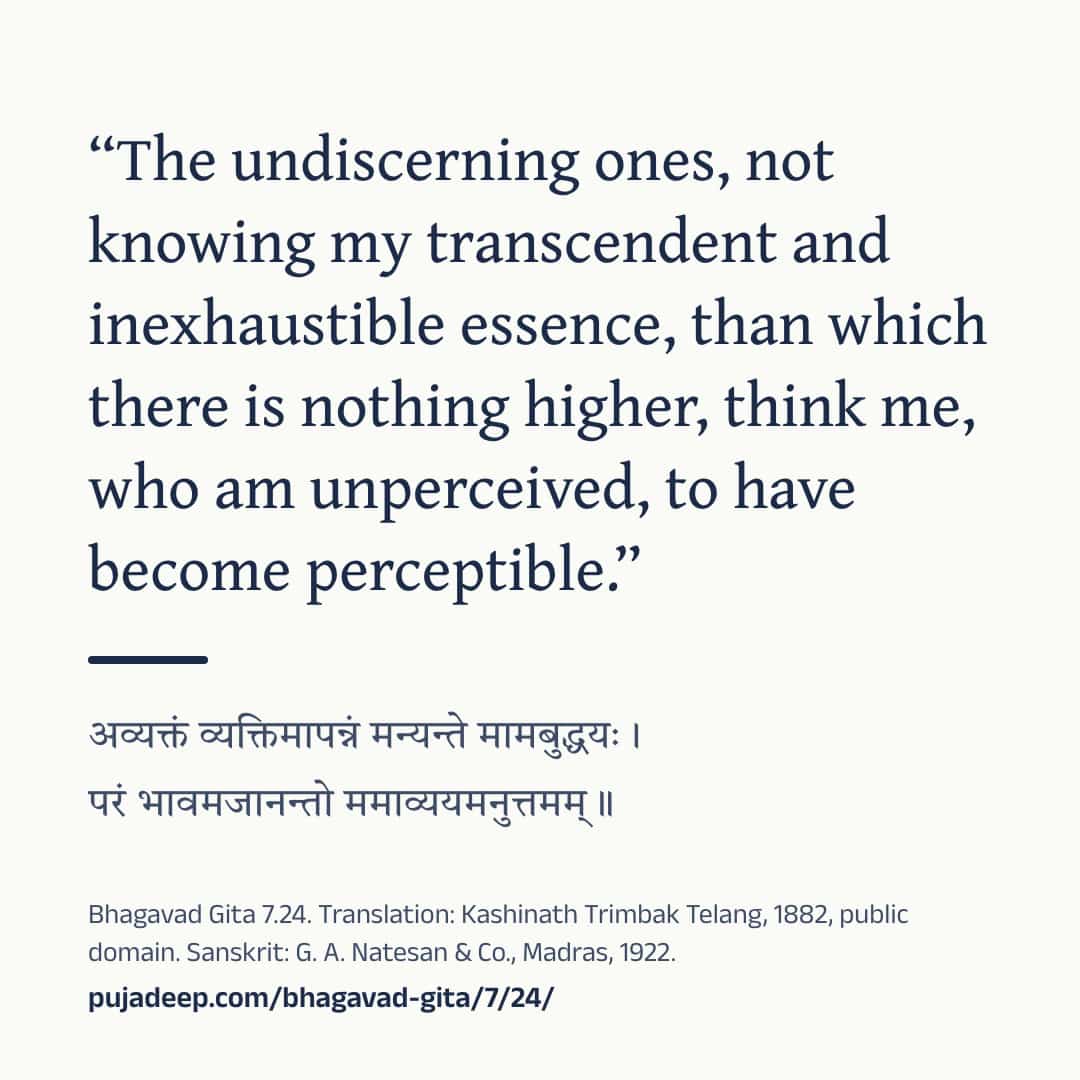
Drawing the picture
See the words
Bhagavad Gita 7.24

अव्यक्तं व्यक्तिमापन्नं मन्यन्ते मामबुद्धयः ।
परं भावमजानन्तो ममाव्ययमनुत्तमम् ॥

“The undiscerning ones, not knowing my transcendent and inexhaustible essence, than which there is nothing higher, think me, who am unperceived, to have become perceptible.”
(K. T. Telang, The Bhagavadgîtâ (The Sacred Books of the East, vol. VIII, Oxford: Clarendon Press, 1882), p. 76, public domain)

“Those without Buddhi think of Me, the Unmanifest, as having manifestation; they know not My supreme nature, imperishable, most excellent.”
(Annie Besant, The Bhagavad Gîtâ, or The Lord's Song (London: Theosophical Publishing Society, 1895), p. 79, public domain)

“The foolish regard Me as (only) the unmanifested come into manifestation, not knowing My supreme state,—the Immutable and transcendental.”
(Swami Swarupananda, Srimad-Bhagavad-Gita (Mayavati: Prabuddha Bharata Press, 1909; first printed in Prabuddha Bharata, 1907–1909), p. 155, public domain)

Sanskrit: G. A. Natesan & Co., Madras, 1922.
https://pujadeep.com/bhagavad-gita/7/24/ Nothing is sent from this site. Your own app sends it, to the chat you choose. The picture quotes the translation you chose on this page, with its name and year.
Sanskrit text: The Bhagavad-Gita, or The Lord's Song, with the text in Devanagari and an English translation, 1922. Meanings: written for Pujadeep and checked against the cited edition. Source and changes
Questions families ask
Who speaks Bhagavad Gita 7.24?
Krishna speaks this verse, in chapter 7 (Jnana Vijnana Yoga).
Where does the Sanskrit text come from?
Sanskrit text: The Bhagavad-Gita, or The Lord's Song, with the text in Devanagari and an English translation, 1922. Meanings: written for Pujadeep and checked against the cited edition. See the source
Is the meaning on this page a translation?
Explanation written for this site from the sources listed here, and checked against the cited edition. It is not a translation and not the only way to read the text. Free to quote with credit.
Source and licence
- Sanskrit text
- The Bhagavad-Gita, or The Lord's Song, with the text in Devanagari and an English translation (Annie Besant, G. A. Natesan & Co., Madras, 1922). Public domain. The Sanskrit on these pages was read from this printing’s page images.
- Translation
- The Bhagavadgîtâ with the Sanatsugâtîya and the Anugîtâ, translated by Kâshinâth Trimbak Telang (The Sacred Books of the East, vol. VIII, ed. F. Max Müller) (Kashinath Trimbak Telang, F. Max Müller, Clarendon Press, Oxford, 1882). Public domain. Shown verbatim, as printed.
- Translation
- The Bhagavad Gîtâ, or The Lord's Song, translated by Annie Besant (Annie Besant, Theosophical Publishing Society, London, 1895). Public domain. Shown verbatim, as printed.
- Translation
- Srimad-Bhagavad-Gita, with Sanskrit Text; Paraphrase with Word-by-word Literal Translation; English Rendering and Comments, Index, &c., by the Swami Swarupananda (Himalayan Series, No. XX) (Swami Swarupananda, The Editors and Publishers, Advaita Ashrama, Mayavati, Prabuddha Bharata Press, Mayavati, Almora, Himalayas, 1909). Public domain. Shown verbatim, as printed.
- Common wording
- In this text, 32 words follow today's common wording, checked against sanskritdocuments.org; Sanskrit Wikisource; Gita Press, Gorakhpur; GRETIL, Göttingen and Bhaktivedanta Book Trust.
- Our explanation
- Explanation written for this site from the sources listed here, and checked against the cited edition. It is not a translation and not the only way to read the text. Free to quote with credit.
- Checked
- Checked against the cited edition, October 15, 2026.
- Updated
- October 27, 2026