Bhagavad Gita 7.27: meaning and translation
Chapter 7: Jnana Vijnana Yoga. Krishna says
From the moment they are born, Krishna says, all beings are confused by the pairs of opposites (dvandva), such as pleasure and pain, which arise from liking and disliking.
Click or tap a word for its meaning and its dictionary page.
Text and layers
Text and layers
These choices stay in this browser.
Bhagavad Gita 7.27
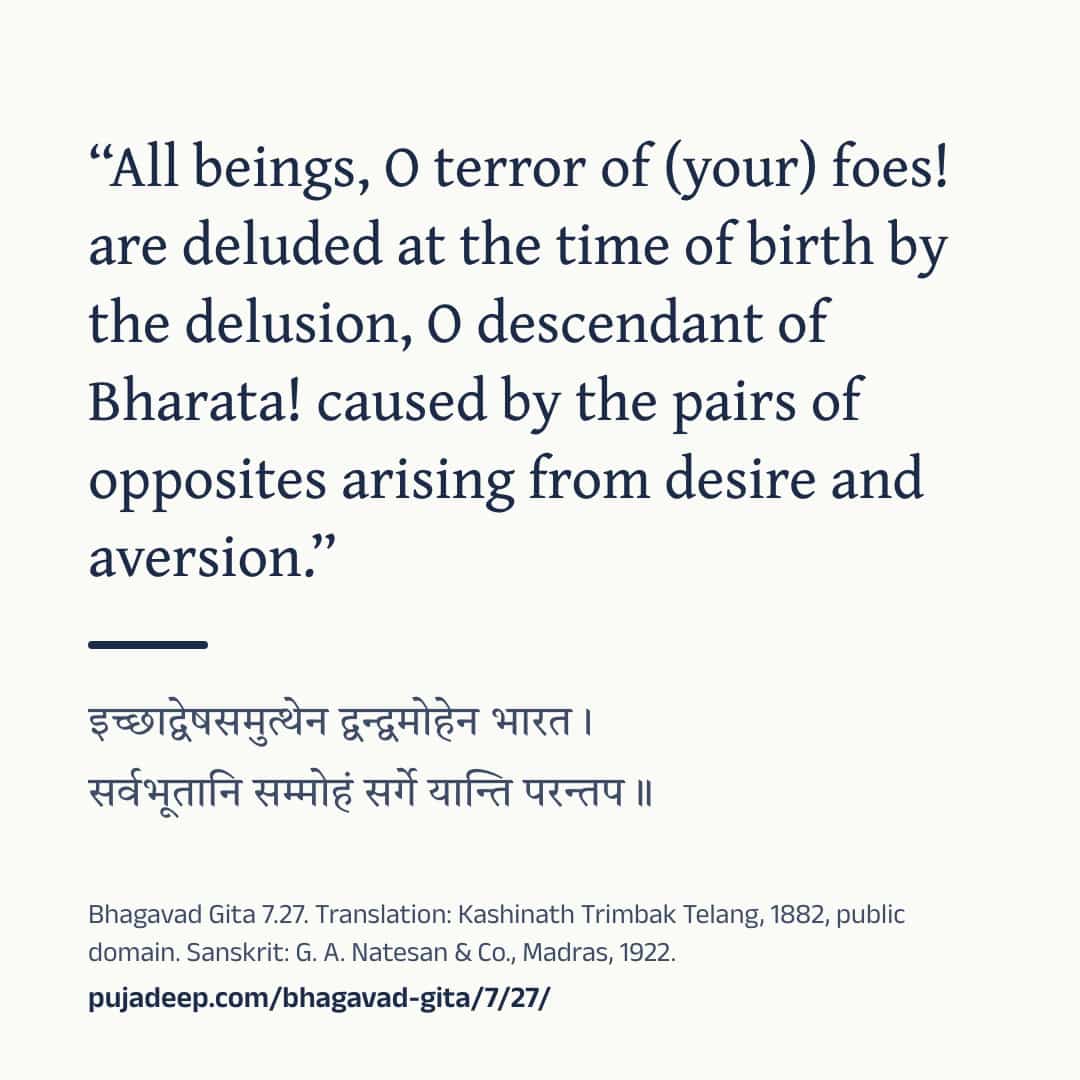
इच्छाद्वेषसमुत्थेन द्वन्द्वमोहेन भारत ।सर्वभूतानि सम्मोहं सर्गे यान्ति परन्तप ॥
Ichchhadveshasamutthena dvandvamohena bharataSarvabhutani sammoham sarge yanti parantapa
icchādveṣasamutthena dvandvamohena bhārata |sarvabhūtāni sammohaṃ sarge yānti parantapa ||
Our explanation From the moment they are born, Krishna says, all beings are confused by the pairs of opposites (dvandva), such as pleasure and pain, which arise from liking and disliking.
हिंदी अर्थ कृष्ण कहते हैं कि जन्म से ही सब प्राणी इच्छा और द्वेष से उत्पन्न होने वाले द्वंद्वों (जैसे सुख-दुःख) के मोह में पड़ जाते हैं।
Word by word
Every word, with its dictionary page
Word by word
- इच्छाद्वेषसमुत्थेन icchādveṣasamutthena · arising from liking and disliking (compound (masculine), instrumental singular) Dictionary: icchā, Monier-Williams 1899, p. 169, col. 1 “wish, desire, inclination”; dveṣa, Monier-Williams 1899, p. 507, col. 1 “hatred, dislike, repugnance, enmity”; sam-uttha, Monier-Williams 1899, p. 1166, col. 1 “sprung or produced or derived from”
- द्वन्द्वमोहेन dvandvamohena · by the confusion of the opposites (compound (masculine), instrumental singular) Dictionary: dvaṃdva, Monier-Williams 1899, p. 503, col. 2 “a pair of opposites (e.g. heat and cold, joy and sorrow &c.)”; moha, Monier-Williams 1899, p. 836, col. 1 “loss of consciousness, bewilderment, perplexity, distraction, infatuation, delusion”
- भारत bhārata · O Bharata (Arjuna) (noun (masculine), vocative singular) Dictionary: bhārata, Monier-Williams 1899, p. 753, col. 1 “a descendant of Bharata”
- सर्वभूतानि sarvabhūtāni · all beings (compound (neuter), nominative plural) Dictionary: sarva, Monier-Williams 1899, p. 1184, col. 3 “whole, entire, all, every”; bhūta, Monier-Williams 1899, p. 761, col. 3 “that which is or exists, any living being”
- सम्मोहम् sammoham · confusion (noun (masculine), accusative singular) Dictionary: sam-moha, Monier-Williams 1899, p. 1181, col. 1 “stupefaction, bewilderment, confusion”
- सर्गे sarge · at birth (noun (masculine), locative singular) Dictionary: sarga, Monier-Williams 1899, p. 1184, col. 1 “emission or creation of matter, primary creation”
- यान्ति yānti · fall into (present, 3rd person plural) Dictionary: 1. yā, Monier-Williams 1899, p. 849, col. 1 “to go, proceed, move, walk, set out”
- परन्तप parantapa · O scorcher of foes (noun (masculine), vocative singular) Dictionary: param-tapa, Monier-Williams 1899, p. 586, col. 3 “destroying foes (said of heroes)”
Old translations
Kashinath Trimbak Telang, 1882. Public domain. Page 76.
All beings, O terror of (your) foes! are deluded at the time of birth by the delusion, O descendant of Bharata! caused by the pairs of opposites arising from desire and aversion.
Compare 3 translations
Kashinath Trimbak Telang, 1882. Public domain. Page 76.
All beings, O terror of (your) foes! are deluded at the time of birth by the delusion, O descendant of Bharata! caused by the pairs of opposites arising from desire and aversion.
You are reading this one
Annie Besant, 1895. Public domain. Page 79.
By the delusion of the pairs of opposites, sprung from attraction and repulsion, O Bhârata! all beings walk this universe wholly deluded, O Parantapa.
You are reading this one
Swami Swarupananda, 1909 (first printed 1907). Public domain. Page 157.
By the delusion of the pairs of opposites, arising from desire and aversion, O descendant of Bharata, all beings fall into delusion at birth, O scorcher of foes.
You are reading this one
Cite this verse
The translation: K. T. Telang, The Bhagavadgîtâ (The Sacred Books of the East, vol. VIII, Oxford: Clarendon Press, 1882), p. 76. Bhagavad Gita 7.27.
The translation: Annie Besant, The Bhagavad Gîtâ, or The Lord's Song (London: Theosophical Publishing Society, 1895), p. 79. Bhagavad Gita 7.27.
The translation: Swami Swarupananda, Srimad-Bhagavad-Gita (Mayavati: Prabuddha Bharata Press, 1909; first printed in Prabuddha Bharata, 1907–1909), p. 157. Bhagavad Gita 7.27.
Our explanation: “Bhagavad Gita 7.27: meaning and translation.” Pujadeep. Updated October 27, 2026. https://pujadeep.com/bhagavad-gita/7/27/
Pujadeep’s explanations are free to quote with credit: name Pujadeep and link to the page. How to credit
Classical readings, by school
No readings by school on this verse yet.
Share
Show the ways to share
Send one picture or the text to one chat. The picture names its source and the address of this page.
Drawing the picture
See the words
Bhagavad Gita 7.27

इच्छाद्वेषसमुत्थेन द्वन्द्वमोहेन भारत ।
सर्वभूतानि सम्मोहं सर्गे यान्ति परन्तप ॥

“All beings, O terror of (your) foes! are deluded at the time of birth by the delusion, O descendant of Bharata! caused by the pairs of opposites arising from desire and aversion.”
(K. T. Telang, The Bhagavadgîtâ (The Sacred Books of the East, vol. VIII, Oxford: Clarendon Press, 1882), p. 76, public domain)

“By the delusion of the pairs of opposites, sprung from attraction and repulsion, O Bhârata! all beings walk this universe wholly deluded, O Parantapa.”
(Annie Besant, The Bhagavad Gîtâ, or The Lord's Song (London: Theosophical Publishing Society, 1895), p. 79, public domain)

“By the delusion of the pairs of opposites, arising from desire and aversion, O descendant of Bharata, all beings fall into delusion at birth, O scorcher of foes.”
(Swami Swarupananda, Srimad-Bhagavad-Gita (Mayavati: Prabuddha Bharata Press, 1909; first printed in Prabuddha Bharata, 1907–1909), p. 157, public domain)

Sanskrit: G. A. Natesan & Co., Madras, 1922.
https://pujadeep.com/bhagavad-gita/7/27/ Nothing is sent from this site. Your own app sends it, to the chat you choose. The picture quotes the translation you chose on this page, with its name and year.
Sanskrit text: The Bhagavad-Gita, or The Lord's Song, with the text in Devanagari and an English translation, 1922. Meanings: written for Pujadeep and checked against the cited edition. Source and changes
Questions families ask
Who speaks Bhagavad Gita 7.27?
Krishna speaks this verse, in chapter 7 (Jnana Vijnana Yoga).
Where does the Sanskrit text come from?
Sanskrit text: The Bhagavad-Gita, or The Lord's Song, with the text in Devanagari and an English translation, 1922. Meanings: written for Pujadeep and checked against the cited edition. See the source
Is the meaning on this page a translation?
Explanation written for this site from the sources listed here, and checked against the cited edition. It is not a translation and not the only way to read the text. Free to quote with credit.
Source and licence
- Sanskrit text
- The Bhagavad-Gita, or The Lord's Song, with the text in Devanagari and an English translation (Annie Besant, G. A. Natesan & Co., Madras, 1922). Public domain. The Sanskrit on these pages was read from this printing’s page images.
- Translation
- The Bhagavadgîtâ with the Sanatsugâtîya and the Anugîtâ, translated by Kâshinâth Trimbak Telang (The Sacred Books of the East, vol. VIII, ed. F. Max Müller) (Kashinath Trimbak Telang, F. Max Müller, Clarendon Press, Oxford, 1882). Public domain. Shown verbatim, as printed.
- Translation
- The Bhagavad Gîtâ, or The Lord's Song, translated by Annie Besant (Annie Besant, Theosophical Publishing Society, London, 1895). Public domain. Shown verbatim, as printed.
- Translation
- Srimad-Bhagavad-Gita, with Sanskrit Text; Paraphrase with Word-by-word Literal Translation; English Rendering and Comments, Index, &c., by the Swami Swarupananda (Himalayan Series, No. XX) (Swami Swarupananda, The Editors and Publishers, Advaita Ashrama, Mayavati, Prabuddha Bharata Press, Mayavati, Almora, Himalayas, 1909). Public domain. Shown verbatim, as printed.
- Common wording
- In this text, 32 words follow today's common wording, checked against sanskritdocuments.org; Sanskrit Wikisource; Gita Press, Gorakhpur; GRETIL, Göttingen and Bhaktivedanta Book Trust.
- Our explanation
- Explanation written for this site from the sources listed here, and checked against the cited edition. It is not a translation and not the only way to read the text. Free to quote with credit.
- Checked
- Checked against the cited edition, October 15, 2026.
- Updated
- October 27, 2026