Bhagavad Gita 7.30: meaning and translation
Chapter 7: Jnana Vijnana Yoga. Krishna says
Krishna says that those who know him together with adhibhūta (what concerns beings), adhidaiva (what concerns the gods) and adhiyajña (what concerns sacrifice), with minds steady in yoga, know him even at the time of leaving the body.
Click or tap a word for its meaning and its dictionary page.
Text and layers
Text and layers
These choices stay in this browser.
Bhagavad Gita 7.30
साधिभूताधिदैवं मां साधियज्ञं च ये विदुः ।प्रयाणकालेऽपि च मां ते विदुर्युक्तचेतसः ॥
Sadhibhutadhidaivam mam sadhiyajnam cha ye viduhPrayanakalepi cha mam te viduryuktachetasah
sādhibhūtādhidaivaṃ māṃ sādhiyajñaṃ ca ye viduḥ |prayāṇakāle’pi ca māṃ te viduryuktacetasaḥ ||
Our explanation Krishna says that those who know him together with adhibhūta (what concerns beings), adhidaiva (what concerns the gods) and adhiyajña (what concerns sacrifice), with minds steady in yoga, know him even at the time of leaving the body. Arjuna asks about these terms at the start of chapter 8.
हिंदी अर्थ कृष्ण कहते हैं कि जो उन्हें अधिभूत (प्राणियों से संबंधित), अधिदैव (देवताओं से संबंधित) और अधियज्ञ (यज्ञ से संबंधित) के साथ जानते हैं, वे योग में स्थिर मन से शरीर छोड़ने के समय भी उन्हें जानते हैं। अध्याय 8 के आरंभ में अर्जुन इन्हीं शब्दों के बारे में पूछते हैं।
Word by word
Every word, with its dictionary page
Word by word
- साधिभूताधिदैवम् sādhibhūtādhidaivam · with adhibhūta and adhidaiva (compound (masculine), accusative singular) Dictionary: 7. sa, Monier-Williams 1899, p. 1111, col. 2 “together or along with”; adhi-bhūta, Monier-Williams 1899, p. 21, col. 2 “the spiritual or fine substratum of material or gross objects”; adhi-daiva, Monier-Williams 1899, p. 21, col. 1 “a presiding or tutelary deity”
- माम् mām · "me" (Krishna) (pronoun, accusative singular) Dictionary: 1. mad, Monier-Williams 1899, p. 777, col. 2 “base of the first pers. pron. in the sg. number (esp. in comp.)”
- साधियज्ञम् sādhiyajñam · with adhiyajña (compound (masculine), accusative singular) Dictionary: 7. sa, Monier-Williams 1899, p. 1111, col. 2 “together or along with”; adhi-yajña, Monier-Williams 1899, p. 21, col. 3 “the chief or principal sacrifice”
- च ca · and (indeclinable) Dictionary: 2. ca, Monier-Williams 1899, p. 380, col. 1 “and, both, also, moreover, as well as”
- ये ye · those who (pronoun (masculine), nominative plural) Dictionary: yad, Monier-Williams 1899, p. 844, col. 2 “who, which, what, whichever, whatever, that”
- विदुः viduḥ · know (perfect with present sense, 3rd person plural) Dictionary: 1. vid, Monier-Williams 1899, p. 963, col. 2 “to know, understand, perceive, learn”
- प्रयाणकाले prayāṇakāle · at the time of departing (this life) (compound (masculine), locative singular) Dictionary: pra-yāṇa, Monier-Williams 1899, p. 688, col. 1 “setting out, starting, advancing”; 2. kāla, Monier-Williams 1899, p. 278, col. 1 “a fixed or right point of time, a space of time, time (in general)”
- अपि api · even (indeclinable) Dictionary: api, Monier-Williams 1899, p. 55, col. 1 “in the sense of even, also, very”
- च ca · and (indeclinable) Dictionary: 2. ca, Monier-Williams 1899, p. 380, col. 1 “and, both, also, moreover, as well as”
- माम् mām · "me" (Krishna) (pronoun, accusative singular) Dictionary: 1. mad, Monier-Williams 1899, p. 777, col. 2 “base of the first pers. pron. in the sg. number (esp. in comp.)”
- ते te · they (pronoun (masculine), nominative plural) Dictionary: tad, Monier-Williams 1899, p. 434, col. 1 “m. he, f. she, n. it, that, this”
- विदुः viduḥ · know (perfect with present sense, 3rd person plural) Dictionary: 1. vid, Monier-Williams 1899, p. 963, col. 2 “to know, understand, perceive, learn”
- युक्तचेतसः yuktacetasaḥ · with minds steady in yoga (compound (masculine), nominative plural) Dictionary: yukta, Monier-Williams 1899, p. 853, col. 2 “absorbed in abstract meditation, concentrated, attentive”; cetas, Monier-Williams 1899, p. 398, col. 1 “consciousness, intelligence, thinking soul, heart, mind”
Old translations
Kashinath Trimbak Telang, 1882. Public domain. Page 77.
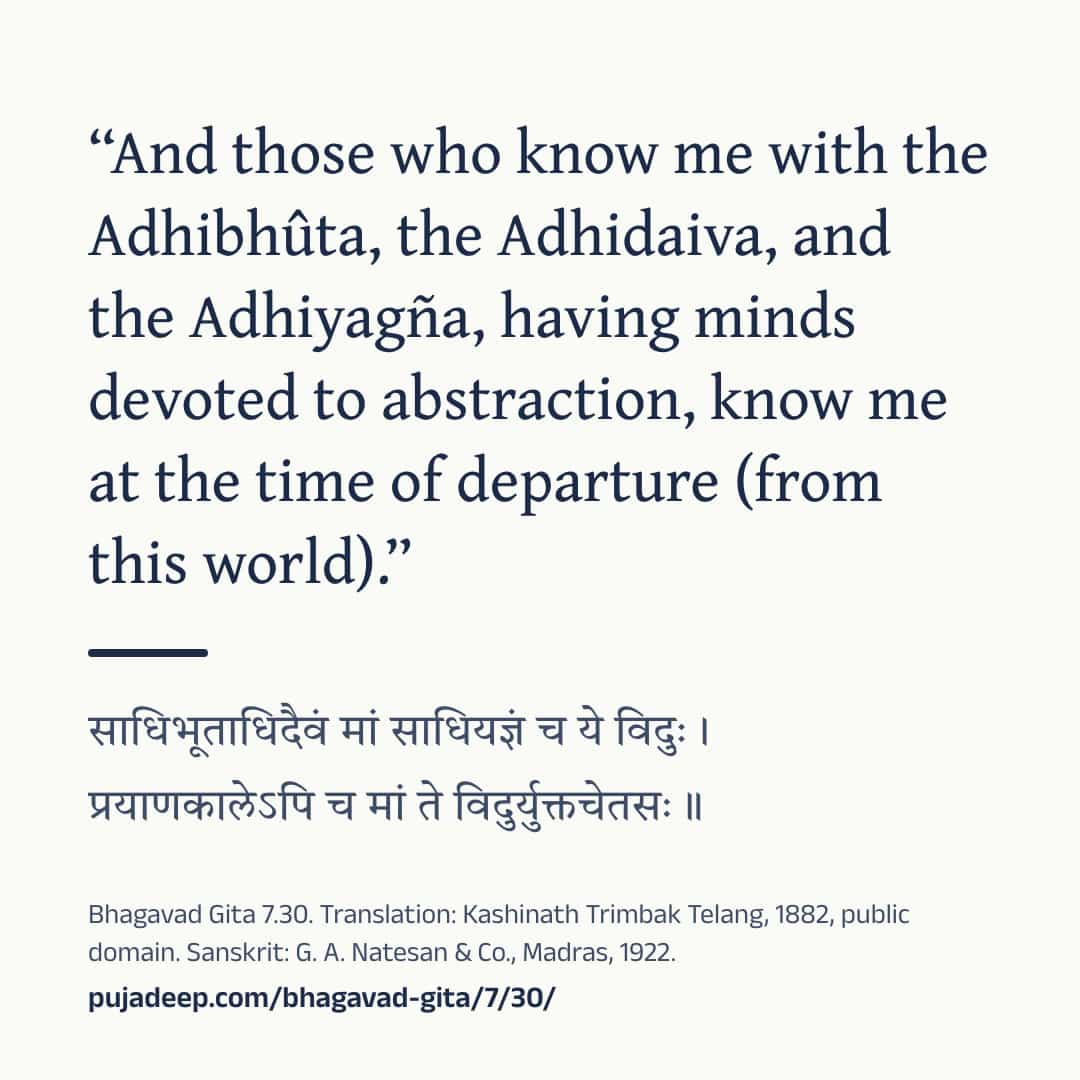
And those who know me with the Adhibhûta, the Adhidaiva, and the Adhiyagña, having minds devoted to abstraction, know me at the time of departure (from this world).
Compare 3 translations
Kashinath Trimbak Telang, 1882. Public domain. Page 77.
And those who know me with the Adhibhûta, the Adhidaiva, and the Adhiyagña, having minds devoted to abstraction, know me at the time of departure (from this world).
You are reading this one
Annie Besant, 1895. Public domain. Page 80.
They who know Me as Adhibhûta, as Adhidaiva and as Adhiyagnya1 they, harmonised in mind, know Me verily in the time of forthgoing.2
Footnotes (the translator’s own) - These five terms mean respectively the Supreme SELF, Action, the Supreme Living Being (in the sense of Element, material for building a universe), the Supreme God, the Supreme Sacrifice. The Sanskrit names are retained, lest the explanation given of them in the next discourse, by Shrî Krishna Himself, should lose any of its force. ↩
- Death—going forth from the body. ↩
You are reading this one
Swami Swarupananda, 1909 (first printed 1907). Public domain. Page 158.
Those who know Me with the Adhibhuta, and the Adhidaiva, and with the Adhiyajna, (continue to) know Me even at the time of death, steadfast in mind.
You are reading this one
Cite this verse
The translation: K. T. Telang, The Bhagavadgîtâ (The Sacred Books of the East, vol. VIII, Oxford: Clarendon Press, 1882), p. 77. Bhagavad Gita 7.30.
The translation: Annie Besant, The Bhagavad Gîtâ, or The Lord's Song (London: Theosophical Publishing Society, 1895), p. 80. Bhagavad Gita 7.30.
The translation: Swami Swarupananda, Srimad-Bhagavad-Gita (Mayavati: Prabuddha Bharata Press, 1909; first printed in Prabuddha Bharata, 1907–1909), p. 158. Bhagavad Gita 7.30.
Our explanation: “Bhagavad Gita 7.30: meaning and translation.” Pujadeep. Updated October 27, 2026. https://pujadeep.com/bhagavad-gita/7/30/
Pujadeep’s explanations are free to quote with credit: name Pujadeep and link to the page. How to credit
Classical readings, by school
No readings by school on this verse yet.
Share
Show the ways to share
Send one picture or the text to one chat. The picture names its source and the address of this page.
Drawing the picture
See the words
Bhagavad Gita 7.30

साधिभूताधिदैवं मां साधियज्ञं च ये विदुः ।
प्रयाणकालेऽपि च मां ते विदुर्युक्तचेतसः ॥

“And those who know me with the Adhibhûta, the Adhidaiva, and the Adhiyagña, having minds devoted to abstraction, know me at the time of departure (from this world).”
(K. T. Telang, The Bhagavadgîtâ (The Sacred Books of the East, vol. VIII, Oxford: Clarendon Press, 1882), p. 77, public domain)

“They who know Me as Adhibhûta, as Adhidaiva and as Adhiyagnya they, harmonised in mind, know Me verily in the time of forthgoing.”
(Annie Besant, The Bhagavad Gîtâ, or The Lord's Song (London: Theosophical Publishing Society, 1895), p. 80, public domain)

“Those who know Me with the Adhibhuta, and the Adhidaiva, and with the Adhiyajna, (continue to) know Me even at the time of death, steadfast in mind.”
(Swami Swarupananda, Srimad-Bhagavad-Gita (Mayavati: Prabuddha Bharata Press, 1909; first printed in Prabuddha Bharata, 1907–1909), p. 158, public domain)

Sanskrit: G. A. Natesan & Co., Madras, 1922.
https://pujadeep.com/bhagavad-gita/7/30/ Nothing is sent from this site. Your own app sends it, to the chat you choose. The picture quotes the translation you chose on this page, with its name and year.
Sanskrit text: The Bhagavad-Gita, or The Lord's Song, with the text in Devanagari and an English translation, 1922. Meanings: written for Pujadeep and checked against the cited edition. Source and changes
Questions families ask
Who speaks Bhagavad Gita 7.30?
Krishna speaks this verse, in chapter 7 (Jnana Vijnana Yoga).
Where does the Sanskrit text come from?
Sanskrit text: The Bhagavad-Gita, or The Lord's Song, with the text in Devanagari and an English translation, 1922. Meanings: written for Pujadeep and checked against the cited edition. See the source
Is the meaning on this page a translation?
Explanation written for this site from the sources listed here, and checked against the cited edition. It is not a translation and not the only way to read the text. Free to quote with credit.
Source and licence
- Sanskrit text
- The Bhagavad-Gita, or The Lord's Song, with the text in Devanagari and an English translation (Annie Besant, G. A. Natesan & Co., Madras, 1922). Public domain. The Sanskrit on these pages was read from this printing’s page images.
- Translation
- The Bhagavadgîtâ with the Sanatsugâtîya and the Anugîtâ, translated by Kâshinâth Trimbak Telang (The Sacred Books of the East, vol. VIII, ed. F. Max Müller) (Kashinath Trimbak Telang, F. Max Müller, Clarendon Press, Oxford, 1882). Public domain. Shown verbatim, as printed.
- Translation
- The Bhagavad Gîtâ, or The Lord's Song, translated by Annie Besant (Annie Besant, Theosophical Publishing Society, London, 1895). Public domain. Shown verbatim, as printed.
- Translation
- Srimad-Bhagavad-Gita, with Sanskrit Text; Paraphrase with Word-by-word Literal Translation; English Rendering and Comments, Index, &c., by the Swami Swarupananda (Himalayan Series, No. XX) (Swami Swarupananda, The Editors and Publishers, Advaita Ashrama, Mayavati, Prabuddha Bharata Press, Mayavati, Almora, Himalayas, 1909). Public domain. Shown verbatim, as printed.
- Common wording
- In this text, 32 words follow today's common wording, checked against sanskritdocuments.org; Sanskrit Wikisource; Gita Press, Gorakhpur; GRETIL, Göttingen and Bhaktivedanta Book Trust.
- Our explanation
- Explanation written for this site from the sources listed here, and checked against the cited edition. It is not a translation and not the only way to read the text. Free to quote with credit.
- Checked
- Checked against the cited edition, October 15, 2026.
- Updated
- October 27, 2026