Bhagavad Gita 8.1: meaning and translation
Chapter 8: Akshara Brahma Yoga. Arjuna says
Arjuna takes up the terms Krishna used at the end of chapter 7 (7.29–7.30).
Click or tap a word for its meaning and its dictionary page.
Text and layers
Text and layers
These choices stay in this browser.
Bhagavad Gita 8.1
अर्जुन उवाच ।
किं तद्ब्रह्म किमध्यात्मं किं कर्म पुरुषोत्तम ।अधिभूतं च किं प्रोक्तमधिदैवं किमुच्यते ॥
Kim tadbrahma kimadhyatmam kim karma purushottamaAdhibhutam cha kim proktamadhidaivam kimuchyate
kiṃ tadbrahma kimadhyātmaṃ kiṃ karma puruṣottama |adhibhūtaṃ ca kiṃ proktamadhidaivaṃ kimucyate ||
Our explanation Arjuna takes up the terms Krishna used at the end of chapter 7 (7.29–7.30). He asks Krishna, whom he calls Purushottama (the highest person): what is that Brahman, what is adhyātma, what is karma, what is called adhibhūta, and what is adhidaiva?
हिंदी अर्थ अर्जुन उन शब्दों के बारे में पूछते हैं जो कृष्ण ने अध्याय 7 के अंत (श्लोक 29–30) में कहे थे। वे कृष्ण को पुरुषोत्तम (सबसे श्रेष्ठ पुरुष) कहकर पूछते हैं: वह ब्रह्म क्या है, अध्यात्म क्या है, कर्म क्या है, अधिभूत किसे कहते हैं, और अधिदैव क्या है?
Word by word
Every word, with its dictionary page
Word by word
- किम् kim · what (interrogative pronoun, nominative singular) Dictionary: kim, Monier-Williams 1899, p. 282, col. 2 “what? how? whence? wherefore? why?”
- तत् tat · that (pronoun, nominative singular) Dictionary: tad, Monier-Williams 1899, p. 434, col. 1 “m. he, f. she, n. it, that, this”
- ब्रह्म brahma · Brahman (nominative singular) Dictionary: brahman, Monier-Williams 1899, p. 738, col. 1 “one self-existent impersonal Spirit, the one universal Soul”
- किम् kim · what (interrogative pronoun, nominative singular) Dictionary: kim, Monier-Williams 1899, p. 282, col. 2 “what? how? whence? wherefore? why?”
- अध्यात्मम् adhyātmam · adhyātma, the self within (nominative singular) Dictionary: adhy-ātma, Monier-Williams 1899, p. 23, col. 2 “the Supreme Spirit”
- किम् kim · what (interrogative pronoun, nominative singular) Dictionary: kim, Monier-Williams 1899, p. 282, col. 2 “what? how? whence? wherefore? why?”
- कर्म karma · karma, action (nominative singular) Dictionary: karman, Monier-Williams 1899, p. 258, col. 2 “act, action, performance, business”
- पुरुषोत्तम puruṣottama · O highest person (Krishna) (compound, vocative singular) Dictionary: puruṣottama, Monier-Williams 1899, p. 637, col. 3 “the highest being, Supreme Spirit, N. of Vishṇu or Kṛishṇa”
- अधिभूतम् adhibhūtam · adhibhūta, what concerns beings (nominative singular) Dictionary: adhi-bhūta, Monier-Williams 1899, p. 21, col. 2 “the spiritual or fine substratum of material or gross objects”
- च ca · and (indeclinable) Dictionary: 2. ca, Monier-Williams 1899, p. 380, col. 1 “and, both, also, moreover, as well as”
- किम् kim · what (interrogative pronoun, nominative singular) Dictionary: kim, Monier-Williams 1899, p. 282, col. 2 “what? how? whence? wherefore? why?”
- प्रोक्तम् proktam · is declared (past participle, nominative singular) Dictionary: prokta, Monier-Williams 1899, p. 690, col. 2 “called, declared, said”
- अधिदैवम् adhidaivam · adhidaiva, what concerns the gods (nominative singular) Dictionary: adhi-daiva, Monier-Williams 1899, p. 21, col. 1 “the supreme deity; the divine agent operating in material objects”
- किम् kim · what (interrogative pronoun, nominative singular) Dictionary: kim, Monier-Williams 1899, p. 282, col. 2 “what? how? whence? wherefore? why?”
- उच्यते ucyate · is called (passive, present, 3rd person singular) Dictionary: vac, Monier-Williams 1899, p. 912, col. 1 “to be called or accounted, be regarded as”
Old translations
Kashinath Trimbak Telang, 1882. Public domain. Page 77.
Arguna said:
What is that Brahman, what the Adhyâtma, and what, O best of beings! is action? And what is called the Adhibhûta?
Compare 3 translations
Kashinath Trimbak Telang, 1882. Public domain. Page 77.
Arguna said:
What is that Brahman, what the Adhyâtma, and what, O best of beings! is action? And what is called the Adhibhûta?
You are reading this one
Annie Besant, 1895. Public domain. Page 81.
Arjuna said:
What that Brahman, what Adhyâtmâ, what Karma, O Purushottama? And what is declared Adhibhûta, what is called Adhidaiva?
You are reading this one
Swami Swarupananda, 1909 (first printed 1907). Public domain. Page 159.
Arjuna said:
What is that Brahman, what is Adhyàtma, what is Karma, O best of Purushas? What is called Adhibhuta, and what Adhidaiva?
You are reading this one
Cite this verse
The translation: K. T. Telang, The Bhagavadgîtâ (The Sacred Books of the East, vol. VIII, Oxford: Clarendon Press, 1882), p. 77. Bhagavad Gita 8.1.
The translation: Annie Besant, The Bhagavad Gîtâ, or The Lord's Song (London: Theosophical Publishing Society, 1895), p. 81. Bhagavad Gita 8.1.
The translation: Swami Swarupananda, Srimad-Bhagavad-Gita (Mayavati: Prabuddha Bharata Press, 1909; first printed in Prabuddha Bharata, 1907–1909), p. 159. Bhagavad Gita 8.1.
Our explanation: “Bhagavad Gita 8.1: meaning and translation.” Pujadeep. Updated October 27, 2026. https://pujadeep.com/bhagavad-gita/8/1/
Pujadeep’s explanations are free to quote with credit: name Pujadeep and link to the page. How to credit
Classical readings, by school
No readings by school on this verse yet.
Share
Show the ways to share
Send one picture or the text to one chat. The picture names its source and the address of this page.
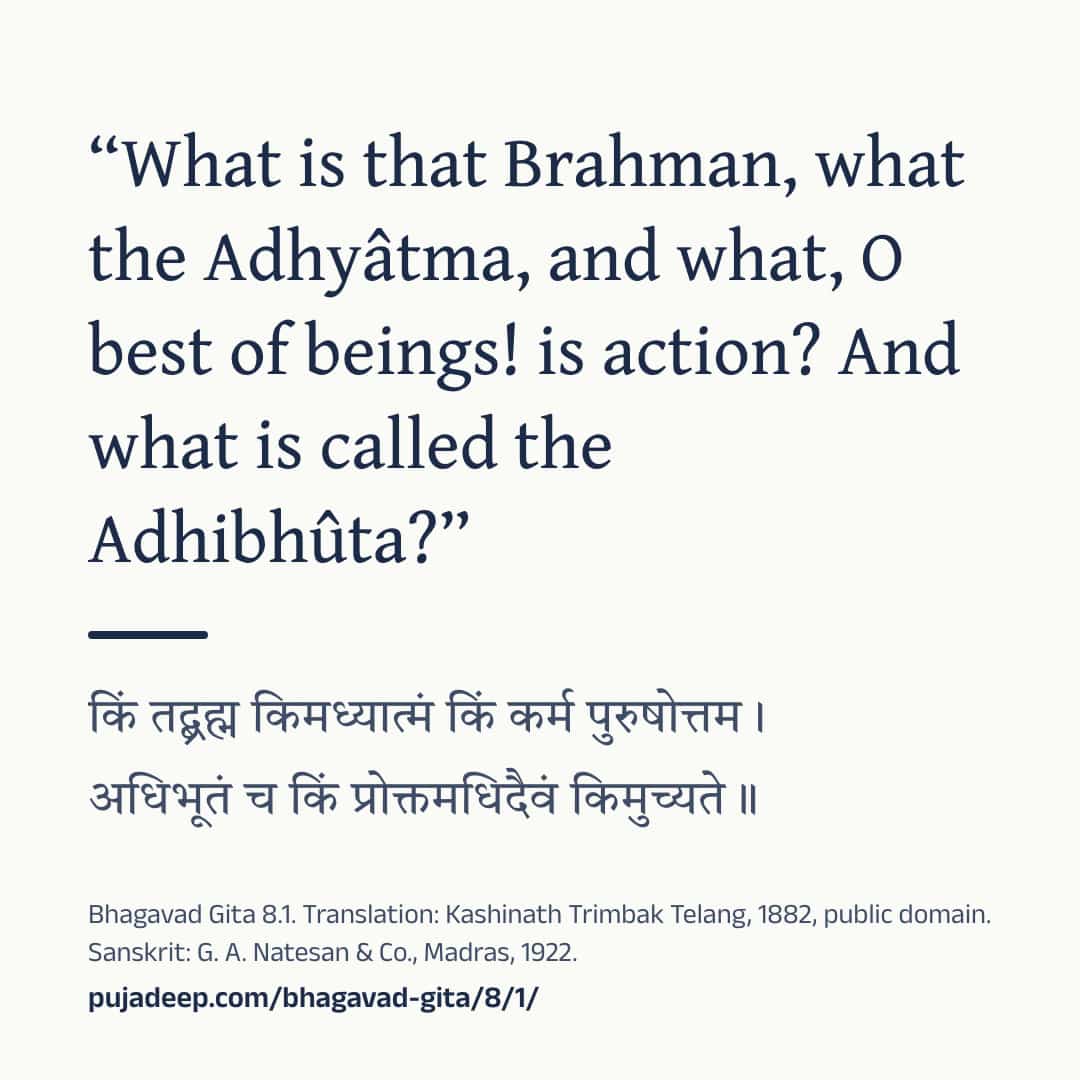
Drawing the picture
See the words
Bhagavad Gita 8.1

किं तद्ब्रह्म किमध्यात्मं किं कर्म पुरुषोत्तम ।
अधिभूतं च किं प्रोक्तमधिदैवं किमुच्यते ॥

“What is that Brahman, what the Adhyâtma, and what, O best of beings! is action? And what is called the Adhibhûta?”
(K. T. Telang, The Bhagavadgîtâ (The Sacred Books of the East, vol. VIII, Oxford: Clarendon Press, 1882), p. 77, public domain)

“What that Brahman, what Adhyâtmâ, what Karma, O Purushottama? And what is declared Adhibhûta, what is called Adhidaiva?”
(Annie Besant, The Bhagavad Gîtâ, or The Lord's Song (London: Theosophical Publishing Society, 1895), p. 81, public domain)

“What is that Brahman, what is Adhyàtma, what is Karma, O best of Purushas? What is called Adhibhuta, and what Adhidaiva?”
(Swami Swarupananda, Srimad-Bhagavad-Gita (Mayavati: Prabuddha Bharata Press, 1909; first printed in Prabuddha Bharata, 1907–1909), p. 159, public domain)

Sanskrit: G. A. Natesan & Co., Madras, 1922.
https://pujadeep.com/bhagavad-gita/8/1/ Nothing is sent from this site. Your own app sends it, to the chat you choose. The picture quotes the translation you chose on this page, with its name and year.
Sanskrit text: The Bhagavad-Gita, or The Lord's Song, with the text in Devanagari and an English translation, 1922. Meanings: written for Pujadeep and checked against the cited edition. Source and changes
Questions families ask
Who speaks Bhagavad Gita 8.1?
Arjuna speaks this verse, in chapter 8 (Akshara Brahma Yoga).
Where does the Sanskrit text come from?
Sanskrit text: The Bhagavad-Gita, or The Lord's Song, with the text in Devanagari and an English translation, 1922. Meanings: written for Pujadeep and checked against the cited edition. See the source
Is the meaning on this page a translation?
Explanation written for this site from the sources listed here, and checked against the cited edition. It is not a translation and not the only way to read the text. Free to quote with credit.
Source and licence
- Sanskrit text
- The Bhagavad-Gita, or The Lord's Song, with the text in Devanagari and an English translation (Annie Besant, G. A. Natesan & Co., Madras, 1922). Public domain. The Sanskrit on these pages was read from this printing’s page images.
- Translation
- The Bhagavadgîtâ with the Sanatsugâtîya and the Anugîtâ, translated by Kâshinâth Trimbak Telang (The Sacred Books of the East, vol. VIII, ed. F. Max Müller) (Kashinath Trimbak Telang, F. Max Müller, Clarendon Press, Oxford, 1882). Public domain. Shown verbatim, as printed.
- Translation
- The Bhagavad Gîtâ, or The Lord's Song, translated by Annie Besant (Annie Besant, Theosophical Publishing Society, London, 1895). Public domain. Shown verbatim, as printed.
- Translation
- Srimad-Bhagavad-Gita, with Sanskrit Text; Paraphrase with Word-by-word Literal Translation; English Rendering and Comments, Index, &c., by the Swami Swarupananda (Himalayan Series, No. XX) (Swami Swarupananda, The Editors and Publishers, Advaita Ashrama, Mayavati, Prabuddha Bharata Press, Mayavati, Almora, Himalayas, 1909). Public domain. Shown verbatim, as printed.
- Common wording
- In this text, 32 words follow today's common wording, checked against sanskritdocuments.org; Sanskrit Wikisource; Gita Press, Gorakhpur; GRETIL, Göttingen and Bhaktivedanta Book Trust.
- Our explanation
- Explanation written for this site from the sources listed here, and checked against the cited edition. It is not a translation and not the only way to read the text. Free to quote with credit.
- Checked
- Checked against the cited edition, October 27, 2026.