Bhagavad Gita 8.12: meaning and translation
Chapter 8: Akshara Brahma Yoga. Krishna says
Krishna describes a yogic death: all the gates of the body (the senses) held in check, the mind kept in the heart, the life-breath placed at the crown of the head, steady in the concentration of yoga.
Click or tap a word for its meaning and its dictionary page.
Text and layers
Text and layers
These choices stay in this browser.
Bhagavad Gita 8.12
सर्वद्वाराणि संयम्य मनो हृदि निरुध्य च ।मूर्ध्न्याधायात्मनः प्राणमास्थितो योगधारणाम् ॥
Sarvadvarani sanyamya mano hridi nirudhya chaMurdhnyadhayatmanah pranamasthito yogadharanam
sarvadvārāṇi saṃyamya mano hṛdi nirudhya ca |mūrdhnyādhāyātmanaḥ prāṇamāsthito yogadhāraṇām ||
Our explanation Krishna describes a yogic death: all the gates of the body (the senses) held in check, the mind kept in the heart, the life-breath placed at the crown of the head, steady in the concentration of yoga. The sentence continues into verse 13.
हिंदी अर्थ कृष्ण योगी के शरीर-त्याग का वर्णन करते हैं: शरीर के सब द्वार (इंद्रियाँ) संयम में, मन हृदय में रुका हुआ, प्राण सिर (मूर्धा) में स्थापित, और योग की धारणा में स्थिर। यह वाक्य श्लोक 13 में पूरा होता है।
Word by word
Every word, with its dictionary page
Word by word
- सर्वद्वाराणि sarvadvārāṇi · all the gates (of the senses) (compound, accusative plural) Dictionary: sarva, Monier-Williams 1899, p. 1184, col. 3 “whole, entire, all, every”; dvāra, Monier-Williams 1899, p. 504, col. 2 “door, gate, passage, entrance”
- संयम्य saṃyamya · having restrained (absolutive ('having done')) Dictionary: saṃ-yam, Monier-Williams 1899, p. 1111, col. 3 “to hold together, hold in, hold fast, restrain, curb, suppress, control”
- मनः manaḥ · the mind (accusative singular) Dictionary: manas, Monier-Williams 1899, p. 783, col. 3 “mind (in its widest sense as applied to all the mental powers)”
- हृदि hṛdi · in the heart (locative singular) Dictionary: hṛd, Monier-Williams 1899, p. 1302, col. 2 “the heart (as the seat of feelings and emotions)”
- निरुध्य nirudhya · having held in (absolutive ('having done')) Dictionary: ni-rudh, Monier-Williams 1899, p. 553, col. 3 “to hold back, stop, hinder, shut up, confine, restrain, check”
- च ca · and (indeclinable) Dictionary: 2. ca, Monier-Williams 1899, p. 380, col. 1 “and, both, also, moreover, as well as”
- मूर्ध्नि mūrdhni · in the head (locative singular) Dictionary: mūrdhan, Monier-Williams 1899, p. 826, col. 1 “the forehead, head in general, skull”
- आधाय ādhāya · having placed (absolutive ('having done')) Dictionary: ā-dhā, Monier-Williams 1899, p. 138, col. 2 “to place on, put down, deposit, put”
- आत्मनः ātmanaḥ · his own (genitive singular) Dictionary: ātman, Monier-Williams 1899, p. 135, col. 1 “the individual soul, self”
- प्राणम् prāṇam · the life-breath (accusative singular) Dictionary: 2. prāṇa, Monier-Williams 1899, p. 705, col. 1 “the breath of life, breath, respiration, spirit, vitality”
- आस्थितः āsthitaḥ · holding to, engaged in (past participle, nominative singular) Dictionary: ā-sthita, Monier-Williams 1899, p. 161, col. 2 “one who has undertaken or performed”
- योगधारणाम् yogadhāraṇām · the concentration of yoga (compound, accusative singular (feminine)) Dictionary: yoga-dhāraṇā, Monier-Williams 1899, p. 857, col. 1 “continuance or perseverance in meditation”
Old translations
Kashinath Trimbak Telang, 1882. Public domain. Page 79.
He who leaves the body and departs (from this world), stopping up all passages1, and confining the mind within the heart2, placing the life-breath in the head, and adhering to uninterrupted meditation3, repeating the single syllable 'Om,' (signifying) the eternal Brahman4, and meditating on me, he reaches the highest goal.
This sentence covers verses 8.12 to 8.13.
Footnotes (the translator’s own) - 'The senses,' say the commentators. Might it not refer to the 'nine portals' at p. 65 supra? See also, however, p. 108. ↩
- I. e. thinking of nothing, making the mind cease to work. Cf. Maitrî-upanishad, p. 179. ↩
- Cf. Maitrî-upanishad, p. 130, uninterrupted, like 'oil when poured out,' says the commentator. ↩
- Cf. Khândogya-upanishad, p. 151; Mândukya, pp. 330–388 (Om is all—past, present, and future); Nrisimha Tâpinî, pp. 110, 117, 171; Maitrî, p. 140; Prasna, p. 220. On the opening passage of the Khândogya, Saṅkara says, 'Om is the closest designation of the supreme Being. He is pleased when it is pronounced, as people are at the mention of a favourite name.' See also Max Müller, Hibbert Lectures, p. 84; Goldstücker's Remains, I, 122. ↩
Compare 3 translations
Kashinath Trimbak Telang, 1882. Public domain. Page 79.
He who leaves the body and departs (from this world), stopping up all passages1, and confining the mind within the heart2, placing the life-breath in the head, and adhering to uninterrupted meditation3, repeating the single syllable 'Om,' (signifying) the eternal Brahman4, and meditating on me, he reaches the highest goal.
This sentence covers verses 8.12 to 8.13.
Footnotes (the translator’s own) - 'The senses,' say the commentators. Might it not refer to the 'nine portals' at p. 65 supra? See also, however, p. 108. ↩
- I. e. thinking of nothing, making the mind cease to work. Cf. Maitrî-upanishad, p. 179. ↩
- Cf. Maitrî-upanishad, p. 130, uninterrupted, like 'oil when poured out,' says the commentator. ↩
- Cf. Khândogya-upanishad, p. 151; Mândukya, pp. 330–388 (Om is all—past, present, and future); Nrisimha Tâpinî, pp. 110, 117, 171; Maitrî, p. 140; Prasna, p. 220. On the opening passage of the Khândogya, Saṅkara says, 'Om is the closest designation of the supreme Being. He is pleased when it is pronounced, as people are at the mention of a favourite name.' See also Max Müller, Hibbert Lectures, p. 84; Goldstücker's Remains, I, 122. ↩
You are reading this one
Annie Besant, 1895. Public domain. Page 83.
All the gates1 closed, Manas confined in the heart, the life-breath fixed in his own head, firm in Yoga,
This sentence goes on in 8.13.
Footnotes (the translator’s own) - The gates of the body, i.e., the sense-organs, ↩
You are reading this one
Swami Swarupananda, 1909 (first printed 1907). Public domain. Page 165.
Controlling all the senses, confining the mind in the heart, drawing the Prana into the head, occupied in the practice of concentration, uttering the one-syllable "Om"—the Brahman, and meditating on Me;—he who departs, leaving the body, attains the Supreme goal,
This sentence covers verses 8.12 to 8.13.
You are reading this one
Cite this verse
The translation: K. T. Telang, The Bhagavadgîtâ (The Sacred Books of the East, vol. VIII, Oxford: Clarendon Press, 1882), p. 79. Bhagavad Gita 8.12–13.
The translation: Annie Besant, The Bhagavad Gîtâ, or The Lord's Song (London: Theosophical Publishing Society, 1895), p. 83. Bhagavad Gita 8.12.
The translation: Swami Swarupananda, Srimad-Bhagavad-Gita (Mayavati: Prabuddha Bharata Press, 1909; first printed in Prabuddha Bharata, 1907–1909), p. 165. Bhagavad Gita 8.12–13.
Our explanation: “Bhagavad Gita 8.12: meaning and translation.” Pujadeep. Updated October 27, 2026. https://pujadeep.com/bhagavad-gita/8/12/
Pujadeep’s explanations are free to quote with credit: name Pujadeep and link to the page. How to credit
Classical readings, by school
No readings by school on this verse yet.
Share
Show the ways to share
Send one picture or the text to one chat. The picture names its source and the address of this page.
Drawing the picture
See the words
Bhagavad Gita 8.12

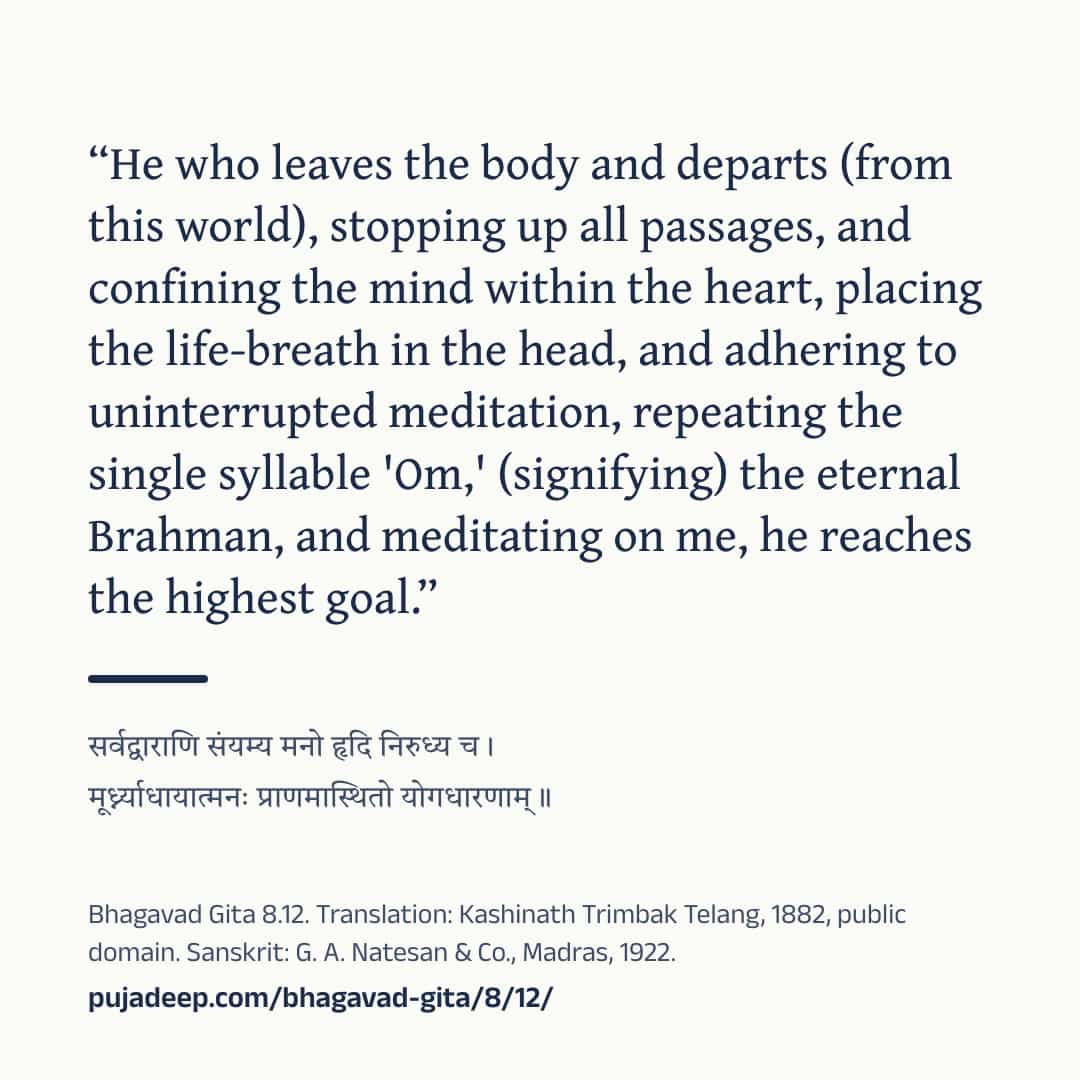
सर्वद्वाराणि संयम्य मनो हृदि निरुध्य च ।
मूर्ध्न्याधायात्मनः प्राणमास्थितो योगधारणाम् ॥

“He who leaves the body and departs (from this world), stopping up all passages, and confining the mind within the heart, placing the life-breath in the head, and adhering to uninterrupted meditation, repeating the single syllable 'Om,' (signifying) the eternal Brahman, and meditating on me, he reaches the highest goal.”
(K. T. Telang, The Bhagavadgîtâ (The Sacred Books of the East, vol. VIII, Oxford: Clarendon Press, 1882), p. 79, public domain)
This sentence covers verses 8.12 to 8.13.

“All the gates closed, Manas confined in the heart, the life-breath fixed in his own head, firm in Yoga,”
(Annie Besant, The Bhagavad Gîtâ, or The Lord's Song (London: Theosophical Publishing Society, 1895), p. 83, public domain)
This sentence goes on in 8.13.

“Controlling all the senses, confining the mind in the heart, drawing the Prana into the head, occupied in the practice of concentration, uttering the one-syllable "Om"—the Brahman, and meditating on Me;—he who departs, leaving the body, attains the Supreme goal,”
(Swami Swarupananda, Srimad-Bhagavad-Gita (Mayavati: Prabuddha Bharata Press, 1909; first printed in Prabuddha Bharata, 1907–1909), p. 165, public domain)
This sentence covers verses 8.12 to 8.13.

Sanskrit: G. A. Natesan & Co., Madras, 1922.
https://pujadeep.com/bhagavad-gita/8/12/ Nothing is sent from this site. Your own app sends it, to the chat you choose. The picture quotes the translation you chose on this page, with its name and year.
Sanskrit text: The Bhagavad-Gita, or The Lord's Song, with the text in Devanagari and an English translation, 1922. Meanings: written for Pujadeep and checked against the cited edition. Source and changes
Questions families ask
Who speaks Bhagavad Gita 8.12?
Krishna speaks this verse, in chapter 8 (Akshara Brahma Yoga).
Where does the Sanskrit text come from?
Sanskrit text: The Bhagavad-Gita, or The Lord's Song, with the text in Devanagari and an English translation, 1922. Meanings: written for Pujadeep and checked against the cited edition. See the source
Is the meaning on this page a translation?
Explanation written for this site from the sources listed here, and checked against the cited edition. It is not a translation and not the only way to read the text. Free to quote with credit.
Source and licence
- Sanskrit text
- The Bhagavad-Gita, or The Lord's Song, with the text in Devanagari and an English translation (Annie Besant, G. A. Natesan & Co., Madras, 1922). Public domain. The Sanskrit on these pages was read from this printing’s page images.
- Translation
- The Bhagavadgîtâ with the Sanatsugâtîya and the Anugîtâ, translated by Kâshinâth Trimbak Telang (The Sacred Books of the East, vol. VIII, ed. F. Max Müller) (Kashinath Trimbak Telang, F. Max Müller, Clarendon Press, Oxford, 1882). Public domain. Shown verbatim, as printed.
- Translation
- The Bhagavad Gîtâ, or The Lord's Song, translated by Annie Besant (Annie Besant, Theosophical Publishing Society, London, 1895). Public domain. Shown verbatim, as printed.
- Translation
- Srimad-Bhagavad-Gita, with Sanskrit Text; Paraphrase with Word-by-word Literal Translation; English Rendering and Comments, Index, &c., by the Swami Swarupananda (Himalayan Series, No. XX) (Swami Swarupananda, The Editors and Publishers, Advaita Ashrama, Mayavati, Prabuddha Bharata Press, Mayavati, Almora, Himalayas, 1909). Public domain. Shown verbatim, as printed.
- Common wording
- In this text, 32 words follow today's common wording, checked against sanskritdocuments.org; Sanskrit Wikisource; Gita Press, Gorakhpur; GRETIL, Göttingen and Bhaktivedanta Book Trust.
- Our explanation
- Explanation written for this site from the sources listed here, and checked against the cited edition. It is not a translation and not the only way to read the text. Free to quote with credit.
- Checked
- Checked against the cited edition, October 27, 2026.