Bhagavad Gita 8.10: meaning and translation
Chapter 8: Akshara Brahma Yoga. Krishna says
Such a person, Krishna says, at the time of departure, with a steady mind, full of devotion, and by the strength of yoga drawing the life-breath (prāṇa) to the point between the eyebrows, reaches that supreme divine Purusha.
Click or tap a word for its meaning and its dictionary page.
Text and layers
Text and layers
These choices stay in this browser.
Bhagavad Gita 8.10
प्रयाणकाले मनसाऽचलेन भक्त्या युक्तो योगबलेन चैव ।भ्रुवोर्मध्ये प्राणमावेश्य सम्यक् स तं परं पुरुषमुपैति दिव्यम् ॥
Prayanakale manasachalena bhaktya yukto yogabalena chaivaBhruvormadhye pranamaveshya samyak sa tam param purushamupaiti divyam
prayāṇakāle manasā’calena bhaktyā yukto yogabalena caiva |bhruvormadhye prāṇamāveśya samyak sa taṃ paraṃ puruṣamupaiti divyam ||
Our explanation Such a person, Krishna says, at the time of departure, with a steady mind, full of devotion, and by the strength of yoga drawing the life-breath (prāṇa) to the point between the eyebrows, reaches that supreme divine Purusha.
हिंदी अर्थ कृष्ण कहते हैं कि ऐसा व्यक्ति प्रयाण (मृत्यु) के समय स्थिर मन से, भक्ति से युक्त होकर, योग के बल से प्राण को भौंहों के बीच ठीक से स्थापित करके, उस परम दिव्य पुरुष को प्राप्त होता है।
Word by word
Every word, with its dictionary page
Word by word
- प्रयाणकाले prayāṇakāle · at the time of departure (death) (compound, locative singular) Dictionary: pra-yāṇa-kāla, Monier-Williams 1899, p. 688, col. 1 “time of departure, death”
- मनसा manasā · with a mind (instrumental singular) Dictionary: manas, Monier-Williams 1899, p. 783, col. 3 “mind (in its widest sense as applied to all the mental powers)”
- अचलेन acalena · steady, unmoving (instrumental singular) Dictionary: a-cala, Monier-Williams 1899, p. 8, col. 3 “not moving, immovable”
- भक्त्या bhaktyā · with devotion (instrumental singular) Dictionary: bhakti, Monier-Williams 1899, p. 743, col. 2 “attachment, devotion, fondness for, devotion to”
- युक्तः yuktaḥ · joined, endowed (past participle, nominative singular) Dictionary: yukta, Monier-Williams 1899, p. 853, col. 2 “absorbed in abstract meditation, concentrated, attentive”
- योगबलेन yogabalena · by the strength of yoga (compound, instrumental singular) Dictionary: yoga-bala, Monier-Williams 1899, p. 857, col. 1 “the force of devotion”
- च ca · and (indeclinable) Dictionary: 2. ca, Monier-Williams 1899, p. 380, col. 1 “and, both, also, moreover, as well as”
- एव eva · also, indeed (indeclinable) Dictionary: 1. eva, Monier-Williams 1899, p. 232, col. 2 “just, exactly, very, same, only, even, alone, merely”
- भ्रुवोः bhruvoḥ · of the two eyebrows (genitive dual) Dictionary: bhrū, Monier-Williams 1899, p. 770, col. 3 “an eyebrow, the brow”
- मध्ये madhye · between (locative singular) Dictionary: madhya, Monier-Williams 1899, p. 781, col. 3 “the middle, midst, centre, inside, interior”
- प्राणम् prāṇam · the life-breath (accusative singular) Dictionary: 2. prāṇa, Monier-Williams 1899, p. 705, col. 1 “the breath of life, breath, respiration, spirit, vitality”
- आवेश्य āveśya · having placed, having fixed (absolutive of the causative ('having made')) Dictionary: ā-viś, Monier-Williams 1899, p. 155, col. 3 “Caus. -veśayati, to cause to enter or approach”
- सम्यक् samyak · rightly, fully (indeclinable) Dictionary: samy-añc, Monier-Williams 1899, p. 1181, col. 2 “correctly, truly, properly, fitly, in the right way or manner, well, duly”
- सः saḥ · he (pronoun, nominative singular) Dictionary: tad, Monier-Williams 1899, p. 434, col. 1 “m. he, f. she, n. it, that, this”
- तम् tam · that (pronoun, accusative singular) Dictionary: tad, Monier-Williams 1899, p. 434, col. 1 “m. he, f. she, n. it, that, this”
- परम् param · supreme (accusative singular) Dictionary: 1. para, Monier-Williams 1899, p. 586, col. 1 “highest, supreme, chief”
- पुरुषम् puruṣam · the Purusha, the person (accusative singular) Dictionary: puruṣa, Monier-Williams 1899, p. 637, col. 1 “the Supreme Being or Soul of the universe”
- उपैति upaiti · reaches (present, 3rd person singular) Dictionary: 1. upe, Monier-Williams 1899, p. 215, col. 2 “to come near to, reach, obtain”
- दिव्यम् divyam · divine (accusative singular) Dictionary: 2. divya, Monier-Williams 1899, p. 479, col. 2 “divine, heavenly, celestial”
Old translations
Kashinath Trimbak Telang, 1882. Public domain.
Telang translates verses 9–10 as one sentence; see 8.9. Read it at 8.9
Compare 3 translations
Kashinath Trimbak Telang, 1882. Public domain.
Telang translates verses 9–10 as one sentence; see 8.9. Read it at 8.9
You are reading this one
Annie Besant, 1895. Public domain. Page 83.
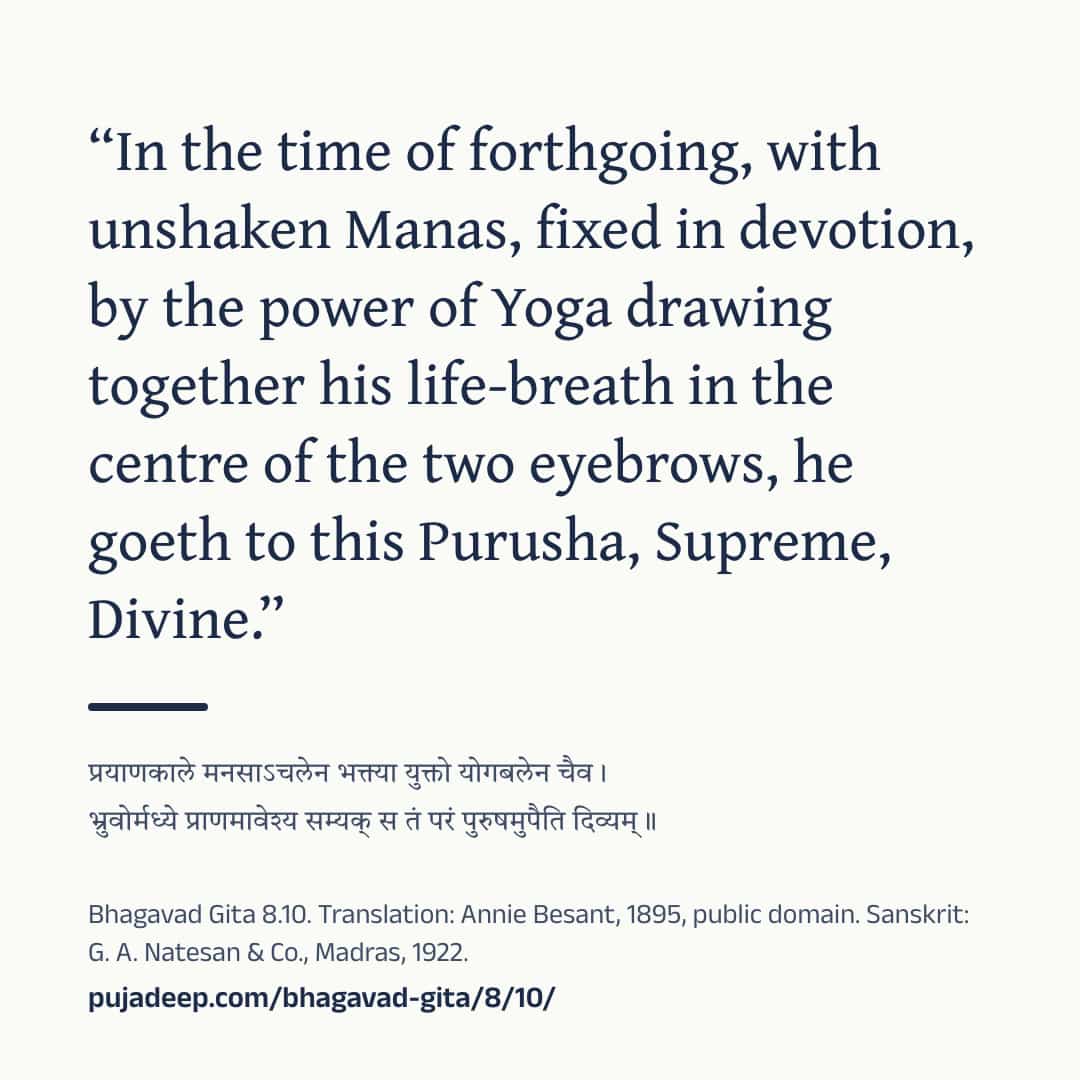
In the time of forthgoing, with unshaken Manas, fixed in devotion, by the power of Yoga drawing together his life-breath in the centre of the two eyebrows, he goeth to this Purusha, Supreme, Divine.
This sentence begins in 8.9.
You are reading this one
Swami Swarupananda, 1909 (first printed 1907). Public domain.
Swarupananda renders verses 9–10 together; see 8.9. Read it at 8.9
You are reading this one
Cite this verse
The translation: K. T. Telang, The Bhagavadgîtâ (The Sacred Books of the East, vol. VIII, Oxford: Clarendon Press, 1882), p. 78. Bhagavad Gita 8.9–10.
The translation: Annie Besant, The Bhagavad Gîtâ, or The Lord's Song (London: Theosophical Publishing Society, 1895), p. 83. Bhagavad Gita 8.10.
The translation: Swami Swarupananda, Srimad-Bhagavad-Gita (Mayavati: Prabuddha Bharata Press, 1909; first printed in Prabuddha Bharata, 1907–1909), p. 164. Bhagavad Gita 8.9–10.
Our explanation: “Bhagavad Gita 8.10: meaning and translation.” Pujadeep. Updated October 27, 2026. https://pujadeep.com/bhagavad-gita/8/10/
Pujadeep’s explanations are free to quote with credit: name Pujadeep and link to the page. How to credit
Classical readings, by school
No readings by school on this verse yet.
Share
Show the ways to share
Send one picture or the text to one chat. The picture names its source and the address of this page.
Drawing the picture
See the words
Bhagavad Gita 8.10

प्रयाणकाले मनसाऽचलेन भक्त्या युक्तो योगबलेन चैव ।
भ्रुवोर्मध्ये प्राणमावेश्य सम्यक् स तं परं पुरुषमुपैति दिव्यम् ॥

“In the time of forthgoing, with unshaken Manas, fixed in devotion, by the power of Yoga drawing together his life-breath in the centre of the two eyebrows, he goeth to this Purusha, Supreme, Divine.”
(Annie Besant, The Bhagavad Gîtâ, or The Lord's Song (London: Theosophical Publishing Society, 1895), p. 83, public domain)
This sentence begins in 8.9.

Sanskrit: G. A. Natesan & Co., Madras, 1922.
https://pujadeep.com/bhagavad-gita/8/10/ Nothing is sent from this site. Your own app sends it, to the chat you choose. The picture quotes the translation you chose on this page, with its name and year.
Sanskrit text: The Bhagavad-Gita, or The Lord's Song, with the text in Devanagari and an English translation, 1922. Meanings: written for Pujadeep and checked against the cited edition. Source and changes
Questions families ask
Who speaks Bhagavad Gita 8.10?
Krishna speaks this verse, in chapter 8 (Akshara Brahma Yoga).
Where does the Sanskrit text come from?
Sanskrit text: The Bhagavad-Gita, or The Lord's Song, with the text in Devanagari and an English translation, 1922. Meanings: written for Pujadeep and checked against the cited edition. See the source
Is the meaning on this page a translation?
Explanation written for this site from the sources listed here, and checked against the cited edition. It is not a translation and not the only way to read the text. Free to quote with credit.
Source and licence
- Sanskrit text
- The Bhagavad-Gita, or The Lord's Song, with the text in Devanagari and an English translation (Annie Besant, G. A. Natesan & Co., Madras, 1922). Public domain. The Sanskrit on these pages was read from this printing’s page images.
- Translation
- The Bhagavadgîtâ with the Sanatsugâtîya and the Anugîtâ, translated by Kâshinâth Trimbak Telang (The Sacred Books of the East, vol. VIII, ed. F. Max Müller) (Kashinath Trimbak Telang, F. Max Müller, Clarendon Press, Oxford, 1882). Public domain. Shown verbatim, as printed.
- Translation
- The Bhagavad Gîtâ, or The Lord's Song, translated by Annie Besant (Annie Besant, Theosophical Publishing Society, London, 1895). Public domain. Shown verbatim, as printed.
- Translation
- Srimad-Bhagavad-Gita, with Sanskrit Text; Paraphrase with Word-by-word Literal Translation; English Rendering and Comments, Index, &c., by the Swami Swarupananda (Himalayan Series, No. XX) (Swami Swarupananda, The Editors and Publishers, Advaita Ashrama, Mayavati, Prabuddha Bharata Press, Mayavati, Almora, Himalayas, 1909). Public domain. Shown verbatim, as printed.
- Common wording
- In this text, 32 words follow today's common wording, checked against sanskritdocuments.org; Sanskrit Wikisource; Gita Press, Gorakhpur; GRETIL, Göttingen and Bhaktivedanta Book Trust.
- Our explanation
- Explanation written for this site from the sources listed here, and checked against the cited edition. It is not a translation and not the only way to read the text. Free to quote with credit.
- Checked
- Checked against the cited edition, October 27, 2026.