Bhagavad Gita 8.11: meaning and translation
Chapter 8: Akshara Brahma Yoga. Krishna says
Krishna will now describe briefly the goal that knowers of the Veda call imperishable, that disciplined people free from passion enter, and for which people keep the vow of brahmacarya (a life of study and self-restraint).
Click or tap a word for its meaning and its dictionary page.
Text and layers
Text and layers
These choices stay in this browser.
Bhagavad Gita 8.11
यदक्षरं वेदविदो वदन्ति विशन्ति यद्यतयो वीतरागाः ।यदिच्छन्तो ब्रह्मचर्यं चरन्ति तत्ते पदं सङ्ग्रहेण प्रवक्ष्ये ॥
Yadaksharam vedavido vadanti vishanti yadyatayo vitaragahYadichchhanto brahmacharyam charanti tatte padam sangrahena pravakshye
yadakṣaraṃ vedavido vadanti viśanti yadyatayo vītarāgāḥ |yadicchanto brahmacaryaṃ caranti tatte padaṃ saṅgraheṇa pravakṣye ||
Our explanation Krishna will now describe briefly the goal that knowers of the Veda call imperishable, that disciplined people free from passion enter, and for which people keep the vow of brahmacarya (a life of study and self-restraint).
हिंदी अर्थ कृष्ण अब संक्षेप में उस पद का वर्णन करेंगे जिसे वेद जानने वाले अक्षर (अविनाशी) कहते हैं, जिसमें राग से रहित यत्नशील लोग प्रवेश करते हैं, और जिसे पाने की इच्छा से लोग ब्रह्मचर्य (अध्ययन और संयम का जीवन) का पालन करते हैं।
Word by word
Every word, with its dictionary page
Word by word
- यत् yat · which (relative pronoun, accusative singular) Dictionary: yad, Monier-Williams 1899, p. 844, col. 2 “who, which, what, whichever, whatever, that”
- अक्षरम् akṣaram · imperishable (accusative singular) Dictionary: a-kṣara, Monier-Williams 1899, p. 3, col. 2 “imperishable; unalterable”
- वेदविदः vedavidaḥ · knowers of the Veda (compound, nominative plural) Dictionary: veda-vid, Monier-Williams 1899, p. 1016, col. 1 “knowing the V°, conversant with it”
- वदन्ति vadanti · call, declare (present, 3rd person plural) Dictionary: vad, Monier-Williams 1899, p. 916, col. 1 “to speak, say, utter, tell, report”
- विशन्ति viśanti · enter (present, 3rd person plural) Dictionary: 1. viś, Monier-Williams 1899, p. 989, col. 2 “to enter, enter in or settle down on, go into”
- यत् yat · which (relative pronoun, accusative singular) Dictionary: yad, Monier-Williams 1899, p. 844, col. 2 “who, which, what, whichever, whatever, that”
- यतयः yatayaḥ · disciplined ascetics (nominative plural) Dictionary: 1. yati, Monier-Williams 1899, p. 841, col. 1 “an ascetic, devotee, one who has restrained his passions and abandoned the world”
- वीतरागाः vītarāgāḥ · free from passion (compound, nominative plural) Dictionary: vīta-rāga, Monier-Williams 1899, p. 1004, col. 2 “free from passions or affections, dispassionate, desireless, calm, tranquil”
- यत् yat · which (relative pronoun, accusative singular) Dictionary: yad, Monier-Williams 1899, p. 844, col. 2 “who, which, what, whichever, whatever, that”
- इच्छन्तः icchantaḥ · desiring (present participle, nominative plural) Dictionary: 3. iṣ, Monier-Williams 1899, p. 169, col. 1 “to endeavour to obtain, strive, seek for”
- ब्रह्मचर्यम् brahmacaryam · brahmacarya, a life of study and restraint (compound, accusative singular) Dictionary: brahma-carya, Monier-Williams 1899, p. 738, col. 2 “study of the Veda, the state of an unmarried religious student”
- चरन्ति caranti · practise, live (present, 3rd person plural) Dictionary: car, Monier-Williams 1899, p. 389, col. 1 “to move one's self, go, walk, move, stir, roam about, wander”
- तत् tat · that (pronoun, accusative singular) Dictionary: tad, Monier-Williams 1899, p. 434, col. 1 “m. he, f. she, n. it, that, this”
- ते te · to you (Arjuna) (pronoun, dative singular) Dictionary: yuṣmad, Monier-Williams 1899, p. 855, col. 3 “the base of the 2nd pers. pron. as used in comp.”
- पदम् padam · goal, state (accusative singular) Dictionary: pada, Monier-Williams 1899, p. 583, col. 1 “a footing, standpoint; position, rank, station, site, abode, home”
- सङ्ग्रहेण saṅgraheṇa · briefly (instrumental singular) Dictionary: saṃ-graha, Monier-Williams 1899, p. 1129, col. 2 “(eṇa or āt, ‘shortly,’ ‘summarily,’ ‘in few words’)”
- प्रवक्ष्ये pravakṣye · will declare (Krishna speaks) (future, 1st person singular) Dictionary: pra-vac, Monier-Williams 1899, p. 690, col. 1 “to proclaim, announce, praise, commend, mention, teach, impart, explain”
Old translations
Kashinath Trimbak Telang, 1882. Public domain. Page 78–79.
I1 will tell you briefly about the seat, which those who know the Vedas declare to be indestructible; which is entered by ascetics from whom all desires have departed; and wishing for which, people pursue the mode of life of Brahmakârins2.
Footnotes (the translator’s own) Compare 3 translations
Kashinath Trimbak Telang, 1882. Public domain. Page 78–79.
I1 will tell you briefly about the seat, which those who know the Vedas declare to be indestructible; which is entered by ascetics from whom all desires have departed; and wishing for which, people pursue the mode of life of Brahmakârins2.
Footnotes (the translator’s own) You are reading this one
Annie Besant, 1895. Public domain. Page 83.
That indestructible Path, declared by the Veda-knowers, that the controlled and passion-free enter, that desiring Brahmachârya is performed, that I will declare to thee with brevity.
You are reading this one
Swami Swarupananda, 1909 (first printed 1907). Public domain. Page 165.
What the knowers of the Veda speak of as imperishable, what the self-controlled (Sannyasins), freed from attachment enter, to gain which goal, they live the life of a Brahmacharin, that I shall declare unto thee in brief.
You are reading this one
Cite this verse
The translation: K. T. Telang, The Bhagavadgîtâ (The Sacred Books of the East, vol. VIII, Oxford: Clarendon Press, 1882), pp. 78–79. Bhagavad Gita 8.11.
The translation: Annie Besant, The Bhagavad Gîtâ, or The Lord's Song (London: Theosophical Publishing Society, 1895), p. 83. Bhagavad Gita 8.11.
The translation: Swami Swarupananda, Srimad-Bhagavad-Gita (Mayavati: Prabuddha Bharata Press, 1909; first printed in Prabuddha Bharata, 1907–1909), p. 165. Bhagavad Gita 8.11.
Our explanation: “Bhagavad Gita 8.11: meaning and translation.” Pujadeep. Updated October 27, 2026. https://pujadeep.com/bhagavad-gita/8/11/
Pujadeep’s explanations are free to quote with credit: name Pujadeep and link to the page. How to credit
Classical readings, by school
No readings by school on this verse yet.
Share
Show the ways to share
Send one picture or the text to one chat. The picture names its source and the address of this page.
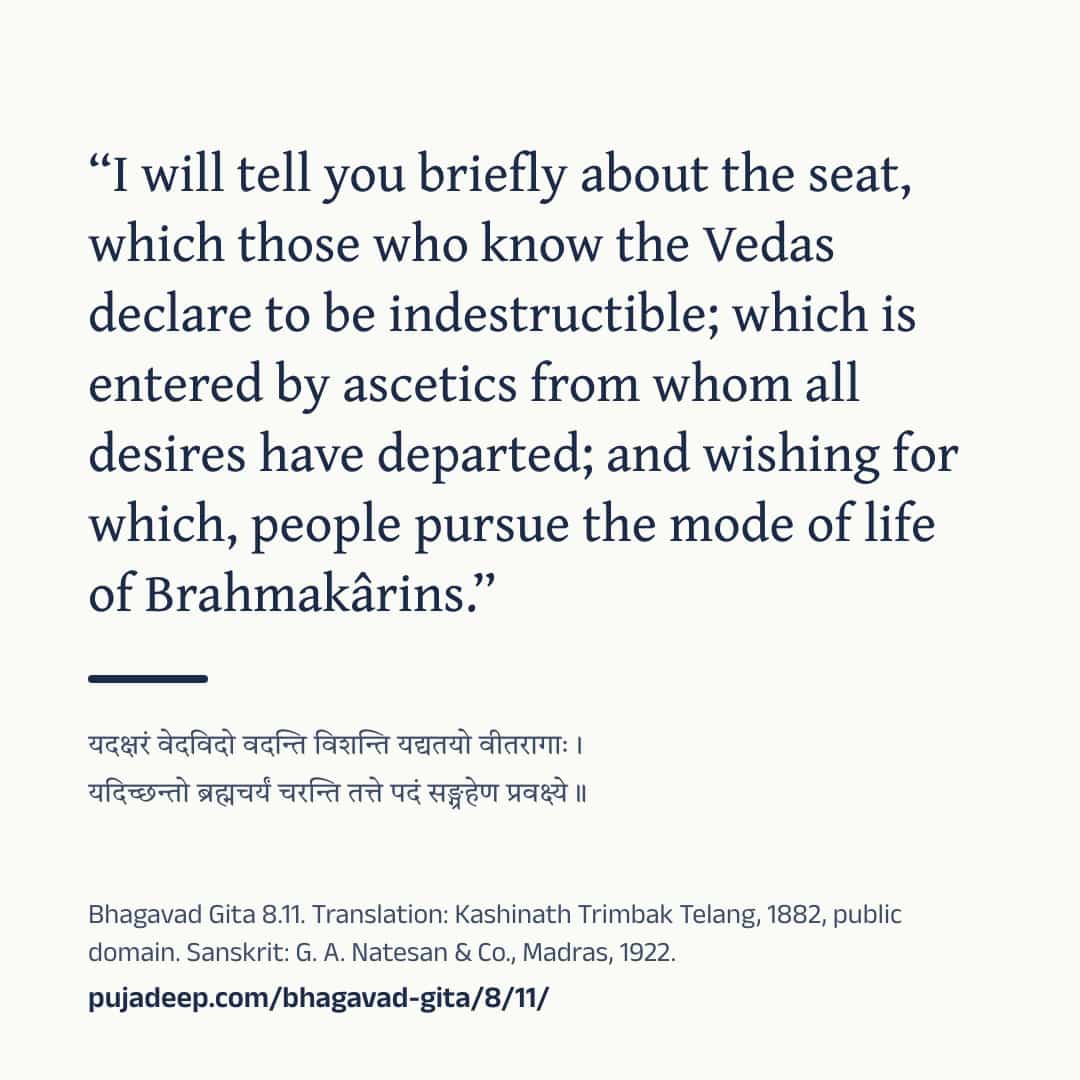
Drawing the picture
See the words
Bhagavad Gita 8.11

यदक्षरं वेदविदो वदन्ति विशन्ति यद्यतयो वीतरागाः ।
यदिच्छन्तो ब्रह्मचर्यं चरन्ति तत्ते पदं सङ्ग्रहेण प्रवक्ष्ये ॥

“I will tell you briefly about the seat, which those who know the Vedas declare to be indestructible; which is entered by ascetics from whom all desires have departed; and wishing for which, people pursue the mode of life of Brahmakârins.”
(K. T. Telang, The Bhagavadgîtâ (The Sacred Books of the East, vol. VIII, Oxford: Clarendon Press, 1882), pp. 78–79, public domain)

“That indestructible Path, declared by the Veda-knowers, that the controlled and passion-free enter, that desiring Brahmachârya is performed, that I will declare to thee with brevity.”
(Annie Besant, The Bhagavad Gîtâ, or The Lord's Song (London: Theosophical Publishing Society, 1895), p. 83, public domain)

“What the knowers of the Veda speak of as imperishable, what the self-controlled (Sannyasins), freed from attachment enter, to gain which goal, they live the life of a Brahmacharin, that I shall declare unto thee in brief.”
(Swami Swarupananda, Srimad-Bhagavad-Gita (Mayavati: Prabuddha Bharata Press, 1909; first printed in Prabuddha Bharata, 1907–1909), p. 165, public domain)

Sanskrit: G. A. Natesan & Co., Madras, 1922.
https://pujadeep.com/bhagavad-gita/8/11/ Nothing is sent from this site. Your own app sends it, to the chat you choose. The picture quotes the translation you chose on this page, with its name and year.
Sanskrit text: The Bhagavad-Gita, or The Lord's Song, with the text in Devanagari and an English translation, 1922. Meanings: written for Pujadeep and checked against the cited edition. Source and changes
Questions families ask
Who speaks Bhagavad Gita 8.11?
Krishna speaks this verse, in chapter 8 (Akshara Brahma Yoga).
Where does the Sanskrit text come from?
Sanskrit text: The Bhagavad-Gita, or The Lord's Song, with the text in Devanagari and an English translation, 1922. Meanings: written for Pujadeep and checked against the cited edition. See the source
Is the meaning on this page a translation?
Explanation written for this site from the sources listed here, and checked against the cited edition. It is not a translation and not the only way to read the text. Free to quote with credit.
Source and licence
- Sanskrit text
- The Bhagavad-Gita, or The Lord's Song, with the text in Devanagari and an English translation (Annie Besant, G. A. Natesan & Co., Madras, 1922). Public domain. The Sanskrit on these pages was read from this printing’s page images.
- Translation
- The Bhagavadgîtâ with the Sanatsugâtîya and the Anugîtâ, translated by Kâshinâth Trimbak Telang (The Sacred Books of the East, vol. VIII, ed. F. Max Müller) (Kashinath Trimbak Telang, F. Max Müller, Clarendon Press, Oxford, 1882). Public domain. Shown verbatim, as printed.
- Translation
- The Bhagavad Gîtâ, or The Lord's Song, translated by Annie Besant (Annie Besant, Theosophical Publishing Society, London, 1895). Public domain. Shown verbatim, as printed.
- Translation
- Srimad-Bhagavad-Gita, with Sanskrit Text; Paraphrase with Word-by-word Literal Translation; English Rendering and Comments, Index, &c., by the Swami Swarupananda (Himalayan Series, No. XX) (Swami Swarupananda, The Editors and Publishers, Advaita Ashrama, Mayavati, Prabuddha Bharata Press, Mayavati, Almora, Himalayas, 1909). Public domain. Shown verbatim, as printed.
- Common wording
- In this text, 32 words follow today's common wording, checked against sanskritdocuments.org; Sanskrit Wikisource; Gita Press, Gorakhpur; GRETIL, Göttingen and Bhaktivedanta Book Trust.
- Our explanation
- Explanation written for this site from the sources listed here, and checked against the cited edition. It is not a translation and not the only way to read the text. Free to quote with credit.
- Checked
- Checked against the cited edition, October 27, 2026.