Bhagavad Gita 8.3: meaning and translation
Chapter 8: Akshara Brahma Yoga. Krishna says
Krishna answers.
Click or tap a word for its meaning and its dictionary page.
Text and layers
Text and layers
These choices stay in this browser.
Bhagavad Gita 8.3
श्रीभगवानुवाच ।
अक्षरं ब्रह्म परमं स्वभावोऽध्यात्ममुच्यते ।भूतभावोद्भवकरो विसर्गः कर्मसंज्ञितः ॥
Aksharam brahma paramam svabhavodhyatmamuchyateBhutabhavodbhavakaro visargah karmasanjnitah
akṣaraṃ brahma paramaṃ svabhāvo’dhyātmamucyate |bhūtabhāvodbhavakaro visargaḥ karmasaṃjñitaḥ ||
Our explanation Krishna answers. Brahman is the imperishable (akṣara), the supreme. Its own nature (svabhāva) is called adhyātma. The creative outpouring (visarga) that brings beings into existence is called karma. The schools explain these terms differently (see the views).
हिंदी अर्थ कृष्ण उत्तर देते हैं। ब्रह्म परम अक्षर (अविनाशी) है। उसका अपना भाव (स्वभाव) अध्यात्म कहलाता है। प्राणियों को उत्पन्न करने वाला विसर्ग (सृष्टि की क्रिया) कर्म कहलाता है। परंपराएँ इन शब्दों को अलग-अलग ढंग से समझाती हैं।
Word by word
Every word, with its dictionary page
Word by word
- अक्षरम् akṣaram · imperishable (nominative singular) Dictionary: a-kṣara, Monier-Williams 1899, p. 3, col. 2 “imperishable; unalterable”
- ब्रह्म brahma · Brahman (nominative singular) Dictionary: brahman, Monier-Williams 1899, p. 738, col. 1 “one self-existent impersonal Spirit, the one universal Soul”
- परमम् paramam · supreme (nominative singular) Dictionary: parama, Monier-Williams 1899, p. 588, col. 1 “chief, highest, primary, most prominent or conspicuous”
- स्वभावः svabhāvaḥ · own nature (compound, nominative singular) Dictionary: sva-bhāva, Monier-Williams 1899, p. 1276, col. 1 “innate or inherent disposition, nature”
- अध्यात्मम् adhyātmam · adhyātma (nominative singular) Dictionary: adhy-ātma, Monier-Williams 1899, p. 23, col. 2 “the Supreme Spirit”
- उच्यते ucyate · is called (passive, present, 3rd person singular) Dictionary: vac, Monier-Williams 1899, p. 912, col. 1 “to be called or accounted, be regarded as”
- भूतभावोद्भवकरः bhūtabhāvodbhavakaraḥ · bringing beings into existence (compound, nominative singular) Dictionary: bhūta, Monier-Williams 1899, p. 761, col. 3 “that which is or exists, any living being”; bhāva, Monier-Williams 1899, p. 754, col. 1 “becoming, being”; ud-bhava, Monier-Williams 1899, p. 190, col. 2 “existence, generation, origin, production, birth”; 1. kara, Monier-Williams 1899, p. 253, col. 1 “a doer, maker, causer, doing, making, causing, producing”
- विसर्गः visargaḥ · the outpouring, the offering (nominative singular) Dictionary: vi-sarga, Monier-Williams 1899, p. 1001, col. 1 “sending forth, letting go, liberation, emission, discharge”
- कर्मसंज्ञितः karmasaṃjñitaḥ · is named karma (compound, nominative singular) Dictionary: karman, Monier-Williams 1899, p. 258, col. 2 “act, action, performance, business”; saṃ-jñita, Monier-Williams 1899, p. 1133, col. 3 “called, named, termed (generally ifc.)”
Old translations
Kashinath Trimbak Telang, 1882. Public domain. Page 77.
The Deity said:
The Brahman is the supreme, the indestructible. Its manifestation (as an individual self) is called the Adhyâtma. The offering (of an oblation to any divinity), which is the cause of the production and development of all things, is named action.
Compare 3 translations
Kashinath Trimbak Telang, 1882. Public domain. Page 77.
The Deity said:
The Brahman is the supreme, the indestructible. Its manifestation (as an individual self) is called the Adhyâtma. The offering (of an oblation to any divinity), which is the cause of the production and development of all things, is named action.
You are reading this one
Annie Besant, 1895. Public domain. Page 81.
The Blessed Lord said:
The Indestructible, the Supreme, is Brahman; His essential Nature is called Adhyâtmâ; the expansion that causes the birth of beings is named Karma;
This sentence goes on in 8.4.
You are reading this one
Swami Swarupananda, 1909 (first printed 1907). Public domain. Page 160.
The Blessed Lord said:
The Imperishable is the Supreme Brahman. Its dwelling in each individual body, is called Adhyàtma; the offering in sacrifice which causes the genesis and support of beings, is called Karma.
You are reading this one
Cite this verse
The translation: K. T. Telang, The Bhagavadgîtâ (The Sacred Books of the East, vol. VIII, Oxford: Clarendon Press, 1882), p. 77. Bhagavad Gita 8.3.
The translation: Annie Besant, The Bhagavad Gîtâ, or The Lord's Song (London: Theosophical Publishing Society, 1895), p. 81. Bhagavad Gita 8.3.
The translation: Swami Swarupananda, Srimad-Bhagavad-Gita (Mayavati: Prabuddha Bharata Press, 1909; first printed in Prabuddha Bharata, 1907–1909), p. 160. Bhagavad Gita 8.3.
Our explanation: “Bhagavad Gita 8.3: meaning and translation.” Pujadeep. Updated October 27, 2026. https://pujadeep.com/bhagavad-gita/8/3/
Pujadeep’s explanations are free to quote with credit: name Pujadeep and link to the page. How to credit
Classical readings, by school
Each reading is named by its school. None is presented as the only meaning.
What Advaita, Vishishtadvaita and Dvaita teach, in short
Shankara Advaita
Shankara says akṣara here is the Supreme Self, not the syllable Om, which comes in 8.13. Adhyātma is that same Brahman present as the innermost self in each body. Karma is the sacrificial offering to the gods, which is the seed from which all beings come into existence.
Source: The Bhagavad-Gita, with the commentary of Sri Sankaracharya, translated by A. Mahadeva Sastri (2nd ed., Mysore: G. T. A. Printing Works, 1901), commentary on 8.3, pp. 201–202. Summarised in our own words; none of its text is reproduced.
Ramanuja Vishishtadvaita
Ramanuja takes the supreme akṣara as the individual self freed from matter, the thing a seeker of liberation should choose. Adhyātma is the subtle matter that clings to the self, which is to be given up. Karma is the act by which embodied beings are brought forth.
Source: Sri Bhagavad-Gita with Sri Ramanujacharya's Visishtadvaita commentary, translated by A. Govindacharya (Madras, 1898), commentary on 8.3, pp. 264–265. Summarised in our own words; none of its text is reproduced.
Share
Show the ways to share
Send one picture or the text to one chat. The picture names its source and the address of this page.
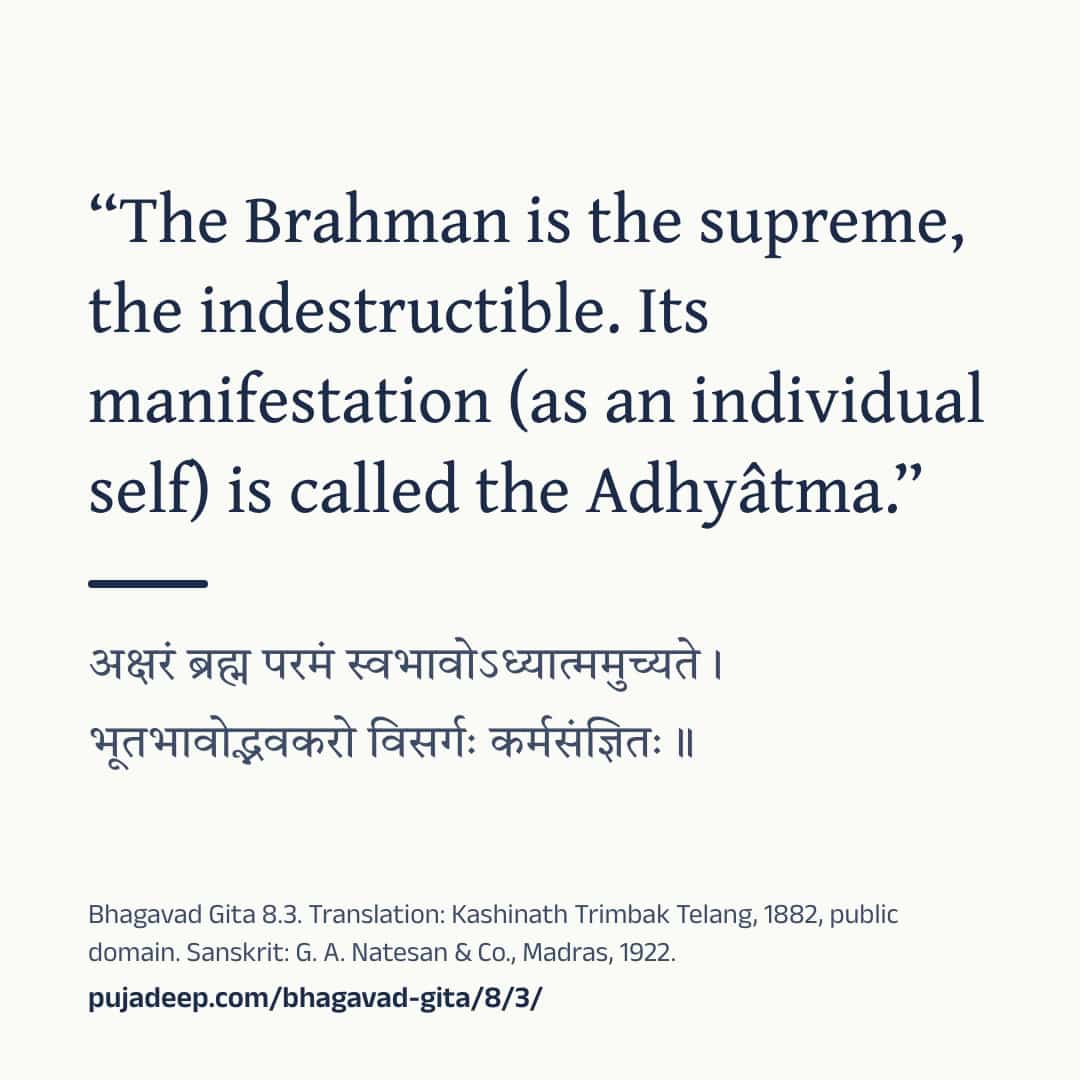
Drawing the picture
See the words
Bhagavad Gita 8.3

अक्षरं ब्रह्म परमं स्वभावोऽध्यात्ममुच्यते ।
भूतभावोद्भवकरो विसर्गः कर्मसंज्ञितः ॥

“The Brahman is the supreme, the indestructible. Its manifestation (as an individual self) is called the Adhyâtma. The offering (of an oblation to any divinity), which is the cause of the production and development of all things, is named action.”
(K. T. Telang, The Bhagavadgîtâ (The Sacred Books of the East, vol. VIII, Oxford: Clarendon Press, 1882), p. 77, public domain)

“The Indestructible, the Supreme, is Brahman; His essential Nature is called Adhyâtmâ; the expansion that causes the birth of beings is named Karma;”
(Annie Besant, The Bhagavad Gîtâ, or The Lord's Song (London: Theosophical Publishing Society, 1895), p. 81, public domain)
This sentence goes on in 8.4.

“The Imperishable is the Supreme Brahman. Its dwelling in each individual body, is called Adhyàtma; the offering in sacrifice which causes the genesis and support of beings, is called Karma.”
(Swami Swarupananda, Srimad-Bhagavad-Gita (Mayavati: Prabuddha Bharata Press, 1909; first printed in Prabuddha Bharata, 1907–1909), p. 160, public domain)

Sanskrit: G. A. Natesan & Co., Madras, 1922.
https://pujadeep.com/bhagavad-gita/8/3/ Nothing is sent from this site. Your own app sends it, to the chat you choose. The picture quotes the translation you chose on this page, with its name and year.
Sanskrit text: The Bhagavad-Gita, or The Lord's Song, with the text in Devanagari and an English translation, 1922. Meanings: written for Pujadeep and checked against the cited edition. Source and changes
Questions families ask
Who speaks Bhagavad Gita 8.3?
Krishna speaks this verse, in chapter 8 (Akshara Brahma Yoga).
Where does the Sanskrit text come from?
Sanskrit text: The Bhagavad-Gita, or The Lord's Song, with the text in Devanagari and an English translation, 1922. Meanings: written for Pujadeep and checked against the cited edition. See the source
Is the meaning on this page a translation?
Explanation written for this site from the sources listed here, and checked against the cited edition. It is not a translation and not the only way to read the text. Free to quote with credit.
Source and licence
- Sanskrit text
- The Bhagavad-Gita, or The Lord's Song, with the text in Devanagari and an English translation (Annie Besant, G. A. Natesan & Co., Madras, 1922). Public domain. The Sanskrit on these pages was read from this printing’s page images.
- Translation
- The Bhagavadgîtâ with the Sanatsugâtîya and the Anugîtâ, translated by Kâshinâth Trimbak Telang (The Sacred Books of the East, vol. VIII, ed. F. Max Müller) (Kashinath Trimbak Telang, F. Max Müller, Clarendon Press, Oxford, 1882). Public domain. Shown verbatim, as printed.
- Translation
- The Bhagavad Gîtâ, or The Lord's Song, translated by Annie Besant (Annie Besant, Theosophical Publishing Society, London, 1895). Public domain. Shown verbatim, as printed.
- Translation
- Srimad-Bhagavad-Gita, with Sanskrit Text; Paraphrase with Word-by-word Literal Translation; English Rendering and Comments, Index, &c., by the Swami Swarupananda (Himalayan Series, No. XX) (Swami Swarupananda, The Editors and Publishers, Advaita Ashrama, Mayavati, Prabuddha Bharata Press, Mayavati, Almora, Himalayas, 1909). Public domain. Shown verbatim, as printed.
- Commentary
- The Bhagavad-Gita, with the commentary of Sri Sankaracharya, translated by A. Mahadeva Sastri (2nd ed., Mysore: G. T. A. Printing Works, 1901) (Public-domain scan, University of California Libraries). Summarised in our own words; none of its text is reproduced.
- Commentary
- Sri Bhagavad-Gita with Sri Ramanujacharya's Visishtadvaita commentary, translated by A. Govindacharya (Madras, 1898) (Scan uploaded to archive.org (folkscanomy collection)). Summarised in our own words; none of its text is reproduced.
- Common wording
- In this text, 32 words follow today's common wording, checked against sanskritdocuments.org; Sanskrit Wikisource; Gita Press, Gorakhpur; GRETIL, Göttingen and Bhaktivedanta Book Trust.
- Our explanation
- Explanation written for this site from the sources listed here, and checked against the cited edition. It is not a translation and not the only way to read the text. Free to quote with credit.
- Checked
- Checked against the cited edition, October 27, 2026.