Bhagavad Gita 8.6: meaning and translation
Chapter 8: Akshara Brahma Yoga. Krishna says
Whatever state of being a person remembers at the end, when leaving the body, to that state the person goes, Krishna tells Arjuna (Kaunteya), because the mind has always been shaped by it.
Click or tap a word for its meaning and its dictionary page.
Text and layers
Text and layers
These choices stay in this browser.
Bhagavad Gita 8.6
यं यं वापि स्मरन्भावं त्यजत्यन्ते कलेवरम् ।तं तमेवैति कौन्तेय सदा तद्भावभावितः ॥
Yam yam vapi smaranbhavam tyajatyante kalevaramTam tamevaiti kaunteya sada tadbhavabhavitah
yaṃ yaṃ vāpi smaranbhāvaṃ tyajatyante kalevaram |taṃ tamevaiti kaunteya sadā tadbhāvabhāvitaḥ ||
Our explanation Whatever state of being a person remembers at the end, when leaving the body, to that state the person goes, Krishna tells Arjuna (Kaunteya), because the mind has always been shaped by it. Both commentators explain that the thought at the end grows out of a whole life's thinking (see the views).
हिंदी अर्थ कृष्ण अर्जुन (कौन्तेय) से कहते हैं कि अंत समय में शरीर छोड़ते हुए व्यक्ति जिस भाव को याद करता है, वह उसी भाव को प्राप्त होता है, क्योंकि उसका मन सदा उसी से भावित (रंगा) रहा है। दोनों टीकाकार समझाते हैं कि अंतिम विचार पूरे जीवन के विचारों से बनता है।
Word by word
Every word, with its dictionary page
Word by word
- यम् yam · whatever (relative pronoun, accusative singular) Dictionary: yad, Monier-Williams 1899, p. 844, col. 2 “who, which, what, whichever, whatever, that”
- यम् yam · (whatever) (relative pronoun, accusative singular) Dictionary: yad, Monier-Williams 1899, p. 844, col. 2 “who, which, what, whichever, whatever, that”
- वा vā · or (indeclinable) Dictionary: 1. vā, Monier-Williams 1899, p. 934, col. 2 “or”
- अपि api · even (indeclinable) Dictionary: api, Monier-Williams 1899, p. 55, col. 1 “in the sense of even, also, very”
- स्मरन् smaran · remembering (present participle, nominative singular) Dictionary: 2. smṛ, Monier-Williams 1899, p. 1271, col. 3 “to remember, recollect, bear in mind, call to mind, think of”
- भावम् bhāvam · state of being (accusative singular) Dictionary: bhāva, Monier-Williams 1899, p. 754, col. 1 “becoming, being”
- त्यजति tyajati · leaves (present, 3rd person singular) Dictionary: 1. tyaj, Monier-Williams 1899, p. 456, col. 3 “to leave, abandon, quit”
- अन्ते ante · at the end (locative singular) Dictionary: anta, Monier-Williams 1899, p. 42, col. 3 “end, limit, boundary, term”
- कलेवरम् kalevaram · the body (accusative singular) Dictionary: kalevara, Monier-Williams 1899, p. 262, col. 2 “the body”
- तम् tam · that (pronoun, accusative singular) Dictionary: tad, Monier-Williams 1899, p. 434, col. 1 “m. he, f. she, n. it, that, this”
- तम् tam · (that) (pronoun, accusative singular) Dictionary: tad, Monier-Williams 1899, p. 434, col. 1 “m. he, f. she, n. it, that, this”
- एव eva · alone, indeed (indeclinable) Dictionary: 1. eva, Monier-Williams 1899, p. 232, col. 2 “just, exactly, very, same, only, even, alone, merely”
- एति eti · goes to (present, 3rd person singular) Dictionary: 5. i, Monier-Williams 1899, p. 163, col. 3 “to arrive at, reach, obtain”
- कौन्तेय kaunteya · O son of Kunti (Arjuna) (vocative singular) Dictionary: kaunteya, Monier-Williams 1899, p. 316, col. 2 “metron. fr. Kuntī”
- सदा sadā · always (indeclinable) Dictionary: sadā, Monier-Williams 1899, p. 1139, col. 2 “always, ever, every time, continually”
- तद्भावभावितः tadbhāvabhāvitaḥ · shaped by that state of being (compound, nominative singular) Dictionary: tad, Monier-Williams 1899, p. 434, col. 1 “m. he, f. she, n. it, that, this”; bhāva, Monier-Williams 1899, p. 754, col. 1 “becoming, being”; bhāvita, Monier-Williams 1899, p. 755, col. 1 “(ifc.) made to become, transformed into”
Old translations
Kashinath Trimbak Telang, 1882. Public domain. Page 78.
Also whichever form1 (of deity) he remembers when he finally leaves this body, to that he goes, O son of Kuntî! having been used to ponder on it.
Footnotes (the translator’s own) - Some commentators say 'whatever thing' generally. The 'form' remembered in one's last moments would be that which had been most often meditated on during life. ↩
Compare 3 translations
Kashinath Trimbak Telang, 1882. Public domain. Page 78.
Also whichever form1 (of deity) he remembers when he finally leaves this body, to that he goes, O son of Kuntî! having been used to ponder on it.
Footnotes (the translator’s own) - Some commentators say 'whatever thing' generally. The 'form' remembered in one's last moments would be that which had been most often meditated on during life. ↩
You are reading this one
Annie Besant, 1895. Public domain. Page 82.
But whosoever at the end, abandoning the body, remembereth any being, he goeth to that, O Kaunteya, ever to that conformed in nature.
You are reading this one
Swami Swarupananda, 1909 (first printed 1907). Public domain. Page 60.
Remembering whatever object, at the end, he leaves the body, that alone is reached by him, O son of Kunti, (because) of his constant thought of that object.
You are reading this one
Cite this verse
The translation: K. T. Telang, The Bhagavadgîtâ (The Sacred Books of the East, vol. VIII, Oxford: Clarendon Press, 1882), p. 78. Bhagavad Gita 8.6.
The translation: Annie Besant, The Bhagavad Gîtâ, or The Lord's Song (London: Theosophical Publishing Society, 1895), p. 82. Bhagavad Gita 8.6.
The translation: Swami Swarupananda, Srimad-Bhagavad-Gita (Mayavati: Prabuddha Bharata Press, 1909; first printed in Prabuddha Bharata, 1907–1909), p. 60. Bhagavad Gita 8.6.
Our explanation: “Bhagavad Gita 8.6: meaning and translation.” Pujadeep. Updated October 27, 2026. https://pujadeep.com/bhagavad-gita/8/6/
Pujadeep’s explanations are free to quote with credit: name Pujadeep and link to the page. How to credit
Classical readings, by school
Each reading is named by its school. None is presented as the only meaning.
What Advaita, Vishishtadvaita and Dvaita teach, in short
Shankara Advaita
Shankara says 'being' here means a particular deity: a person reaches only the being thought of at the end, and that final thought comes from what was constantly dwelt upon. Because the final thought decides the next body, 8.7 tells Arjuna to think of the Lord at all times.
Source: The Bhagavad-Gita, with the commentary of Sri Sankaracharya, translated by A. Mahadeva Sastri (2nd ed., Mysore: G. T. A. Printing Works, 1901), commentary on 8.6, p. 203. Summarised in our own words; none of its text is reproduced.
Ramanuja Vishishtadvaita
Ramanuja says that whatever image is most present in the mind at death, that the person becomes, as with King Bharata, who died thinking of a deer he loved and was born as one. The last thought will be the one a person has dwelt on throughout life.
Source: Sri Bhagavad-Gita with Sri Ramanujacharya's Visishtadvaita commentary, translated by A. Govindacharya (Madras, 1898), commentary on 8.5–8.6, pp. 266–267. Summarised in our own words; none of its text is reproduced.
Share
Show the ways to share
Send one picture or the text to one chat. The picture names its source and the address of this page.
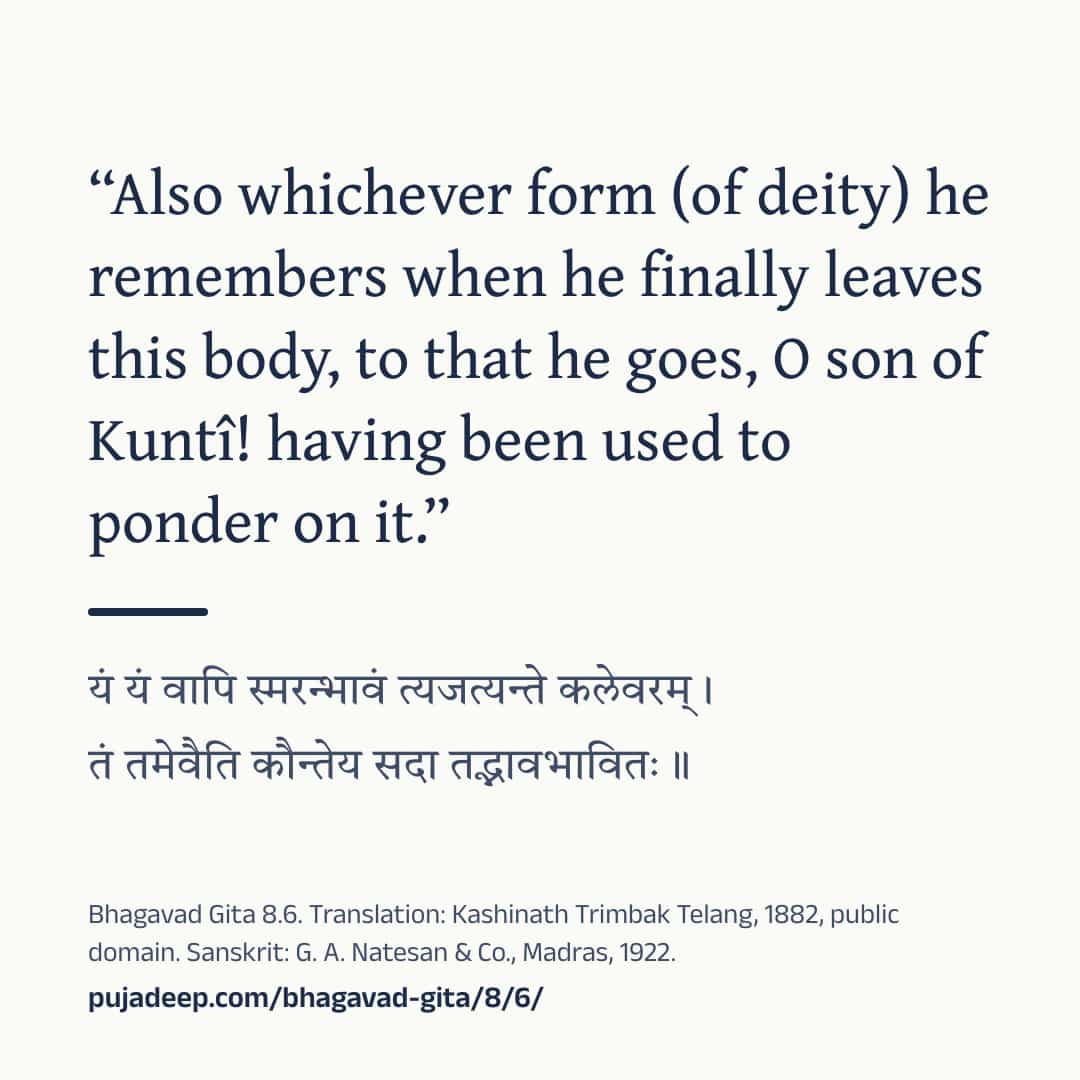
Drawing the picture
See the words
Bhagavad Gita 8.6

यं यं वापि स्मरन्भावं त्यजत्यन्ते कलेवरम् ।
तं तमेवैति कौन्तेय सदा तद्भावभावितः ॥

“Also whichever form (of deity) he remembers when he finally leaves this body, to that he goes, O son of Kuntî! having been used to ponder on it.”
(K. T. Telang, The Bhagavadgîtâ (The Sacred Books of the East, vol. VIII, Oxford: Clarendon Press, 1882), p. 78, public domain)

“But whosoever at the end, abandoning the body, remembereth any being, he goeth to that, O Kaunteya, ever to that conformed in nature.”
(Annie Besant, The Bhagavad Gîtâ, or The Lord's Song (London: Theosophical Publishing Society, 1895), p. 82, public domain)

“Remembering whatever object, at the end, he leaves the body, that alone is reached by him, O son of Kunti, (because) of his constant thought of that object.”
(Swami Swarupananda, Srimad-Bhagavad-Gita (Mayavati: Prabuddha Bharata Press, 1909; first printed in Prabuddha Bharata, 1907–1909), p. 60, public domain)

Sanskrit: G. A. Natesan & Co., Madras, 1922.
https://pujadeep.com/bhagavad-gita/8/6/ Nothing is sent from this site. Your own app sends it, to the chat you choose. The picture quotes the translation you chose on this page, with its name and year.
Sanskrit text: The Bhagavad-Gita, or The Lord's Song, with the text in Devanagari and an English translation, 1922. Meanings: written for Pujadeep and checked against the cited edition. Source and changes
Questions families ask
Who speaks Bhagavad Gita 8.6?
Krishna speaks this verse, in chapter 8 (Akshara Brahma Yoga).
Where does the Sanskrit text come from?
Sanskrit text: The Bhagavad-Gita, or The Lord's Song, with the text in Devanagari and an English translation, 1922. Meanings: written for Pujadeep and checked against the cited edition. See the source
Is the meaning on this page a translation?
Explanation written for this site from the sources listed here, and checked against the cited edition. It is not a translation and not the only way to read the text. Free to quote with credit.
Source and licence
- Sanskrit text
- The Bhagavad-Gita, or The Lord's Song, with the text in Devanagari and an English translation (Annie Besant, G. A. Natesan & Co., Madras, 1922). Public domain. The Sanskrit on these pages was read from this printing’s page images.
- Translation
- The Bhagavadgîtâ with the Sanatsugâtîya and the Anugîtâ, translated by Kâshinâth Trimbak Telang (The Sacred Books of the East, vol. VIII, ed. F. Max Müller) (Kashinath Trimbak Telang, F. Max Müller, Clarendon Press, Oxford, 1882). Public domain. Shown verbatim, as printed.
- Translation
- The Bhagavad Gîtâ, or The Lord's Song, translated by Annie Besant (Annie Besant, Theosophical Publishing Society, London, 1895). Public domain. Shown verbatim, as printed.
- Translation
- Srimad-Bhagavad-Gita, with Sanskrit Text; Paraphrase with Word-by-word Literal Translation; English Rendering and Comments, Index, &c., by the Swami Swarupananda (Himalayan Series, No. XX) (Swami Swarupananda, The Editors and Publishers, Advaita Ashrama, Mayavati, Prabuddha Bharata Press, Mayavati, Almora, Himalayas, 1909). Public domain. Shown verbatim, as printed.
- Commentary
- The Bhagavad-Gita, with the commentary of Sri Sankaracharya, translated by A. Mahadeva Sastri (2nd ed., Mysore: G. T. A. Printing Works, 1901) (Public-domain scan, University of California Libraries). Summarised in our own words; none of its text is reproduced.
- Commentary
- Sri Bhagavad-Gita with Sri Ramanujacharya's Visishtadvaita commentary, translated by A. Govindacharya (Madras, 1898) (Scan uploaded to archive.org (folkscanomy collection)). Summarised in our own words; none of its text is reproduced.
- Common wording
- In this text, 32 words follow today's common wording, checked against sanskritdocuments.org; Sanskrit Wikisource; Gita Press, Gorakhpur; GRETIL, Göttingen and Bhaktivedanta Book Trust.
- Our explanation
- Explanation written for this site from the sources listed here, and checked against the cited edition. It is not a translation and not the only way to read the text. Free to quote with credit.
- Checked
- Checked against the cited edition, October 27, 2026.