Bhagavad Gita 8.17: meaning and translation
Chapter 8: Akshara Brahma Yoga. Krishna says
Krishna says that those who know that a day of Brahmā lasts a thousand yugas (ages), and his night another thousand, truly know day and night.
Click or tap a word for its meaning and its dictionary page.
Text and layers
Text and layers
These choices stay in this browser.
Bhagavad Gita 8.17
सहस्रयुगपर्यन्तमहर्यद्ब्रह्मणो विदुः ।रात्रिं युगसहस्रान्तां तेऽहोरात्रविदो जनाः ॥
Sahasrayugaparyantamaharyadbrahmano viduhRatrim yugasahasrantam tehoratravido janah
sahasrayugaparyantamaharyadbrahmaṇo viduḥ |rātriṃ yugasahasrāntāṃ te’horātravido janāḥ ||
Our explanation Krishna says that those who know that a day of Brahmā lasts a thousand yugas (ages), and his night another thousand, truly know day and night. Even the creator's world, he is saying, is bound by time.
हिंदी अर्थ कृष्ण कहते हैं कि जो जानते हैं कि ब्रह्मा का एक दिन हज़ार युगों का होता है और उनकी रात भी हज़ार युगों की, वही सचमुच दिन और रात को जानते हैं। उनका आशय है कि सृष्टिकर्ता का लोक भी समय से बँधा है।
Word by word
Every word, with its dictionary page
Word by word
- सहस्रयुगपर्यन्तम् sahasrayugaparyantam · lasting a thousand yugas (compound, accusative singular) Dictionary: sahasra-yuga, Monier-Williams 1899, p. 1196, col. 1 “a period of a th° ages”; pary-anta, Monier-Williams 1899, p. 607, col. 1 “edge, limit, border; side, flank, extremity, end”
- अहः ahaḥ · day (accusative singular) Dictionary: ahar, Monier-Williams 1899, p. 124, col. 3 “a day”
- यत् yat · which (relative pronoun, accusative singular) Dictionary: yad, Monier-Williams 1899, p. 844, col. 2 “who, which, what, whichever, whatever, that”
- ब्रह्मणः brahmaṇaḥ · of Brahmā (genitive singular) Dictionary: brahman, Monier-Williams 1899, p. 738, col. 1 “Brahmā or the one impersonal universal Spirit manifested as a personal Creator”
- विदुः viduḥ · (they) know (perfect form, present sense, 3rd person plural) Dictionary: 1. vid, Monier-Williams 1899, p. 963, col. 2 “to know, understand, perceive, learn”
- रात्रिम् rātrim · night (accusative singular (feminine)) Dictionary: rātri, Monier-Williams 1899, p. 876, col. 1 “night, the darkness or stillness of night”
- युगसहस्रान्ताम् yugasahasrāntām · ending after a thousand yugas (compound, accusative singular (feminine)) Dictionary: yuga, Monier-Williams 1899, p. 854, col. 1 “an age of the world, long mundane period of years”; sahasra, Monier-Williams 1899, p. 1195, col. 2 “a thousand”; anta, Monier-Williams 1899, p. 42, col. 3 “end, limit, boundary, term”
- ते te · they (pronoun, nominative plural) Dictionary: tad, Monier-Williams 1899, p. 434, col. 1 “m. he, f. she, n. it, that, this”
- अहोरात्रविदः ahorātravidaḥ · knowers of day and night (compound, nominative plural) Dictionary: aho-rātra, Monier-Williams 1899, p. 124, col. 3 “a day and night”; 2. vid, Monier-Williams 1899, p. 963, col. 3 “knowing, understanding, a knower”
- जनाः janāḥ · people (nominative plural) Dictionary: jana, Monier-Williams 1899, p. 410, col. 1 “creature, living being, man, person, race”
Old translations
Kashinath Trimbak Telang, 1882. Public domain. Page 79–80.
Those who know a day of Brahman to end after one thousand ages, and the night to terminate after one thousand ages, are the persons who know day and night1.
Footnotes (the translator’s own) - Cf. Manu I, 73. Saṅkara says, that this explains why the abodes of Brahmâ and others are said to be not lasting. They are limited by time. As to ages, Srîdhara says, a human year is a day and night of the gods. Twelve thousand years made of such days and nights make up the four ages: one thousand such 'quaternions of ages' make up a day, and another thousand a night of Brahmâ. Of such days and nights Brahmâ has a hundred years to live. At the close of his life, the universe is destroyed. ↩
Compare 3 translations
Kashinath Trimbak Telang, 1882. Public domain. Page 79–80.
Those who know a day of Brahman to end after one thousand ages, and the night to terminate after one thousand ages, are the persons who know day and night1.
Footnotes (the translator’s own) - Cf. Manu I, 73. Saṅkara says, that this explains why the abodes of Brahmâ and others are said to be not lasting. They are limited by time. As to ages, Srîdhara says, a human year is a day and night of the gods. Twelve thousand years made of such days and nights make up the four ages: one thousand such 'quaternions of ages' make up a day, and another thousand a night of Brahmâ. Of such days and nights Brahmâ has a hundred years to live. At the close of his life, the universe is destroyed. ↩
You are reading this one
Annie Besant, 1895. Public domain. Page 84.
The people who know the day of Brahmâ, a thousand Yugas in revolution, and the night, a thousand ages in ending, they know day and night.
You are reading this one
Swami Swarupananda, 1909 (first printed 1907). Public domain. Page 167.
They know (the true measure of) day and night, who know the day of Brahmâ, which ends in a thousand Yugas, and the night which (also) ends in a thousand Yugas.
You are reading this one
Cite this verse
The translation: K. T. Telang, The Bhagavadgîtâ (The Sacred Books of the East, vol. VIII, Oxford: Clarendon Press, 1882), pp. 79–80. Bhagavad Gita 8.17.
The translation: Annie Besant, The Bhagavad Gîtâ, or The Lord's Song (London: Theosophical Publishing Society, 1895), p. 84. Bhagavad Gita 8.17.
The translation: Swami Swarupananda, Srimad-Bhagavad-Gita (Mayavati: Prabuddha Bharata Press, 1909; first printed in Prabuddha Bharata, 1907–1909), p. 167. Bhagavad Gita 8.17.
Our explanation: “Bhagavad Gita 8.17: meaning and translation.” Pujadeep. Updated October 27, 2026. https://pujadeep.com/bhagavad-gita/8/17/
Pujadeep’s explanations are free to quote with credit: name Pujadeep and link to the page. How to credit
Classical readings, by school
No readings by school on this verse yet.
Share
Show the ways to share
Send one picture or the text to one chat. The picture names its source and the address of this page.
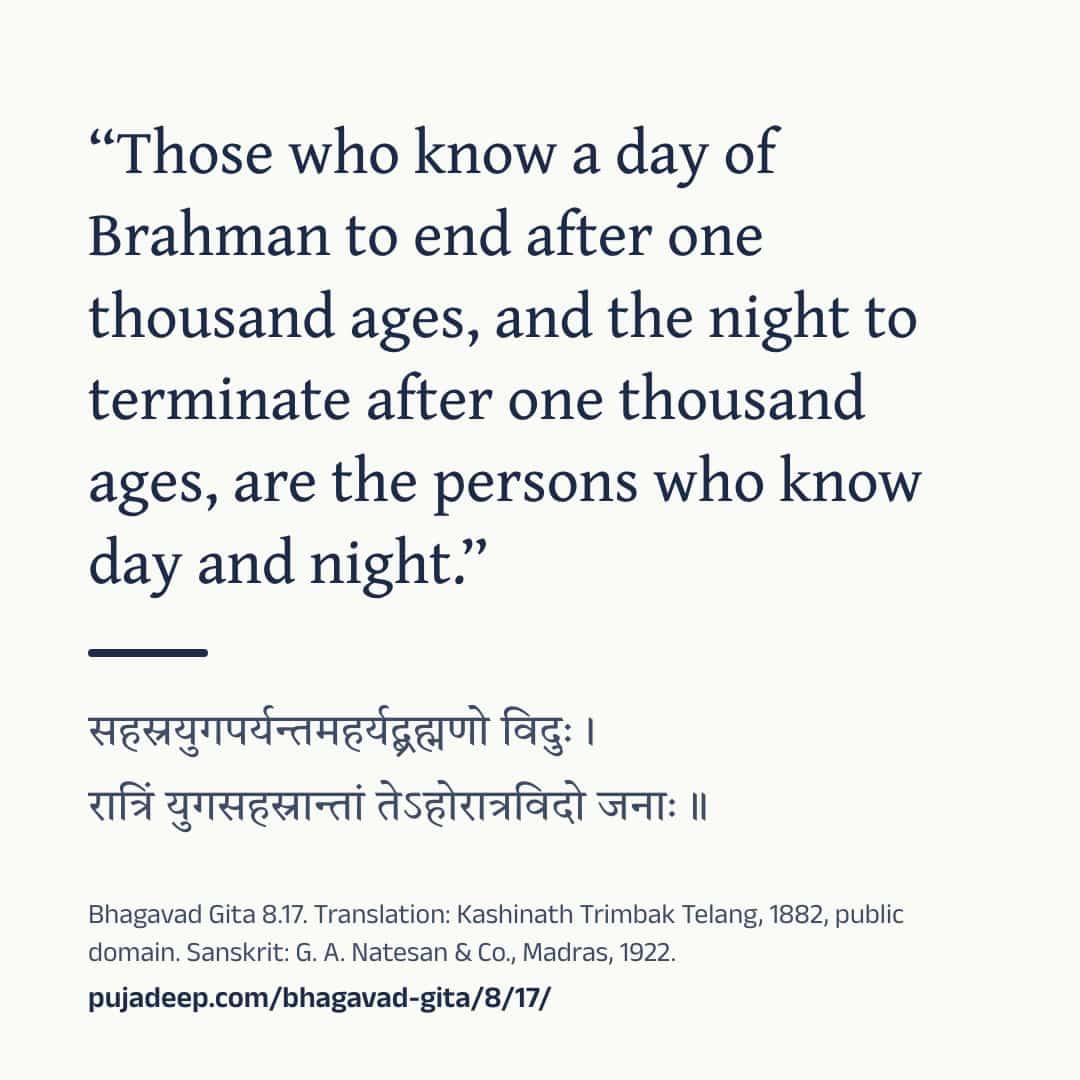
Drawing the picture
See the words
Bhagavad Gita 8.17

सहस्रयुगपर्यन्तमहर्यद्ब्रह्मणो विदुः ।
रात्रिं युगसहस्रान्तां तेऽहोरात्रविदो जनाः ॥

“Those who know a day of Brahman to end after one thousand ages, and the night to terminate after one thousand ages, are the persons who know day and night.”
(K. T. Telang, The Bhagavadgîtâ (The Sacred Books of the East, vol. VIII, Oxford: Clarendon Press, 1882), pp. 79–80, public domain)

“The people who know the day of Brahmâ, a thousand Yugas in revolution, and the night, a thousand ages in ending, they know day and night.”
(Annie Besant, The Bhagavad Gîtâ, or The Lord's Song (London: Theosophical Publishing Society, 1895), p. 84, public domain)

“They know (the true measure of) day and night, who know the day of Brahmâ, which ends in a thousand Yugas, and the night which (also) ends in a thousand Yugas.”
(Swami Swarupananda, Srimad-Bhagavad-Gita (Mayavati: Prabuddha Bharata Press, 1909; first printed in Prabuddha Bharata, 1907–1909), p. 167, public domain)

Sanskrit: G. A. Natesan & Co., Madras, 1922.
https://pujadeep.com/bhagavad-gita/8/17/ Nothing is sent from this site. Your own app sends it, to the chat you choose. The picture quotes the translation you chose on this page, with its name and year.
Sanskrit text: The Bhagavad-Gita, or The Lord's Song, with the text in Devanagari and an English translation, 1922. Meanings: written for Pujadeep and checked against the cited edition. Source and changes
Questions families ask
Who speaks Bhagavad Gita 8.17?
Krishna speaks this verse, in chapter 8 (Akshara Brahma Yoga).
Where does the Sanskrit text come from?
Sanskrit text: The Bhagavad-Gita, or The Lord's Song, with the text in Devanagari and an English translation, 1922. Meanings: written for Pujadeep and checked against the cited edition. See the source
Is the meaning on this page a translation?
Explanation written for this site from the sources listed here, and checked against the cited edition. It is not a translation and not the only way to read the text. Free to quote with credit.
Source and licence
- Sanskrit text
- The Bhagavad-Gita, or The Lord's Song, with the text in Devanagari and an English translation (Annie Besant, G. A. Natesan & Co., Madras, 1922). Public domain. The Sanskrit on these pages was read from this printing’s page images.
- Translation
- The Bhagavadgîtâ with the Sanatsugâtîya and the Anugîtâ, translated by Kâshinâth Trimbak Telang (The Sacred Books of the East, vol. VIII, ed. F. Max Müller) (Kashinath Trimbak Telang, F. Max Müller, Clarendon Press, Oxford, 1882). Public domain. Shown verbatim, as printed.
- Translation
- The Bhagavad Gîtâ, or The Lord's Song, translated by Annie Besant (Annie Besant, Theosophical Publishing Society, London, 1895). Public domain. Shown verbatim, as printed.
- Translation
- Srimad-Bhagavad-Gita, with Sanskrit Text; Paraphrase with Word-by-word Literal Translation; English Rendering and Comments, Index, &c., by the Swami Swarupananda (Himalayan Series, No. XX) (Swami Swarupananda, The Editors and Publishers, Advaita Ashrama, Mayavati, Prabuddha Bharata Press, Mayavati, Almora, Himalayas, 1909). Public domain. Shown verbatim, as printed.
- Common wording
- In this text, 32 words follow today's common wording, checked against sanskritdocuments.org; Sanskrit Wikisource; Gita Press, Gorakhpur; GRETIL, Göttingen and Bhaktivedanta Book Trust.
- Our explanation
- Explanation written for this site from the sources listed here, and checked against the cited edition. It is not a translation and not the only way to read the text. Free to quote with credit.
- Checked
- Checked against the cited edition, October 27, 2026.