Bhagavad Gita 8.27: meaning and translation
Chapter 8: Akshara Brahma Yoga. Krishna says
A yogi who knows these two paths is never confused, Krishna says.
Click or tap a word for its meaning and its dictionary page.
Text and layers
Text and layers
These choices stay in this browser.
Bhagavad Gita 8.27
नैते सृती पार्थ जानन्योगी मुह्यति कश्चन ।तस्मात्सर्वेषु कालेषु योगयुक्तो भवार्जुन ॥
Naite sriti partha jananyogi muhyati kashchanaTasmatsarveshu kaleshu yogayukto bhavarjuna
naite sṛtī pārtha jānanyogī muhyati kaścana |tasmātsarveṣu kāleṣu yogayukto bhavārjuna ||
Our explanation A yogi who knows these two paths is never confused, Krishna says. So Arjuna should be steady in yoga at all times. The verse turns from the hour of death to the whole of life: what Krishna asks of Arjuna is to live in yoga always, not to choose a time to die.
हिंदी अर्थ कृष्ण कहते हैं कि इन दो मार्गों को जानने वाला कोई भी योगी मोह में नहीं पड़ता। इसलिए अर्जुन हर समय योग में स्थित रहें। श्लोक मृत्यु के समय से हटकर पूरे जीवन की बात करता है: कृष्ण अर्जुन से सदा योग में जीने को कहते हैं, मृत्यु का समय चुनने को नहीं।
Word by word
Every word, with its dictionary page
Word by word
- न na · not (indeclinable) Dictionary: 2. na, Monier-Williams 1899, p. 523, col. 1 “not, no, nor, neither”
- एते ete · these two (pronoun, accusative dual (feminine)) Dictionary: etad, Monier-Williams 1899, p. 231, col. 2 “this, this here, here”
- सृती sṛtī · paths (accusative dual (feminine)) Dictionary: sṛti, Monier-Williams 1899, p. 1245, col. 1 “a road, path”
- पार्थ pārtha · O son of Pritha (Arjuna) (vocative singular) Dictionary: 2. pārtha, Monier-Williams 1899, p. 621, col. 3 “metron. of Yudhi-shṭhira or Bhīma-sena or Arjuna”
- जानन् jānan · knowing (present participle, nominative singular) Dictionary: 1. jñā, Monier-Williams 1899, p. 425, col. 3 “to know, have knowledge, become acquainted with”
- योगी yogī · a yogi (nominative singular) Dictionary: yogin, Monier-Williams 1899, p. 857, col. 3 “a follower of the Yoga system, a Yogin (usually called Yogī) or contemplative saint”
- मुह्यति muhyati · is confused (present, 3rd person singular) Dictionary: 1. muh, Monier-Williams 1899, p. 825, col. 1 “to become stupefied or unconscious, be bewildered or perplexed”
- कश्चन kaścana · any (one) (indefinite pronoun (kaḥ + cana), nominative singular) Dictionary: kim, Monier-Williams 1899, p. 282, col. 2 “what? how? whence? wherefore? why?”; cana, Monier-Williams 1899, p. 386, col. 2 “and not, also not, even not, not even”
- तस्मात् tasmāt · therefore (indeclinable) Dictionary: tasmāt, Monier-Williams 1899, p. 441, col. 2 “from that, on that account, therefore”
- सर्वेषु sarveṣu · all (pronoun, locative plural) Dictionary: sarva, Monier-Williams 1899, p. 1184, col. 3 “whole, entire, all, every”
- कालेषु kāleṣu · times (locative plural) Dictionary: 2. kāla, Monier-Williams 1899, p. 278, col. 1 “time (as destroying all things), death, time of death”
- योगयुक्तः yogayuktaḥ · steady in yoga (compound, nominative singular) Dictionary: yoga-yukta, Monier-Williams 1899, p. 857, col. 1 “immersed in deep meditation, absorbed in Yoga”
- भव bhava · be (imperative, 2nd person singular) Dictionary: 1. bhū, Monier-Williams 1899, p. 760, col. 2 “arise, come into being, exist”
- अर्जुन arjuna · O Arjuna (vocative singular) Dictionary: arjuna, Monier-Williams 1899, p. 90, col. 1
Old translations
Kashinath Trimbak Telang, 1882. Public domain. Page 81.
Knowing these two paths, O son of Prithâ! no devotee is deluded1. Therefore at all times be possessed of devotion, O Arguna!
Footnotes (the translator’s own) - I. e. does not desire heaven, but devotes himself to the supreme Being, seeing that heavenly bliss is only temporary. ↩
Compare 3 translations
Kashinath Trimbak Telang, 1882. Public domain. Page 81.
Knowing these two paths, O son of Prithâ! no devotee is deluded1. Therefore at all times be possessed of devotion, O Arguna!
Footnotes (the translator’s own) - I. e. does not desire heaven, but devotes himself to the supreme Being, seeing that heavenly bliss is only temporary. ↩
You are reading this one
Annie Besant, 1895. Public domain. Page 86.
Knowing these paths, O Pârtha, the Yogî is nowise troubled. Therefore in all times be firm in Yoga, O Arjuna.
You are reading this one
Swami Swarupananda, 1909 (first printed 1907). Public domain. Page 173.
No Yogi, O son of Prithâ, is deluded after knowing these paths. Therefore, O Arjuna, be thou steadfast in Yoga, at all times.
You are reading this one
Cite this verse
The translation: K. T. Telang, The Bhagavadgîtâ (The Sacred Books of the East, vol. VIII, Oxford: Clarendon Press, 1882), p. 81. Bhagavad Gita 8.27.
The translation: Annie Besant, The Bhagavad Gîtâ, or The Lord's Song (London: Theosophical Publishing Society, 1895), p. 86. Bhagavad Gita 8.27.
The translation: Swami Swarupananda, Srimad-Bhagavad-Gita (Mayavati: Prabuddha Bharata Press, 1909; first printed in Prabuddha Bharata, 1907–1909), p. 173. Bhagavad Gita 8.27.
Our explanation: “Bhagavad Gita 8.27: meaning and translation.” Pujadeep. Updated October 27, 2026. https://pujadeep.com/bhagavad-gita/8/27/
Pujadeep’s explanations are free to quote with credit: name Pujadeep and link to the page. How to credit
Classical readings, by school
No readings by school on this verse yet.
Share
Show the ways to share
Send one picture or the text to one chat. The picture names its source and the address of this page.
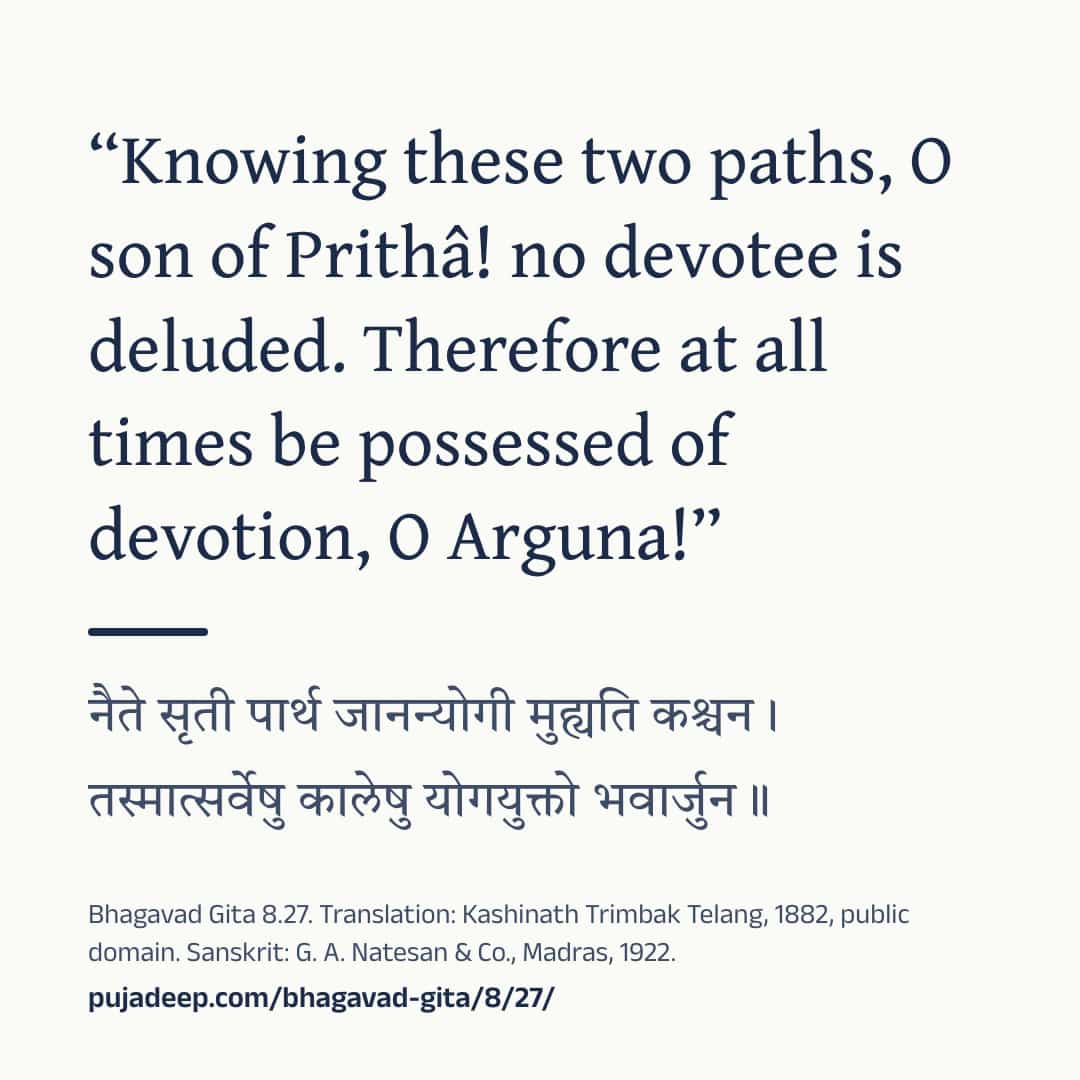
Drawing the picture
See the words
Bhagavad Gita 8.27

नैते सृती पार्थ जानन्योगी मुह्यति कश्चन ।
तस्मात्सर्वेषु कालेषु योगयुक्तो भवार्जुन ॥

“Knowing these two paths, O son of Prithâ! no devotee is deluded. Therefore at all times be possessed of devotion, O Arguna!”
(K. T. Telang, The Bhagavadgîtâ (The Sacred Books of the East, vol. VIII, Oxford: Clarendon Press, 1882), p. 81, public domain)

“Knowing these paths, O Pârtha, the Yogî is nowise troubled. Therefore in all times be firm in Yoga, O Arjuna.”
(Annie Besant, The Bhagavad Gîtâ, or The Lord's Song (London: Theosophical Publishing Society, 1895), p. 86, public domain)

“No Yogi, O son of Prithâ, is deluded after knowing these paths. Therefore, O Arjuna, be thou steadfast in Yoga, at all times.”
(Swami Swarupananda, Srimad-Bhagavad-Gita (Mayavati: Prabuddha Bharata Press, 1909; first printed in Prabuddha Bharata, 1907–1909), p. 173, public domain)

Sanskrit: G. A. Natesan & Co., Madras, 1922.
https://pujadeep.com/bhagavad-gita/8/27/ Nothing is sent from this site. Your own app sends it, to the chat you choose. The picture quotes the translation you chose on this page, with its name and year.
Sanskrit text: The Bhagavad-Gita, or The Lord's Song, with the text in Devanagari and an English translation, 1922. Meanings: written for Pujadeep and checked against the cited edition. Source and changes
Questions families ask
Who speaks Bhagavad Gita 8.27?
Krishna speaks this verse, in chapter 8 (Akshara Brahma Yoga).
Where does the Sanskrit text come from?
Sanskrit text: The Bhagavad-Gita, or The Lord's Song, with the text in Devanagari and an English translation, 1922. Meanings: written for Pujadeep and checked against the cited edition. See the source
Is the meaning on this page a translation?
Explanation written for this site from the sources listed here, and checked against the cited edition. It is not a translation and not the only way to read the text. Free to quote with credit.
Source and licence
- Sanskrit text
- The Bhagavad-Gita, or The Lord's Song, with the text in Devanagari and an English translation (Annie Besant, G. A. Natesan & Co., Madras, 1922). Public domain. The Sanskrit on these pages was read from this printing’s page images.
- Translation
- The Bhagavadgîtâ with the Sanatsugâtîya and the Anugîtâ, translated by Kâshinâth Trimbak Telang (The Sacred Books of the East, vol. VIII, ed. F. Max Müller) (Kashinath Trimbak Telang, F. Max Müller, Clarendon Press, Oxford, 1882). Public domain. Shown verbatim, as printed.
- Translation
- The Bhagavad Gîtâ, or The Lord's Song, translated by Annie Besant (Annie Besant, Theosophical Publishing Society, London, 1895). Public domain. Shown verbatim, as printed.
- Translation
- Srimad-Bhagavad-Gita, with Sanskrit Text; Paraphrase with Word-by-word Literal Translation; English Rendering and Comments, Index, &c., by the Swami Swarupananda (Himalayan Series, No. XX) (Swami Swarupananda, The Editors and Publishers, Advaita Ashrama, Mayavati, Prabuddha Bharata Press, Mayavati, Almora, Himalayas, 1909). Public domain. Shown verbatim, as printed.
- Common wording
- In this text, 32 words follow today's common wording, checked against sanskritdocuments.org; Sanskrit Wikisource; Gita Press, Gorakhpur; GRETIL, Göttingen and Bhaktivedanta Book Trust.
- Our explanation
- Explanation written for this site from the sources listed here, and checked against the cited edition. It is not a translation and not the only way to read the text. Free to quote with credit.
- Checked
- Checked against the cited edition, October 27, 2026.