Bhagavad Gita 8.25: meaning and translation
Chapter 8: Akshara Brahma Yoga. Krishna says
Krishna names the second path: smoke, night, the dark half of the month, and the six months when the sun moves south (dakṣiṇāyana).
Click or tap a word for its meaning and its dictionary page.
Text and layers
Text and layers
These choices stay in this browser.
Bhagavad Gita 8.25
धूमो रात्रिस्तथा कृष्णः षण्मासा दक्षिणायनम् ।तत्र चान्द्रमसं ज्योतिर्योगी प्राप्य निवर्तते ॥
Dhumo ratristatha krishnah shanmasa dakshinayanamTatra chandramasam jyotiryogi prapya nivartate
dhūmo rātristathā kṛṣṇaḥ ṣaṇmāsā dakṣiṇāyanam |tatra cāndramasaṃ jyotiryogī prāpya nivartate ||
Our explanation Krishna names the second path: smoke, night, the dark half of the month, and the six months when the sun moves south (dakṣiṇāyana). The yogi who goes by this path, he says, reaches the light of the moon and then returns. Shankara and Ramanuja both say 'yogi' here means a person of good works and rites, who enjoys their fruit and then returns to birth.
हिंदी अर्थ कृष्ण दूसरा मार्ग बताते हैं: धुआँ, रात, कृष्ण पक्ष (अँधेरा पखवाड़ा) और दक्षिणायन के छह महीने। वे कहते हैं कि इस मार्ग से जाने वाला योगी चंद्रमा की ज्योति को पाकर लौट आता है। शंकराचार्य और रामानुजाचार्य दोनों कहते हैं कि यहाँ 'योगी' का अर्थ पुण्य कर्म और यज्ञ करने वाला है, जो उनका फल भोगकर फिर जन्म लेता है।
Word by word
Every word, with its dictionary page
Word by word
- धूमः dhūmaḥ · smoke (nominative singular) Dictionary: dhūma, Monier-Williams 1899, p. 518, col. 1 “smoke, vapour, mist”
- रात्रिः rātriḥ · night (nominative singular (feminine)) Dictionary: rātri, Monier-Williams 1899, p. 876, col. 1 “night, the darkness or stillness of night”
- तथा tathā · also, likewise (indeclinable) Dictionary: tathā, Monier-Williams 1899, p. 433, col. 3 “in that manner, so, thus”
- कृष्णः kṛṣṇaḥ · the dark (fortnight) (nominative singular) Dictionary: 1. kṛṣṇa, Monier-Williams 1899, p. 306, col. 2 “black, dark”
- षण्मासाः ṣaṇmāsāḥ · the six months (compound, nominative plural) Dictionary: ṣaṇ-māsa, Monier-Williams 1899, p. 1109, col. 3 “a period of six months, half a year”
- दक्षिणायनम् dakṣiṇāyanam · the sun's southward course (compound, nominative singular) Dictionary: dakṣiṇāyana, Monier-Williams 1899, p. 465, col. 3 “sun's progress south of the equator”
- तत्र tatra · then, there (indeclinable) Dictionary: tatra, Monier-Williams 1899, p. 433, col. 2 “in that place, there”
- चान्द्रमसम् cāndramasam · of the moon (accusative singular) Dictionary: cāndramasa, Monier-Williams 1899, p. 392, col. 3 “lunar, relating to the moon”
- ज्योतिः jyotiḥ · light (accusative singular) Dictionary: jyotis, Monier-Williams 1899, p. 427, col. 3 “light (of the sun, dawn, fire, lightning, &c.; also pl.)”
- योगी yogī · the yogi (nominative singular) Dictionary: yogin, Monier-Williams 1899, p. 857, col. 3 “a follower of the Yoga system, a Yogin (usually called Yogī) or contemplative saint”
- प्राप्य prāpya · having reached (absolutive ('having done')) Dictionary: prāp, Monier-Williams 1899, p. 707, col. 2 “to attain to, reach, arrive at, meet with, find”
- निवर्तते nivartate · returns (present, 3rd person singular) Dictionary: ni-vṛt, Monier-Williams 1899, p. 560, col. 1 “to turn back, stop; to return from”
Old translations
Kashinath Trimbak Telang, 1882. Public domain. Page 81.
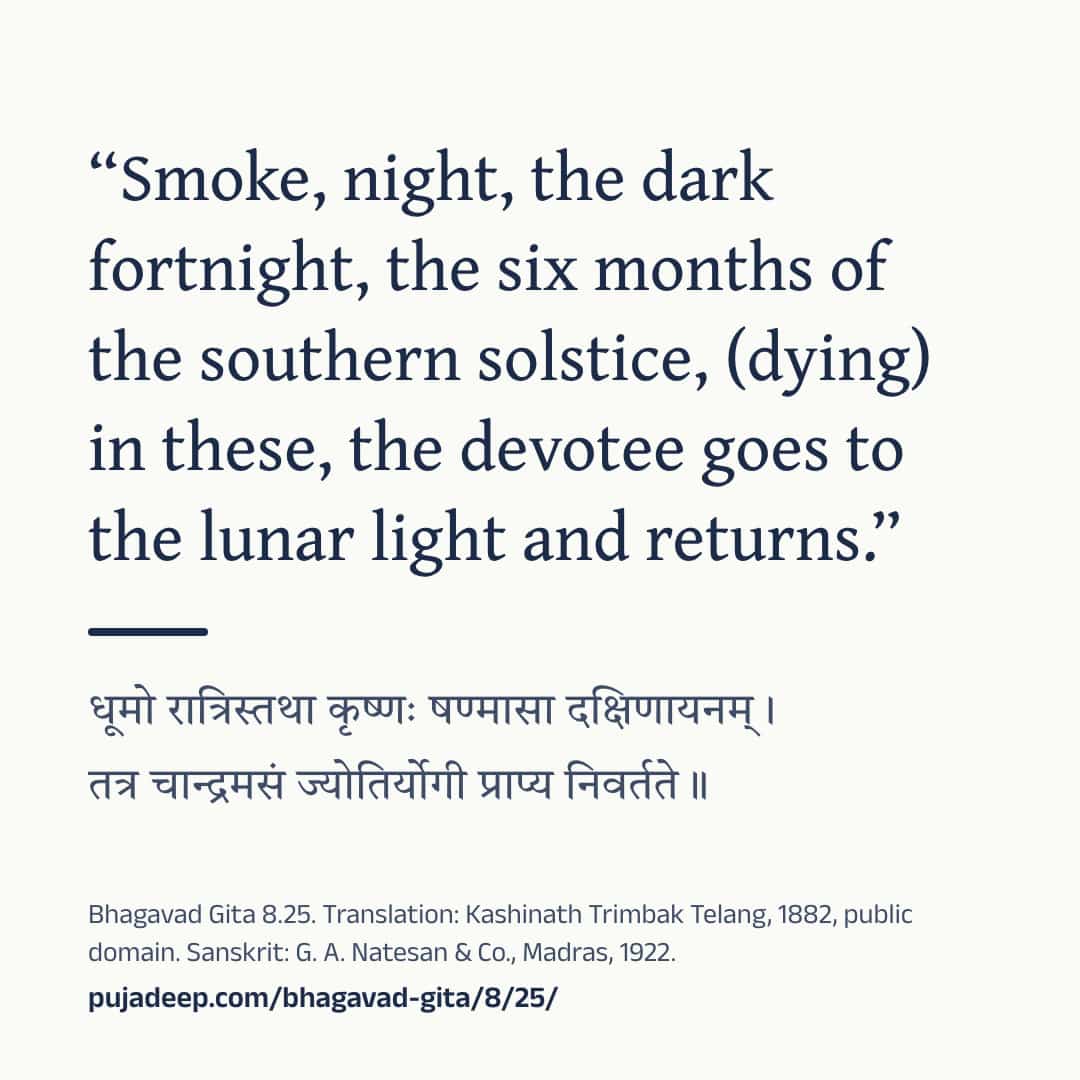
Smoke, night, the dark fortnight, the six months of the southern solstice, (dying) in these, the devotee goes to the lunar light and returns1.
Footnotes (the translator’s own) - Cf. Prasna-upanishad, p. 64; and Sârîraka Bhâshya, p. 747 seq. ↩
Compare 3 translations
Kashinath Trimbak Telang, 1882. Public domain. Page 81.
Smoke, night, the dark fortnight, the six months of the southern solstice, (dying) in these, the devotee goes to the lunar light and returns1.
Footnotes (the translator’s own) - Cf. Prasna-upanishad, p. 64; and Sârîraka Bhâshya, p. 747 seq. ↩
You are reading this one
Annie Besant, 1895. Public domain. Page 85–86.
Smoke, night-time, the dark fortnight also, the six months of the southern path—then the Yogî, obtaining the moonlight,1 returneth.
Footnotes (the translator’s own) - The lunar, or astral, body. Until this is slain the Soul returns to birth, ↩
You are reading this one
Swami Swarupananda, 1909 (first printed 1907). Public domain. Page 171.
Smoke, night-time, the dark fortnight, the six months of the Southern passage of the Sun—taking this path the Yogi, attaining the lunar light, returns.
You are reading this one
Cite this verse
The translation: K. T. Telang, The Bhagavadgîtâ (The Sacred Books of the East, vol. VIII, Oxford: Clarendon Press, 1882), p. 81. Bhagavad Gita 8.25.
The translation: Annie Besant, The Bhagavad Gîtâ, or The Lord's Song (London: Theosophical Publishing Society, 1895), pp. 85–86. Bhagavad Gita 8.25.
The translation: Swami Swarupananda, Srimad-Bhagavad-Gita (Mayavati: Prabuddha Bharata Press, 1909; first printed in Prabuddha Bharata, 1907–1909), p. 171. Bhagavad Gita 8.25.
Our explanation: “Bhagavad Gita 8.25: meaning and translation.” Pujadeep. Updated October 27, 2026. https://pujadeep.com/bhagavad-gita/8/25/
Pujadeep’s explanations are free to quote with credit: name Pujadeep and link to the page. How to credit
Classical readings, by school
No readings by school on this verse yet.
Share
Show the ways to share
Send one picture or the text to one chat. The picture names its source and the address of this page.
Drawing the picture
See the words
Bhagavad Gita 8.25

धूमो रात्रिस्तथा कृष्णः षण्मासा दक्षिणायनम् ।
तत्र चान्द्रमसं ज्योतिर्योगी प्राप्य निवर्तते ॥

“Smoke, night, the dark fortnight, the six months of the southern solstice, (dying) in these, the devotee goes to the lunar light and returns.”
(K. T. Telang, The Bhagavadgîtâ (The Sacred Books of the East, vol. VIII, Oxford: Clarendon Press, 1882), p. 81, public domain)

“Smoke, night-time, the dark fortnight also, the six months of the southern path—then the Yogî, obtaining the moonlight, returneth.”
(Annie Besant, The Bhagavad Gîtâ, or The Lord's Song (London: Theosophical Publishing Society, 1895), pp. 85–86, public domain)

“Smoke, night-time, the dark fortnight, the six months of the Southern passage of the Sun—taking this path the Yogi, attaining the lunar light, returns.”
(Swami Swarupananda, Srimad-Bhagavad-Gita (Mayavati: Prabuddha Bharata Press, 1909; first printed in Prabuddha Bharata, 1907–1909), p. 171, public domain)

Sanskrit: G. A. Natesan & Co., Madras, 1922.
https://pujadeep.com/bhagavad-gita/8/25/ Nothing is sent from this site. Your own app sends it, to the chat you choose. The picture quotes the translation you chose on this page, with its name and year.
Sanskrit text: The Bhagavad-Gita, or The Lord's Song, with the text in Devanagari and an English translation, 1922. Meanings: written for Pujadeep and checked against the cited edition. Source and changes
Questions families ask
Who speaks Bhagavad Gita 8.25?
Krishna speaks this verse, in chapter 8 (Akshara Brahma Yoga).
Where does the Sanskrit text come from?
Sanskrit text: The Bhagavad-Gita, or The Lord's Song, with the text in Devanagari and an English translation, 1922. Meanings: written for Pujadeep and checked against the cited edition. See the source
Is the meaning on this page a translation?
Explanation written for this site from the sources listed here, and checked against the cited edition. It is not a translation and not the only way to read the text. Free to quote with credit.
Source and licence
- Sanskrit text
- The Bhagavad-Gita, or The Lord's Song, with the text in Devanagari and an English translation (Annie Besant, G. A. Natesan & Co., Madras, 1922). Public domain. The Sanskrit on these pages was read from this printing’s page images.
- Translation
- The Bhagavadgîtâ with the Sanatsugâtîya and the Anugîtâ, translated by Kâshinâth Trimbak Telang (The Sacred Books of the East, vol. VIII, ed. F. Max Müller) (Kashinath Trimbak Telang, F. Max Müller, Clarendon Press, Oxford, 1882). Public domain. Shown verbatim, as printed.
- Translation
- The Bhagavad Gîtâ, or The Lord's Song, translated by Annie Besant (Annie Besant, Theosophical Publishing Society, London, 1895). Public domain. Shown verbatim, as printed.
- Translation
- Srimad-Bhagavad-Gita, with Sanskrit Text; Paraphrase with Word-by-word Literal Translation; English Rendering and Comments, Index, &c., by the Swami Swarupananda (Himalayan Series, No. XX) (Swami Swarupananda, The Editors and Publishers, Advaita Ashrama, Mayavati, Prabuddha Bharata Press, Mayavati, Almora, Himalayas, 1909). Public domain. Shown verbatim, as printed.
- Common wording
- In this text, 32 words follow today's common wording, checked against sanskritdocuments.org; Sanskrit Wikisource; Gita Press, Gorakhpur; GRETIL, Göttingen and Bhaktivedanta Book Trust.
- Our explanation
- Explanation written for this site from the sources listed here, and checked against the cited edition. It is not a translation and not the only way to read the text. Free to quote with credit.
- Checked
- Checked against the cited edition, October 27, 2026.