Bhagavad Gita 8.20: meaning and translation
Chapter 8: Akshara Brahma Yoga. Krishna says
But beyond that unmanifest, Krishna says, there is another unmanifest reality, eternal, which does not perish when all beings perish.
Click or tap a word for its meaning and its dictionary page.
Text and layers
Text and layers
These choices stay in this browser.
Bhagavad Gita 8.20
परस्तस्मात्तु भावोऽन्योऽव्यक्तोऽव्यक्तात्सनातनः ।यः स सर्वेषु भूतेषु नश्यत्सु न विनश्यति ॥
Parastasmattu bhavonyovyaktovyaktatsanatanahYah sa sarveshu bhuteshu nashyatsu na vinashyati
parastasmāttu bhāvo’nyo’vyakto’vyaktātsanātanaḥ |yaḥ sa sarveṣu bhūteṣu naśyatsu na vinaśyati ||
Our explanation But beyond that unmanifest, Krishna says, there is another unmanifest reality, eternal, which does not perish when all beings perish.
हिंदी अर्थ कृष्ण कहते हैं कि उस अव्यक्त से परे एक दूसरा अव्यक्त, सनातन भाव है, जो सब प्राणियों के नष्ट होने पर भी नष्ट नहीं होता।
Word by word
Every word, with its dictionary page
Word by word
- परः paraḥ · beyond, higher (nominative singular) Dictionary: 1. para, Monier-Williams 1899, p. 586, col. 1 “highest, supreme, chief”
- तस्मात् tasmāt · than that (pronoun, ablative singular) Dictionary: tad, Monier-Williams 1899, p. 434, col. 1 “m. he, f. she, n. it, that, this”
- तु tu · but (indeclinable) Dictionary: 2. tu, Monier-Williams 1899, p. 449, col. 3 “but; and; or”
- भावः bhāvaḥ · being, reality (nominative singular) Dictionary: bhāva, Monier-Williams 1899, p. 754, col. 1 “becoming, being”
- अन्यः anyaḥ · another (pronoun, nominative singular) Dictionary: 2. anya, Monier-Williams 1899, p. 45, col. 2 “other, different”
- अव्यक्तः avyaktaḥ · unmanifest (nominative singular) Dictionary: a-vyakta, Monier-Williams 1899, p. 111, col. 2 “undeveloped, not manifest, unapparent, indistinct, invisible”
- अव्यक्तात् avyaktāt · than the unmanifest (ablative singular) Dictionary: a-vyakta, Monier-Williams 1899, p. 111, col. 2 “undeveloped, not manifest, unapparent, indistinct, invisible”
- सनातनः sanātanaḥ · eternal (nominative singular) Dictionary: sanātana, Monier-Williams 1899, p. 1141, col. 1 “eternal, perpetual, permanent, everlasting, primeval, ancient”
- यः yaḥ · which (relative pronoun, nominative singular) Dictionary: yad, Monier-Williams 1899, p. 844, col. 2 “who, which, what, whichever, whatever, that”
- सः saḥ · that (pronoun, nominative singular) Dictionary: tad, Monier-Williams 1899, p. 434, col. 1 “m. he, f. she, n. it, that, this”
- सर्वेषु sarveṣu · all (pronoun, locative plural) Dictionary: sarva, Monier-Williams 1899, p. 1184, col. 3 “whole, entire, all, every”
- भूतेषु bhūteṣu · beings (locative plural) Dictionary: bhūta, Monier-Williams 1899, p. 761, col. 3 “that which is or exists, any living being”
- नश्यत्सु naśyatsu · perishing (present participle, locative plural) Dictionary: naśyat, Monier-Williams 1899, p. 532, col. 1 “perishing, being destroyed”; 2. naś, Monier-Williams 1899, p. 532, col. 1 “to be lost, perish, disappear, be gone”
- न na · not (indeclinable) Dictionary: 2. na, Monier-Williams 1899, p. 523, col. 1 “not, no, nor, neither”
- विनश्यति vinaśyati · perishes (present, 3rd person singular) Dictionary: vi-naś, Monier-Williams 1899, p. 969, col. 2 “to be utterly lost, perish, disappear, vanish”
Old translations
Kashinath Trimbak Telang, 1882. Public domain. Page 80.
But there is another entity, unperceived and eternal, and distinct from this unperceived (principle), which is not destroyed when all entities are destroyed.
Compare 3 translations
Kashinath Trimbak Telang, 1882. Public domain. Page 80.
But there is another entity, unperceived and eternal, and distinct from this unperceived (principle), which is not destroyed when all entities are destroyed.
You are reading this one
Annie Besant, 1895. Public domain. Page 84–85.
Therefore verily there existeth, higher than the manifested, Another, unmanifested, eternal, which, in the destroying of all beings, is not destroyed.
You are reading this one
Swami Swarupananda, 1909 (first printed 1907). Public domain. Page 169.
But beyond this unmanifested, there is that other Unmanifested, Eternal Existence—That which is not destroyed at the destruction of all beings.
You are reading this one
Cite this verse
The translation: K. T. Telang, The Bhagavadgîtâ (The Sacred Books of the East, vol. VIII, Oxford: Clarendon Press, 1882), p. 80. Bhagavad Gita 8.20.
The translation: Annie Besant, The Bhagavad Gîtâ, or The Lord's Song (London: Theosophical Publishing Society, 1895), pp. 84–85. Bhagavad Gita 8.20.
The translation: Swami Swarupananda, Srimad-Bhagavad-Gita (Mayavati: Prabuddha Bharata Press, 1909; first printed in Prabuddha Bharata, 1907–1909), p. 169. Bhagavad Gita 8.20.
Our explanation: “Bhagavad Gita 8.20: meaning and translation.” Pujadeep. Updated October 27, 2026. https://pujadeep.com/bhagavad-gita/8/20/
Pujadeep’s explanations are free to quote with credit: name Pujadeep and link to the page. How to credit
Classical readings, by school
No readings by school on this verse yet.
Share
Show the ways to share
Send one picture or the text to one chat. The picture names its source and the address of this page.
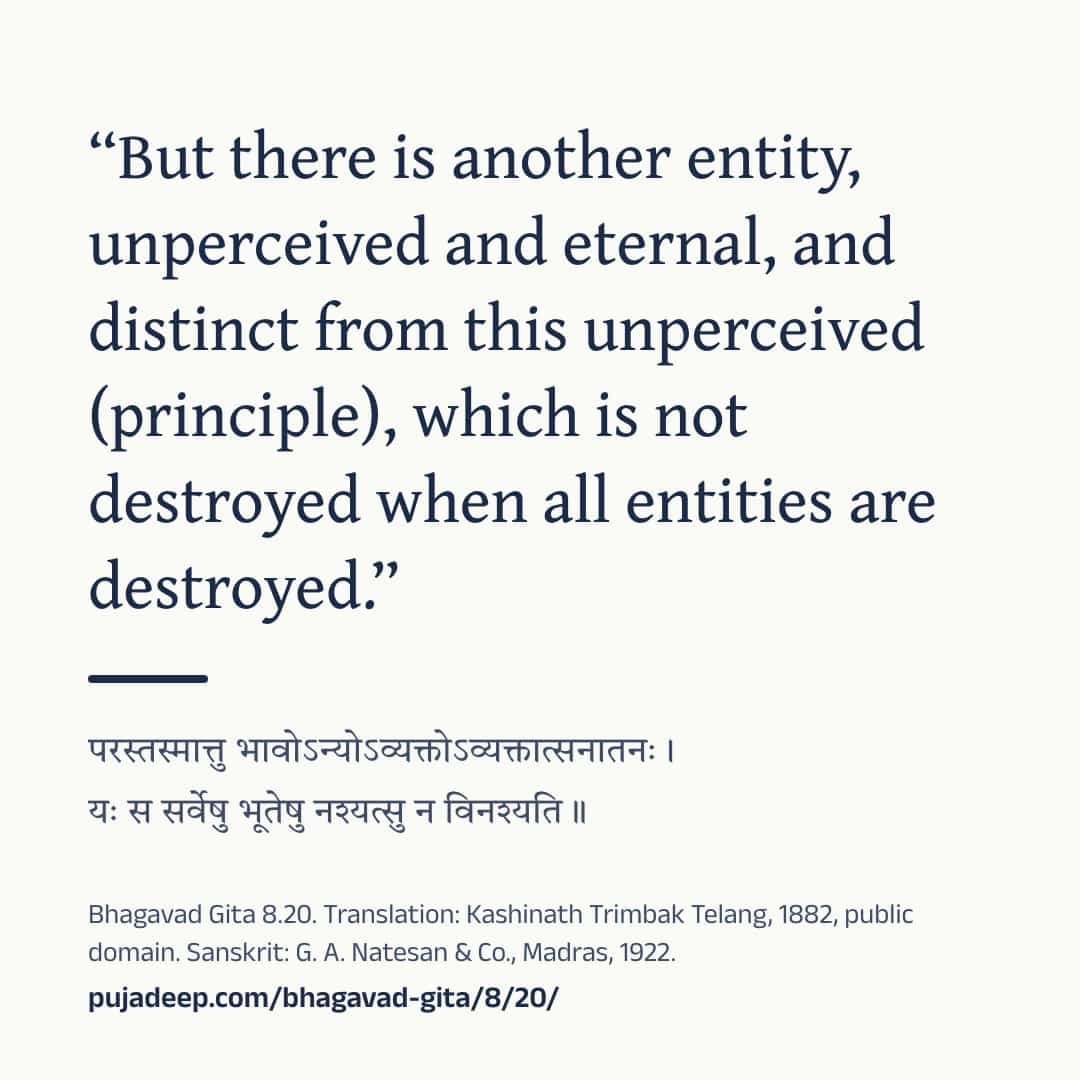
Drawing the picture
See the words
Bhagavad Gita 8.20

परस्तस्मात्तु भावोऽन्योऽव्यक्तोऽव्यक्तात्सनातनः ।
यः स सर्वेषु भूतेषु नश्यत्सु न विनश्यति ॥

“But there is another entity, unperceived and eternal, and distinct from this unperceived (principle), which is not destroyed when all entities are destroyed.”
(K. T. Telang, The Bhagavadgîtâ (The Sacred Books of the East, vol. VIII, Oxford: Clarendon Press, 1882), p. 80, public domain)

“Therefore verily there existeth, higher than the manifested, Another, unmanifested, eternal, which, in the destroying of all beings, is not destroyed.”
(Annie Besant, The Bhagavad Gîtâ, or The Lord's Song (London: Theosophical Publishing Society, 1895), pp. 84–85, public domain)

“But beyond this unmanifested, there is that other Unmanifested, Eternal Existence—That which is not destroyed at the destruction of all beings.”
(Swami Swarupananda, Srimad-Bhagavad-Gita (Mayavati: Prabuddha Bharata Press, 1909; first printed in Prabuddha Bharata, 1907–1909), p. 169, public domain)

Sanskrit: G. A. Natesan & Co., Madras, 1922.
https://pujadeep.com/bhagavad-gita/8/20/ Nothing is sent from this site. Your own app sends it, to the chat you choose. The picture quotes the translation you chose on this page, with its name and year.
Sanskrit text: The Bhagavad-Gita, or The Lord's Song, with the text in Devanagari and an English translation, 1922. Meanings: written for Pujadeep and checked against the cited edition. Source and changes
Questions families ask
Who speaks Bhagavad Gita 8.20?
Krishna speaks this verse, in chapter 8 (Akshara Brahma Yoga).
Where does the Sanskrit text come from?
Sanskrit text: The Bhagavad-Gita, or The Lord's Song, with the text in Devanagari and an English translation, 1922. Meanings: written for Pujadeep and checked against the cited edition. See the source
Is the meaning on this page a translation?
Explanation written for this site from the sources listed here, and checked against the cited edition. It is not a translation and not the only way to read the text. Free to quote with credit.
Source and licence
- Sanskrit text
- The Bhagavad-Gita, or The Lord's Song, with the text in Devanagari and an English translation (Annie Besant, G. A. Natesan & Co., Madras, 1922). Public domain. The Sanskrit on these pages was read from this printing’s page images.
- Translation
- The Bhagavadgîtâ with the Sanatsugâtîya and the Anugîtâ, translated by Kâshinâth Trimbak Telang (The Sacred Books of the East, vol. VIII, ed. F. Max Müller) (Kashinath Trimbak Telang, F. Max Müller, Clarendon Press, Oxford, 1882). Public domain. Shown verbatim, as printed.
- Translation
- The Bhagavad Gîtâ, or The Lord's Song, translated by Annie Besant (Annie Besant, Theosophical Publishing Society, London, 1895). Public domain. Shown verbatim, as printed.
- Translation
- Srimad-Bhagavad-Gita, with Sanskrit Text; Paraphrase with Word-by-word Literal Translation; English Rendering and Comments, Index, &c., by the Swami Swarupananda (Himalayan Series, No. XX) (Swami Swarupananda, The Editors and Publishers, Advaita Ashrama, Mayavati, Prabuddha Bharata Press, Mayavati, Almora, Himalayas, 1909). Public domain. Shown verbatim, as printed.
- Common wording
- In this text, 32 words follow today's common wording, checked against sanskritdocuments.org; Sanskrit Wikisource; Gita Press, Gorakhpur; GRETIL, Göttingen and Bhaktivedanta Book Trust.
- Our explanation
- Explanation written for this site from the sources listed here, and checked against the cited edition. It is not a translation and not the only way to read the text. Free to quote with credit.
- Checked
- Checked against the cited edition, October 27, 2026.