Bhagavad Gita 8.14: meaning and translation
Chapter 8: Akshara Brahma Yoga. Krishna says
For the yogi who remembers him constantly, every day, with a mind turned to nothing else, Krishna says he is easy to reach.
Click or tap a word for its meaning and its dictionary page.
Text and layers
Text and layers
These choices stay in this browser.
Bhagavad Gita 8.14
अनन्यचेताः सततं यो मां स्मरति नित्यशः ।तस्याहं सुलभः पार्थ नित्ययुक्तस्य योगिनः ॥
Ananyachetah satatam yo mam smarati nityashahTasyaham sulabhah partha nityayuktasya yoginah
ananyacetāḥ satataṃ yo māṃ smarati nityaśaḥ |tasyāhaṃ sulabhaḥ pārtha nityayuktasya yoginaḥ ||
Our explanation For the yogi who remembers him constantly, every day, with a mind turned to nothing else, Krishna says he is easy to reach.
हिंदी अर्थ कृष्ण कहते हैं कि जो योगी अनन्य मन से सदा, हर दिन उनका स्मरण करता है, उस नित्य-युक्त योगी के लिए वे सुलभ (आसानी से मिलने वाले) हैं।
Word by word
Every word, with its dictionary page
Word by word
- अनन्यचेताः ananyacetāḥ · with a mind on nothing else (compound, nominative singular) Dictionary: an-anya, Monier-Williams 1899, p. 25, col. 2 “having no other (object), undistracted”; cetas, Monier-Williams 1899, p. 398, col. 1 “consciousness, intelligence, thinking soul, heart, mind”
- सततम् satatam · constantly (adverb) Dictionary: sa-tata, Monier-Williams 1899, p. 1138, col. 1 “constantly, always, ever”
- यः yaḥ · who (relative pronoun, nominative singular) Dictionary: yad, Monier-Williams 1899, p. 844, col. 2 “who, which, what, whichever, whatever, that”
- माम् mām · "me" (Krishna) (pronoun, accusative singular) Dictionary: 1. mad, Monier-Williams 1899, p. 777, col. 2 “base of the first pers. pron. in the sg. number (esp. in comp.)”
- स्मरति smarati · remembers (present, 3rd person singular) Dictionary: 2. smṛ, Monier-Williams 1899, p. 1271, col. 3 “to remember, recollect, bear in mind, call to mind, think of”
- नित्यशः nityaśaḥ · always, every day (indeclinable) Dictionary: nitya-śas, Monier-Williams 1899, p. 547, col. 3 “always, constantly, eternally”
- तस्य tasya · for him (pronoun, genitive singular) Dictionary: tad, Monier-Williams 1899, p. 434, col. 1 “m. he, f. she, n. it, that, this”
- अहम् aham · "I" (Krishna) (pronoun, nominative singular) Dictionary: aham, Monier-Williams 1899, p. 124, col. 2 “nom. sg. ‘I,’”
- सुलभः sulabhaḥ · easy to reach (nominative singular) Dictionary: su-labha, Monier-Williams 1899, p. 1232, col. 3 “easy to be obtained or effected, easily accessible or attainable”
- पार्थ pārtha · O son of Pritha (Arjuna) (vocative singular) Dictionary: 2. pārtha, Monier-Williams 1899, p. 621, col. 3 “metron. of Yudhi-shṭhira or Bhīma-sena or Arjuna”
- नित्ययुक्तस्य nityayuktasya · ever joined, always steadfast (compound, genitive singular) Dictionary: nitya-yukta, Monier-Williams 1899, p. 547, col. 3 “always busy or intent upon”
- योगिनः yoginaḥ · of the yogi (genitive singular) Dictionary: yogin, Monier-Williams 1899, p. 857, col. 3 “a follower of the Yoga system, a Yogin (usually called Yogī) or contemplative saint”
Old translations
Kashinath Trimbak Telang, 1882. Public domain. Page 79.
To the devotee who constantly practises abstraction, O son of Prithâ! and who with a mind not (turned) to anything else, is ever and constantly meditating on me, I am easy of access.
Compare 3 translations
Kashinath Trimbak Telang, 1882. Public domain. Page 79.
To the devotee who constantly practises abstraction, O son of Prithâ! and who with a mind not (turned) to anything else, is ever and constantly meditating on me, I am easy of access.
You are reading this one
Annie Besant, 1895. Public domain. Page 83.
He who constantly remembereth Me, not thinking ever of another, of him I am easily reached, O Pârtha, of this ever harmonised Yogî.
You are reading this one
Swami Swarupananda, 1909 (first printed 1907). Public domain. Page 166.
I am easily attainable by that ever-steadfast Yogin who remembers Me constantly and daily, with a single mind, O son of Prithâ.
You are reading this one
Cite this verse
The translation: K. T. Telang, The Bhagavadgîtâ (The Sacred Books of the East, vol. VIII, Oxford: Clarendon Press, 1882), p. 79. Bhagavad Gita 8.14.
The translation: Annie Besant, The Bhagavad Gîtâ, or The Lord's Song (London: Theosophical Publishing Society, 1895), p. 83. Bhagavad Gita 8.14.
The translation: Swami Swarupananda, Srimad-Bhagavad-Gita (Mayavati: Prabuddha Bharata Press, 1909; first printed in Prabuddha Bharata, 1907–1909), p. 166. Bhagavad Gita 8.14.
Our explanation: “Bhagavad Gita 8.14: meaning and translation.” Pujadeep. Updated October 27, 2026. https://pujadeep.com/bhagavad-gita/8/14/
Pujadeep’s explanations are free to quote with credit: name Pujadeep and link to the page. How to credit
Classical readings, by school
No readings by school on this verse yet.
Share
Show the ways to share
Send one picture or the text to one chat. The picture names its source and the address of this page.
Drawing the picture
See the words
Bhagavad Gita 8.14

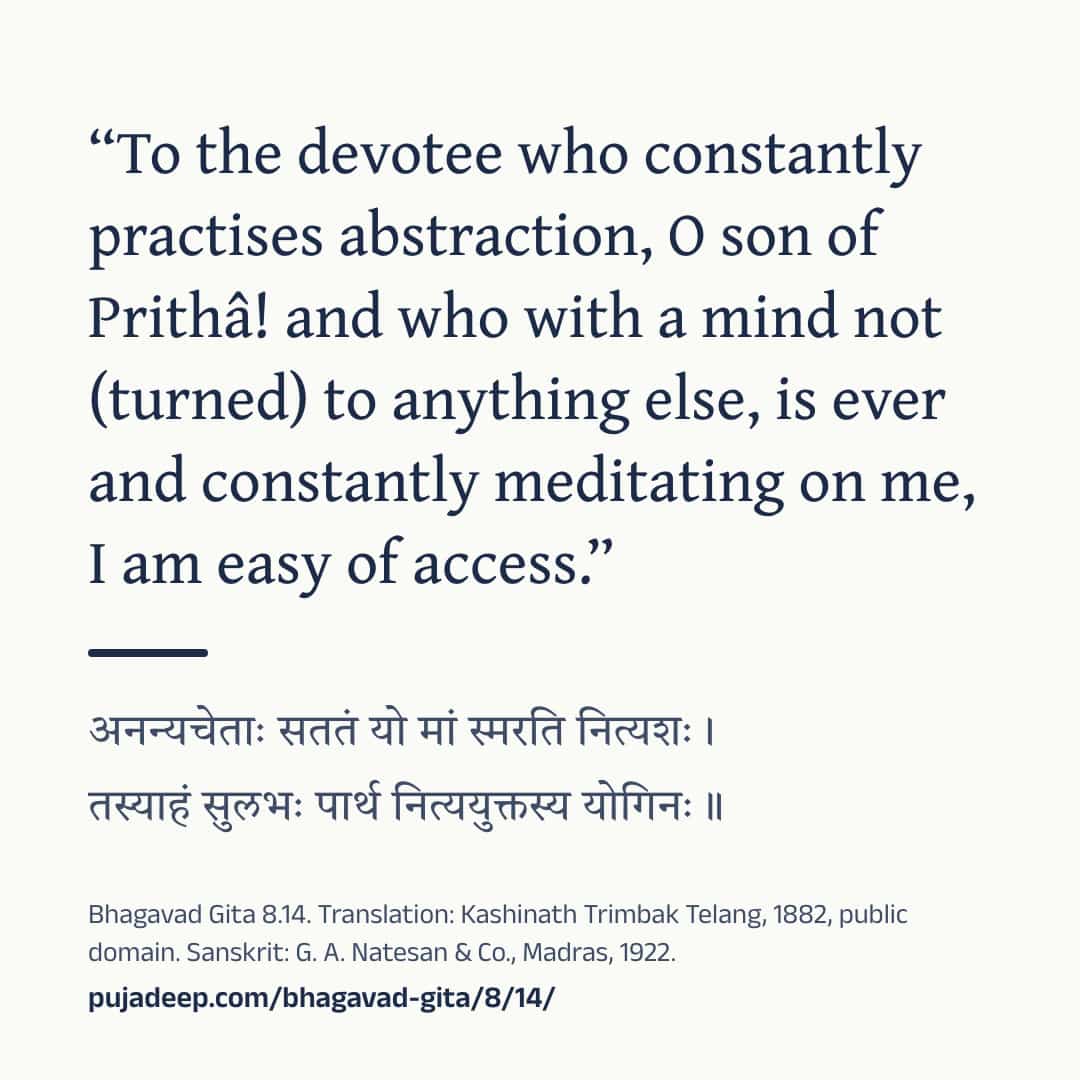
अनन्यचेताः सततं यो मां स्मरति नित्यशः ।
तस्याहं सुलभः पार्थ नित्ययुक्तस्य योगिनः ॥

“To the devotee who constantly practises abstraction, O son of Prithâ! and who with a mind not (turned) to anything else, is ever and constantly meditating on me, I am easy of access.”
(K. T. Telang, The Bhagavadgîtâ (The Sacred Books of the East, vol. VIII, Oxford: Clarendon Press, 1882), p. 79, public domain)

“He who constantly remembereth Me, not thinking ever of another, of him I am easily reached, O Pârtha, of this ever harmonised Yogî.”
(Annie Besant, The Bhagavad Gîtâ, or The Lord's Song (London: Theosophical Publishing Society, 1895), p. 83, public domain)

“I am easily attainable by that ever-steadfast Yogin who remembers Me constantly and daily, with a single mind, O son of Prithâ.”
(Swami Swarupananda, Srimad-Bhagavad-Gita (Mayavati: Prabuddha Bharata Press, 1909; first printed in Prabuddha Bharata, 1907–1909), p. 166, public domain)

Sanskrit: G. A. Natesan & Co., Madras, 1922.
https://pujadeep.com/bhagavad-gita/8/14/ Nothing is sent from this site. Your own app sends it, to the chat you choose. The picture quotes the translation you chose on this page, with its name and year.
Sanskrit text: The Bhagavad-Gita, or The Lord's Song, with the text in Devanagari and an English translation, 1922. Meanings: written for Pujadeep and checked against the cited edition. Source and changes
Questions families ask
Who speaks Bhagavad Gita 8.14?
Krishna speaks this verse, in chapter 8 (Akshara Brahma Yoga).
Where does the Sanskrit text come from?
Sanskrit text: The Bhagavad-Gita, or The Lord's Song, with the text in Devanagari and an English translation, 1922. Meanings: written for Pujadeep and checked against the cited edition. See the source
Is the meaning on this page a translation?
Explanation written for this site from the sources listed here, and checked against the cited edition. It is not a translation and not the only way to read the text. Free to quote with credit.
Source and licence
- Sanskrit text
- The Bhagavad-Gita, or The Lord's Song, with the text in Devanagari and an English translation (Annie Besant, G. A. Natesan & Co., Madras, 1922). Public domain. The Sanskrit on these pages was read from this printing’s page images.
- Translation
- The Bhagavadgîtâ with the Sanatsugâtîya and the Anugîtâ, translated by Kâshinâth Trimbak Telang (The Sacred Books of the East, vol. VIII, ed. F. Max Müller) (Kashinath Trimbak Telang, F. Max Müller, Clarendon Press, Oxford, 1882). Public domain. Shown verbatim, as printed.
- Translation
- The Bhagavad Gîtâ, or The Lord's Song, translated by Annie Besant (Annie Besant, Theosophical Publishing Society, London, 1895). Public domain. Shown verbatim, as printed.
- Translation
- Srimad-Bhagavad-Gita, with Sanskrit Text; Paraphrase with Word-by-word Literal Translation; English Rendering and Comments, Index, &c., by the Swami Swarupananda (Himalayan Series, No. XX) (Swami Swarupananda, The Editors and Publishers, Advaita Ashrama, Mayavati, Prabuddha Bharata Press, Mayavati, Almora, Himalayas, 1909). Public domain. Shown verbatim, as printed.
- Common wording
- In this text, 32 words follow today's common wording, checked against sanskritdocuments.org; Sanskrit Wikisource; Gita Press, Gorakhpur; GRETIL, Göttingen and Bhaktivedanta Book Trust.
- Our explanation
- Explanation written for this site from the sources listed here, and checked against the cited edition. It is not a translation and not the only way to read the text. Free to quote with credit.
- Checked
- Checked against the cited edition, October 27, 2026.