Bhagavad Gita 8.4: meaning and translation
Chapter 8: Akshara Brahma Yoga. Krishna says
Krishna: Adhibhūta is all that perishes.
Click or tap a word for its meaning and its dictionary page.
Text and layers
Text and layers
These choices stay in this browser.
Bhagavad Gita 8.4
अधिभूतं क्षरो भावः पुरुषश्चाधिदैवतम् ।अधियज्ञोऽहमेवात्र देहे देहभृतां वर ॥
Adhibhutam ksharo bhavah purushashchadhidaivatamAdhiyajnohamevatra dehe dehabhritam vara
adhibhūtaṃ kṣaro bhāvaḥ puruṣaścādhidaivatam |adhiyajño’hamevātra dehe dehabhṛtāṃ vara ||
Our explanation Adhibhūta is all that perishes. Adhidaiva is the Purusha (the cosmic person). And Krishna himself, here in the body, is adhiyajña, the one to whom offerings go. He calls Arjuna the best of embodied beings.
हिंदी अर्थ अधिभूत वह सब है जो नष्ट होता है। अधिदैव पुरुष (विराट पुरुष) है। और इस शरीर में अधियज्ञ, यानी जिसे सब यज्ञ अर्पित होते हैं, स्वयं कृष्ण हैं। वे अर्जुन को देहधारियों में श्रेष्ठ कहते हैं।
Word by word
Every word, with its dictionary page
Word by word
- अधिभूतम् adhibhūtam · adhibhūta (nominative singular) Dictionary: adhi-bhūta, Monier-Williams 1899, p. 21, col. 2 “the spiritual or fine substratum of material or gross objects”
- क्षरः kṣaraḥ · perishable (nominative singular) Dictionary: kṣara, Monier-Williams 1899, p. 327, col. 1 “melting away, perishable”
- भावः bhāvaḥ · existence, being (nominative singular) Dictionary: bhāva, Monier-Williams 1899, p. 754, col. 1 “becoming, being”
- पुरुषः puruṣaḥ · the Purusha, the person (nominative singular) Dictionary: puruṣa, Monier-Williams 1899, p. 637, col. 1 “the Supreme Being or Soul of the universe”
- च ca · and (indeclinable) Dictionary: 2. ca, Monier-Williams 1899, p. 380, col. 1 “and, both, also, moreover, as well as”
- अधिदैवतम् adhidaivatam · adhidaiva (nominative singular) Dictionary: adhi-daiva, Monier-Williams 1899, p. 21, col. 1 “the supreme deity; the divine agent operating in material objects”
- अधियज्ञः adhiyajñaḥ · adhiyajña (nominative singular) Dictionary: adhi-yajña, Monier-Williams 1899, p. 21, col. 3 “the chief or principal sacrifice”
- अहम् aham · "I" (Krishna) (pronoun, nominative singular) Dictionary: aham, Monier-Williams 1899, p. 124, col. 2 “nom. sg. ‘I,’”
- एव eva · alone, indeed (indeclinable) Dictionary: 1. eva, Monier-Williams 1899, p. 232, col. 2 “just, exactly, very, same, only, even, alone, merely”
- अत्र atra · here (indeclinable) Dictionary: 1. a-tra, Monier-Williams 1899, p. 17, col. 2 “in this place, here”
- देहे dehe · in the body (locative singular) Dictionary: deha, Monier-Williams 1899, p. 496, col. 3 “the body”
- देहभृताम् dehabhṛtām · of the embodied (compound, genitive plural) Dictionary: deha-bhṛt, Monier-Williams 1899, p. 497, col. 1 “embodied, corporeal; m. a living creature (esp. man)”
- वर vara · O best (vocative singular) Dictionary: 2. vara, Monier-Williams 1899, p. 922, col. 1 “best, most excellent”
Old translations
Kashinath Trimbak Telang, 1882. Public domain. Page 77.
The Adhibhûta is all perishable things. The Adhidaivata is the (primal) being. And the Adhiyagña, O best of embodied (beings)! is I myself in this body1.
Footnotes (the translator’s own) - Adhyâtma where it occurs before (e. g. p. 55) has been rendered 'the relation between the supreme and individual soul.' As to action, cf. pp. 53, 54. Adhibhûta is apparently the whole inanimate creation, and Adhidaivata is the being supposed to dwell in the sun. Adhiyagña is Krishna. Cf. too pp. 113, 114. ↩
Compare 3 translations
Kashinath Trimbak Telang, 1882. Public domain. Page 77.
The Adhibhûta is all perishable things. The Adhidaivata is the (primal) being. And the Adhiyagña, O best of embodied (beings)! is I myself in this body1.
Footnotes (the translator’s own) - Adhyâtma where it occurs before (e. g. p. 55) has been rendered 'the relation between the supreme and individual soul.' As to action, cf. pp. 53, 54. Adhibhûta is apparently the whole inanimate creation, and Adhidaivata is the being supposed to dwell in the sun. Adhiyagña is Krishna. Cf. too pp. 113, 114. ↩
You are reading this one
Annie Besant, 1895. Public domain. Page 81–82.
Adhibhûta is My perishable Nature, and Adhidaiva the life-giving energy;1 Adhiyagnya am I, here in the body, O best of living beings.
This sentence begins in 8.3.
Footnotes (the translator’s own) - Purusha, the male creative energy. ↩
You are reading this one
Swami Swarupananda, 1909 (first printed 1907). Public domain. Page 161.
The perishable adjunct is the Adhibhuta, and the Indweller is the Adhidaivata; I alone am the Adhiyajna here in this body, O best of the embodied.
You are reading this one
Cite this verse
The translation: K. T. Telang, The Bhagavadgîtâ (The Sacred Books of the East, vol. VIII, Oxford: Clarendon Press, 1882), p. 77. Bhagavad Gita 8.4.
The translation: Annie Besant, The Bhagavad Gîtâ, or The Lord's Song (London: Theosophical Publishing Society, 1895), pp. 81–82. Bhagavad Gita 8.4.
The translation: Swami Swarupananda, Srimad-Bhagavad-Gita (Mayavati: Prabuddha Bharata Press, 1909; first printed in Prabuddha Bharata, 1907–1909), p. 161. Bhagavad Gita 8.4.
Our explanation: “Bhagavad Gita 8.4: meaning and translation.” Pujadeep. Updated October 27, 2026. https://pujadeep.com/bhagavad-gita/8/4/
Pujadeep’s explanations are free to quote with credit: name Pujadeep and link to the page. How to credit
Classical readings, by school
Each reading is named by its school. None is presented as the only meaning.
What Advaita, Vishishtadvaita and Dvaita teach, in short
Shankara Advaita
Shankara says adhibhūta is all that has birth and perishes; the Purusha of adhidaiva is Hiraṇyagarbha, the universal soul in the sun that stirs the senses of all beings; and adhiyajña is Vishnu, the deity of all sacrifice, present in the body because sacrifice is done with the body.
Source: The Bhagavad-Gita, with the commentary of Sri Sankaracharya, translated by A. Mahadeva Sastri (2nd ed., Mysore: G. T. A. Printing Works, 1901), commentary on 8.4, pp. 202–203. Summarised in our own words; none of its text is reproduced.
Ramanuja Vishishtadvaita
Ramanuja reads these as what the different seekers meditate on: adhibhūta is the subtle objects of the senses, which those seeking power contemplate; adhidaiva is the Purusha as an enjoyer of delights beyond those of the gods; adhiyajña is the Lord himself, dwelling in the gods as his body and worshipped through every sacrifice.
Source: Sri Bhagavad-Gita with Sri Ramanujacharya's Visishtadvaita commentary, translated by A. Govindacharya (Madras, 1898), commentary on 8.4, pp. 265–266. Summarised in our own words; none of its text is reproduced.
Share
Show the ways to share
Send one picture or the text to one chat. The picture names its source and the address of this page.
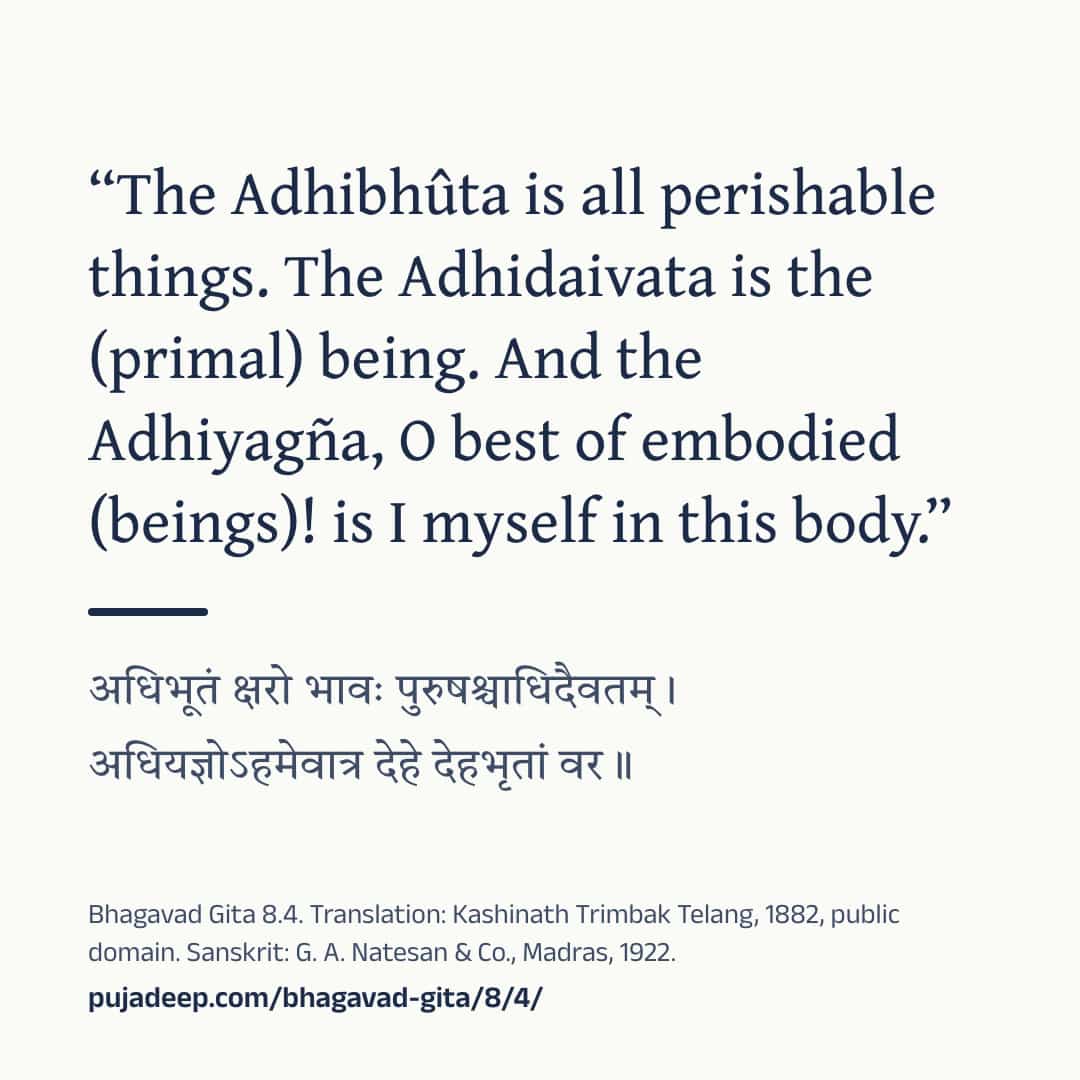
Drawing the picture
See the words
Bhagavad Gita 8.4

अधिभूतं क्षरो भावः पुरुषश्चाधिदैवतम् ।
अधियज्ञोऽहमेवात्र देहे देहभृतां वर ॥

“The Adhibhûta is all perishable things. The Adhidaivata is the (primal) being. And the Adhiyagña, O best of embodied (beings)! is I myself in this body.”
(K. T. Telang, The Bhagavadgîtâ (The Sacred Books of the East, vol. VIII, Oxford: Clarendon Press, 1882), p. 77, public domain)

“Adhibhûta is My perishable Nature, and Adhidaiva the life-giving energy; Adhiyagnya am I, here in the body, O best of living beings.”
(Annie Besant, The Bhagavad Gîtâ, or The Lord's Song (London: Theosophical Publishing Society, 1895), pp. 81–82, public domain)
This sentence begins in 8.3.

“The perishable adjunct is the Adhibhuta, and the Indweller is the Adhidaivata; I alone am the Adhiyajna here in this body, O best of the embodied.”
(Swami Swarupananda, Srimad-Bhagavad-Gita (Mayavati: Prabuddha Bharata Press, 1909; first printed in Prabuddha Bharata, 1907–1909), p. 161, public domain)

Sanskrit: G. A. Natesan & Co., Madras, 1922.
https://pujadeep.com/bhagavad-gita/8/4/ Nothing is sent from this site. Your own app sends it, to the chat you choose. The picture quotes the translation you chose on this page, with its name and year.
Sanskrit text: The Bhagavad-Gita, or The Lord's Song, with the text in Devanagari and an English translation, 1922. Meanings: written for Pujadeep and checked against the cited edition. Source and changes
Questions families ask
Who speaks Bhagavad Gita 8.4?
Krishna speaks this verse, in chapter 8 (Akshara Brahma Yoga).
Where does the Sanskrit text come from?
Sanskrit text: The Bhagavad-Gita, or The Lord's Song, with the text in Devanagari and an English translation, 1922. Meanings: written for Pujadeep and checked against the cited edition. See the source
Is the meaning on this page a translation?
Explanation written for this site from the sources listed here, and checked against the cited edition. It is not a translation and not the only way to read the text. Free to quote with credit.
Source and licence
- Sanskrit text
- The Bhagavad-Gita, or The Lord's Song, with the text in Devanagari and an English translation (Annie Besant, G. A. Natesan & Co., Madras, 1922). Public domain. The Sanskrit on these pages was read from this printing’s page images.
- Translation
- The Bhagavadgîtâ with the Sanatsugâtîya and the Anugîtâ, translated by Kâshinâth Trimbak Telang (The Sacred Books of the East, vol. VIII, ed. F. Max Müller) (Kashinath Trimbak Telang, F. Max Müller, Clarendon Press, Oxford, 1882). Public domain. Shown verbatim, as printed.
- Translation
- The Bhagavad Gîtâ, or The Lord's Song, translated by Annie Besant (Annie Besant, Theosophical Publishing Society, London, 1895). Public domain. Shown verbatim, as printed.
- Translation
- Srimad-Bhagavad-Gita, with Sanskrit Text; Paraphrase with Word-by-word Literal Translation; English Rendering and Comments, Index, &c., by the Swami Swarupananda (Himalayan Series, No. XX) (Swami Swarupananda, The Editors and Publishers, Advaita Ashrama, Mayavati, Prabuddha Bharata Press, Mayavati, Almora, Himalayas, 1909). Public domain. Shown verbatim, as printed.
- Commentary
- The Bhagavad-Gita, with the commentary of Sri Sankaracharya, translated by A. Mahadeva Sastri (2nd ed., Mysore: G. T. A. Printing Works, 1901) (Public-domain scan, University of California Libraries). Summarised in our own words; none of its text is reproduced.
- Commentary
- Sri Bhagavad-Gita with Sri Ramanujacharya's Visishtadvaita commentary, translated by A. Govindacharya (Madras, 1898) (Scan uploaded to archive.org (folkscanomy collection)). Summarised in our own words; none of its text is reproduced.
- Common wording
- In this text, 32 words follow today's common wording, checked against sanskritdocuments.org; Sanskrit Wikisource; Gita Press, Gorakhpur; GRETIL, Göttingen and Bhaktivedanta Book Trust.
- Our explanation
- Explanation written for this site from the sources listed here, and checked against the cited edition. It is not a translation and not the only way to read the text. Free to quote with credit.
- Checked
- Checked against the cited edition, October 27, 2026.