Bhagavad Gita 8.9: meaning and translation
Chapter 8: Akshara Brahma Yoga. Krishna says
Krishna describes the one to meditate on: the ancient seer, the ruler of all, subtler than the subtlest, the support of everything, of a form beyond thought, shining like the sun, beyond all darkness.
Click or tap a word for its meaning and its dictionary page.
Text and layers
Text and layers
These choices stay in this browser.
Bhagavad Gita 8.9
कविं पुराणमनुशासितारमणोरणीयांसमनुस्मरेद्यः ।सर्वस्य धातारमचिन्त्यरूपमादित्यवर्णं तमसः परस्तात् ॥
Kavim puranamanushasitaramanoraniyansamanusmaredyahSarvasya dhataramachintyarupamadityavarnam tamasah parastat
kaviṃ purāṇamanuśāsitāramaṇoraṇīyāṃsamanusmaredyaḥ |sarvasya dhātāramacintyarūpamādityavarṇaṃ tamasaḥ parastāt ||
Our explanation Krishna describes the one to meditate on: the ancient seer, the ruler of all, subtler than the subtlest, the support of everything, of a form beyond thought, shining like the sun, beyond all darkness. The sentence continues into verse 10.
हिंदी अर्थ कृष्ण बताते हैं कि किसका ध्यान करना है: जो कवि (सर्वज्ञ), पुराण (सनातन), सबका शासक, अणु से भी सूक्ष्म, सबका धारण करने वाला, विचार से परे रूप वाला, सूर्य जैसा प्रकाशमान और अंधकार से परे है। यह वाक्य श्लोक 10 में पूरा होता है।
Word by word
Every word, with its dictionary page
Word by word
- कविम् kavim · the seer (accusative singular) Dictionary: kavi, Monier-Williams 1899, p. 264, col. 2 “gifted with insight, intelligent, knowing, enlightened, wise”
- पुराणम् purāṇam · ancient (accusative singular) Dictionary: purāṇa, Monier-Williams 1899, p. 635, col. 1 “belonging to ancient or olden times, ancient, old”
- अनुशासितारम् anuśāsitāram · the ruler (accusative singular) Dictionary: anu-śāsitṛ, Monier-Williams 1899, p. 39, col. 3 “governing, instructing”
- अणोः aṇoḥ · than the atom (ablative singular) Dictionary: aṇu, Monier-Williams 1899, p. 11, col. 3 “fine, minute, atomic”
- अणीयांसम् aṇīyāṃsam · subtler, smaller (comparative, accusative singular) Dictionary: aṇīyas, Monier-Williams 1899, p. 11, col. 3 “more minute than usual”
- अनुस्मरेत् anusmaret · would remember (optative, 3rd person singular) Dictionary: anu-smṛ, Monier-Williams 1899, p. 41, col. 2 “to remember, recollect”
- यः yaḥ · who (relative pronoun, nominative singular) Dictionary: yad, Monier-Williams 1899, p. 844, col. 2 “who, which, what, whichever, whatever, that”
- सर्वस्य sarvasya · of all (pronoun, genitive singular) Dictionary: sarva, Monier-Williams 1899, p. 1184, col. 3 “whole, entire, all, every”
- धातारम् dhātāram · the supporter (accusative singular) Dictionary: dhātṛ, Monier-Williams 1899, p. 514, col. 1 “establisher, founder, creator, bearer, supporter”
- अचिन्त्यरूपम् acintyarūpam · of a form beyond thought (compound, accusative singular) Dictionary: a-cintya-rūpa, Monier-Williams 1899, p. 9, col. 1 “having an inconceivable form”
- आदित्यवर्णम् ādityavarṇam · shining like the sun (compound, accusative singular) Dictionary: āditya-varṇa, Monier-Williams 1899, p. 137, col. 2 “having the sun's colour”
- तमसः tamasaḥ · darkness (ablative singular) Dictionary: tamas, Monier-Williams 1899, p. 438, col. 1 “darkness, gloom”
- परस्तात् parastāt · beyond (indeclinable) Dictionary: parastāt, Monier-Williams 1899, p. 589, col. 1 “beyond, above”
Old translations
Kashinath Trimbak Telang, 1882. Public domain. Page 78.
He who, possessed of reverence (for the supreme Being) with a steady mind, and with the power of devotion, properly concentrates the life-breath between the brows1, and meditates on the ancient Seer, the ruler, more minute than the minutest atom2, the supporter of all, who is of an unthinkable form, whose brilliance is like that of the sun, and who is beyond all darkness3, he attains to that transcendent and divine Being.
This sentence covers verses 8.9 to 8.10.
Footnotes (the translator’s own) Compare 3 translations
Kashinath Trimbak Telang, 1882. Public domain. Page 78.
He who, possessed of reverence (for the supreme Being) with a steady mind, and with the power of devotion, properly concentrates the life-breath between the brows1, and meditates on the ancient Seer, the ruler, more minute than the minutest atom2, the supporter of all, who is of an unthinkable form, whose brilliance is like that of the sun, and who is beyond all darkness3, he attains to that transcendent and divine Being.
This sentence covers verses 8.9 to 8.10.
Footnotes (the translator’s own) You are reading this one
Annie Besant, 1895. Public domain. Page 82.
He who remembereth exclusively the Ancient, the Omniscient, the All-Ruler, minuter than the atom, the support of all, of form unimaginable, beauteous as the sun beyond the darkness,
This sentence goes on in 8.10.
You are reading this one
Swami Swarupananda, 1909 (first printed 1907). Public domain. Page 164.
The Omniscient, the Ancient, the Overruler, minuter than an atom, the Sustainer of all, of form inconceivable, self-luminous like the sun, and beyond the darkness of Maya—he, who meditates on Him thus, at the time of death, full of devotion, with the mind unmoving, and also by the power of Yoga, fixing the whole Prana betwixt the eye-brows, he goes to that Supreme, Resplendent Purusha.
This sentence covers verses 8.9 to 8.10.
You are reading this one
Cite this verse
The translation: K. T. Telang, The Bhagavadgîtâ (The Sacred Books of the East, vol. VIII, Oxford: Clarendon Press, 1882), p. 78. Bhagavad Gita 8.9–10.
The translation: Annie Besant, The Bhagavad Gîtâ, or The Lord's Song (London: Theosophical Publishing Society, 1895), p. 82. Bhagavad Gita 8.9.
The translation: Swami Swarupananda, Srimad-Bhagavad-Gita (Mayavati: Prabuddha Bharata Press, 1909; first printed in Prabuddha Bharata, 1907–1909), p. 164. Bhagavad Gita 8.9–10.
Our explanation: “Bhagavad Gita 8.9: meaning and translation.” Pujadeep. Updated October 27, 2026. https://pujadeep.com/bhagavad-gita/8/9/
Pujadeep’s explanations are free to quote with credit: name Pujadeep and link to the page. How to credit
Classical readings, by school
No readings by school on this verse yet.
Share
Show the ways to share
Send one picture or the text to one chat. The picture names its source and the address of this page.
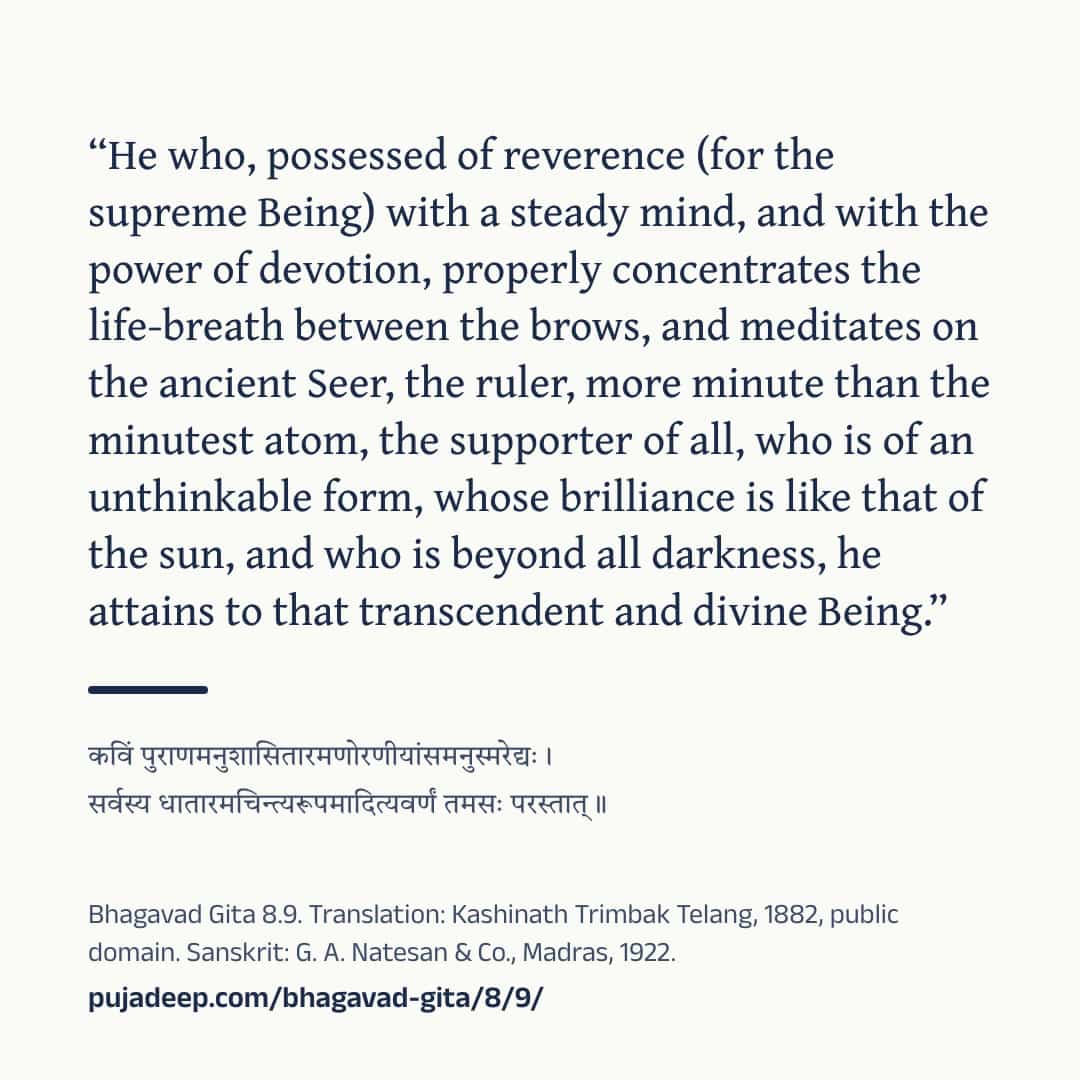
Drawing the picture
See the words
Bhagavad Gita 8.9

कविं पुराणमनुशासितारमणोरणीयांसमनुस्मरेद्यः ।
सर्वस्य धातारमचिन्त्यरूपमादित्यवर्णं तमसः परस्तात् ॥

“He who, possessed of reverence (for the supreme Being) with a steady mind, and with the power of devotion, properly concentrates the life-breath between the brows, and meditates on the ancient Seer, the ruler, more minute than the minutest atom, the supporter of all, who is of an unthinkable form, whose brilliance is like that of the sun, and who is beyond all darkness, he attains to that transcendent and divine Being.”
(K. T. Telang, The Bhagavadgîtâ (The Sacred Books of the East, vol. VIII, Oxford: Clarendon Press, 1882), p. 78, public domain)
This sentence covers verses 8.9 to 8.10.

“He who remembereth exclusively the Ancient, the Omniscient, the All-Ruler, minuter than the atom, the support of all, of form unimaginable, beauteous as the sun beyond the darkness,”
(Annie Besant, The Bhagavad Gîtâ, or The Lord's Song (London: Theosophical Publishing Society, 1895), p. 82, public domain)
This sentence goes on in 8.10.

“The Omniscient, the Ancient, the Overruler, minuter than an atom, the Sustainer of all, of form inconceivable, self-luminous like the sun, and beyond the darkness of Maya—he, who meditates on Him thus, at the time of death, full of devotion, with the mind unmoving, and also by the power of Yoga, fixing the whole Prana betwixt the eye-brows, he goes to that Supreme, Resplendent Purusha.”
(Swami Swarupananda, Srimad-Bhagavad-Gita (Mayavati: Prabuddha Bharata Press, 1909; first printed in Prabuddha Bharata, 1907–1909), p. 164, public domain)
This sentence covers verses 8.9 to 8.10.

Sanskrit: G. A. Natesan & Co., Madras, 1922.
https://pujadeep.com/bhagavad-gita/8/9/ Nothing is sent from this site. Your own app sends it, to the chat you choose. The picture quotes the translation you chose on this page, with its name and year.
Sanskrit text: The Bhagavad-Gita, or The Lord's Song, with the text in Devanagari and an English translation, 1922. Meanings: written for Pujadeep and checked against the cited edition. Source and changes
Questions families ask
Who speaks Bhagavad Gita 8.9?
Krishna speaks this verse, in chapter 8 (Akshara Brahma Yoga).
Where does the Sanskrit text come from?
Sanskrit text: The Bhagavad-Gita, or The Lord's Song, with the text in Devanagari and an English translation, 1922. Meanings: written for Pujadeep and checked against the cited edition. See the source
Is the meaning on this page a translation?
Explanation written for this site from the sources listed here, and checked against the cited edition. It is not a translation and not the only way to read the text. Free to quote with credit.
Source and licence
- Sanskrit text
- The Bhagavad-Gita, or The Lord's Song, with the text in Devanagari and an English translation (Annie Besant, G. A. Natesan & Co., Madras, 1922). Public domain. The Sanskrit on these pages was read from this printing’s page images.
- Translation
- The Bhagavadgîtâ with the Sanatsugâtîya and the Anugîtâ, translated by Kâshinâth Trimbak Telang (The Sacred Books of the East, vol. VIII, ed. F. Max Müller) (Kashinath Trimbak Telang, F. Max Müller, Clarendon Press, Oxford, 1882). Public domain. Shown verbatim, as printed.
- Translation
- The Bhagavad Gîtâ, or The Lord's Song, translated by Annie Besant (Annie Besant, Theosophical Publishing Society, London, 1895). Public domain. Shown verbatim, as printed.
- Translation
- Srimad-Bhagavad-Gita, with Sanskrit Text; Paraphrase with Word-by-word Literal Translation; English Rendering and Comments, Index, &c., by the Swami Swarupananda (Himalayan Series, No. XX) (Swami Swarupananda, The Editors and Publishers, Advaita Ashrama, Mayavati, Prabuddha Bharata Press, Mayavati, Almora, Himalayas, 1909). Public domain. Shown verbatim, as printed.
- Common wording
- In this text, 32 words follow today's common wording, checked against sanskritdocuments.org; Sanskrit Wikisource; Gita Press, Gorakhpur; GRETIL, Göttingen and Bhaktivedanta Book Trust.
- Our explanation
- Explanation written for this site from the sources listed here, and checked against the cited edition. It is not a translation and not the only way to read the text. Free to quote with credit.
- Checked
- Checked against the cited edition, October 27, 2026.