भगवद्गीता 8.9: अर्थ और अनुवाद
अध्याय 8: अक्षरब्रह्मयोग। कृष्ण कहते हैं
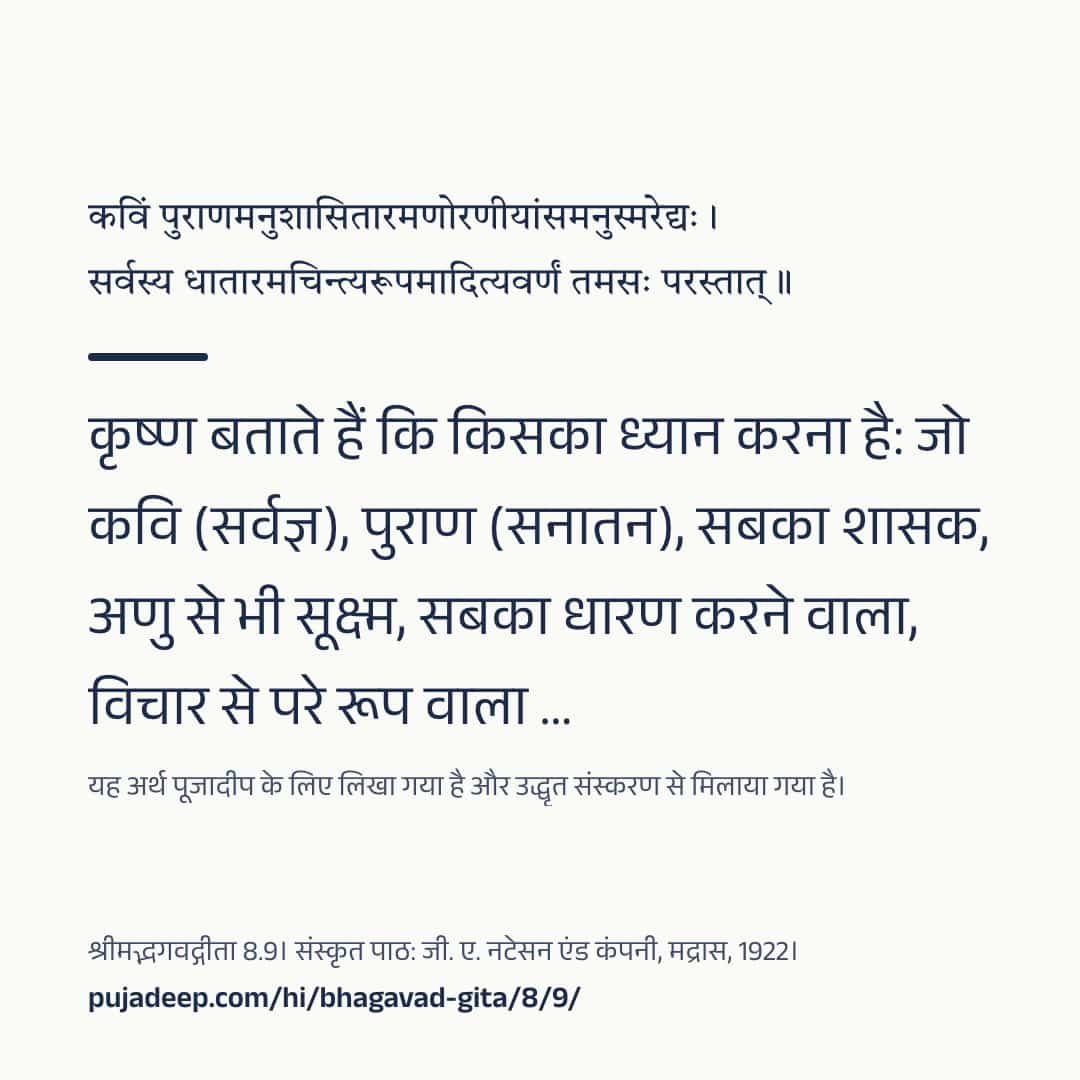
श्रीमद्भगवद्गीता (Bhagavad Gita) 8.9: कृष्ण बताते हैं कि किसका ध्यान करना है: जो कवि (सर्वज्ञ), पुराण (सनातन), सबका शासक, अणु से भी सूक्ष्म, सबका धारण करने वाला, विचार से परे रूप वाला, सूर्य जैसा प्रकाशमान और अंधकार से परे है।
किसी शब्द पर क्लिक करें या उसे छुएँ, उसका अर्थ और कोश का पृष्ठ देखें।
दिखावट
दिखावट
ये चुनाव इसी ब्राउज़र में रहते हैं।
श्रीमद्भगवद्गीता 8.9
कविं पुराणमनुशासितारमणोरणीयांसमनुस्मरेद्यः ।सर्वस्य धातारमचिन्त्यरूपमादित्यवर्णं तमसः परस्तात् ॥
Kavim puranamanushasitaramanoraniyansamanusmaredyahSarvasya dhataramachintyarupamadityavarnam tamasah parastat
kaviṃ purāṇamanuśāsitāramaṇoraṇīyāṃsamanusmaredyaḥ |sarvasya dhātāramacintyarūpamādityavarṇaṃ tamasaḥ parastāt ||
भावार्थ कृष्ण बताते हैं कि किसका ध्यान करना है: जो कवि (सर्वज्ञ), पुराण (सनातन), सबका शासक, अणु से भी सूक्ष्म, सबका धारण करने वाला, विचार से परे रूप वाला, सूर्य जैसा प्रकाशमान और अंधकार से परे है। यह वाक्य श्लोक 10 में पूरा होता है।
English meaning Krishna describes the one to meditate on: the ancient seer, the ruler of all, subtler than the subtlest, the support of everything, of a form beyond thought, shining like the sun, beyond all darkness. The sentence continues into verse 10.
शब्दार्थ
हर शब्द, शब्दकोश के पृष्ठ के साथ
शब्दार्थ
- कविम् kavim · कवि, क्रांतदर्शी (द्वितीया एकवचन) शब्दकोश: kavi, मोनियर-विलियम्स 1899, पृ. 264, स्तंभ 2
gifted with insight, intelligent, knowing, enlightened, wise
- पुराणम् purāṇam · पुरातन (द्वितीया एकवचन) शब्दकोश: purāṇa, मोनियर-विलियम्स 1899, पृ. 635, स्तंभ 1
belonging to ancient or olden times, ancient, old
- अनुशासितारम् anuśāsitāram · शासन करने वाला (द्वितीया एकवचन) शब्दकोश: anu-śāsitṛ, मोनियर-विलियम्स 1899, पृ. 39, स्तंभ 3
governing, instructing
- अणोः aṇoḥ · अणु से (पंचमी एकवचन) शब्दकोश: aṇu, मोनियर-विलियम्स 1899, पृ. 11, स्तंभ 3
fine, minute, atomic
- अणीयांसम् aṇīyāṃsam · अधिक सूक्ष्म (तुलनावाचक, द्वितीया एकवचन) शब्दकोश: aṇīyas, मोनियर-विलियम्स 1899, पृ. 11, स्तंभ 3
more minute than usual
- अनुस्मरेत् anusmaret · स्मरण करे (विधिलिङ्, प्रथम पुरुष एकवचन) शब्दकोश: anu-smṛ, मोनियर-विलियम्स 1899, पृ. 41, स्तंभ 2
to remember, recollect
- यः yaḥ · जो (संबंधवाचक सर्वनाम, प्रथमा एकवचन) शब्दकोश: yad, मोनियर-विलियम्स 1899, पृ. 844, स्तंभ 2
who, which, what, whichever, whatever, that
- सर्वस्य sarvasya · सबका (सर्वनाम, षष्ठी एकवचन) शब्दकोश: sarva, मोनियर-विलियम्स 1899, पृ. 1184, स्तंभ 3
whole, entire, all, every
- धातारम् dhātāram · धारण करने वाला (द्वितीया एकवचन) शब्दकोश: dhātṛ, मोनियर-विलियम्स 1899, पृ. 514, स्तंभ 1
establisher, founder, creator, bearer, supporter
- अचिन्त्यरूपम् acintyarūpam · अचिन्त्य रूप वाला (समास, द्वितीया एकवचन) शब्दकोश: a-cintya-rūpa, मोनियर-विलियम्स 1899, पृ. 9, स्तंभ 1
having an inconceivable form
- आदित्यवर्णम् ādityavarṇam · सूर्य के समान वर्ण वाला (समास, द्वितीया एकवचन) शब्दकोश: āditya-varṇa, मोनियर-विलियम्स 1899, पृ. 137, स्तंभ 2
having the sun's colour
- तमसः tamasaḥ · अंधकार से (पंचमी एकवचन) शब्दकोश: tamas, मोनियर-विलियम्स 1899, पृ. 438, स्तंभ 1
darkness, gloom
- परस्तात् parastāt · परे (अव्यय) शब्दकोश: parastāt, मोनियर-विलियम्स 1899, पृ. 589, स्तंभ 1
beyond, above
पुराने अंग्रेज़ी अनुवाद
Kashinath Trimbak Telang, 1882। सार्वजनिक डोमेन (कॉपीराइट-मुक्त)। पृष्ठ 78।
He who, possessed of reverence (for the supreme Being) with a steady mind, and with the power of devotion, properly concentrates the life-breath between the brows1, and meditates on the ancient Seer, the ruler, more minute than the minutest atom2, the supporter of all, who is of an unthinkable form, whose brilliance is like that of the sun, and who is beyond all darkness3, he attains to that transcendent and divine Being.
यह वाक्य श्लोक 8.9 से 8.10 तक का है।
पाद-टिप्पणियाँ (अनुवादक की अपनी) 3 अनुवादों की तुलना करें
Kashinath Trimbak Telang, 1882। सार्वजनिक डोमेन (कॉपीराइट-मुक्त)। पृष्ठ 78।
He who, possessed of reverence (for the supreme Being) with a steady mind, and with the power of devotion, properly concentrates the life-breath between the brows1, and meditates on the ancient Seer, the ruler, more minute than the minutest atom2, the supporter of all, who is of an unthinkable form, whose brilliance is like that of the sun, and who is beyond all darkness3, he attains to that transcendent and divine Being.
यह वाक्य श्लोक 8.9 से 8.10 तक का है।
पाद-टिप्पणियाँ (अनुवादक की अपनी) आप यही पढ़ रहे हैं
Annie Besant, 1895। सार्वजनिक डोमेन (कॉपीराइट-मुक्त)। पृष्ठ 82।
He who remembereth exclusively the Ancient, the Omniscient, the All-Ruler, minuter than the atom, the support of all, of form unimaginable, beauteous as the sun beyond the darkness,
यह वाक्य 8.10 में आगे चलता है।
आप यही पढ़ रहे हैं
Swami Swarupananda, 1909 (पहली बार 1907 में छपा)। सार्वजनिक डोमेन (कॉपीराइट-मुक्त)। पृष्ठ 164।
The Omniscient, the Ancient, the Overruler, minuter than an atom, the Sustainer of all, of form inconceivable, self-luminous like the sun, and beyond the darkness of Maya—he, who meditates on Him thus, at the time of death, full of devotion, with the mind unmoving, and also by the power of Yoga, fixing the whole Prana betwixt the eye-brows, he goes to that Supreme, Resplendent Purusha.
यह वाक्य श्लोक 8.9 से 8.10 तक का है।
आप यही पढ़ रहे हैं
इस श्लोक का हवाला दें
अनुवाद: K. T. Telang, The Bhagavadgîtâ (The Sacred Books of the East, vol. VIII, Oxford: Clarendon Press, 1882), पृष्ठ 78। भगवद्गीता 8.9–10।
अनुवाद: Annie Besant, The Bhagavad Gîtâ, or The Lord's Song (London: Theosophical Publishing Society, 1895), पृष्ठ 82। भगवद्गीता 8.9।
अनुवाद: Swami Swarupananda, Srimad-Bhagavad-Gita (Mayavati: Prabuddha Bharata Press, 1909; first printed in Prabuddha Bharata, 1907–1909), पृष्ठ 164। भगवद्गीता 8.9–10।
हमारी व्याख्या: “भगवद्गीता 8.9: अर्थ और अनुवाद”। पूजादीप। अद्यतन 27 अक्टूबर 2026। https://pujadeep.com/hi/bhagavad-gita/8/9/
पूजादीप की व्याख्याएँ श्रेय देकर उद्धृत की जा सकती हैं: पूजादीप का नाम और पृष्ठ का लिंक दें। श्रेय कैसे दें
शास्त्रीय व्याख्याएँ, संप्रदाय के अनुसार
इस श्लोक पर अभी संप्रदायों की व्याख्या नहीं है।
भेजें
साझा करने के तरीके दिखाएँ
एक तस्वीर या पाठ एक चैट में भेजें। तस्वीर पर उसका स्रोत और इस पृष्ठ का पता लिखा है।
तस्वीर बन रही है
शब्द देखें
श्रीमद्भगवद्गीता 8.9

कविं पुराणमनुशासितारमणोरणीयांसमनुस्मरेद्यः ।
सर्वस्य धातारमचिन्त्यरूपमादित्यवर्णं तमसः परस्तात् ॥

“He who, possessed of reverence (for the supreme Being) with a steady mind, and with the power of devotion, properly concentrates the life-breath between the brows, and meditates on the ancient Seer, the ruler, more minute than the minutest atom, the supporter of all, who is of an unthinkable form, whose brilliance is like that of the sun, and who is beyond all darkness, he attains to that transcendent and divine Being.”
(K. T. Telang, The Bhagavadgîtâ (The Sacred Books of the East, vol. VIII, Oxford: Clarendon Press, 1882), p. 78, public domain)
यह वाक्य श्लोक 8.9 से 8.10 तक का है।

“He who remembereth exclusively the Ancient, the Omniscient, the All-Ruler, minuter than the atom, the support of all, of form unimaginable, beauteous as the sun beyond the darkness,”
(Annie Besant, The Bhagavad Gîtâ, or The Lord's Song (London: Theosophical Publishing Society, 1895), p. 82, public domain)
यह वाक्य 8.10 में आगे चलता है।

“The Omniscient, the Ancient, the Overruler, minuter than an atom, the Sustainer of all, of form inconceivable, self-luminous like the sun, and beyond the darkness of Maya—he, who meditates on Him thus, at the time of death, full of devotion, with the mind unmoving, and also by the power of Yoga, fixing the whole Prana betwixt the eye-brows, he goes to that Supreme, Resplendent Purusha.”
(Swami Swarupananda, Srimad-Bhagavad-Gita (Mayavati: Prabuddha Bharata Press, 1909; first printed in Prabuddha Bharata, 1907–1909), p. 164, public domain)
यह वाक्य श्लोक 8.9 से 8.10 तक का है।

संस्कृत पाठ: जी. ए. नटेसन एंड कंपनी, मद्रास, 1922।
https://pujadeep.com/hi/bhagavad-gita/8/9/
इस साइट से कुछ नहीं भेजा जाता। आपका अपना ऐप उसे आपकी चुनी हुई चैट में भेजता है। तस्वीर में वही अनुवाद है जो आपने इस पृष्ठ पर चुना है, उसके नाम और वर्ष के साथ।
संस्कृत पाठ: 1922 का मद्रास मुद्रण। अर्थ: पूजादीप के लिए लिखे और जाँचे गए। स्रोत और बदलाव
परिवारों के प्रश्न
गीता 8.9 कौन कहता है?
यह श्लोक कृष्ण कहते हैं, अध्याय 8 (अक्षरब्रह्मयोग) में।
संस्कृत पाठ कहाँ से लिया गया है?
संस्कृत पाठ: 1922 का मद्रास मुद्रण। अर्थ: पूजादीप के लिए लिखे और जाँचे गए। स्रोत देखें
क्या इस पृष्ठ का अर्थ अनुवाद है?
इस साइट के लिए यहाँ दिए स्रोतों के आधार पर लिखी और उद्धृत संस्करण से मिलाई गई व्याख्या। यह अनुवाद नहीं है, और पाठ को पढ़ने का एकमात्र तरीका भी नहीं है। श्रेय देकर आप इसे उद्धृत कर सकते हैं।
स्रोत और लाइसेंस
- संस्कृत पाठ
- The Bhagavad-Gita, or The Lord's Song, with the text in Devanagari and an English translation (Annie Besant, G. A. Natesan & Co., Madras, 1922). सार्वजनिक डोमेन (कॉपीराइट-मुक्त)। इन पृष्ठों का संस्कृत पाठ इसी मुद्रण के पृष्ठ-चित्रों से पढ़ा गया है।
- अनुवाद
- The Bhagavadgîtâ with the Sanatsugâtîya and the Anugîtâ, translated by Kâshinâth Trimbak Telang (The Sacred Books of the East, vol. VIII, ed. F. Max Müller) (Kashinath Trimbak Telang, F. Max Müller, Clarendon Press, Oxford, 1882). सार्वजनिक डोमेन (कॉपीराइट-मुक्त)। जैसा छपा है, वैसा ही दिखाया गया।
- अनुवाद
- The Bhagavad Gîtâ, or The Lord's Song, translated by Annie Besant (Annie Besant, Theosophical Publishing Society, London, 1895). सार्वजनिक डोमेन (कॉपीराइट-मुक्त)। जैसा छपा है, वैसा ही दिखाया गया।
- अनुवाद
- Srimad-Bhagavad-Gita, with Sanskrit Text; Paraphrase with Word-by-word Literal Translation; English Rendering and Comments, Index, &c., by the Swami Swarupananda (Himalayan Series, No. XX) (Swami Swarupananda, The Editors and Publishers, Advaita Ashrama, Mayavati, Prabuddha Bharata Press, Mayavati, Almora, Himalayas, 1909). सार्वजनिक डोमेन (कॉपीराइट-मुक्त)। जैसा छपा है, वैसा ही दिखाया गया।
- प्रचलित पाठ
- इस पाठ में 32 शब्द आज के प्रचलित रूप में हैं; इन्हें sanskritdocuments.org; संस्कृत विकिस्रोत; गीता प्रेस, गोरखपुर; ग्रेटिल, गॉटिंगेन और भक्तिवेदांत बुक ट्रस्ट के पाठ से मिलाकर जाँचा गया।
- हमारी व्याख्या
- इस साइट के लिए यहाँ दिए स्रोतों के आधार पर लिखी और उद्धृत संस्करण से मिलाई गई व्याख्या। यह अनुवाद नहीं है, और पाठ को पढ़ने का एकमात्र तरीका भी नहीं है। श्रेय देकर आप इसे उद्धृत कर सकते हैं।
- जाँच
- उद्धृत संस्करण से मिलाया गया, 27 अक्टूबर 2026।