भगवद्गीता 8.12: अर्थ और अनुवाद
अध्याय 8: अक्षरब्रह्मयोग। कृष्ण कहते हैं
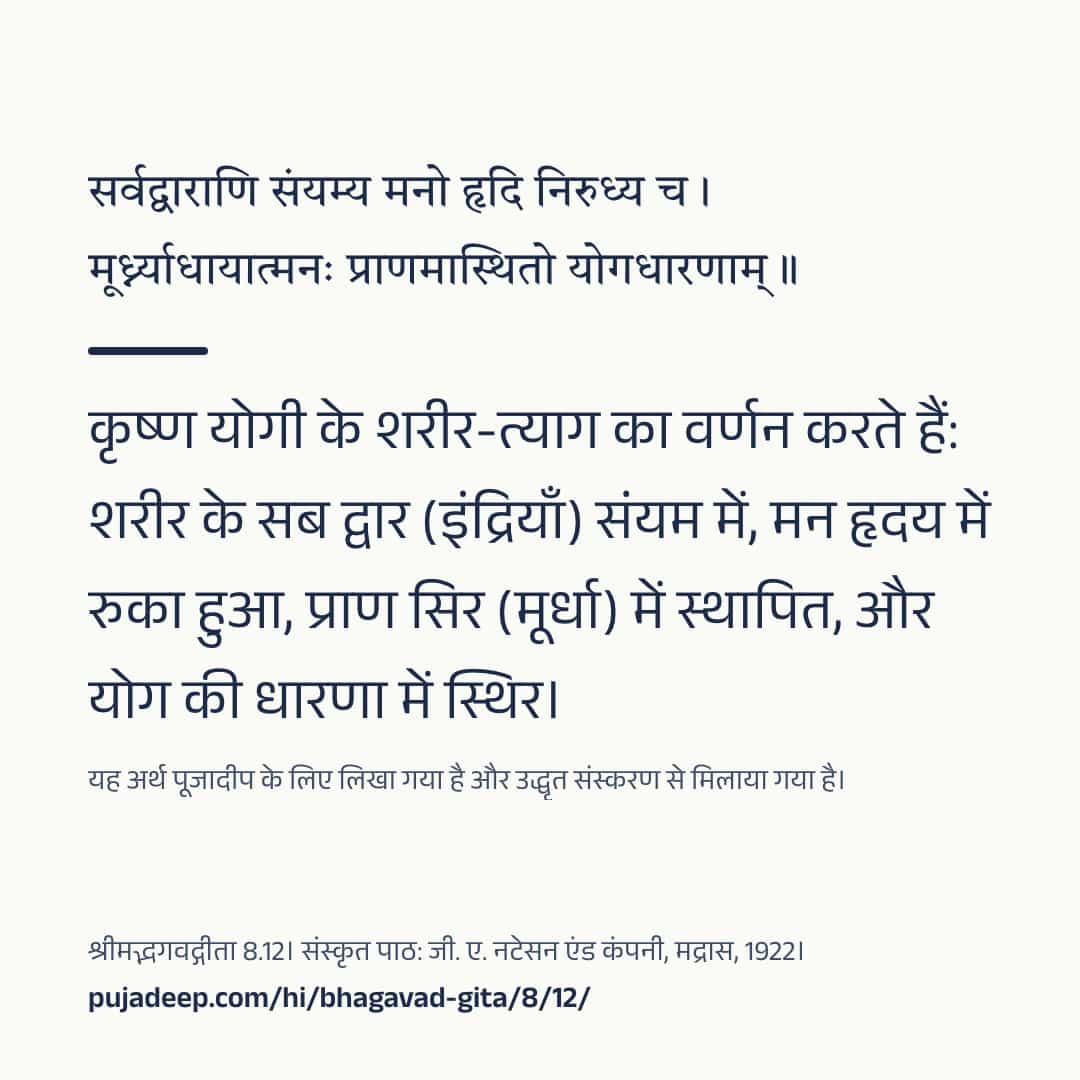
श्रीमद्भगवद्गीता (Bhagavad Gita) 8.12: कृष्ण योगी के शरीर-त्याग का वर्णन करते हैं: शरीर के सब द्वार (इंद्रियाँ) संयम में, मन हृदय में रुका हुआ, प्राण सिर (मूर्धा) में स्थापित, और योग की धारणा में स्थिर।
किसी शब्द पर क्लिक करें या उसे छुएँ, उसका अर्थ और कोश का पृष्ठ देखें।
दिखावट
दिखावट
ये चुनाव इसी ब्राउज़र में रहते हैं।
श्रीमद्भगवद्गीता 8.12
सर्वद्वाराणि संयम्य मनो हृदि निरुध्य च ।मूर्ध्न्याधायात्मनः प्राणमास्थितो योगधारणाम् ॥
Sarvadvarani sanyamya mano hridi nirudhya chaMurdhnyadhayatmanah pranamasthito yogadharanam
sarvadvārāṇi saṃyamya mano hṛdi nirudhya ca |mūrdhnyādhāyātmanaḥ prāṇamāsthito yogadhāraṇām ||
भावार्थ कृष्ण योगी के शरीर-त्याग का वर्णन करते हैं: शरीर के सब द्वार (इंद्रियाँ) संयम में, मन हृदय में रुका हुआ, प्राण सिर (मूर्धा) में स्थापित, और योग की धारणा में स्थिर। यह वाक्य श्लोक 13 में पूरा होता है।
English meaning Krishna describes a yogic death: all the gates of the body (the senses) held in check, the mind kept in the heart, the life-breath placed at the crown of the head, steady in the concentration of yoga. The sentence continues into verse 13.
शब्दार्थ
हर शब्द, शब्दकोश के पृष्ठ के साथ
शब्दार्थ
- सर्वद्वाराणि sarvadvārāṇi · सब द्वार (इंद्रियाँ) (समास, द्वितीया बहुवचन) शब्दकोश: sarva, मोनियर-विलियम्स 1899, पृ. 1184, स्तंभ 3
whole, entire, all, every
; dvāra, मोनियर-विलियम्स 1899, पृ. 504, स्तंभ 2door, gate, passage, entrance
- संयम्य saṃyamya · संयम करके (पूर्वकालिक कृदन्त) शब्दकोश: saṃ-yam, मोनियर-विलियम्स 1899, पृ. 1111, स्तंभ 3
to hold together, hold in, hold fast, restrain, curb, suppress, control
- मनः manaḥ · मन (द्वितीया एकवचन) शब्दकोश: manas, मोनियर-विलियम्स 1899, पृ. 783, स्तंभ 3
mind (in its widest sense as applied to all the mental powers)
- हृदि hṛdi · हृदय में (सप्तमी एकवचन) शब्दकोश: hṛd, मोनियर-विलियम्स 1899, पृ. 1302, स्तंभ 2
the heart (as the seat of feelings and emotions)
- निरुध्य nirudhya · रोककर (पूर्वकालिक कृदन्त) शब्दकोश: ni-rudh, मोनियर-विलियम्स 1899, पृ. 553, स्तंभ 3
to hold back, stop, hinder, shut up, confine, restrain, check
- च ca · और (अव्यय) शब्दकोश: 2. ca, मोनियर-विलियम्स 1899, पृ. 380, स्तंभ 1
and, both, also, moreover, as well as
- मूर्ध्नि mūrdhni · मस्तक में (सप्तमी एकवचन) शब्दकोश: mūrdhan, मोनियर-विलियम्स 1899, पृ. 826, स्तंभ 1
the forehead, head in general, skull
- आधाय ādhāya · रखकर (पूर्वकालिक कृदन्त) शब्दकोश: ā-dhā, मोनियर-विलियम्स 1899, पृ. 138, स्तंभ 2
to place on, put down, deposit, put
- आत्मनः ātmanaḥ · अपने (षष्ठी एकवचन) शब्दकोश: ātman, मोनियर-विलियम्स 1899, पृ. 135, स्तंभ 1
the individual soul, self
- प्राणम् prāṇam · प्राण (द्वितीया एकवचन) शब्दकोश: 2. prāṇa, मोनियर-विलियम्स 1899, पृ. 705, स्तंभ 1
the breath of life, breath, respiration, spirit, vitality
- आस्थितः āsthitaḥ · धारण किए हुए (भूतकालिक कृदन्त, प्रथमा एकवचन) शब्दकोश: ā-sthita, मोनियर-विलियम्स 1899, पृ. 161, स्तंभ 2
one who has undertaken or performed
- योगधारणाम् yogadhāraṇām · योग की धारणा (समास, द्वितीया एकवचन (स्त्रीलिंग)) शब्दकोश: yoga-dhāraṇā, मोनियर-विलियम्स 1899, पृ. 857, स्तंभ 1
continuance or perseverance in meditation
पुराने अंग्रेज़ी अनुवाद
Kashinath Trimbak Telang, 1882। सार्वजनिक डोमेन (कॉपीराइट-मुक्त)। पृष्ठ 79।
He who leaves the body and departs (from this world), stopping up all passages1, and confining the mind within the heart2, placing the life-breath in the head, and adhering to uninterrupted meditation3, repeating the single syllable 'Om,' (signifying) the eternal Brahman4, and meditating on me, he reaches the highest goal.
यह वाक्य श्लोक 8.12 से 8.13 तक का है।
पाद-टिप्पणियाँ (अनुवादक की अपनी) - 'The senses,' say the commentators. Might it not refer to the 'nine portals' at p. 65 supra? See also, however, p. 108. ↩
- I. e. thinking of nothing, making the mind cease to work. Cf. Maitrî-upanishad, p. 179. ↩
- Cf. Maitrî-upanishad, p. 130, uninterrupted, like 'oil when poured out,' says the commentator. ↩
- Cf. Khândogya-upanishad, p. 151; Mândukya, pp. 330–388 (Om is all—past, present, and future); Nrisimha Tâpinî, pp. 110, 117, 171; Maitrî, p. 140; Prasna, p. 220. On the opening passage of the Khândogya, Saṅkara says, 'Om is the closest designation of the supreme Being. He is pleased when it is pronounced, as people are at the mention of a favourite name.' See also Max Müller, Hibbert Lectures, p. 84; Goldstücker's Remains, I, 122. ↩
3 अनुवादों की तुलना करें
Kashinath Trimbak Telang, 1882। सार्वजनिक डोमेन (कॉपीराइट-मुक्त)। पृष्ठ 79।
He who leaves the body and departs (from this world), stopping up all passages1, and confining the mind within the heart2, placing the life-breath in the head, and adhering to uninterrupted meditation3, repeating the single syllable 'Om,' (signifying) the eternal Brahman4, and meditating on me, he reaches the highest goal.
यह वाक्य श्लोक 8.12 से 8.13 तक का है।
पाद-टिप्पणियाँ (अनुवादक की अपनी) - 'The senses,' say the commentators. Might it not refer to the 'nine portals' at p. 65 supra? See also, however, p. 108. ↩
- I. e. thinking of nothing, making the mind cease to work. Cf. Maitrî-upanishad, p. 179. ↩
- Cf. Maitrî-upanishad, p. 130, uninterrupted, like 'oil when poured out,' says the commentator. ↩
- Cf. Khândogya-upanishad, p. 151; Mândukya, pp. 330–388 (Om is all—past, present, and future); Nrisimha Tâpinî, pp. 110, 117, 171; Maitrî, p. 140; Prasna, p. 220. On the opening passage of the Khândogya, Saṅkara says, 'Om is the closest designation of the supreme Being. He is pleased when it is pronounced, as people are at the mention of a favourite name.' See also Max Müller, Hibbert Lectures, p. 84; Goldstücker's Remains, I, 122. ↩
आप यही पढ़ रहे हैं
Annie Besant, 1895। सार्वजनिक डोमेन (कॉपीराइट-मुक्त)। पृष्ठ 83।
All the gates1 closed, Manas confined in the heart, the life-breath fixed in his own head, firm in Yoga,
यह वाक्य 8.13 में आगे चलता है।
पाद-टिप्पणियाँ (अनुवादक की अपनी) - The gates of the body, i.e., the sense-organs, ↩
आप यही पढ़ रहे हैं
Swami Swarupananda, 1909 (पहली बार 1907 में छपा)। सार्वजनिक डोमेन (कॉपीराइट-मुक्त)। पृष्ठ 165।
Controlling all the senses, confining the mind in the heart, drawing the Prana into the head, occupied in the practice of concentration, uttering the one-syllable "Om"—the Brahman, and meditating on Me;—he who departs, leaving the body, attains the Supreme goal,
यह वाक्य श्लोक 8.12 से 8.13 तक का है।
आप यही पढ़ रहे हैं
इस श्लोक का हवाला दें
अनुवाद: K. T. Telang, The Bhagavadgîtâ (The Sacred Books of the East, vol. VIII, Oxford: Clarendon Press, 1882), पृष्ठ 79। भगवद्गीता 8.12–13।
अनुवाद: Annie Besant, The Bhagavad Gîtâ, or The Lord's Song (London: Theosophical Publishing Society, 1895), पृष्ठ 83। भगवद्गीता 8.12।
अनुवाद: Swami Swarupananda, Srimad-Bhagavad-Gita (Mayavati: Prabuddha Bharata Press, 1909; first printed in Prabuddha Bharata, 1907–1909), पृष्ठ 165। भगवद्गीता 8.12–13।
हमारी व्याख्या: “भगवद्गीता 8.12: अर्थ और अनुवाद”। पूजादीप। अद्यतन 27 अक्टूबर 2026। https://pujadeep.com/hi/bhagavad-gita/8/12/
पूजादीप की व्याख्याएँ श्रेय देकर उद्धृत की जा सकती हैं: पूजादीप का नाम और पृष्ठ का लिंक दें। श्रेय कैसे दें
शास्त्रीय व्याख्याएँ, संप्रदाय के अनुसार
इस श्लोक पर अभी संप्रदायों की व्याख्या नहीं है।
भेजें
साझा करने के तरीके दिखाएँ
एक तस्वीर या पाठ एक चैट में भेजें। तस्वीर पर उसका स्रोत और इस पृष्ठ का पता लिखा है।
तस्वीर बन रही है
शब्द देखें
श्रीमद्भगवद्गीता 8.12

सर्वद्वाराणि संयम्य मनो हृदि निरुध्य च ।
मूर्ध्न्याधायात्मनः प्राणमास्थितो योगधारणाम् ॥

“He who leaves the body and departs (from this world), stopping up all passages, and confining the mind within the heart, placing the life-breath in the head, and adhering to uninterrupted meditation, repeating the single syllable 'Om,' (signifying) the eternal Brahman, and meditating on me, he reaches the highest goal.”
(K. T. Telang, The Bhagavadgîtâ (The Sacred Books of the East, vol. VIII, Oxford: Clarendon Press, 1882), p. 79, public domain)
यह वाक्य श्लोक 8.12 से 8.13 तक का है।

“All the gates closed, Manas confined in the heart, the life-breath fixed in his own head, firm in Yoga,”
(Annie Besant, The Bhagavad Gîtâ, or The Lord's Song (London: Theosophical Publishing Society, 1895), p. 83, public domain)
यह वाक्य 8.13 में आगे चलता है।

“Controlling all the senses, confining the mind in the heart, drawing the Prana into the head, occupied in the practice of concentration, uttering the one-syllable "Om"—the Brahman, and meditating on Me;—he who departs, leaving the body, attains the Supreme goal,”
(Swami Swarupananda, Srimad-Bhagavad-Gita (Mayavati: Prabuddha Bharata Press, 1909; first printed in Prabuddha Bharata, 1907–1909), p. 165, public domain)
यह वाक्य श्लोक 8.12 से 8.13 तक का है।

संस्कृत पाठ: जी. ए. नटेसन एंड कंपनी, मद्रास, 1922।
https://pujadeep.com/hi/bhagavad-gita/8/12/
इस साइट से कुछ नहीं भेजा जाता। आपका अपना ऐप उसे आपकी चुनी हुई चैट में भेजता है। तस्वीर में वही अनुवाद है जो आपने इस पृष्ठ पर चुना है, उसके नाम और वर्ष के साथ।
संस्कृत पाठ: 1922 का मद्रास मुद्रण। अर्थ: पूजादीप के लिए लिखे और जाँचे गए। स्रोत और बदलाव
परिवारों के प्रश्न
गीता 8.12 कौन कहता है?
यह श्लोक कृष्ण कहते हैं, अध्याय 8 (अक्षरब्रह्मयोग) में।
संस्कृत पाठ कहाँ से लिया गया है?
संस्कृत पाठ: 1922 का मद्रास मुद्रण। अर्थ: पूजादीप के लिए लिखे और जाँचे गए। स्रोत देखें
क्या इस पृष्ठ का अर्थ अनुवाद है?
इस साइट के लिए यहाँ दिए स्रोतों के आधार पर लिखी और उद्धृत संस्करण से मिलाई गई व्याख्या। यह अनुवाद नहीं है, और पाठ को पढ़ने का एकमात्र तरीका भी नहीं है। श्रेय देकर आप इसे उद्धृत कर सकते हैं।
स्रोत और लाइसेंस
- संस्कृत पाठ
- The Bhagavad-Gita, or The Lord's Song, with the text in Devanagari and an English translation (Annie Besant, G. A. Natesan & Co., Madras, 1922). सार्वजनिक डोमेन (कॉपीराइट-मुक्त)। इन पृष्ठों का संस्कृत पाठ इसी मुद्रण के पृष्ठ-चित्रों से पढ़ा गया है।
- अनुवाद
- The Bhagavadgîtâ with the Sanatsugâtîya and the Anugîtâ, translated by Kâshinâth Trimbak Telang (The Sacred Books of the East, vol. VIII, ed. F. Max Müller) (Kashinath Trimbak Telang, F. Max Müller, Clarendon Press, Oxford, 1882). सार्वजनिक डोमेन (कॉपीराइट-मुक्त)। जैसा छपा है, वैसा ही दिखाया गया।
- अनुवाद
- The Bhagavad Gîtâ, or The Lord's Song, translated by Annie Besant (Annie Besant, Theosophical Publishing Society, London, 1895). सार्वजनिक डोमेन (कॉपीराइट-मुक्त)। जैसा छपा है, वैसा ही दिखाया गया।
- अनुवाद
- Srimad-Bhagavad-Gita, with Sanskrit Text; Paraphrase with Word-by-word Literal Translation; English Rendering and Comments, Index, &c., by the Swami Swarupananda (Himalayan Series, No. XX) (Swami Swarupananda, The Editors and Publishers, Advaita Ashrama, Mayavati, Prabuddha Bharata Press, Mayavati, Almora, Himalayas, 1909). सार्वजनिक डोमेन (कॉपीराइट-मुक्त)। जैसा छपा है, वैसा ही दिखाया गया।
- प्रचलित पाठ
- इस पाठ में 32 शब्द आज के प्रचलित रूप में हैं; इन्हें sanskritdocuments.org; संस्कृत विकिस्रोत; गीता प्रेस, गोरखपुर; ग्रेटिल, गॉटिंगेन और भक्तिवेदांत बुक ट्रस्ट के पाठ से मिलाकर जाँचा गया।
- हमारी व्याख्या
- इस साइट के लिए यहाँ दिए स्रोतों के आधार पर लिखी और उद्धृत संस्करण से मिलाई गई व्याख्या। यह अनुवाद नहीं है, और पाठ को पढ़ने का एकमात्र तरीका भी नहीं है। श्रेय देकर आप इसे उद्धृत कर सकते हैं।
- जाँच
- उद्धृत संस्करण से मिलाया गया, 27 अक्टूबर 2026।