भगवद्गीता 8.17: अर्थ और अनुवाद
अध्याय 8: अक्षरब्रह्मयोग। कृष्ण कहते हैं
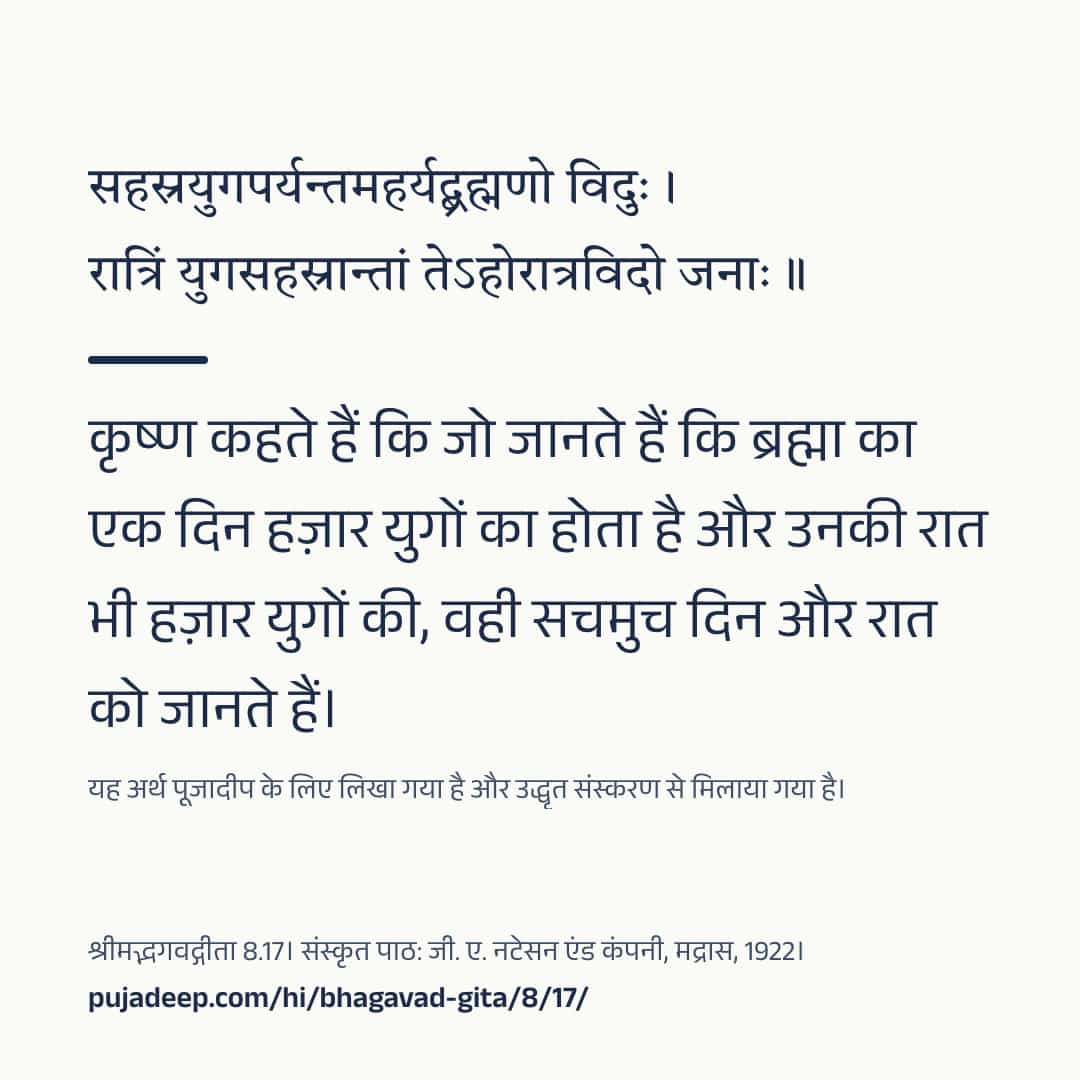
श्रीमद्भगवद्गीता (Bhagavad Gita) 8.17: कृष्ण कहते हैं कि जो जानते हैं कि ब्रह्मा का एक दिन हज़ार युगों का होता है और उनकी रात भी हज़ार युगों की, वही सचमुच दिन और रात को जानते हैं।
किसी शब्द पर क्लिक करें या उसे छुएँ, उसका अर्थ और कोश का पृष्ठ देखें।
दिखावट
दिखावट
ये चुनाव इसी ब्राउज़र में रहते हैं।
श्रीमद्भगवद्गीता 8.17
सहस्रयुगपर्यन्तमहर्यद्ब्रह्मणो विदुः ।रात्रिं युगसहस्रान्तां तेऽहोरात्रविदो जनाः ॥
Sahasrayugaparyantamaharyadbrahmano viduhRatrim yugasahasrantam tehoratravido janah
sahasrayugaparyantamaharyadbrahmaṇo viduḥ |rātriṃ yugasahasrāntāṃ te’horātravido janāḥ ||
भावार्थ कृष्ण कहते हैं कि जो जानते हैं कि ब्रह्मा का एक दिन हज़ार युगों का होता है और उनकी रात भी हज़ार युगों की, वही सचमुच दिन और रात को जानते हैं। उनका आशय है कि सृष्टिकर्ता का लोक भी समय से बँधा है।
English meaning Krishna says that those who know that a day of Brahmā lasts a thousand yugas (ages), and his night another thousand, truly know day and night. Even the creator's world, he is saying, is bound by time.
शब्दार्थ
हर शब्द, शब्दकोश के पृष्ठ के साथ
शब्दार्थ
- सहस्रयुगपर्यन्तम् sahasrayugaparyantam · हज़ार युगों तक चलने वाला (समास, द्वितीया एकवचन) शब्दकोश: sahasra-yuga, मोनियर-विलियम्स 1899, पृ. 1196, स्तंभ 1
a period of a th° ages
; pary-anta, मोनियर-विलियम्स 1899, पृ. 607, स्तंभ 1edge, limit, border; side, flank, extremity, end
- अहः ahaḥ · दिन (द्वितीया एकवचन) शब्दकोश: ahar, मोनियर-विलियम्स 1899, पृ. 124, स्तंभ 3
a day
- यत् yat · जो (संबंधवाचक सर्वनाम, द्वितीया एकवचन) शब्दकोश: yad, मोनियर-विलियम्स 1899, पृ. 844, स्तंभ 2
who, which, what, whichever, whatever, that
- ब्रह्मणः brahmaṇaḥ · ब्रह्मा का (षष्ठी एकवचन) शब्दकोश: brahman, मोनियर-विलियम्स 1899, पृ. 738, स्तंभ 1
Brahmā or the one impersonal universal Spirit manifested as a personal Creator
- विदुः viduḥ · जानते हैं (लिट् रूप, वर्तमान अर्थ, प्रथम पुरुष बहुवचन) शब्दकोश: 1. vid, मोनियर-विलियम्स 1899, पृ. 963, स्तंभ 2
to know, understand, perceive, learn
- रात्रिम् rātrim · रात्रि (द्वितीया एकवचन (स्त्रीलिंग)) शब्दकोश: rātri, मोनियर-विलियम्स 1899, पृ. 876, स्तंभ 1
night, the darkness or stillness of night
- युगसहस्रान्ताम् yugasahasrāntām · हज़ार युगों में समाप्त होने वाली (समास, द्वितीया एकवचन (स्त्रीलिंग)) शब्दकोश: yuga, मोनियर-विलियम्स 1899, पृ. 854, स्तंभ 1
an age of the world, long mundane period of years
; sahasra, मोनियर-विलियम्स 1899, पृ. 1195, स्तंभ 2a thousand
; anta, मोनियर-विलियम्स 1899, पृ. 42, स्तंभ 3end, limit, boundary, term
- ते te · वे (सर्वनाम, प्रथमा बहुवचन) शब्दकोश: tad, मोनियर-विलियम्स 1899, पृ. 434, स्तंभ 1
m. he, f. she, n. it, that, this
- अहोरात्रविदः ahorātravidaḥ · दिन-रात के ज्ञाता (समास, प्रथमा बहुवचन) शब्दकोश: aho-rātra, मोनियर-विलियम्स 1899, पृ. 124, स्तंभ 3
a day and night
; 2. vid, मोनियर-विलियम्स 1899, पृ. 963, स्तंभ 3knowing, understanding, a knower
- जनाः janāḥ · लोग (प्रथमा बहुवचन) शब्दकोश: jana, मोनियर-विलियम्स 1899, पृ. 410, स्तंभ 1
creature, living being, man, person, race
पुराने अंग्रेज़ी अनुवाद
Kashinath Trimbak Telang, 1882। सार्वजनिक डोमेन (कॉपीराइट-मुक्त)। पृष्ठ 79–80।
Those who know a day of Brahman to end after one thousand ages, and the night to terminate after one thousand ages, are the persons who know day and night1.
पाद-टिप्पणियाँ (अनुवादक की अपनी) - Cf. Manu I, 73. Saṅkara says, that this explains why the abodes of Brahmâ and others are said to be not lasting. They are limited by time. As to ages, Srîdhara says, a human year is a day and night of the gods. Twelve thousand years made of such days and nights make up the four ages: one thousand such 'quaternions of ages' make up a day, and another thousand a night of Brahmâ. Of such days and nights Brahmâ has a hundred years to live. At the close of his life, the universe is destroyed. ↩
3 अनुवादों की तुलना करें
Kashinath Trimbak Telang, 1882। सार्वजनिक डोमेन (कॉपीराइट-मुक्त)। पृष्ठ 79–80।
Those who know a day of Brahman to end after one thousand ages, and the night to terminate after one thousand ages, are the persons who know day and night1.
पाद-टिप्पणियाँ (अनुवादक की अपनी) - Cf. Manu I, 73. Saṅkara says, that this explains why the abodes of Brahmâ and others are said to be not lasting. They are limited by time. As to ages, Srîdhara says, a human year is a day and night of the gods. Twelve thousand years made of such days and nights make up the four ages: one thousand such 'quaternions of ages' make up a day, and another thousand a night of Brahmâ. Of such days and nights Brahmâ has a hundred years to live. At the close of his life, the universe is destroyed. ↩
आप यही पढ़ रहे हैं
Annie Besant, 1895। सार्वजनिक डोमेन (कॉपीराइट-मुक्त)। पृष्ठ 84।
The people who know the day of Brahmâ, a thousand Yugas in revolution, and the night, a thousand ages in ending, they know day and night.
आप यही पढ़ रहे हैं
Swami Swarupananda, 1909 (पहली बार 1907 में छपा)। सार्वजनिक डोमेन (कॉपीराइट-मुक्त)। पृष्ठ 167।
They know (the true measure of) day and night, who know the day of Brahmâ, which ends in a thousand Yugas, and the night which (also) ends in a thousand Yugas.
आप यही पढ़ रहे हैं
इस श्लोक का हवाला दें
अनुवाद: K. T. Telang, The Bhagavadgîtâ (The Sacred Books of the East, vol. VIII, Oxford: Clarendon Press, 1882), पृष्ठ 79–80। भगवद्गीता 8.17।
अनुवाद: Annie Besant, The Bhagavad Gîtâ, or The Lord's Song (London: Theosophical Publishing Society, 1895), पृष्ठ 84। भगवद्गीता 8.17।
अनुवाद: Swami Swarupananda, Srimad-Bhagavad-Gita (Mayavati: Prabuddha Bharata Press, 1909; first printed in Prabuddha Bharata, 1907–1909), पृष्ठ 167। भगवद्गीता 8.17।
हमारी व्याख्या: “भगवद्गीता 8.17: अर्थ और अनुवाद”। पूजादीप। अद्यतन 27 अक्टूबर 2026। https://pujadeep.com/hi/bhagavad-gita/8/17/
पूजादीप की व्याख्याएँ श्रेय देकर उद्धृत की जा सकती हैं: पूजादीप का नाम और पृष्ठ का लिंक दें। श्रेय कैसे दें
शास्त्रीय व्याख्याएँ, संप्रदाय के अनुसार
इस श्लोक पर अभी संप्रदायों की व्याख्या नहीं है।
भेजें
साझा करने के तरीके दिखाएँ
एक तस्वीर या पाठ एक चैट में भेजें। तस्वीर पर उसका स्रोत और इस पृष्ठ का पता लिखा है।
तस्वीर बन रही है
शब्द देखें
श्रीमद्भगवद्गीता 8.17

सहस्रयुगपर्यन्तमहर्यद्ब्रह्मणो विदुः ।
रात्रिं युगसहस्रान्तां तेऽहोरात्रविदो जनाः ॥

“Those who know a day of Brahman to end after one thousand ages, and the night to terminate after one thousand ages, are the persons who know day and night.”
(K. T. Telang, The Bhagavadgîtâ (The Sacred Books of the East, vol. VIII, Oxford: Clarendon Press, 1882), pp. 79–80, public domain)

“The people who know the day of Brahmâ, a thousand Yugas in revolution, and the night, a thousand ages in ending, they know day and night.”
(Annie Besant, The Bhagavad Gîtâ, or The Lord's Song (London: Theosophical Publishing Society, 1895), p. 84, public domain)

“They know (the true measure of) day and night, who know the day of Brahmâ, which ends in a thousand Yugas, and the night which (also) ends in a thousand Yugas.”
(Swami Swarupananda, Srimad-Bhagavad-Gita (Mayavati: Prabuddha Bharata Press, 1909; first printed in Prabuddha Bharata, 1907–1909), p. 167, public domain)

संस्कृत पाठ: जी. ए. नटेसन एंड कंपनी, मद्रास, 1922।
https://pujadeep.com/hi/bhagavad-gita/8/17/
इस साइट से कुछ नहीं भेजा जाता। आपका अपना ऐप उसे आपकी चुनी हुई चैट में भेजता है। तस्वीर में वही अनुवाद है जो आपने इस पृष्ठ पर चुना है, उसके नाम और वर्ष के साथ।
संस्कृत पाठ: 1922 का मद्रास मुद्रण। अर्थ: पूजादीप के लिए लिखे और जाँचे गए। स्रोत और बदलाव
परिवारों के प्रश्न
गीता 8.17 कौन कहता है?
यह श्लोक कृष्ण कहते हैं, अध्याय 8 (अक्षरब्रह्मयोग) में।
संस्कृत पाठ कहाँ से लिया गया है?
संस्कृत पाठ: 1922 का मद्रास मुद्रण। अर्थ: पूजादीप के लिए लिखे और जाँचे गए। स्रोत देखें
क्या इस पृष्ठ का अर्थ अनुवाद है?
इस साइट के लिए यहाँ दिए स्रोतों के आधार पर लिखी और उद्धृत संस्करण से मिलाई गई व्याख्या। यह अनुवाद नहीं है, और पाठ को पढ़ने का एकमात्र तरीका भी नहीं है। श्रेय देकर आप इसे उद्धृत कर सकते हैं।
स्रोत और लाइसेंस
- संस्कृत पाठ
- The Bhagavad-Gita, or The Lord's Song, with the text in Devanagari and an English translation (Annie Besant, G. A. Natesan & Co., Madras, 1922). सार्वजनिक डोमेन (कॉपीराइट-मुक्त)। इन पृष्ठों का संस्कृत पाठ इसी मुद्रण के पृष्ठ-चित्रों से पढ़ा गया है।
- अनुवाद
- The Bhagavadgîtâ with the Sanatsugâtîya and the Anugîtâ, translated by Kâshinâth Trimbak Telang (The Sacred Books of the East, vol. VIII, ed. F. Max Müller) (Kashinath Trimbak Telang, F. Max Müller, Clarendon Press, Oxford, 1882). सार्वजनिक डोमेन (कॉपीराइट-मुक्त)। जैसा छपा है, वैसा ही दिखाया गया।
- अनुवाद
- The Bhagavad Gîtâ, or The Lord's Song, translated by Annie Besant (Annie Besant, Theosophical Publishing Society, London, 1895). सार्वजनिक डोमेन (कॉपीराइट-मुक्त)। जैसा छपा है, वैसा ही दिखाया गया।
- अनुवाद
- Srimad-Bhagavad-Gita, with Sanskrit Text; Paraphrase with Word-by-word Literal Translation; English Rendering and Comments, Index, &c., by the Swami Swarupananda (Himalayan Series, No. XX) (Swami Swarupananda, The Editors and Publishers, Advaita Ashrama, Mayavati, Prabuddha Bharata Press, Mayavati, Almora, Himalayas, 1909). सार्वजनिक डोमेन (कॉपीराइट-मुक्त)। जैसा छपा है, वैसा ही दिखाया गया।
- प्रचलित पाठ
- इस पाठ में 32 शब्द आज के प्रचलित रूप में हैं; इन्हें sanskritdocuments.org; संस्कृत विकिस्रोत; गीता प्रेस, गोरखपुर; ग्रेटिल, गॉटिंगेन और भक्तिवेदांत बुक ट्रस्ट के पाठ से मिलाकर जाँचा गया।
- हमारी व्याख्या
- इस साइट के लिए यहाँ दिए स्रोतों के आधार पर लिखी और उद्धृत संस्करण से मिलाई गई व्याख्या। यह अनुवाद नहीं है, और पाठ को पढ़ने का एकमात्र तरीका भी नहीं है। श्रेय देकर आप इसे उद्धृत कर सकते हैं।
- जाँच
- उद्धृत संस्करण से मिलाया गया, 27 अक्टूबर 2026।