भगवद्गीता 8.24: अर्थ और अनुवाद
अध्याय 8: अक्षरब्रह्मयोग। कृष्ण कहते हैं
श्रीमद्भगवद्गीता (Bhagavad Gita) 8.24: कृष्ण पहला मार्ग बताते हैं: अग्नि, ज्योति, दिन, शुक्ल पक्ष (चाँदनी वाला पखवाड़ा) और उत्तरायण के छह महीने।
किसी शब्द पर क्लिक करें या उसे छुएँ, उसका अर्थ और कोश का पृष्ठ देखें।
दिखावट
दिखावट
ये चुनाव इसी ब्राउज़र में रहते हैं।
श्रीमद्भगवद्गीता 8.24
अग्निर्ज्योतिरहः शुक्लः षण्मासा उत्तरायणम् ।तत्र प्रयाता गच्छन्ति ब्रह्म ब्रह्मविदो जनाः ॥
Agnirjyotirahah shuklah shanmasa uttarayanamTatra prayata gachchhanti brahma brahmavido janah
agnirjyotirahaḥ śuklaḥ ṣaṇmāsā uttarāyaṇam |tatra prayātā gacchanti brahma brahmavido janāḥ ||
भावार्थ कृष्ण पहला मार्ग बताते हैं: अग्नि, ज्योति, दिन, शुक्ल पक्ष (चाँदनी वाला पखवाड़ा) और उत्तरायण के छह महीने। वे कहते हैं कि इस मार्ग से जाने वाले ब्रह्मज्ञानी ब्रह्म को प्राप्त होते हैं। ये श्लोक मृत्यु के बाद के उन दो मार्गों का वर्णन करते हैं जो उपनिषदों में भी मिलते हैं (प्रकाश का मार्ग और धुएँ का मार्ग); टीकाकार इन्हें अपने-अपने ढंग से समझाते हैं।
English meaning Krishna names the first path: fire, light, the day, the bright half of the lunar month, the six months when the sun moves north (uttarāyaṇa). Knowers of Brahman who depart by this path, he says, go to Brahman. These verses describe two paths after death that are also found in the Upanishads (the bright path and the smoky path); the commentators explain them in their own ways (see the views).
शब्दार्थ
हर शब्द, शब्दकोश के पृष्ठ के साथ
शब्दार्थ
- अग्निः agniḥ · अग्नि (प्रथमा एकवचन) शब्दकोश: agni, मोनियर-विलियम्स 1899, पृ. 5, स्तंभ 1
fire; sacrificial fire
- ज्योतिः jyotiḥ · ज्योति, प्रकाश (प्रथमा एकवचन) शब्दकोश: jyotis, मोनियर-विलियम्स 1899, पृ. 427, स्तंभ 3
light (of the sun, dawn, fire, lightning, &c.; also pl.)
- अहः ahaḥ · दिन (प्रथमा एकवचन) शब्दकोश: ahar, मोनियर-विलियम्स 1899, पृ. 124, स्तंभ 3
a day
- शुक्लः śuklaḥ · शुक्ल पक्ष (प्रथमा एकवचन) शब्दकोश: śukla, मोनियर-विलियम्स 1899, पृ. 1080, स्तंभ 2
the bright half of a lunar month or any day in it
- षण्मासाः ṣaṇmāsāḥ · छह महीने (समास, प्रथमा बहुवचन) शब्दकोश: ṣaṇ-māsa, मोनियर-विलियम्स 1899, पृ. 1109, स्तंभ 3
a period of six months, half a year
- उत्तरायणम् uttarāyaṇam · उत्तरायण (समास, प्रथमा एकवचन) शब्दकोश: uttarāyaṇa, मोनियर-विलियम्स 1899, पृ. 178, स्तंभ 3
the progress (of the sun) to the north
- तत्र tatra · तब, वहाँ (अव्यय) शब्दकोश: tatra, मोनियर-विलियम्स 1899, पृ. 433, स्तंभ 2
in that place, there
- प्रयाताः prayātāḥ · प्रयाण करने वाले (भूतकालिक कृदन्त, प्रथमा बहुवचन) शब्दकोश: pra-yāta, मोनियर-विलियम्स 1899, पृ. 688, स्तंभ 1
set out, gone, advanced
- गच्छन्ति gacchanti · जाते हैं (वर्तमान काल, प्रथम पुरुष बहुवचन) शब्दकोश: 1. gam, मोनियर-विलियम्स 1899, पृ. 347, स्तंभ 1
to go, move, go away, set out, come
- ब्रह्म brahma · ब्रह्म को (द्वितीया एकवचन) शब्दकोश: brahman, मोनियर-विलियम्स 1899, पृ. 738, स्तंभ 1
one self-existent impersonal Spirit, the one universal Soul
- ब्रह्मविदः brahmavidaḥ · ब्रह्म के ज्ञाता (समास, प्रथमा बहुवचन) शब्दकोश: brahma-vid, मोनियर-विलियम्स 1899, पृ. 740, स्तंभ 1
- जनाः janāḥ · लोग (प्रथमा बहुवचन) शब्दकोश: jana, मोनियर-विलियम्स 1899, पृ. 410, स्तंभ 1
creature, living being, man, person, race
पुराने अंग्रेज़ी अनुवाद
Kashinath Trimbak Telang, 1882। सार्वजनिक डोमेन (कॉपीराइट-मुक्त)। पृष्ठ 80–81।
The fire, the flame1, the day, the bright fortnight, the six months of the northern solstice, departing (from the world) in these, those who know the Brahman go to the Brahman.
पाद-टिप्पणियाँ (अनुवादक की अपनी) - Srîdhara understands 'the time when,' in the sentence preceding this, to mean 'the path indicated by a deity presiding over time, by which;' and the fire-flame as included in this, though having no connexion with time. Saṅkara agrees, though he also suggests that fire means a deity presiding over time. I own I have no clear notion of the meaning of these verses. Cf. Khândogya, p. 342; Brihad-âranyaka-upanishad, p. 1057 seq. ↩
3 अनुवादों की तुलना करें
Kashinath Trimbak Telang, 1882। सार्वजनिक डोमेन (कॉपीराइट-मुक्त)। पृष्ठ 80–81।
The fire, the flame1, the day, the bright fortnight, the six months of the northern solstice, departing (from the world) in these, those who know the Brahman go to the Brahman.
पाद-टिप्पणियाँ (अनुवादक की अपनी) - Srîdhara understands 'the time when,' in the sentence preceding this, to mean 'the path indicated by a deity presiding over time, by which;' and the fire-flame as included in this, though having no connexion with time. Saṅkara agrees, though he also suggests that fire means a deity presiding over time. I own I have no clear notion of the meaning of these verses. Cf. Khândogya, p. 342; Brihad-âranyaka-upanishad, p. 1057 seq. ↩
आप यही पढ़ रहे हैं
Annie Besant, 1895। सार्वजनिक डोमेन (कॉपीराइट-मुक्त)। पृष्ठ 85।
Fire, light, day-time, the bright fortnight, the six months of the northern path—then, going forth, the men who know Brahman go to Brahman.
आप यही पढ़ रहे हैं
Swami Swarupananda, 1909 (पहली बार 1907 में छपा)। सार्वजनिक डोमेन (कॉपीराइट-मुक्त)। पृष्ठ 79।
Fire, flame, day-time, the bright fortnight, the six months of the Northern passage of the Sun,—taking this path, the knowers of Brahman go to Brahman.
आप यही पढ़ रहे हैं
इस श्लोक का हवाला दें
अनुवाद: K. T. Telang, The Bhagavadgîtâ (The Sacred Books of the East, vol. VIII, Oxford: Clarendon Press, 1882), पृष्ठ 80–81। भगवद्गीता 8.24।
अनुवाद: Annie Besant, The Bhagavad Gîtâ, or The Lord's Song (London: Theosophical Publishing Society, 1895), पृष्ठ 85। भगवद्गीता 8.24।
अनुवाद: Swami Swarupananda, Srimad-Bhagavad-Gita (Mayavati: Prabuddha Bharata Press, 1909; first printed in Prabuddha Bharata, 1907–1909), पृष्ठ 79। भगवद्गीता 8.24।
हमारी व्याख्या: “भगवद्गीता 8.24: अर्थ और अनुवाद”। पूजादीप। अद्यतन 27 अक्टूबर 2026। https://pujadeep.com/hi/bhagavad-gita/8/24/
पूजादीप की व्याख्याएँ श्रेय देकर उद्धृत की जा सकती हैं: पूजादीप का नाम और पृष्ठ का लिंक दें। श्रेय कैसे दें
शास्त्रीय व्याख्याएँ, संप्रदाय के अनुसार
हर व्याख्या अपने संप्रदाय के नाम से दी गई है। कोई भी एकमात्र अर्थ के रूप में प्रस्तुत नहीं है।
अद्वैत, विशिष्टाद्वैत और द्वैत क्या सिखाते हैं, संक्षेप में
शंकराचार्य अद्वैत
शंकराचार्य अग्नि, ज्योति, दिन, शुक्ल पक्ष और उत्तरायण के महीनों को काल के अधिष्ठाता देवता मानते हैं, जो ब्रह्म की उपासना करने वालों को इस मार्ग से ले जाते हैं, ताकि वे क्रम से ब्रह्म को प्राप्त हों। जिनके पास पूरा ज्ञान है और जो तुरंत मुक्त हो जाते हैं, उनके लिए न कहीं जाना है न लौटना।
स्रोत: The Bhagavad-Gita, with the commentary of Sri Sankaracharya, translated by A. Mahadeva Sastri (2nd ed., Mysore: G. T. A. Printing Works, 1901), commentary on 8.24, p. 212. हमारे अपने शब्दों में सार; इसका कोई पाठ उद्धृत नहीं किया गया।
रामानुजाचार्य विशिष्टाद्वैत
रामानुजाचार्य कहते हैं कि यहाँ 'काल' का अर्थ वह मार्ग है जिस पर समय के विभागों के अधिष्ठाता देवता रहते हैं। प्रकाश का मार्ग (अर्चिरादि मार्ग) दोनों तरह के ज्ञानियों के लिए है, भगवान को चाहने वाले और आत्मा को चाहने वाले; यह उस अवस्था तक ले जाता है जहाँ से लौटना नहीं होता।
स्रोत: Sri Bhagavad-Gita with Sri Ramanujacharya's Visishtadvaita commentary, translated by A. Govindacharya (Madras, 1898), commentary on 8.24–8.26, pp. 281–283. हमारे अपने शब्दों में सार; इसका कोई पाठ उद्धृत नहीं किया गया।
भेजें
साझा करने के तरीके दिखाएँ
एक तस्वीर या पाठ एक चैट में भेजें। तस्वीर पर उसका स्रोत और इस पृष्ठ का पता लिखा है।
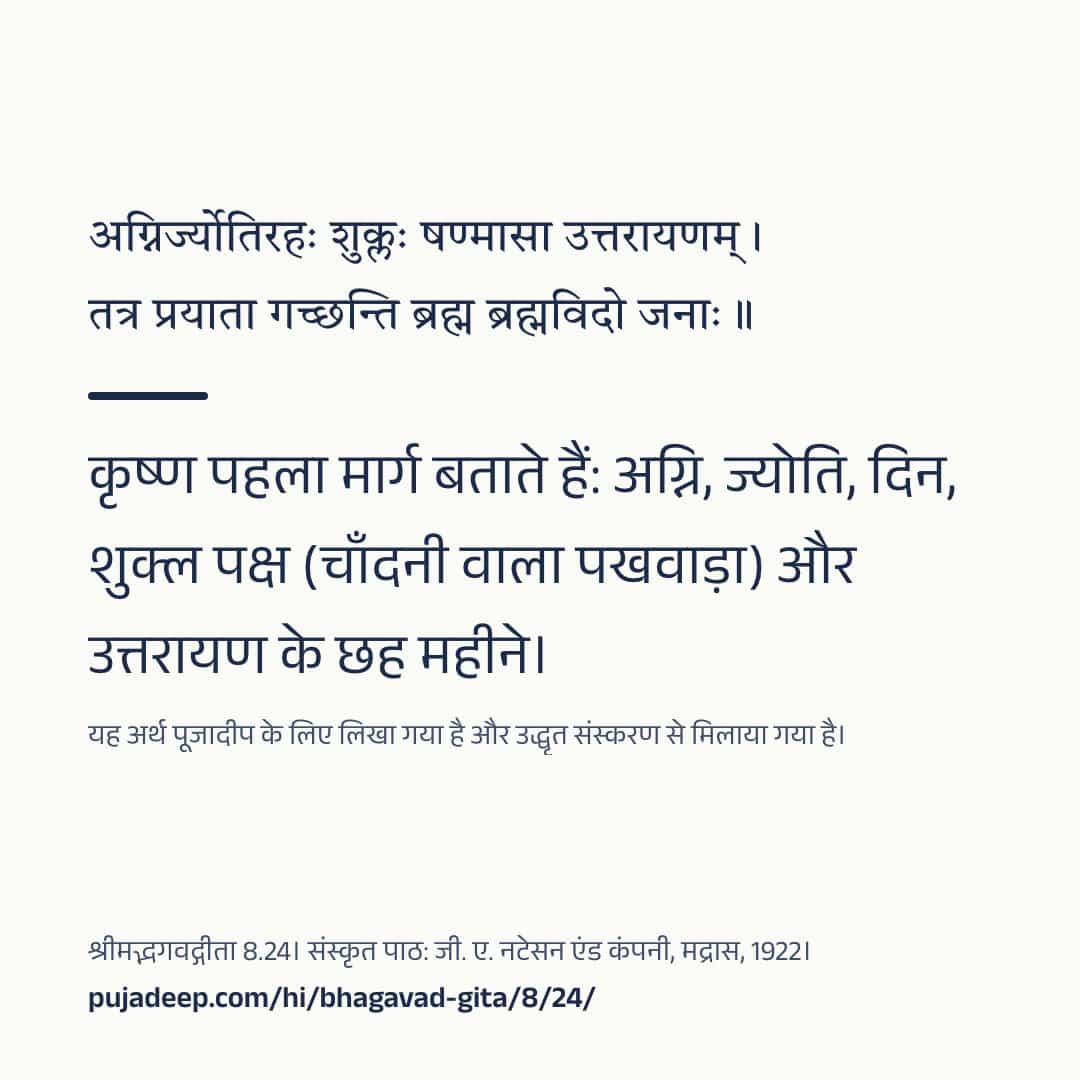
तस्वीर बन रही है
शब्द देखें
श्रीमद्भगवद्गीता 8.24

अग्निर्ज्योतिरहः शुक्लः षण्मासा उत्तरायणम् ।
तत्र प्रयाता गच्छन्ति ब्रह्म ब्रह्मविदो जनाः ॥

“The fire, the flame, the day, the bright fortnight, the six months of the northern solstice, departing (from the world) in these, those who know the Brahman go to the Brahman.”
(K. T. Telang, The Bhagavadgîtâ (The Sacred Books of the East, vol. VIII, Oxford: Clarendon Press, 1882), pp. 80–81, public domain)

“Fire, light, day-time, the bright fortnight, the six months of the northern path—then, going forth, the men who know Brahman go to Brahman.”
(Annie Besant, The Bhagavad Gîtâ, or The Lord's Song (London: Theosophical Publishing Society, 1895), p. 85, public domain)

“Fire, flame, day-time, the bright fortnight, the six months of the Northern passage of the Sun,—taking this path, the knowers of Brahman go to Brahman.”
(Swami Swarupananda, Srimad-Bhagavad-Gita (Mayavati: Prabuddha Bharata Press, 1909; first printed in Prabuddha Bharata, 1907–1909), p. 79, public domain)

संस्कृत पाठ: जी. ए. नटेसन एंड कंपनी, मद्रास, 1922।
https://pujadeep.com/hi/bhagavad-gita/8/24/
इस साइट से कुछ नहीं भेजा जाता। आपका अपना ऐप उसे आपकी चुनी हुई चैट में भेजता है। तस्वीर में वही अनुवाद है जो आपने इस पृष्ठ पर चुना है, उसके नाम और वर्ष के साथ।
संस्कृत पाठ: 1922 का मद्रास मुद्रण। अर्थ: पूजादीप के लिए लिखे और जाँचे गए। स्रोत और बदलाव
परिवारों के प्रश्न
गीता 8.24 कौन कहता है?
यह श्लोक कृष्ण कहते हैं, अध्याय 8 (अक्षरब्रह्मयोग) में।
संस्कृत पाठ कहाँ से लिया गया है?
संस्कृत पाठ: 1922 का मद्रास मुद्रण। अर्थ: पूजादीप के लिए लिखे और जाँचे गए। स्रोत देखें
क्या इस पृष्ठ का अर्थ अनुवाद है?
इस साइट के लिए यहाँ दिए स्रोतों के आधार पर लिखी और उद्धृत संस्करण से मिलाई गई व्याख्या। यह अनुवाद नहीं है, और पाठ को पढ़ने का एकमात्र तरीका भी नहीं है। श्रेय देकर आप इसे उद्धृत कर सकते हैं।
स्रोत और लाइसेंस
- संस्कृत पाठ
- The Bhagavad-Gita, or The Lord's Song, with the text in Devanagari and an English translation (Annie Besant, G. A. Natesan & Co., Madras, 1922). सार्वजनिक डोमेन (कॉपीराइट-मुक्त)। इन पृष्ठों का संस्कृत पाठ इसी मुद्रण के पृष्ठ-चित्रों से पढ़ा गया है।
- अनुवाद
- The Bhagavadgîtâ with the Sanatsugâtîya and the Anugîtâ, translated by Kâshinâth Trimbak Telang (The Sacred Books of the East, vol. VIII, ed. F. Max Müller) (Kashinath Trimbak Telang, F. Max Müller, Clarendon Press, Oxford, 1882). सार्वजनिक डोमेन (कॉपीराइट-मुक्त)। जैसा छपा है, वैसा ही दिखाया गया।
- अनुवाद
- The Bhagavad Gîtâ, or The Lord's Song, translated by Annie Besant (Annie Besant, Theosophical Publishing Society, London, 1895). सार्वजनिक डोमेन (कॉपीराइट-मुक्त)। जैसा छपा है, वैसा ही दिखाया गया।
- अनुवाद
- Srimad-Bhagavad-Gita, with Sanskrit Text; Paraphrase with Word-by-word Literal Translation; English Rendering and Comments, Index, &c., by the Swami Swarupananda (Himalayan Series, No. XX) (Swami Swarupananda, The Editors and Publishers, Advaita Ashrama, Mayavati, Prabuddha Bharata Press, Mayavati, Almora, Himalayas, 1909). सार्वजनिक डोमेन (कॉपीराइट-मुक्त)। जैसा छपा है, वैसा ही दिखाया गया।
- भाष्य
- The Bhagavad-Gita, with the commentary of Sri Sankaracharya, translated by A. Mahadeva Sastri (2nd ed., Mysore: G. T. A. Printing Works, 1901) (Public-domain scan, University of California Libraries). हमारे अपने शब्दों में सार; इसका कोई पाठ उद्धृत नहीं किया गया।
- भाष्य
- Sri Bhagavad-Gita with Sri Ramanujacharya's Visishtadvaita commentary, translated by A. Govindacharya (Madras, 1898) (Scan uploaded to archive.org (folkscanomy collection)). हमारे अपने शब्दों में सार; इसका कोई पाठ उद्धृत नहीं किया गया।
- प्रचलित पाठ
- इस पाठ में 32 शब्द आज के प्रचलित रूप में हैं; इन्हें sanskritdocuments.org; संस्कृत विकिस्रोत; गीता प्रेस, गोरखपुर; ग्रेटिल, गॉटिंगेन और भक्तिवेदांत बुक ट्रस्ट के पाठ से मिलाकर जाँचा गया।
- हमारी व्याख्या
- इस साइट के लिए यहाँ दिए स्रोतों के आधार पर लिखी और उद्धृत संस्करण से मिलाई गई व्याख्या। यह अनुवाद नहीं है, और पाठ को पढ़ने का एकमात्र तरीका भी नहीं है। श्रेय देकर आप इसे उद्धृत कर सकते हैं।
- जाँच
- उद्धृत संस्करण से मिलाया गया, 27 अक्टूबर 2026।