Bhagavad Gita 8.24: meaning and translation
Chapter 8: Akshara Brahma Yoga. Krishna says
Krishna names the first path: fire, light, the day, the bright half of the lunar month, the six months when the sun moves north (uttarāyaṇa).
Click or tap a word for its meaning and its dictionary page.
Text and layers
Text and layers
These choices stay in this browser.
Bhagavad Gita 8.24
अग्निर्ज्योतिरहः शुक्लः षण्मासा उत्तरायणम् ।तत्र प्रयाता गच्छन्ति ब्रह्म ब्रह्मविदो जनाः ॥
Agnirjyotirahah shuklah shanmasa uttarayanamTatra prayata gachchhanti brahma brahmavido janah
agnirjyotirahaḥ śuklaḥ ṣaṇmāsā uttarāyaṇam |tatra prayātā gacchanti brahma brahmavido janāḥ ||
Our explanation Krishna names the first path: fire, light, the day, the bright half of the lunar month, the six months when the sun moves north (uttarāyaṇa). Knowers of Brahman who depart by this path, he says, go to Brahman. These verses describe two paths after death that are also found in the Upanishads (the bright path and the smoky path); the commentators explain them in their own ways (see the views).
हिंदी अर्थ कृष्ण पहला मार्ग बताते हैं: अग्नि, ज्योति, दिन, शुक्ल पक्ष (चाँदनी वाला पखवाड़ा) और उत्तरायण के छह महीने। वे कहते हैं कि इस मार्ग से जाने वाले ब्रह्मज्ञानी ब्रह्म को प्राप्त होते हैं। ये श्लोक मृत्यु के बाद के उन दो मार्गों का वर्णन करते हैं जो उपनिषदों में भी मिलते हैं (प्रकाश का मार्ग और धुएँ का मार्ग); टीकाकार इन्हें अपने-अपने ढंग से समझाते हैं।
Word by word
Every word, with its dictionary page
Word by word
- अग्निः agniḥ · fire (nominative singular) Dictionary: agni, Monier-Williams 1899, p. 5, col. 1 “fire; sacrificial fire”
- ज्योतिः jyotiḥ · light (nominative singular) Dictionary: jyotis, Monier-Williams 1899, p. 427, col. 3 “light (of the sun, dawn, fire, lightning, &c.; also pl.)”
- अहः ahaḥ · day (nominative singular) Dictionary: ahar, Monier-Williams 1899, p. 124, col. 3 “a day”
- शुक्लः śuklaḥ · the bright (fortnight) (nominative singular) Dictionary: śukla, Monier-Williams 1899, p. 1080, col. 2 “the bright half of a lunar month or any day in it”
- षण्मासाः ṣaṇmāsāḥ · the six months (compound, nominative plural) Dictionary: ṣaṇ-māsa, Monier-Williams 1899, p. 1109, col. 3 “a period of six months, half a year”
- उत्तरायणम् uttarāyaṇam · the sun's northward course (compound, nominative singular) Dictionary: uttarāyaṇa, Monier-Williams 1899, p. 178, col. 3 “the progress (of the sun) to the north”
- तत्र tatra · then, there (indeclinable) Dictionary: tatra, Monier-Williams 1899, p. 433, col. 2 “in that place, there”
- प्रयाताः prayātāḥ · departing (past participle, nominative plural) Dictionary: pra-yāta, Monier-Williams 1899, p. 688, col. 1 “set out, gone, advanced”
- गच्छन्ति gacchanti · go (present, 3rd person plural) Dictionary: 1. gam, Monier-Williams 1899, p. 347, col. 1 “to go, move, go away, set out, come”
- ब्रह्म brahma · to Brahman (accusative singular) Dictionary: brahman, Monier-Williams 1899, p. 738, col. 1 “one self-existent impersonal Spirit, the one universal Soul”
- ब्रह्मविदः brahmavidaḥ · knowers of Brahman (compound, nominative plural) Dictionary: brahma-vid, Monier-Williams 1899, p. 740, col. 1
- जनाः janāḥ · people (nominative plural) Dictionary: jana, Monier-Williams 1899, p. 410, col. 1 “creature, living being, man, person, race”
Old translations
Kashinath Trimbak Telang, 1882. Public domain. Page 80–81.
The fire, the flame1, the day, the bright fortnight, the six months of the northern solstice, departing (from the world) in these, those who know the Brahman go to the Brahman.
Footnotes (the translator’s own) - Srîdhara understands 'the time when,' in the sentence preceding this, to mean 'the path indicated by a deity presiding over time, by which;' and the fire-flame as included in this, though having no connexion with time. Saṅkara agrees, though he also suggests that fire means a deity presiding over time. I own I have no clear notion of the meaning of these verses. Cf. Khândogya, p. 342; Brihad-âranyaka-upanishad, p. 1057 seq. ↩
Compare 3 translations
Kashinath Trimbak Telang, 1882. Public domain. Page 80–81.
The fire, the flame1, the day, the bright fortnight, the six months of the northern solstice, departing (from the world) in these, those who know the Brahman go to the Brahman.
Footnotes (the translator’s own) - Srîdhara understands 'the time when,' in the sentence preceding this, to mean 'the path indicated by a deity presiding over time, by which;' and the fire-flame as included in this, though having no connexion with time. Saṅkara agrees, though he also suggests that fire means a deity presiding over time. I own I have no clear notion of the meaning of these verses. Cf. Khândogya, p. 342; Brihad-âranyaka-upanishad, p. 1057 seq. ↩
You are reading this one
Annie Besant, 1895. Public domain. Page 85.
Fire, light, day-time, the bright fortnight, the six months of the northern path—then, going forth, the men who know Brahman go to Brahman.
You are reading this one
Swami Swarupananda, 1909 (first printed 1907). Public domain. Page 79.
Fire, flame, day-time, the bright fortnight, the six months of the Northern passage of the Sun,—taking this path, the knowers of Brahman go to Brahman.
You are reading this one
Cite this verse
The translation: K. T. Telang, The Bhagavadgîtâ (The Sacred Books of the East, vol. VIII, Oxford: Clarendon Press, 1882), pp. 80–81. Bhagavad Gita 8.24.
The translation: Annie Besant, The Bhagavad Gîtâ, or The Lord's Song (London: Theosophical Publishing Society, 1895), p. 85. Bhagavad Gita 8.24.
The translation: Swami Swarupananda, Srimad-Bhagavad-Gita (Mayavati: Prabuddha Bharata Press, 1909; first printed in Prabuddha Bharata, 1907–1909), p. 79. Bhagavad Gita 8.24.
Our explanation: “Bhagavad Gita 8.24: meaning and translation.” Pujadeep. Updated October 27, 2026. https://pujadeep.com/bhagavad-gita/8/24/
Pujadeep’s explanations are free to quote with credit: name Pujadeep and link to the page. How to credit
Classical readings, by school
Each reading is named by its school. None is presented as the only meaning.
What Advaita, Vishishtadvaita and Dvaita teach, in short
Shankara Advaita
Shankara takes fire, light, day, the bright fortnight and the northern months as deities presiding over time, who lead those devoted to Brahman along this path, to reach Brahman in course of time. Those who have full knowledge and are liberated at once have nowhere to go and nothing to return from.
Source: The Bhagavad-Gita, with the commentary of Sri Sankaracharya, translated by A. Mahadeva Sastri (2nd ed., Mysore: G. T. A. Printing Works, 1901), commentary on 8.24, p. 212. Summarised in our own words; none of its text is reproduced.
Ramanuja Vishishtadvaita
Ramanuja says the 'time' here is the path on which the deities of the divisions of time dwell. The bright path (the path of light, arcir-ādi) is for both kinds of knowers, those who seek the Lord and those who seek the self; it leads to the state from which there is no return.
Source: Sri Bhagavad-Gita with Sri Ramanujacharya's Visishtadvaita commentary, translated by A. Govindacharya (Madras, 1898), commentary on 8.24–8.26, pp. 281–283. Summarised in our own words; none of its text is reproduced.
Share
Show the ways to share
Send one picture or the text to one chat. The picture names its source and the address of this page.
Drawing the picture
See the words
Bhagavad Gita 8.24

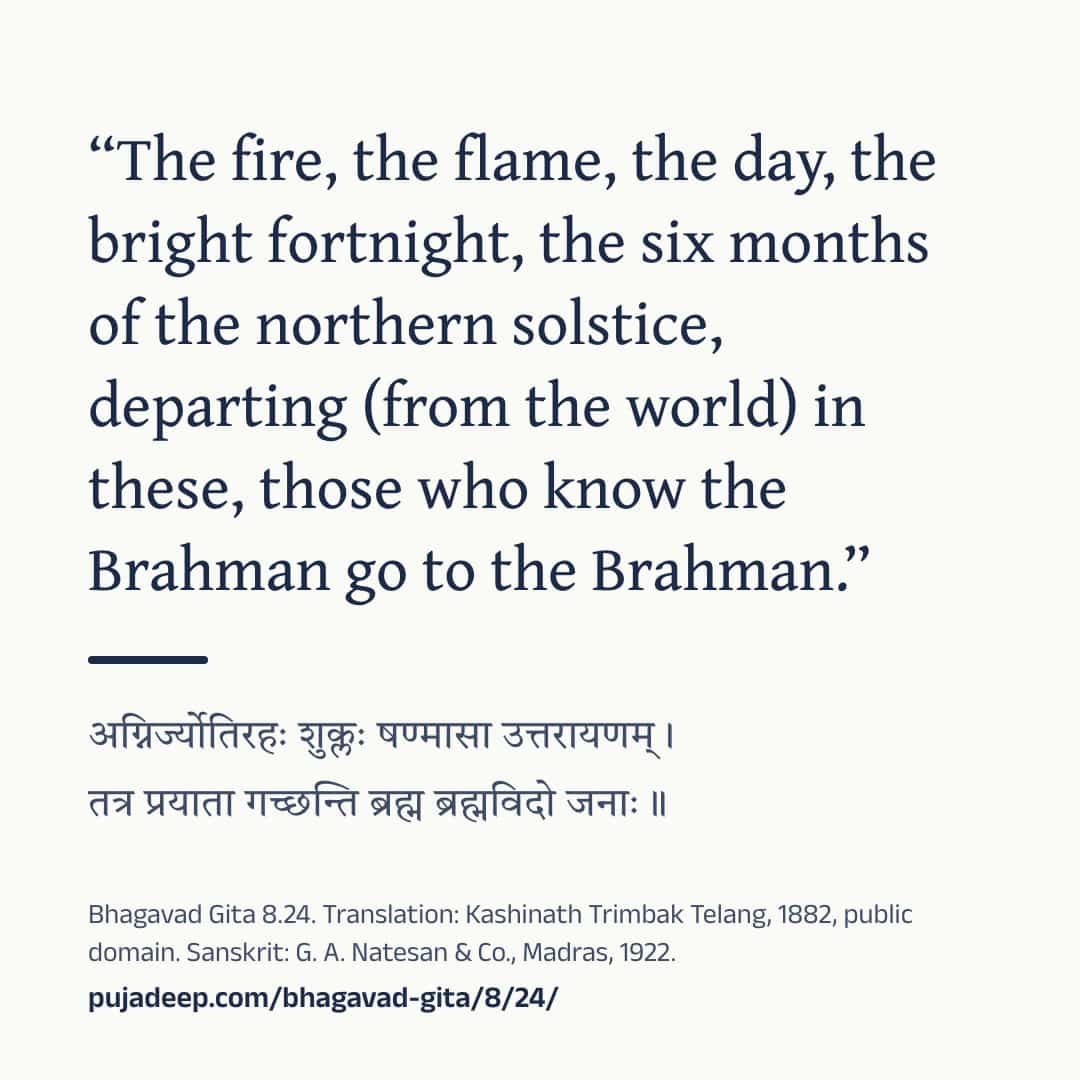
अग्निर्ज्योतिरहः शुक्लः षण्मासा उत्तरायणम् ।
तत्र प्रयाता गच्छन्ति ब्रह्म ब्रह्मविदो जनाः ॥

“The fire, the flame, the day, the bright fortnight, the six months of the northern solstice, departing (from the world) in these, those who know the Brahman go to the Brahman.”
(K. T. Telang, The Bhagavadgîtâ (The Sacred Books of the East, vol. VIII, Oxford: Clarendon Press, 1882), pp. 80–81, public domain)

“Fire, light, day-time, the bright fortnight, the six months of the northern path—then, going forth, the men who know Brahman go to Brahman.”
(Annie Besant, The Bhagavad Gîtâ, or The Lord's Song (London: Theosophical Publishing Society, 1895), p. 85, public domain)

“Fire, flame, day-time, the bright fortnight, the six months of the Northern passage of the Sun,—taking this path, the knowers of Brahman go to Brahman.”
(Swami Swarupananda, Srimad-Bhagavad-Gita (Mayavati: Prabuddha Bharata Press, 1909; first printed in Prabuddha Bharata, 1907–1909), p. 79, public domain)

Sanskrit: G. A. Natesan & Co., Madras, 1922.
https://pujadeep.com/bhagavad-gita/8/24/ Nothing is sent from this site. Your own app sends it, to the chat you choose. The picture quotes the translation you chose on this page, with its name and year.
Sanskrit text: The Bhagavad-Gita, or The Lord's Song, with the text in Devanagari and an English translation, 1922. Meanings: written for Pujadeep and checked against the cited edition. Source and changes
Questions families ask
Who speaks Bhagavad Gita 8.24?
Krishna speaks this verse, in chapter 8 (Akshara Brahma Yoga).
Where does the Sanskrit text come from?
Sanskrit text: The Bhagavad-Gita, or The Lord's Song, with the text in Devanagari and an English translation, 1922. Meanings: written for Pujadeep and checked against the cited edition. See the source
Is the meaning on this page a translation?
Explanation written for this site from the sources listed here, and checked against the cited edition. It is not a translation and not the only way to read the text. Free to quote with credit.
Source and licence
- Sanskrit text
- The Bhagavad-Gita, or The Lord's Song, with the text in Devanagari and an English translation (Annie Besant, G. A. Natesan & Co., Madras, 1922). Public domain. The Sanskrit on these pages was read from this printing’s page images.
- Translation
- The Bhagavadgîtâ with the Sanatsugâtîya and the Anugîtâ, translated by Kâshinâth Trimbak Telang (The Sacred Books of the East, vol. VIII, ed. F. Max Müller) (Kashinath Trimbak Telang, F. Max Müller, Clarendon Press, Oxford, 1882). Public domain. Shown verbatim, as printed.
- Translation
- The Bhagavad Gîtâ, or The Lord's Song, translated by Annie Besant (Annie Besant, Theosophical Publishing Society, London, 1895). Public domain. Shown verbatim, as printed.
- Translation
- Srimad-Bhagavad-Gita, with Sanskrit Text; Paraphrase with Word-by-word Literal Translation; English Rendering and Comments, Index, &c., by the Swami Swarupananda (Himalayan Series, No. XX) (Swami Swarupananda, The Editors and Publishers, Advaita Ashrama, Mayavati, Prabuddha Bharata Press, Mayavati, Almora, Himalayas, 1909). Public domain. Shown verbatim, as printed.
- Commentary
- The Bhagavad-Gita, with the commentary of Sri Sankaracharya, translated by A. Mahadeva Sastri (2nd ed., Mysore: G. T. A. Printing Works, 1901) (Public-domain scan, University of California Libraries). Summarised in our own words; none of its text is reproduced.
- Commentary
- Sri Bhagavad-Gita with Sri Ramanujacharya's Visishtadvaita commentary, translated by A. Govindacharya (Madras, 1898) (Scan uploaded to archive.org (folkscanomy collection)). Summarised in our own words; none of its text is reproduced.
- Common wording
- In this text, 32 words follow today's common wording, checked against sanskritdocuments.org; Sanskrit Wikisource; Gita Press, Gorakhpur; GRETIL, Göttingen and Bhaktivedanta Book Trust.
- Our explanation
- Explanation written for this site from the sources listed here, and checked against the cited edition. It is not a translation and not the only way to read the text. Free to quote with credit.
- Checked
- Checked against the cited edition, October 27, 2026.