Bhagavad Gita 8.18: meaning and translation
Chapter 8: Akshara Brahma Yoga. Krishna says
Krishna says that when Brahmā's day begins, all manifest things come forth from the unmanifest (avyakta), and when his night comes, they dissolve back into that same unmanifest.
Click or tap a word for its meaning and its dictionary page.
Text and layers
Text and layers
These choices stay in this browser.
Bhagavad Gita 8.18
अव्यक्ताद्व्यक्तयः सर्वाः प्रभवन्त्यहरागमे ।रात्र्यागमे प्रलीयन्ते तत्रैवाव्यक्तसंज्ञके ॥
Avyaktadvyaktayah sarvah prabhavantyaharagameRatryagame praliyante tatraivavyaktasanjnake
avyaktādvyaktayaḥ sarvāḥ prabhavantyaharāgame |rātryāgame pralīyante tatraivāvyaktasaṃjñake ||
Our explanation Krishna says that when Brahmā's day begins, all manifest things come forth from the unmanifest (avyakta), and when his night comes, they dissolve back into that same unmanifest.
हिंदी अर्थ कृष्ण कहते हैं कि ब्रह्मा का दिन आरंभ होने पर सब व्यक्त (प्रकट) पदार्थ अव्यक्त से उत्पन्न होते हैं, और रात आने पर वे उसी अव्यक्त में फिर लीन हो जाते हैं।
Word by word
Every word, with its dictionary page
Word by word
- अव्यक्तात् avyaktāt · from the unmanifest (ablative singular) Dictionary: a-vyakta, Monier-Williams 1899, p. 111, col. 2 “undeveloped, not manifest, unapparent, indistinct, invisible”
- व्यक्तयः vyaktayaḥ · manifest things (nominative plural (feminine)) Dictionary: vy-akti, Monier-Williams 1899, p. 1029, col. 3 “visible appearance or manifestation”
- सर्वाः sarvāḥ · all (pronoun, nominative plural (feminine)) Dictionary: sarva, Monier-Williams 1899, p. 1184, col. 3 “whole, entire, all, every”
- प्रभवन्ति prabhavanti · come forth (present, 3rd person plural) Dictionary: pra-bhū, Monier-Williams 1899, p. 684, col. 2 “to come forth, spring up, arise or originate from (abl.), appear”
- अहरागमे aharāgame · at the coming of day (compound, locative singular) Dictionary: ahar-āgama, Monier-Williams 1899, p. 124, col. 3 “the approach of the day”
- रात्र्यागमे rātryāgame · at the coming of night (compound, locative singular) Dictionary: rātri, Monier-Williams 1899, p. 876, col. 1 “night, the darkness or stillness of night”; ā-gama, Monier-Williams 1899, p. 129, col. 3 “arrival, coming, approach”
- प्रलीयन्ते pralīyante · dissolve (present, 3rd person plural) Dictionary: pra-lī, Monier-Williams 1899, p. 689, col. 3 “to become dissolved or reabsorbed into (loc.), disappear”
- तत्र tatra · there, in that (indeclinable) Dictionary: tatra, Monier-Williams 1899, p. 433, col. 2 “in that place, there”
- एव eva · alone, indeed (indeclinable) Dictionary: 1. eva, Monier-Williams 1899, p. 232, col. 2 “just, exactly, very, same, only, even, alone, merely”
- अव्यक्तसंज्ञके avyaktasaṃjñake · called the unmanifest (compound, locative singular) Dictionary: a-vyakta, Monier-Williams 1899, p. 111, col. 2 “undeveloped, not manifest, unapparent, indistinct, invisible”; saṃ-jñaka, Monier-Williams 1899, p. 1133, col. 3; saṃ-jñā, Monier-Williams 1899, p. 1133, col. 3 “a name, appellation, title, technical term (ifc. = ‘called, named’)”
Old translations
Kashinath Trimbak Telang, 1882. Public domain. Page 80.
On the advent of day, all perceptible things are produced from the unperceived; and on the advent of night they dissolve in that same (principle) called the unperceived.
Compare 3 translations
Kashinath Trimbak Telang, 1882. Public domain. Page 80.
On the advent of day, all perceptible things are produced from the unperceived; and on the advent of night they dissolve in that same (principle) called the unperceived.
You are reading this one
Annie Besant, 1895. Public domain. Page 84.
From the Unmanifested all the manifested stream forth at the coming of day; at the coming of night they dissolve, even in That called the Unmanifested.
You are reading this one
Swami Swarupananda, 1909 (first printed 1907). Public domain. Page 78.
At the approach of (Brahmà's) day, all manifestations proceed from the unmanifested state; at the approach of night, they merge verily into that alone, called the Unmanifested.
You are reading this one
Cite this verse
The translation: K. T. Telang, The Bhagavadgîtâ (The Sacred Books of the East, vol. VIII, Oxford: Clarendon Press, 1882), p. 80. Bhagavad Gita 8.18.
The translation: Annie Besant, The Bhagavad Gîtâ, or The Lord's Song (London: Theosophical Publishing Society, 1895), p. 84. Bhagavad Gita 8.18.
The translation: Swami Swarupananda, Srimad-Bhagavad-Gita (Mayavati: Prabuddha Bharata Press, 1909; first printed in Prabuddha Bharata, 1907–1909), p. 78. Bhagavad Gita 8.18.
Our explanation: “Bhagavad Gita 8.18: meaning and translation.” Pujadeep. Updated October 27, 2026. https://pujadeep.com/bhagavad-gita/8/18/
Pujadeep’s explanations are free to quote with credit: name Pujadeep and link to the page. How to credit
Classical readings, by school
No readings by school on this verse yet.
Share
Show the ways to share
Send one picture or the text to one chat. The picture names its source and the address of this page.
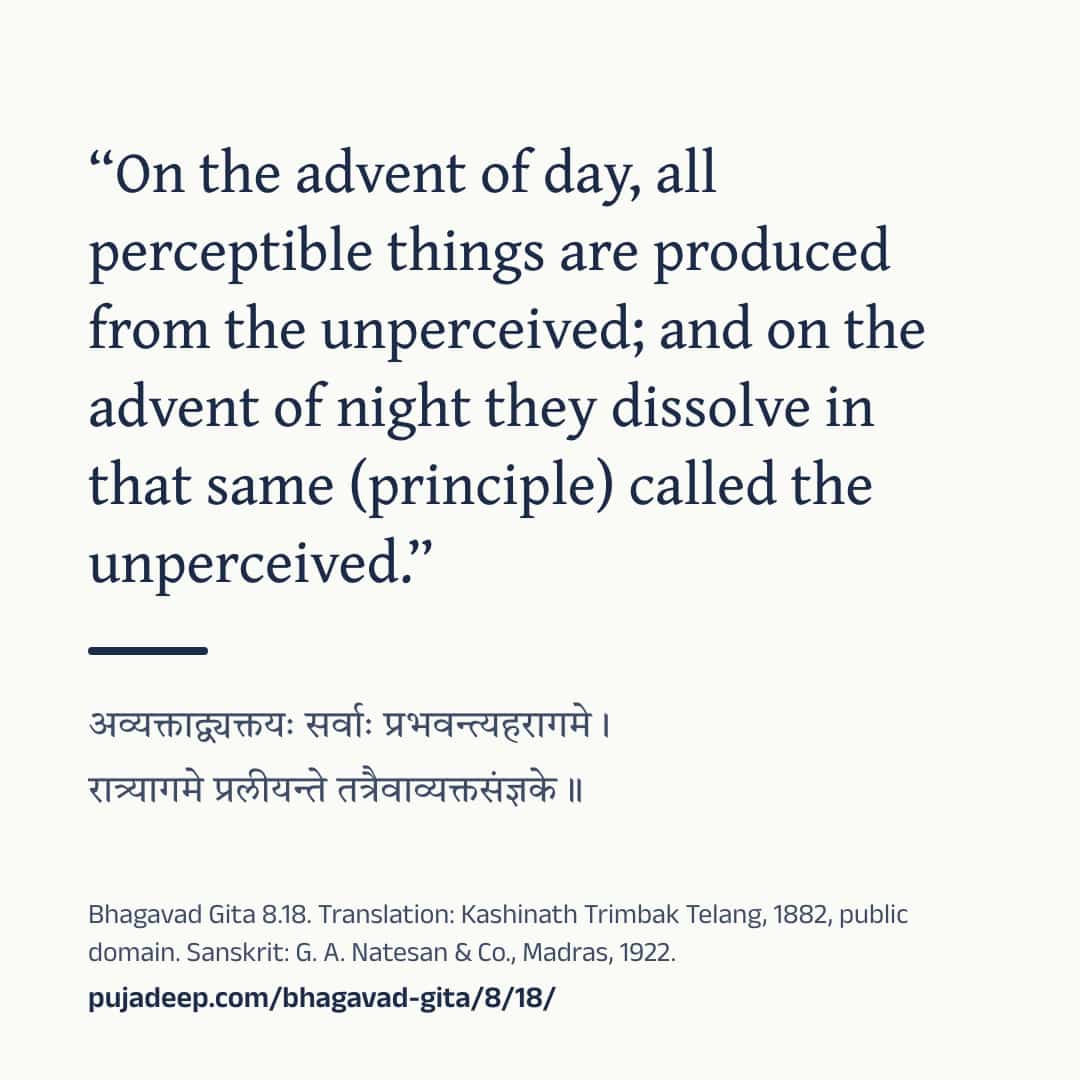
Drawing the picture
See the words
Bhagavad Gita 8.18

अव्यक्ताद्व्यक्तयः सर्वाः प्रभवन्त्यहरागमे ।
रात्र्यागमे प्रलीयन्ते तत्रैवाव्यक्तसंज्ञके ॥

“On the advent of day, all perceptible things are produced from the unperceived; and on the advent of night they dissolve in that same (principle) called the unperceived.”
(K. T. Telang, The Bhagavadgîtâ (The Sacred Books of the East, vol. VIII, Oxford: Clarendon Press, 1882), p. 80, public domain)

“From the Unmanifested all the manifested stream forth at the coming of day; at the coming of night they dissolve, even in That called the Unmanifested.”
(Annie Besant, The Bhagavad Gîtâ, or The Lord's Song (London: Theosophical Publishing Society, 1895), p. 84, public domain)

“At the approach of (Brahmà's) day, all manifestations proceed from the unmanifested state; at the approach of night, they merge verily into that alone, called the Unmanifested.”
(Swami Swarupananda, Srimad-Bhagavad-Gita (Mayavati: Prabuddha Bharata Press, 1909; first printed in Prabuddha Bharata, 1907–1909), p. 78, public domain)

Sanskrit: G. A. Natesan & Co., Madras, 1922.
https://pujadeep.com/bhagavad-gita/8/18/ Nothing is sent from this site. Your own app sends it, to the chat you choose. The picture quotes the translation you chose on this page, with its name and year.
Sanskrit text: The Bhagavad-Gita, or The Lord's Song, with the text in Devanagari and an English translation, 1922. Meanings: written for Pujadeep and checked against the cited edition. Source and changes
Questions families ask
Who speaks Bhagavad Gita 8.18?
Krishna speaks this verse, in chapter 8 (Akshara Brahma Yoga).
Where does the Sanskrit text come from?
Sanskrit text: The Bhagavad-Gita, or The Lord's Song, with the text in Devanagari and an English translation, 1922. Meanings: written for Pujadeep and checked against the cited edition. See the source
Is the meaning on this page a translation?
Explanation written for this site from the sources listed here, and checked against the cited edition. It is not a translation and not the only way to read the text. Free to quote with credit.
Source and licence
- Sanskrit text
- The Bhagavad-Gita, or The Lord's Song, with the text in Devanagari and an English translation (Annie Besant, G. A. Natesan & Co., Madras, 1922). Public domain. The Sanskrit on these pages was read from this printing’s page images.
- Translation
- The Bhagavadgîtâ with the Sanatsugâtîya and the Anugîtâ, translated by Kâshinâth Trimbak Telang (The Sacred Books of the East, vol. VIII, ed. F. Max Müller) (Kashinath Trimbak Telang, F. Max Müller, Clarendon Press, Oxford, 1882). Public domain. Shown verbatim, as printed.
- Translation
- The Bhagavad Gîtâ, or The Lord's Song, translated by Annie Besant (Annie Besant, Theosophical Publishing Society, London, 1895). Public domain. Shown verbatim, as printed.
- Translation
- Srimad-Bhagavad-Gita, with Sanskrit Text; Paraphrase with Word-by-word Literal Translation; English Rendering and Comments, Index, &c., by the Swami Swarupananda (Himalayan Series, No. XX) (Swami Swarupananda, The Editors and Publishers, Advaita Ashrama, Mayavati, Prabuddha Bharata Press, Mayavati, Almora, Himalayas, 1909). Public domain. Shown verbatim, as printed.
- Common wording
- In this text, 32 words follow today's common wording, checked against sanskritdocuments.org; Sanskrit Wikisource; Gita Press, Gorakhpur; GRETIL, Göttingen and Bhaktivedanta Book Trust.
- Our explanation
- Explanation written for this site from the sources listed here, and checked against the cited edition. It is not a translation and not the only way to read the text. Free to quote with credit.
- Checked
- Checked against the cited edition, October 27, 2026.