Bhagavad Gita 8.19: meaning and translation
Chapter 8: Akshara Brahma Yoga. Krishna says
This same host of beings comes into being again and again, dissolves when night comes, and comes forth again at daybreak, Krishna says, not by its own will (avaśa).
Click or tap a word for its meaning and its dictionary page.
Text and layers
Text and layers
These choices stay in this browser.
Bhagavad Gita 8.19
भूतग्रामः स एवायं भूत्वा भूत्वा प्रलीयते ।रात्र्यागमेऽवशः पार्थ प्रभवत्यहरागमे ॥
Bhutagramah sa evayam bhutva bhutva praliyateRatryagamevashah partha prabhavatyaharagame
bhūtagrāmaḥ sa evāyaṃ bhūtvā bhūtvā pralīyate |rātryāgame’vaśaḥ pārtha prabhavatyaharāgame ||
Our explanation This same host of beings comes into being again and again, dissolves when night comes, and comes forth again at daybreak, Krishna says, not by its own will (avaśa).
हिंदी अर्थ कृष्ण कहते हैं कि यही प्राणियों का समूह बार-बार उत्पन्न होकर रात आने पर लीन हो जाता है, और दिन आने पर फिर उत्पन्न होता है, अपने वश में नहीं।
Word by word
Every word, with its dictionary page
Word by word
- भूतग्रामः bhūtagrāmaḥ · the host of beings (compound, nominative singular) Dictionary: bhūta-grāma, Monier-Williams 1899, p. 761, col. 3; bhūta-gaṇa, Monier-Williams 1899, p. 761, col. 3 “the host of living beings”
- सः saḥ · that (pronoun, nominative singular) Dictionary: tad, Monier-Williams 1899, p. 434, col. 1 “m. he, f. she, n. it, that, this”
- एव eva · same, indeed (indeclinable) Dictionary: 1. eva, Monier-Williams 1899, p. 232, col. 2 “just, exactly, very, same, only, even, alone, merely”
- अयम् ayam · this (pronoun, nominative singular) Dictionary: 1. idam, Monier-Williams 1899, p. 165, col. 2 “this, this here, referring to something near the speaker”
- भूत्वा bhūtvā · having come into being (absolutive ('having done')) Dictionary: 1. bhū, Monier-Williams 1899, p. 760, col. 2 “arise, come into being, exist”
- भूत्वा bhūtvā · (again and again) (absolutive ('having done')) Dictionary: 1. bhū, Monier-Williams 1899, p. 760, col. 2 “arise, come into being, exist”
- प्रलीयते pralīyate · dissolves (present, 3rd person singular) Dictionary: pra-lī, Monier-Williams 1899, p. 689, col. 3 “to become dissolved or reabsorbed into (loc.), disappear”
- रात्र्यागमे rātryāgame · at the coming of night (compound, locative singular) Dictionary: rātri, Monier-Williams 1899, p. 876, col. 1 “night, the darkness or stillness of night”; ā-gama, Monier-Williams 1899, p. 129, col. 3 “arrival, coming, approach”
- अवशः avaśaḥ · without its own will (nominative singular) Dictionary: a-vaśa, Monier-Williams 1899, p. 104, col. 1 “not having one's own free will”
- पार्थ pārtha · O son of Pritha (Arjuna) (vocative singular) Dictionary: 2. pārtha, Monier-Williams 1899, p. 621, col. 3 “metron. of Yudhi-shṭhira or Bhīma-sena or Arjuna”
- प्रभवति prabhavati · comes forth (present, 3rd person singular) Dictionary: pra-bhū, Monier-Williams 1899, p. 684, col. 2 “to come forth, spring up, arise or originate from (abl.), appear”
- अहरागमे aharāgame · at the coming of day (compound, locative singular) Dictionary: ahar-āgama, Monier-Williams 1899, p. 124, col. 3 “the approach of the day”
Old translations
Kashinath Trimbak Telang, 1882. Public domain. Page 80.
This same assemblage of entities, being produced again and again, dissolves on the advent of night, and, O son of Prithâ! issues forth on the advent of day, without a will of its own1.
Footnotes (the translator’s own) - Cf. p. 82 infra; also Manu-smriti I, 52; and Kâlidâsa's Kumârasambhava II, 8. ↩
Compare 3 translations
Kashinath Trimbak Telang, 1882. Public domain. Page 80.
This same assemblage of entities, being produced again and again, dissolves on the advent of night, and, O son of Prithâ! issues forth on the advent of day, without a will of its own1.
Footnotes (the translator’s own) - Cf. p. 82 infra; also Manu-smriti I, 52; and Kâlidâsa's Kumârasambhava II, 8. ↩
You are reading this one
Annie Besant, 1895. Public domain. Page 84.
This multitude of beings, going forth repeatedly, is dissolved at the coming of night; not by its will, O Pârtha, it streams forth at the coming of day.
You are reading this one
Swami Swarupananda, 1909 (first printed 1907). Public domain. Page 78–79.
The very same multitude of beings (that existed in the preceding day of Brahmà), being born again and again, merge, in spite of themselves, O son of Pritha, (into the unmanifested), at the approach of night, and re-manifest at the approach of day.
You are reading this one
Cite this verse
The translation: K. T. Telang, The Bhagavadgîtâ (The Sacred Books of the East, vol. VIII, Oxford: Clarendon Press, 1882), p. 80. Bhagavad Gita 8.19.
The translation: Annie Besant, The Bhagavad Gîtâ, or The Lord's Song (London: Theosophical Publishing Society, 1895), p. 84. Bhagavad Gita 8.19.
The translation: Swami Swarupananda, Srimad-Bhagavad-Gita (Mayavati: Prabuddha Bharata Press, 1909; first printed in Prabuddha Bharata, 1907–1909), pp. 78–79. Bhagavad Gita 8.19.
Our explanation: “Bhagavad Gita 8.19: meaning and translation.” Pujadeep. Updated October 27, 2026. https://pujadeep.com/bhagavad-gita/8/19/
Pujadeep’s explanations are free to quote with credit: name Pujadeep and link to the page. How to credit
Classical readings, by school
No readings by school on this verse yet.
Share
Show the ways to share
Send one picture or the text to one chat. The picture names its source and the address of this page.
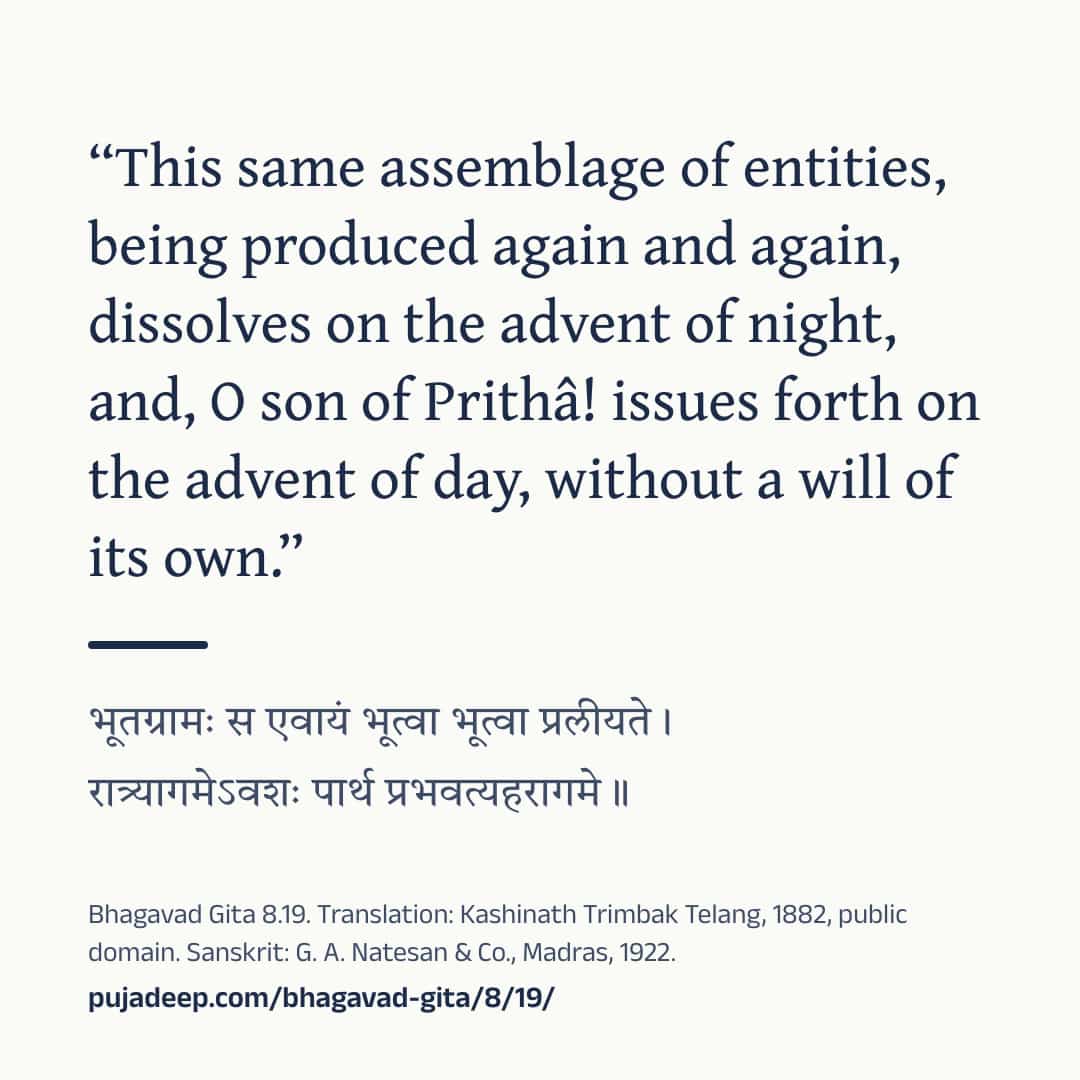
Drawing the picture
See the words
Bhagavad Gita 8.19

भूतग्रामः स एवायं भूत्वा भूत्वा प्रलीयते ।
रात्र्यागमेऽवशः पार्थ प्रभवत्यहरागमे ॥

“This same assemblage of entities, being produced again and again, dissolves on the advent of night, and, O son of Prithâ! issues forth on the advent of day, without a will of its own.”
(K. T. Telang, The Bhagavadgîtâ (The Sacred Books of the East, vol. VIII, Oxford: Clarendon Press, 1882), p. 80, public domain)

“This multitude of beings, going forth repeatedly, is dissolved at the coming of night; not by its will, O Pârtha, it streams forth at the coming of day.”
(Annie Besant, The Bhagavad Gîtâ, or The Lord's Song (London: Theosophical Publishing Society, 1895), p. 84, public domain)

“The very same multitude of beings (that existed in the preceding day of Brahmà), being born again and again, merge, in spite of themselves, O son of Pritha, (into the unmanifested), at the approach of night, and re-manifest at the approach of day.”
(Swami Swarupananda, Srimad-Bhagavad-Gita (Mayavati: Prabuddha Bharata Press, 1909; first printed in Prabuddha Bharata, 1907–1909), pp. 78–79, public domain)

Sanskrit: G. A. Natesan & Co., Madras, 1922.
https://pujadeep.com/bhagavad-gita/8/19/ Nothing is sent from this site. Your own app sends it, to the chat you choose. The picture quotes the translation you chose on this page, with its name and year.
Sanskrit text: The Bhagavad-Gita, or The Lord's Song, with the text in Devanagari and an English translation, 1922. Meanings: written for Pujadeep and checked against the cited edition. Source and changes
Questions families ask
Who speaks Bhagavad Gita 8.19?
Krishna speaks this verse, in chapter 8 (Akshara Brahma Yoga).
Where does the Sanskrit text come from?
Sanskrit text: The Bhagavad-Gita, or The Lord's Song, with the text in Devanagari and an English translation, 1922. Meanings: written for Pujadeep and checked against the cited edition. See the source
Is the meaning on this page a translation?
Explanation written for this site from the sources listed here, and checked against the cited edition. It is not a translation and not the only way to read the text. Free to quote with credit.
Source and licence
- Sanskrit text
- The Bhagavad-Gita, or The Lord's Song, with the text in Devanagari and an English translation (Annie Besant, G. A. Natesan & Co., Madras, 1922). Public domain. The Sanskrit on these pages was read from this printing’s page images.
- Translation
- The Bhagavadgîtâ with the Sanatsugâtîya and the Anugîtâ, translated by Kâshinâth Trimbak Telang (The Sacred Books of the East, vol. VIII, ed. F. Max Müller) (Kashinath Trimbak Telang, F. Max Müller, Clarendon Press, Oxford, 1882). Public domain. Shown verbatim, as printed.
- Translation
- The Bhagavad Gîtâ, or The Lord's Song, translated by Annie Besant (Annie Besant, Theosophical Publishing Society, London, 1895). Public domain. Shown verbatim, as printed.
- Translation
- Srimad-Bhagavad-Gita, with Sanskrit Text; Paraphrase with Word-by-word Literal Translation; English Rendering and Comments, Index, &c., by the Swami Swarupananda (Himalayan Series, No. XX) (Swami Swarupananda, The Editors and Publishers, Advaita Ashrama, Mayavati, Prabuddha Bharata Press, Mayavati, Almora, Himalayas, 1909). Public domain. Shown verbatim, as printed.
- Common wording
- In this text, 32 words follow today's common wording, checked against sanskritdocuments.org; Sanskrit Wikisource; Gita Press, Gorakhpur; GRETIL, Göttingen and Bhaktivedanta Book Trust.
- Our explanation
- Explanation written for this site from the sources listed here, and checked against the cited edition. It is not a translation and not the only way to read the text. Free to quote with credit.
- Checked
- Checked against the cited edition, October 27, 2026.