Bhagavad Gita 8.23: meaning and translation
Chapter 8: Akshara Brahma Yoga. Krishna says
Krishna now says he will describe the times at which yogis who depart do not return, and the times at which they do return.
Click or tap a word for its meaning and its dictionary page.
Text and layers
Text and layers
These choices stay in this browser.
Bhagavad Gita 8.23
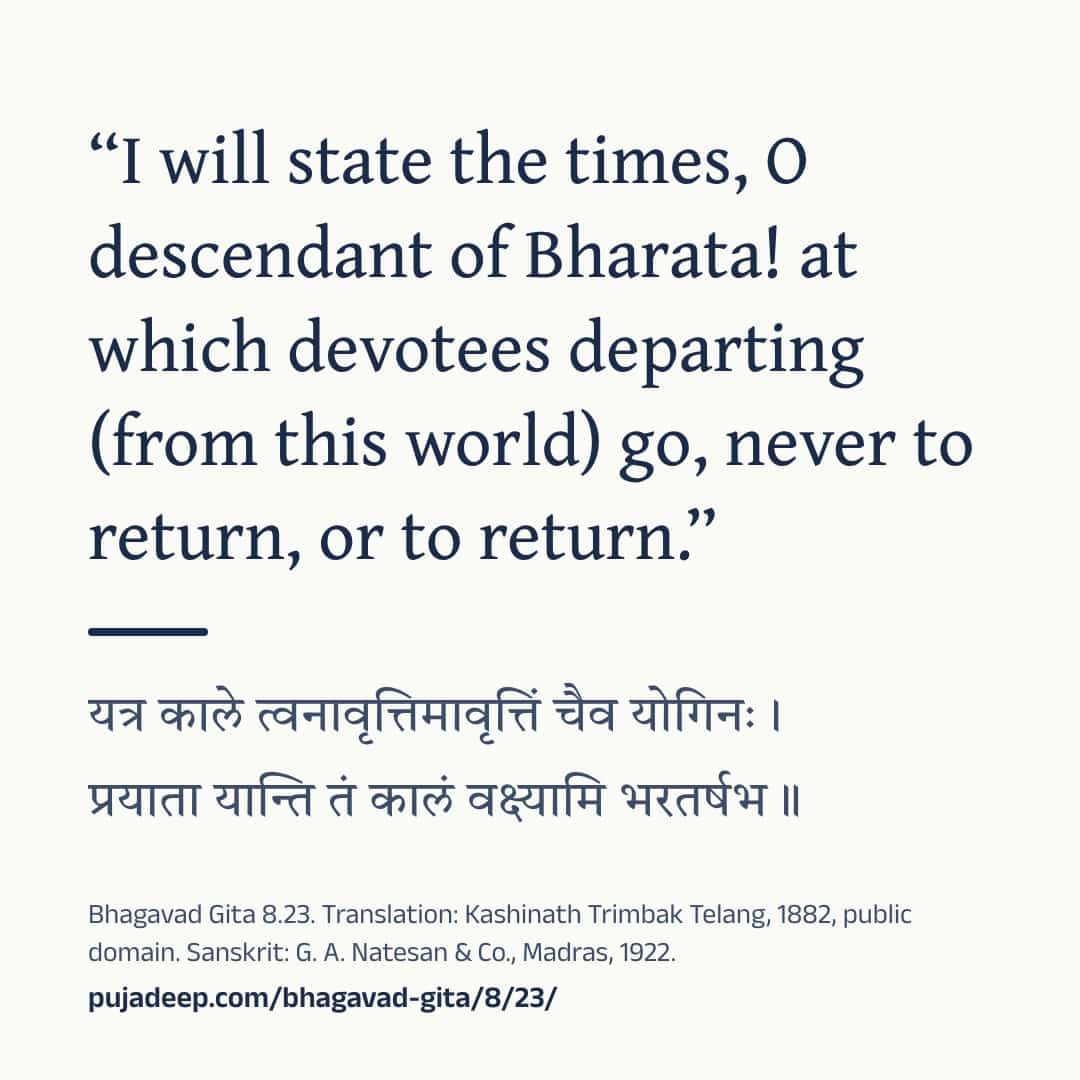
यत्र काले त्वनावृत्तिमावृत्तिं चैव योगिनः ।प्रयाता यान्ति तं कालं वक्ष्यामि भरतर्षभ ॥
Yatra kale tvanavrittimavrittim chaiva yoginahPrayata yanti tam kalam vakshyami bharatarshabha
yatra kāle tvanāvṛttimāvṛttiṃ caiva yoginaḥ |prayātā yānti taṃ kālaṃ vakṣyāmi bharatarṣabha ||
Our explanation Krishna now says he will describe the times at which yogis who depart do not return, and the times at which they do return.
हिंदी अर्थ अब कृष्ण कहते हैं कि वे बताएँगे कि किस काल में शरीर छोड़ने वाले योगी लौटकर नहीं आते, और किस काल में लौट आते हैं।
Word by word
Every word, with its dictionary page
Word by word
- यत्र yatra · in which (indeclinable) Dictionary: yatra, Monier-Williams 1899, p. 841, col. 2 “in or to which place, where, wherein”
- काले kāle · time (locative singular) Dictionary: 2. kāla, Monier-Williams 1899, p. 278, col. 1 “time (as destroying all things), death, time of death”
- तु tu · but, now (indeclinable) Dictionary: 2. tu, Monier-Williams 1899, p. 449, col. 3 “but; and; or”
- अनावृत्तिम् anāvṛttim · no return (accusative singular (feminine)) Dictionary: an-āvṛtti, Monier-Williams 1899, p. 28, col. 3 “non-return to a body, final emancipation”
- आवृत्तिम् āvṛttim · return (accusative singular (feminine)) Dictionary: ā-vṛtti, Monier-Williams 1899, p. 156, col. 2 “turning back or from, reversion, retreat, flight; recurrence to the same point”
- च ca · and (indeclinable) Dictionary: 2. ca, Monier-Williams 1899, p. 380, col. 1 “and, both, also, moreover, as well as”
- एव eva · also, indeed (indeclinable) Dictionary: 1. eva, Monier-Williams 1899, p. 232, col. 2 “just, exactly, very, same, only, even, alone, merely”
- योगिनः yoginaḥ · yogis (nominative plural) Dictionary: yogin, Monier-Williams 1899, p. 857, col. 3 “a follower of the Yoga system, a Yogin (usually called Yogī) or contemplative saint”
- प्रयाताः prayātāḥ · having departed (past participle, nominative plural) Dictionary: pra-yāta, Monier-Williams 1899, p. 688, col. 1 “set out, gone, advanced”
- यान्ति yānti · go (present, 3rd person plural) Dictionary: yā, Monier-Williams 1899, p. 849, col. 1 “to go, proceed, move, walk, set out”
- तम् tam · that (pronoun, accusative singular) Dictionary: tad, Monier-Williams 1899, p. 434, col. 1 “m. he, f. she, n. it, that, this”
- कालम् kālam · time (accusative singular) Dictionary: 2. kāla, Monier-Williams 1899, p. 278, col. 1 “time (as destroying all things), death, time of death”
- वक्ष्यामि vakṣyāmi · will tell (Krishna speaks) (future, 1st person singular) Dictionary: vac, Monier-Williams 1899, p. 912, col. 1 “to speak, say, tell, utter, announce, declare”
- भरतर्षभ bharatarṣabha · O best of the Bharatas (Arjuna) (compound, vocative singular) Dictionary: bharatarṣabha, Monier-Williams 1899, p. 747, col. 3 “the best or a prince (lit. ‘bull’) of the Bh°s”
Old translations
Kashinath Trimbak Telang, 1882. Public domain. Page 80.
I will state the times, O descendant of Bharata! at which devotees departing (from this world) go, never to return, or to return.
Compare 3 translations
Kashinath Trimbak Telang, 1882. Public domain. Page 80.
I will state the times, O descendant of Bharata! at which devotees departing (from this world) go, never to return, or to return.
You are reading this one
Annie Besant, 1895. Public domain. Page 85.
In what time Yogîs, going forth, go to return not, and also to return, that time will I declare to thee, O prince of the Bhâratas.
You are reading this one
Swami Swarupananda, 1909 (first printed 1907). Public domain. Page 79.
Now I shall tell thee, O bull of the Bharatas, of the time (path) travelling in which, the Yogis return, (and again of that, taking which) they do not return.
You are reading this one
Cite this verse
The translation: K. T. Telang, The Bhagavadgîtâ (The Sacred Books of the East, vol. VIII, Oxford: Clarendon Press, 1882), p. 80. Bhagavad Gita 8.23.
The translation: Annie Besant, The Bhagavad Gîtâ, or The Lord's Song (London: Theosophical Publishing Society, 1895), p. 85. Bhagavad Gita 8.23.
The translation: Swami Swarupananda, Srimad-Bhagavad-Gita (Mayavati: Prabuddha Bharata Press, 1909; first printed in Prabuddha Bharata, 1907–1909), p. 79. Bhagavad Gita 8.23.
Our explanation: “Bhagavad Gita 8.23: meaning and translation.” Pujadeep. Updated October 27, 2026. https://pujadeep.com/bhagavad-gita/8/23/
Pujadeep’s explanations are free to quote with credit: name Pujadeep and link to the page. How to credit
Classical readings, by school
No readings by school on this verse yet.
Share
Show the ways to share
Send one picture or the text to one chat. The picture names its source and the address of this page.
Drawing the picture
See the words
Bhagavad Gita 8.23

यत्र काले त्वनावृत्तिमावृत्तिं चैव योगिनः ।
प्रयाता यान्ति तं कालं वक्ष्यामि भरतर्षभ ॥

“I will state the times, O descendant of Bharata! at which devotees departing (from this world) go, never to return, or to return.”
(K. T. Telang, The Bhagavadgîtâ (The Sacred Books of the East, vol. VIII, Oxford: Clarendon Press, 1882), p. 80, public domain)

“In what time Yogîs, going forth, go to return not, and also to return, that time will I declare to thee, O prince of the Bhâratas.”
(Annie Besant, The Bhagavad Gîtâ, or The Lord's Song (London: Theosophical Publishing Society, 1895), p. 85, public domain)

“Now I shall tell thee, O bull of the Bharatas, of the time (path) travelling in which, the Yogis return, (and again of that, taking which) they do not return.”
(Swami Swarupananda, Srimad-Bhagavad-Gita (Mayavati: Prabuddha Bharata Press, 1909; first printed in Prabuddha Bharata, 1907–1909), p. 79, public domain)

Sanskrit: G. A. Natesan & Co., Madras, 1922.
https://pujadeep.com/bhagavad-gita/8/23/ Nothing is sent from this site. Your own app sends it, to the chat you choose. The picture quotes the translation you chose on this page, with its name and year.
Sanskrit text: The Bhagavad-Gita, or The Lord's Song, with the text in Devanagari and an English translation, 1922. Meanings: written for Pujadeep and checked against the cited edition. Source and changes
Questions families ask
Who speaks Bhagavad Gita 8.23?
Krishna speaks this verse, in chapter 8 (Akshara Brahma Yoga).
Where does the Sanskrit text come from?
Sanskrit text: The Bhagavad-Gita, or The Lord's Song, with the text in Devanagari and an English translation, 1922. Meanings: written for Pujadeep and checked against the cited edition. See the source
Is the meaning on this page a translation?
Explanation written for this site from the sources listed here, and checked against the cited edition. It is not a translation and not the only way to read the text. Free to quote with credit.
Source and licence
- Sanskrit text
- The Bhagavad-Gita, or The Lord's Song, with the text in Devanagari and an English translation (Annie Besant, G. A. Natesan & Co., Madras, 1922). Public domain. The Sanskrit on these pages was read from this printing’s page images.
- Translation
- The Bhagavadgîtâ with the Sanatsugâtîya and the Anugîtâ, translated by Kâshinâth Trimbak Telang (The Sacred Books of the East, vol. VIII, ed. F. Max Müller) (Kashinath Trimbak Telang, F. Max Müller, Clarendon Press, Oxford, 1882). Public domain. Shown verbatim, as printed.
- Translation
- The Bhagavad Gîtâ, or The Lord's Song, translated by Annie Besant (Annie Besant, Theosophical Publishing Society, London, 1895). Public domain. Shown verbatim, as printed.
- Translation
- Srimad-Bhagavad-Gita, with Sanskrit Text; Paraphrase with Word-by-word Literal Translation; English Rendering and Comments, Index, &c., by the Swami Swarupananda (Himalayan Series, No. XX) (Swami Swarupananda, The Editors and Publishers, Advaita Ashrama, Mayavati, Prabuddha Bharata Press, Mayavati, Almora, Himalayas, 1909). Public domain. Shown verbatim, as printed.
- Common wording
- In this text, 32 words follow today's common wording, checked against sanskritdocuments.org; Sanskrit Wikisource; Gita Press, Gorakhpur; GRETIL, Göttingen and Bhaktivedanta Book Trust.
- Our explanation
- Explanation written for this site from the sources listed here, and checked against the cited edition. It is not a translation and not the only way to read the text. Free to quote with credit.
- Checked
- Checked against the cited edition, October 27, 2026.