Bhagavad Gita 8.28: meaning and translation
Chapter 8: Akshara Brahma Yoga. Krishna says
Krishna says that whatever good fruit is promised for studying the Vedas, for sacrifices, for austerities and for giving, the yogi who knows this goes beyond all of it and reaches the supreme, original abode.
Click or tap a word for its meaning and its dictionary page.
Text and layers
Text and layers
These choices stay in this browser.
Bhagavad Gita 8.28
वेदेषु यज्ञेषु तपःसु चैव दानेषु यत्पुण्यफलं प्रदिष्टम् ।अत्येति तत्सर्वमिदं विदित्वा योगी परं स्थानमुपैति चाद्यम् ॥
Vedeshu yajneshu tapahsu chaiva daneshu yatpunyaphalam pradishtamAtyeti tatsarvamidam viditva yogi param sthanamupaiti chadyam
vedeṣu yajñeṣu tapaḥsu caiva dāneṣu yatpuṇyaphalaṃ pradiṣṭam |atyeti tatsarvamidaṃ viditvā yogī paraṃ sthānamupaiti cādyam ||
Our explanation Krishna says that whatever good fruit is promised for studying the Vedas, for sacrifices, for austerities and for giving, the yogi who knows this goes beyond all of it and reaches the supreme, original abode. The two translations read 'goes beyond' (atyeti) differently: Telang says the devotee obtains all that fruit, Besant that the yogi passes it all by.
हिंदी अर्थ कृष्ण कहते हैं कि वेदों के अध्ययन, यज्ञों, तप और दान के लिए जो भी पुण्य फल बताया गया है, यह जानने वाला योगी उस सबसे आगे निकल जाता है और परम आदि स्थान को प्राप्त होता है। दोनों अनुवाद 'अत्येति' को अलग ढंग से लेते हैं: तेलंग कहते हैं कि भक्त वह सारा फल पाता है, बेसेंट कहती हैं कि योगी उस सबको पार कर जाता है।
Word by word
Every word, with its dictionary page
Word by word
- वेदेषु vedeṣu · in the Vedas (locative plural) Dictionary: 1. veda, Monier-Williams 1899, p. 1015, col. 1 “N. of certain celebrated works”
- यज्ञेषु yajñeṣu · in sacrifices (locative plural) Dictionary: yajña, Monier-Williams 1899, p. 839, col. 2 “worship, devotion, prayer, praise; act of worship or devotion, offering, oblation, sacrifice”
- तपःसु tapaḥsu · in austerities (locative plural) Dictionary: tapas, Monier-Williams 1899, p. 437, col. 1 “religious austerity, bodily mortification, penance”
- च ca · and (indeclinable) Dictionary: 2. ca, Monier-Williams 1899, p. 380, col. 1 “and, both, also, moreover, as well as”
- एव eva · also (indeclinable) Dictionary: 1. eva, Monier-Williams 1899, p. 232, col. 2 “just, exactly, very, same, only, even, alone, merely”
- दानेषु dāneṣu · in giving (locative plural) Dictionary: 1. dāna, Monier-Williams 1899, p. 474, col. 1 “the act of giving”
- यत् yat · whatever (relative pronoun, nominative singular) Dictionary: yad, Monier-Williams 1899, p. 844, col. 2 “who, which, what, whichever, whatever, that”
- पुण्यफलम् puṇyaphalam · the fruit of merit (compound, nominative singular) Dictionary: puṇya-phala, Monier-Williams 1899, p. 632, col. 2 “the fruit or reward of good works”
- प्रदिष्टम् pradiṣṭam · is declared (past participle, nominative singular) Dictionary: pra-diṣṭa, Monier-Williams 1899, p. 679, col. 3 “pointed out, indicated, fixed, ordained”
- अत्येति atyeti · goes beyond (present, 3rd person singular) Dictionary: atī, Monier-Williams 1899, p. 16, col. 2 “to overcome, overtake, outdo”
- तत् tat · that (pronoun, accusative singular) Dictionary: tad, Monier-Williams 1899, p. 434, col. 1 “m. he, f. she, n. it, that, this”
- सर्वम् sarvam · all (pronoun, accusative singular) Dictionary: sarva, Monier-Williams 1899, p. 1184, col. 3 “whole, entire, all, every”
- इदम् idam · this (pronoun, accusative singular) Dictionary: 1. idam, Monier-Williams 1899, p. 165, col. 2 “this, this here, referring to something near the speaker”
- विदित्वा viditvā · having known (absolutive ('having done')) Dictionary: 1. vid, Monier-Williams 1899, p. 963, col. 2 “to know, understand, perceive, learn”
- योगी yogī · the yogi (nominative singular) Dictionary: yogin, Monier-Williams 1899, p. 857, col. 3 “a follower of the Yoga system, a Yogin (usually called Yogī) or contemplative saint”
- परम् param · supreme (accusative singular) Dictionary: 1. para, Monier-Williams 1899, p. 586, col. 1 “highest, supreme, chief”
- स्थानम् sthānam · place, abode (accusative singular) Dictionary: sthāna, Monier-Williams 1899, p. 1263, col. 1 “place of standing or staying, any place, spot, locality, abode, dwelling, house, site”
- उपैति upaiti · reaches (present, 3rd person singular) Dictionary: 1. upe, Monier-Williams 1899, p. 215, col. 2 “to come near to, reach, obtain”
- च ca · and (indeclinable) Dictionary: 2. ca, Monier-Williams 1899, p. 380, col. 1 “and, both, also, moreover, as well as”
- आद्यम् ādyam · first, original (accusative singular) Dictionary: 1. ādya, Monier-Williams 1899, p. 137, col. 1 “being at the beginning, first, primitive”
Old translations
Kashinath Trimbak Telang, 1882. Public domain. Page 81.
A devotee knowing all this1, obtains all the holy fruit which is prescribed for (study of) the Vedas, for sacrifices, and also for penances and gifts, and he attains to the highest and primeval seat.
Footnotes (the translator’s own) - All that is stated in this chapter. ↩
Compare 3 translations
Kashinath Trimbak Telang, 1882. Public domain. Page 81.
A devotee knowing all this1, obtains all the holy fruit which is prescribed for (study of) the Vedas, for sacrifices, and also for penances and gifts, and he attains to the highest and primeval seat.
Footnotes (the translator’s own) - All that is stated in this chapter. ↩
You are reading this one
Annie Besant, 1895. Public domain. Page 86.
The pure fruit declared in the Vedas, in sacrifices, in austerities, and also in almsgiving, having known this, the Yogî passeth all by, and goeth to the supreme and ancient Seat.
You are reading this one
Swami Swarupananda, 1909 (first printed 1907). Public domain. Page 80.
Whatever meritorious effect is declared (in the Scriptures) to accrue from (the study of) the Vedas, (the performance of) Yajnas, (the practice of) austerities and gifts, having known this, the Yogi rises above it all, and attains to the Primeval, Supreme Abode.
You are reading this one
Cite this verse
The translation: K. T. Telang, The Bhagavadgîtâ (The Sacred Books of the East, vol. VIII, Oxford: Clarendon Press, 1882), p. 81. Bhagavad Gita 8.28.
The translation: Annie Besant, The Bhagavad Gîtâ, or The Lord's Song (London: Theosophical Publishing Society, 1895), p. 86. Bhagavad Gita 8.28.
The translation: Swami Swarupananda, Srimad-Bhagavad-Gita (Mayavati: Prabuddha Bharata Press, 1909; first printed in Prabuddha Bharata, 1907–1909), p. 80. Bhagavad Gita 8.28.
Our explanation: “Bhagavad Gita 8.28: meaning and translation.” Pujadeep. Updated October 27, 2026. https://pujadeep.com/bhagavad-gita/8/28/
Pujadeep’s explanations are free to quote with credit: name Pujadeep and link to the page. How to credit
Classical readings, by school
No readings by school on this verse yet.
Share
Show the ways to share
Send one picture or the text to one chat. The picture names its source and the address of this page.
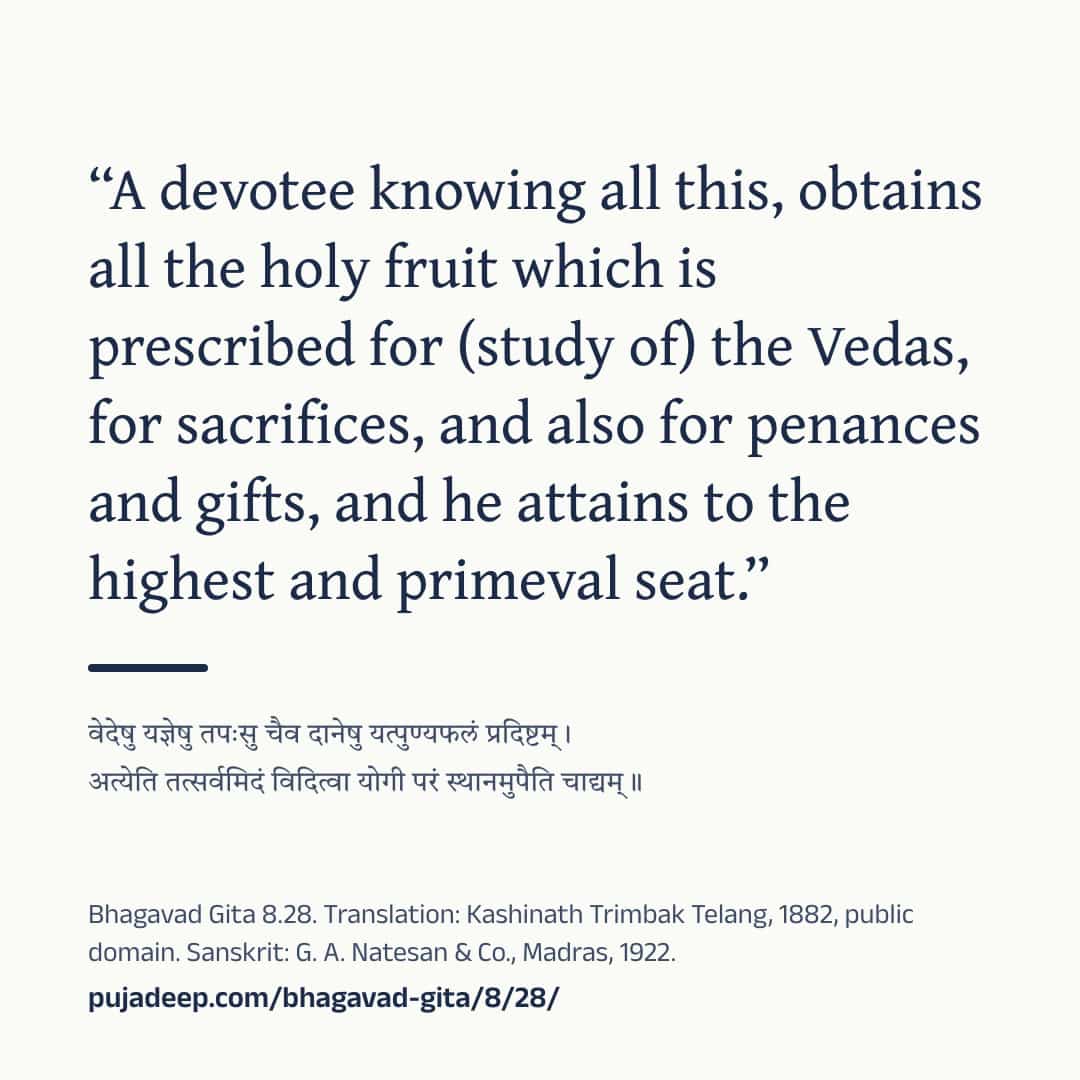
Drawing the picture
See the words
Bhagavad Gita 8.28

वेदेषु यज्ञेषु तपःसु चैव दानेषु यत्पुण्यफलं प्रदिष्टम् ।
अत्येति तत्सर्वमिदं विदित्वा योगी परं स्थानमुपैति चाद्यम् ॥

“A devotee knowing all this, obtains all the holy fruit which is prescribed for (study of) the Vedas, for sacrifices, and also for penances and gifts, and he attains to the highest and primeval seat.”
(K. T. Telang, The Bhagavadgîtâ (The Sacred Books of the East, vol. VIII, Oxford: Clarendon Press, 1882), p. 81, public domain)

“The pure fruit declared in the Vedas, in sacrifices, in austerities, and also in almsgiving, having known this, the Yogî passeth all by, and goeth to the supreme and ancient Seat.”
(Annie Besant, The Bhagavad Gîtâ, or The Lord's Song (London: Theosophical Publishing Society, 1895), p. 86, public domain)

“Whatever meritorious effect is declared (in the Scriptures) to accrue from (the study of) the Vedas, (the performance of) Yajnas, (the practice of) austerities and gifts, having known this, the Yogi rises above it all, and attains to the Primeval, Supreme Abode.”
(Swami Swarupananda, Srimad-Bhagavad-Gita (Mayavati: Prabuddha Bharata Press, 1909; first printed in Prabuddha Bharata, 1907–1909), p. 80, public domain)

Sanskrit: G. A. Natesan & Co., Madras, 1922.
https://pujadeep.com/bhagavad-gita/8/28/ Nothing is sent from this site. Your own app sends it, to the chat you choose. The picture quotes the translation you chose on this page, with its name and year.
Sanskrit text: The Bhagavad-Gita, or The Lord's Song, with the text in Devanagari and an English translation, 1922. Meanings: written for Pujadeep and checked against the cited edition. Source and changes
Questions families ask
Who speaks Bhagavad Gita 8.28?
Krishna speaks this verse, in chapter 8 (Akshara Brahma Yoga).
Where does the Sanskrit text come from?
Sanskrit text: The Bhagavad-Gita, or The Lord's Song, with the text in Devanagari and an English translation, 1922. Meanings: written for Pujadeep and checked against the cited edition. See the source
Is the meaning on this page a translation?
Explanation written for this site from the sources listed here, and checked against the cited edition. It is not a translation and not the only way to read the text. Free to quote with credit.
Source and licence
- Sanskrit text
- The Bhagavad-Gita, or The Lord's Song, with the text in Devanagari and an English translation (Annie Besant, G. A. Natesan & Co., Madras, 1922). Public domain. The Sanskrit on these pages was read from this printing’s page images.
- Translation
- The Bhagavadgîtâ with the Sanatsugâtîya and the Anugîtâ, translated by Kâshinâth Trimbak Telang (The Sacred Books of the East, vol. VIII, ed. F. Max Müller) (Kashinath Trimbak Telang, F. Max Müller, Clarendon Press, Oxford, 1882). Public domain. Shown verbatim, as printed.
- Translation
- The Bhagavad Gîtâ, or The Lord's Song, translated by Annie Besant (Annie Besant, Theosophical Publishing Society, London, 1895). Public domain. Shown verbatim, as printed.
- Translation
- Srimad-Bhagavad-Gita, with Sanskrit Text; Paraphrase with Word-by-word Literal Translation; English Rendering and Comments, Index, &c., by the Swami Swarupananda (Himalayan Series, No. XX) (Swami Swarupananda, The Editors and Publishers, Advaita Ashrama, Mayavati, Prabuddha Bharata Press, Mayavati, Almora, Himalayas, 1909). Public domain. Shown verbatim, as printed.
- Common wording
- In this text, 32 words follow today's common wording, checked against sanskritdocuments.org; Sanskrit Wikisource; Gita Press, Gorakhpur; GRETIL, Göttingen and Bhaktivedanta Book Trust.
- Our explanation
- Explanation written for this site from the sources listed here, and checked against the cited edition. It is not a translation and not the only way to read the text. Free to quote with credit.
- Checked
- Checked against the cited edition, October 27, 2026.