Bhagavad Gita 8.26: meaning and translation
Chapter 8: Akshara Brahma Yoga. Krishna says
Krishna says that these two paths of the world, the bright and the dark, are held to be everlasting.
Click or tap a word for its meaning and its dictionary page.
Text and layers
Text and layers
These choices stay in this browser.
Bhagavad Gita 8.26
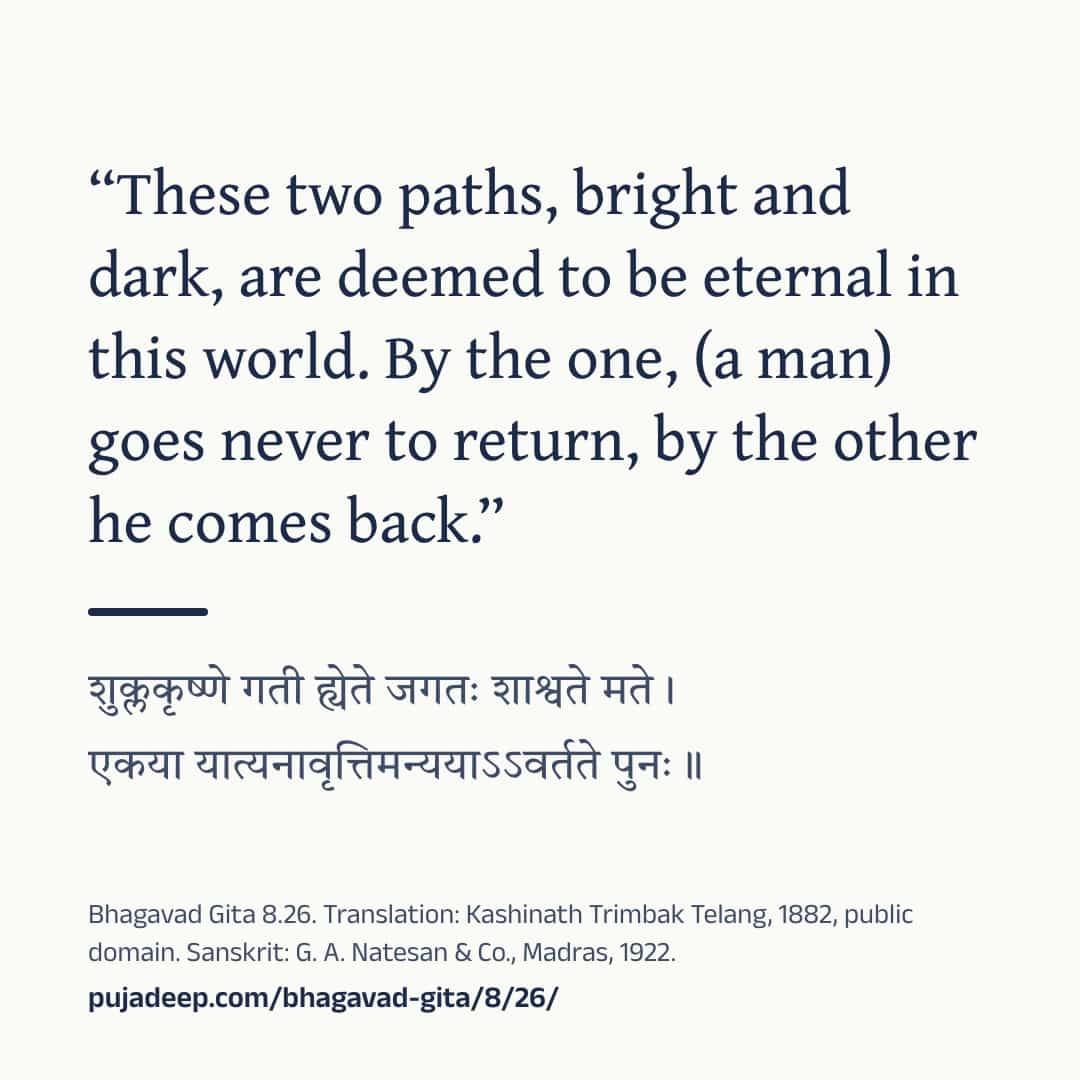
शुक्लकृष्णे गती ह्येते जगतः शाश्वते मते ।एकया यात्यनावृत्तिमन्ययाऽऽवर्तते पुनः ॥
Shuklakrishne gati hyete jagatah shashvate mateEkaya yatyanavrittimanyayavartate punah
śuklakṛṣṇe gatī hyete jagataḥ śāśvate mate |ekayā yātyanāvṛttimanyayā’’vartate punaḥ ||
Our explanation Krishna says that these two paths of the world, the bright and the dark, are held to be everlasting. By one a person goes and does not return; by the other a person returns again.
हिंदी अर्थ कृष्ण कहते हैं कि संसार के ये दो मार्ग, शुक्ल (प्रकाश का) और कृष्ण (अंधकार का), सनातन माने गए हैं। एक से जाने वाला लौटता नहीं; दूसरे से जाने वाला फिर लौट आता है।
Word by word
Every word, with its dictionary page
Word by word
- शुक्लकृष्णे śuklakṛṣṇe · bright and dark (compound, nominative dual (feminine)) Dictionary: śukla-kṛṣṇa, Monier-Williams 1899, p. 1080, col. 2 “light and dark fortnight”
- गती gatī · paths (nominative dual (feminine)) Dictionary: gati, Monier-Williams 1899, p. 347, col. 3 “going, moving, gait, deportment, motion in general”
- हि hi · indeed (indeclinable) Dictionary: 2. hi, Monier-Williams 1899, p. 1297, col. 3 “for, because, on account of”
- एते ete · these (pronoun, nominative dual (feminine)) Dictionary: etad, Monier-Williams 1899, p. 231, col. 2 “this, this here, here”
- जगतः jagataḥ · of the world (genitive singular) Dictionary: jagat, Monier-Williams 1899, p. 408, col. 1 “the world, esp. this world, earth”
- शाश्वते śāśvate · everlasting (nominative dual (feminine)) Dictionary: śāśvata, Monier-Williams 1899, p. 1068, col. 3 “eternal, constant, perpetual”
- मते mate · are held (past participle, nominative dual (feminine)) Dictionary: mata, Monier-Williams 1899, p. 783, col. 1 “thought, believed, imagined, supposed, understood; regarded or considered as”
- एकया ekayā · by one (instrumental singular (feminine)) Dictionary: eka, Monier-Williams 1899, p. 227, col. 3 “one”
- याति yāti · goes (present, 3rd person singular) Dictionary: yā, Monier-Williams 1899, p. 849, col. 1 “to go, proceed, move, walk, set out”
- अनावृत्तिम् anāvṛttim · to no return (accusative singular (feminine)) Dictionary: an-āvṛtti, Monier-Williams 1899, p. 28, col. 3 “non-return to a body, final emancipation”
- अन्यया anyayā · by the other (instrumental singular (feminine)) Dictionary: 2. anya, Monier-Williams 1899, p. 45, col. 2 “other, different”
- आवर्तते āvartate · returns (present, 3rd person singular) Dictionary: 1. ā-vṛt, Monier-Williams 1899, p. 156, col. 1 “to turn round or back, return”
- पुनः punaḥ · again (indeclinable) Dictionary: punar, Monier-Williams 1899, p. 633, col. 2 “again, once more”
1 printing differs
Edition differences. Another printing or text reads this place differently.
- Spelling A digital text reads Same words. The 1922 edition marks the merged vowel with an avagraha (ऽ); this e-text does not. Edition: मन्ययाऽऽवर्तते.
Old translations
Kashinath Trimbak Telang, 1882. Public domain. Page 81.
These two paths, bright and dark, are deemed to be eternal in this world1. By the one, (a man) goes never to return, by the other he comes back.
Footnotes (the translator’s own) - I. e. for those who are fitted for knowledge or action. ↩
Compare 3 translations
Kashinath Trimbak Telang, 1882. Public domain. Page 81.
These two paths, bright and dark, are deemed to be eternal in this world1. By the one, (a man) goes never to return, by the other he comes back.
Footnotes (the translator’s own) - I. e. for those who are fitted for knowledge or action. ↩
You are reading this one
Annie Besant, 1895. Public domain. Page 86.
Light and darkness, these are thought the world's eternal paths; by the one he goeth who returneth not, by the other he returneth again.
You are reading this one
Swami Swarupananda, 1909 (first printed 1907). Public domain. Page 172–173.
Truly are these bright and dark paths of the world considered eternal: one leads to non-return; by the other, one returns.
You are reading this one
Cite this verse
The translation: K. T. Telang, The Bhagavadgîtâ (The Sacred Books of the East, vol. VIII, Oxford: Clarendon Press, 1882), p. 81. Bhagavad Gita 8.26.
The translation: Annie Besant, The Bhagavad Gîtâ, or The Lord's Song (London: Theosophical Publishing Society, 1895), p. 86. Bhagavad Gita 8.26.
The translation: Swami Swarupananda, Srimad-Bhagavad-Gita (Mayavati: Prabuddha Bharata Press, 1909; first printed in Prabuddha Bharata, 1907–1909), pp. 172–173. Bhagavad Gita 8.26.
Our explanation: “Bhagavad Gita 8.26: meaning and translation.” Pujadeep. Updated October 27, 2026. https://pujadeep.com/bhagavad-gita/8/26/
Pujadeep’s explanations are free to quote with credit: name Pujadeep and link to the page. How to credit
Classical readings, by school
No readings by school on this verse yet.
Share
Show the ways to share
Send one picture or the text to one chat. The picture names its source and the address of this page.
Drawing the picture
See the words
Bhagavad Gita 8.26

शुक्लकृष्णे गती ह्येते जगतः शाश्वते मते ।
एकया यात्यनावृत्तिमन्ययाऽऽवर्तते पुनः ॥

“These two paths, bright and dark, are deemed to be eternal in this world. By the one, (a man) goes never to return, by the other he comes back.”
(K. T. Telang, The Bhagavadgîtâ (The Sacred Books of the East, vol. VIII, Oxford: Clarendon Press, 1882), p. 81, public domain)

“Light and darkness, these are thought the world's eternal paths; by the one he goeth who returneth not, by the other he returneth again.”
(Annie Besant, The Bhagavad Gîtâ, or The Lord's Song (London: Theosophical Publishing Society, 1895), p. 86, public domain)

“Truly are these bright and dark paths of the world considered eternal: one leads to non-return; by the other, one returns.”
(Swami Swarupananda, Srimad-Bhagavad-Gita (Mayavati: Prabuddha Bharata Press, 1909; first printed in Prabuddha Bharata, 1907–1909), pp. 172–173, public domain)

Sanskrit: G. A. Natesan & Co., Madras, 1922.
https://pujadeep.com/bhagavad-gita/8/26/ Nothing is sent from this site. Your own app sends it, to the chat you choose. The picture quotes the translation you chose on this page, with its name and year.
Sanskrit text: The Bhagavad-Gita, or The Lord's Song, with the text in Devanagari and an English translation, 1922. Meanings: written for Pujadeep and checked against the cited edition. Source and changes
Questions families ask
Who speaks Bhagavad Gita 8.26?
Krishna speaks this verse, in chapter 8 (Akshara Brahma Yoga).
Where does the Sanskrit text come from?
Sanskrit text: The Bhagavad-Gita, or The Lord's Song, with the text in Devanagari and an English translation, 1922. Meanings: written for Pujadeep and checked against the cited edition. See the source
Is the meaning on this page a translation?
Explanation written for this site from the sources listed here, and checked against the cited edition. It is not a translation and not the only way to read the text. Free to quote with credit.
Source and licence
- Sanskrit text
- The Bhagavad-Gita, or The Lord's Song, with the text in Devanagari and an English translation (Annie Besant, G. A. Natesan & Co., Madras, 1922). Public domain. The Sanskrit on these pages was read from this printing’s page images.
- Translation
- The Bhagavadgîtâ with the Sanatsugâtîya and the Anugîtâ, translated by Kâshinâth Trimbak Telang (The Sacred Books of the East, vol. VIII, ed. F. Max Müller) (Kashinath Trimbak Telang, F. Max Müller, Clarendon Press, Oxford, 1882). Public domain. Shown verbatim, as printed.
- Translation
- The Bhagavad Gîtâ, or The Lord's Song, translated by Annie Besant (Annie Besant, Theosophical Publishing Society, London, 1895). Public domain. Shown verbatim, as printed.
- Translation
- Srimad-Bhagavad-Gita, with Sanskrit Text; Paraphrase with Word-by-word Literal Translation; English Rendering and Comments, Index, &c., by the Swami Swarupananda (Himalayan Series, No. XX) (Swami Swarupananda, The Editors and Publishers, Advaita Ashrama, Mayavati, Prabuddha Bharata Press, Mayavati, Almora, Himalayas, 1909). Public domain. Shown verbatim, as printed.
- Common wording
- In this text, 32 words follow today's common wording, checked against sanskritdocuments.org; Sanskrit Wikisource; Gita Press, Gorakhpur; GRETIL, Göttingen and Bhaktivedanta Book Trust.
- Our explanation
- Explanation written for this site from the sources listed here, and checked against the cited edition. It is not a translation and not the only way to read the text. Free to quote with credit.
- Checked
- Checked against the cited edition, October 27, 2026.