Bhagavad Gita 8.2: meaning and translation
Chapter 8: Akshara Brahma Yoga. Arjuna says
Arjuna: He asks who is adhiyajña here in this body, and how; and how those who have mastered themselves can know Krishna at the time of death.
Click or tap a word for its meaning and its dictionary page.
Text and layers
Text and layers
These choices stay in this browser.
Bhagavad Gita 8.2
अधियज्ञः कथं कोऽत्र देहेऽस्मिन्मधुसूदन ।प्रयाणकाले च कथं ज्ञेयोऽसि नियतात्मभिः ॥
Adhiyajnah katham kotra dehesminmadhusudanaPrayanakale cha katham jneyosi niyatatmabhih
adhiyajñaḥ kathaṃ ko’tra dehe’sminmadhusūdana |prayāṇakāle ca kathaṃ jñeyo’si niyatātmabhiḥ ||
Our explanation He asks who is adhiyajña here in this body, and how; and how those who have mastered themselves can know Krishna at the time of death.
हिंदी अर्थ वे पूछते हैं कि इस शरीर में अधियज्ञ कौन है और कैसे है; और संयमी लोग मृत्यु के समय कृष्ण को कैसे जान सकते हैं।
Word by word
Every word, with its dictionary page
Word by word
- अधियज्ञः adhiyajñaḥ · adhiyajña, the lord of sacrifice (nominative singular) Dictionary: adhi-yajña, Monier-Williams 1899, p. 21, col. 3 “the chief or principal sacrifice”
- कथम् katham · how (indeclinable) Dictionary: katham, Monier-Williams 1899, p. 247, col. 2 “how? in what manner?”
- कः kaḥ · who (interrogative pronoun, nominative singular) Dictionary: kim, Monier-Williams 1899, p. 282, col. 2 “what? how? whence? wherefore? why?”
- अत्र atra · here (indeclinable) Dictionary: 1. a-tra, Monier-Williams 1899, p. 17, col. 2 “in this place, here”
- देहे dehe · in the body (locative singular) Dictionary: deha, Monier-Williams 1899, p. 496, col. 3 “the body”
- अस्मिन् asmin · this (pronoun, locative singular) Dictionary: 1. idam, Monier-Williams 1899, p. 165, col. 2 “this, this here, referring to something near the speaker”
- मधुसूदन madhusūdana · O slayer of Madhu (Krishna) (compound, vocative singular) Dictionary: madhu-sūdana, Monier-Williams 1899, p. 780, col. 3 “destroyer of the demon Madhu”
- प्रयाणकाले prayāṇakāle · at the time of departure (death) (compound, locative singular) Dictionary: pra-yāṇa-kāla, Monier-Williams 1899, p. 688, col. 1 “time of departure, death”
- च ca · and (indeclinable) Dictionary: 2. ca, Monier-Williams 1899, p. 380, col. 1 “and, both, also, moreover, as well as”
- कथम् katham · how (indeclinable) Dictionary: katham, Monier-Williams 1899, p. 247, col. 2 “how? in what manner?”
- ज्ञेयः jñeyaḥ · to be known (gerundive ("to be done"), nominative singular) Dictionary: jñeya, Monier-Williams 1899, p. 426, col. 2 “to be known”
- असि asi · (you) are (present, 2nd person singular) Dictionary: 1. as, Monier-Williams 1899, p. 117, col. 2 “to be, live, exist, be present”
- नियतात्मभिः niyatātmabhiḥ · by the self-controlled (compound, instrumental plural) Dictionary: ni-yatātman, Monier-Williams 1899, p. 552, col. 1 “self-controlled, self-restrained”
Old translations
Kashinath Trimbak Telang, 1882. Public domain. Page 77.
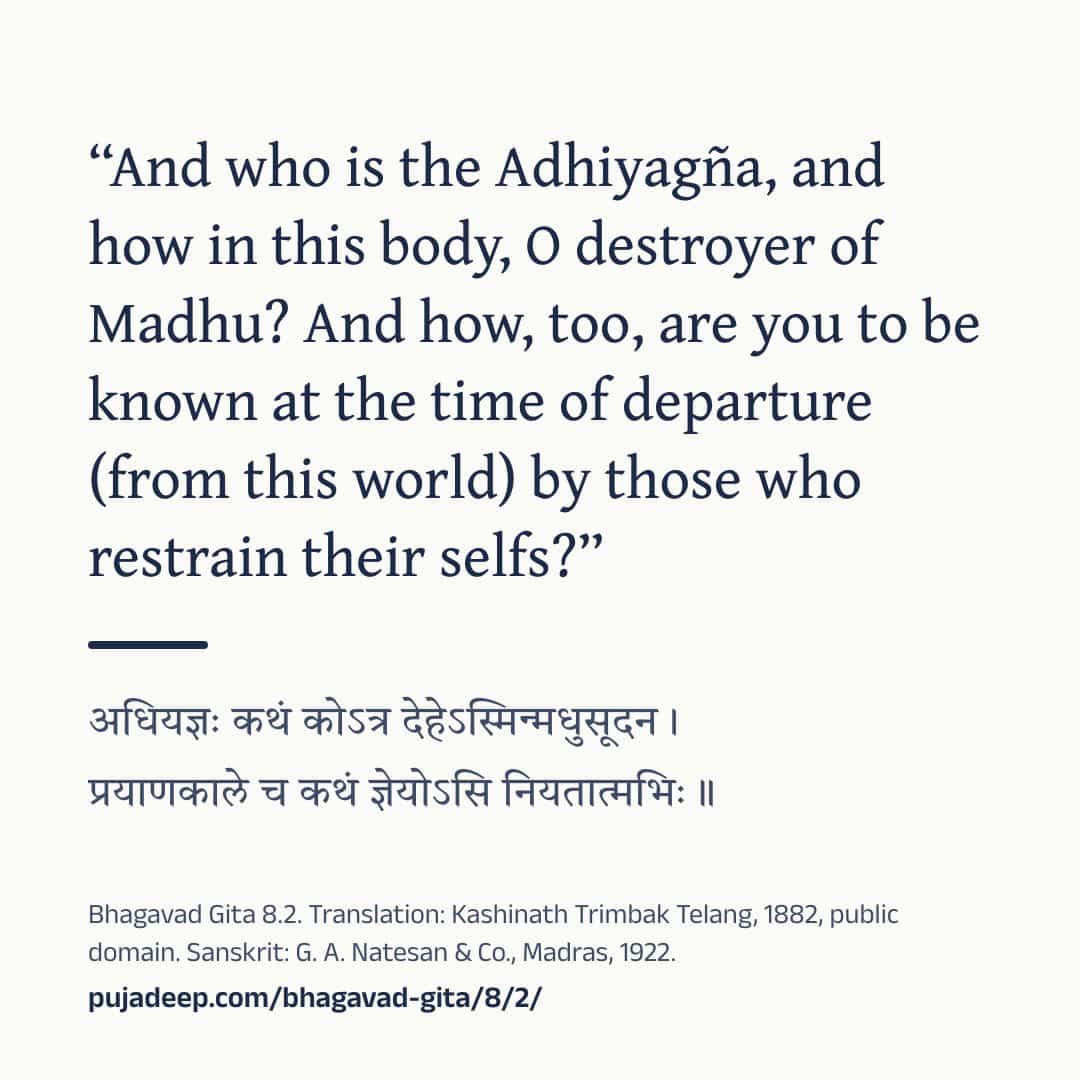
And who is the Adhiyagña, and how in this body, O destroyer of Madhu? And how, too, are you to be known at the time of departure (from this world) by those who restrain their selfs?
Compare 3 translations
Kashinath Trimbak Telang, 1882. Public domain. Page 77.
And who is the Adhiyagña, and how in this body, O destroyer of Madhu? And how, too, are you to be known at the time of departure (from this world) by those who restrain their selfs?
You are reading this one
Annie Besant, 1895. Public domain. Page 81.
What Adhiyagnya, how here in this body, O Madhusûdana? And how at the time of forthgoing art Thou known by the SELF-controlled?
You are reading this one
Swami Swarupananda, 1909 (first printed 1907). Public domain. Page 160.
And who in what way is Adhiyajna here in this body, O destroyer of Madhu? And how art Thou known at the time of death, by the self-controlled?
You are reading this one
Cite this verse
The translation: K. T. Telang, The Bhagavadgîtâ (The Sacred Books of the East, vol. VIII, Oxford: Clarendon Press, 1882), p. 77. Bhagavad Gita 8.2.
The translation: Annie Besant, The Bhagavad Gîtâ, or The Lord's Song (London: Theosophical Publishing Society, 1895), p. 81. Bhagavad Gita 8.2.
The translation: Swami Swarupananda, Srimad-Bhagavad-Gita (Mayavati: Prabuddha Bharata Press, 1909; first printed in Prabuddha Bharata, 1907–1909), p. 160. Bhagavad Gita 8.2.
Our explanation: “Bhagavad Gita 8.2: meaning and translation.” Pujadeep. Updated October 27, 2026. https://pujadeep.com/bhagavad-gita/8/2/
Pujadeep’s explanations are free to quote with credit: name Pujadeep and link to the page. How to credit
Classical readings, by school
No readings by school on this verse yet.
Share
Show the ways to share
Send one picture or the text to one chat. The picture names its source and the address of this page.
Drawing the picture
See the words
Bhagavad Gita 8.2

अधियज्ञः कथं कोऽत्र देहेऽस्मिन्मधुसूदन ।
प्रयाणकाले च कथं ज्ञेयोऽसि नियतात्मभिः ॥

“And who is the Adhiyagña, and how in this body, O destroyer of Madhu? And how, too, are you to be known at the time of departure (from this world) by those who restrain their selfs?”
(K. T. Telang, The Bhagavadgîtâ (The Sacred Books of the East, vol. VIII, Oxford: Clarendon Press, 1882), p. 77, public domain)

“What Adhiyagnya, how here in this body, O Madhusûdana? And how at the time of forthgoing art Thou known by the SELF-controlled?”
(Annie Besant, The Bhagavad Gîtâ, or The Lord's Song (London: Theosophical Publishing Society, 1895), p. 81, public domain)

“And who in what way is Adhiyajna here in this body, O destroyer of Madhu? And how art Thou known at the time of death, by the self-controlled?”
(Swami Swarupananda, Srimad-Bhagavad-Gita (Mayavati: Prabuddha Bharata Press, 1909; first printed in Prabuddha Bharata, 1907–1909), p. 160, public domain)

Sanskrit: G. A. Natesan & Co., Madras, 1922.
https://pujadeep.com/bhagavad-gita/8/2/ Nothing is sent from this site. Your own app sends it, to the chat you choose. The picture quotes the translation you chose on this page, with its name and year.
Sanskrit text: The Bhagavad-Gita, or The Lord's Song, with the text in Devanagari and an English translation, 1922. Meanings: written for Pujadeep and checked against the cited edition. Source and changes
Questions families ask
Who speaks Bhagavad Gita 8.2?
Arjuna speaks this verse, in chapter 8 (Akshara Brahma Yoga).
Where does the Sanskrit text come from?
Sanskrit text: The Bhagavad-Gita, or The Lord's Song, with the text in Devanagari and an English translation, 1922. Meanings: written for Pujadeep and checked against the cited edition. See the source
Is the meaning on this page a translation?
Explanation written for this site from the sources listed here, and checked against the cited edition. It is not a translation and not the only way to read the text. Free to quote with credit.
Source and licence
- Sanskrit text
- The Bhagavad-Gita, or The Lord's Song, with the text in Devanagari and an English translation (Annie Besant, G. A. Natesan & Co., Madras, 1922). Public domain. The Sanskrit on these pages was read from this printing’s page images.
- Translation
- The Bhagavadgîtâ with the Sanatsugâtîya and the Anugîtâ, translated by Kâshinâth Trimbak Telang (The Sacred Books of the East, vol. VIII, ed. F. Max Müller) (Kashinath Trimbak Telang, F. Max Müller, Clarendon Press, Oxford, 1882). Public domain. Shown verbatim, as printed.
- Translation
- The Bhagavad Gîtâ, or The Lord's Song, translated by Annie Besant (Annie Besant, Theosophical Publishing Society, London, 1895). Public domain. Shown verbatim, as printed.
- Translation
- Srimad-Bhagavad-Gita, with Sanskrit Text; Paraphrase with Word-by-word Literal Translation; English Rendering and Comments, Index, &c., by the Swami Swarupananda (Himalayan Series, No. XX) (Swami Swarupananda, The Editors and Publishers, Advaita Ashrama, Mayavati, Prabuddha Bharata Press, Mayavati, Almora, Himalayas, 1909). Public domain. Shown verbatim, as printed.
- Common wording
- In this text, 32 words follow today's common wording, checked against sanskritdocuments.org; Sanskrit Wikisource; Gita Press, Gorakhpur; GRETIL, Göttingen and Bhaktivedanta Book Trust.
- Our explanation
- Explanation written for this site from the sources listed here, and checked against the cited edition. It is not a translation and not the only way to read the text. Free to quote with credit.
- Checked
- Checked against the cited edition, October 27, 2026.