Bhagavad Gita 8.7: meaning and translation
Chapter 8: Akshara Brahma Yoga. Krishna says
So, Krishna says, Arjuna should remember him at all times, and fight.
Click or tap a word for its meaning and its dictionary page.
Text and layers
Text and layers
These choices stay in this browser.
Bhagavad Gita 8.7
तस्मात्सर्वेषु कालेषु मामनुस्मर युध्य च ।मय्यर्पितमनोबुद्धिर्मामेवैष्यस्यसंशयम् ॥
Tasmatsarveshu kaleshu mamanusmara yudhya chaMayyarpitamanobuddhirmamevaishyasyasanshayam
tasmātsarveṣu kāleṣu māmanusmara yudhya ca |mayyarpitamanobuddhirmāmevaiṣyasyasaṃśayam ||
Our explanation So, Krishna says, Arjuna should remember him at all times, and fight. With mind and intellect offered to him, Krishna says, Arjuna will come to him without doubt. The remembering is meant to go on alongside the work, not instead of it.
हिंदी अर्थ इसलिए कृष्ण कहते हैं कि अर्जुन हर समय उनका स्मरण करें और युद्ध करें। मन और बुद्धि उन्हें अर्पित करके अर्जुन निःसंदेह उन्हीं को प्राप्त होंगे। स्मरण कर्तव्य के साथ-साथ चलना है, उसकी जगह नहीं।
Word by word
Every word, with its dictionary page
Word by word
- तस्मात् tasmāt · therefore (indeclinable) Dictionary: tasmāt, Monier-Williams 1899, p. 441, col. 2 “from that, on that account, therefore”
- सर्वेषु sarveṣu · all (pronoun, locative plural) Dictionary: sarva, Monier-Williams 1899, p. 1184, col. 3 “whole, entire, all, every”
- कालेषु kāleṣu · times (locative plural) Dictionary: 2. kāla, Monier-Williams 1899, p. 278, col. 1 “time (as destroying all things), death, time of death”
- माम् mām · "me" (Krishna) (pronoun, accusative singular) Dictionary: 1. mad, Monier-Williams 1899, p. 777, col. 2 “base of the first pers. pron. in the sg. number (esp. in comp.)”
- अनुस्मर anusmara · remember (imperative, 2nd person singular) Dictionary: anu-smṛ, Monier-Williams 1899, p. 41, col. 2 “to remember, recollect”
- युध्य yudhya · fight (imperative, 2nd person singular) Dictionary: 1. yudh, Monier-Williams 1899, p. 854, col. 3 “to fight, wage war”
- च ca · and (indeclinable) Dictionary: 2. ca, Monier-Williams 1899, p. 380, col. 1 “and, both, also, moreover, as well as”
- मयि mayi · on "me" (Krishna) (pronoun, locative singular) Dictionary: 1. mad, Monier-Williams 1899, p. 777, col. 2 “base of the first pers. pron. in the sg. number (esp. in comp.)”
- अर्पितमनोबुद्धिः arpitamanobuddhiḥ · with mind and intellect offered (compound, nominative singular) Dictionary: arpita, Monier-Williams 1899, p. 92, col. 3 “offered, delivered, entrusted”; manas, Monier-Williams 1899, p. 783, col. 3 “mind (in its widest sense as applied to all the mental powers)”; buddhi, Monier-Williams 1899, p. 733, col. 3 “intelligence, reason, intellect, mind”
- माम् mām · "me" (Krishna) (pronoun, accusative singular) Dictionary: 1. mad, Monier-Williams 1899, p. 777, col. 2 “base of the first pers. pron. in the sg. number (esp. in comp.)”
- एव eva · alone, indeed (indeclinable) Dictionary: 1. eva, Monier-Williams 1899, p. 232, col. 2 “just, exactly, very, same, only, even, alone, merely”
- एष्यसि eṣyasi · (you) will come (future, 2nd person singular) Dictionary: 5. i, Monier-Williams 1899, p. 163, col. 3 “to arrive at, reach, obtain”
- असंशयम् asaṃśayam · without doubt (adverb) Dictionary: a-saṃśaya, Monier-Williams 1899, p. 117, col. 3 “without doubt”
2 printings differ
Edition differences. Another printing or text reads this place differently.
- Word A digital text reads Reads असंशयः ('free from doubt', describing Arjuna) and gives the edition's असंशयम् ('without doubt', an adverb) in brackets as an alternative. The sense is the same; both translations render it 'without doubt' / 'there is no doubt'.
- Word A digital text reads Reads asaṃśayaḥ, like another digital text.
Old translations
Kashinath Trimbak Telang, 1882. Public domain. Page 78.
Therefore, at all times remember me, and engage in battle. Fixing your mind and understanding on me, you will come to me, there is no doubt.
Compare 3 translations
Kashinath Trimbak Telang, 1882. Public domain. Page 78.
Therefore, at all times remember me, and engage in battle. Fixing your mind and understanding on me, you will come to me, there is no doubt.
You are reading this one
Annie Besant, 1895. Public domain. Page 82.
Therefore at all times remember Me exclusively, and fight. With Manas and Buddhi set on Me, without doubt thou shalt come to Me.
You are reading this one
Swami Swarupananda, 1909 (first printed 1907). Public domain. Page 60; 77.
Therefore, at all times, constantly remember Me and fight. With mind and intellect absorbed in Me, thou shalt doubtless come to Me.
You are reading this one
Cite this verse
The translation: K. T. Telang, The Bhagavadgîtâ (The Sacred Books of the East, vol. VIII, Oxford: Clarendon Press, 1882), p. 78. Bhagavad Gita 8.7.
The translation: Annie Besant, The Bhagavad Gîtâ, or The Lord's Song (London: Theosophical Publishing Society, 1895), p. 82. Bhagavad Gita 8.7.
The translation: Swami Swarupananda, Srimad-Bhagavad-Gita (Mayavati: Prabuddha Bharata Press, 1909; first printed in Prabuddha Bharata, 1907–1909), p. 60; 77. Bhagavad Gita 8.7.
Our explanation: “Bhagavad Gita 8.7: meaning and translation.” Pujadeep. Updated October 27, 2026. https://pujadeep.com/bhagavad-gita/8/7/
Pujadeep’s explanations are free to quote with credit: name Pujadeep and link to the page. How to credit
Classical readings, by school
No readings by school on this verse yet.
Share
Show the ways to share
Send one picture or the text to one chat. The picture names its source and the address of this page.
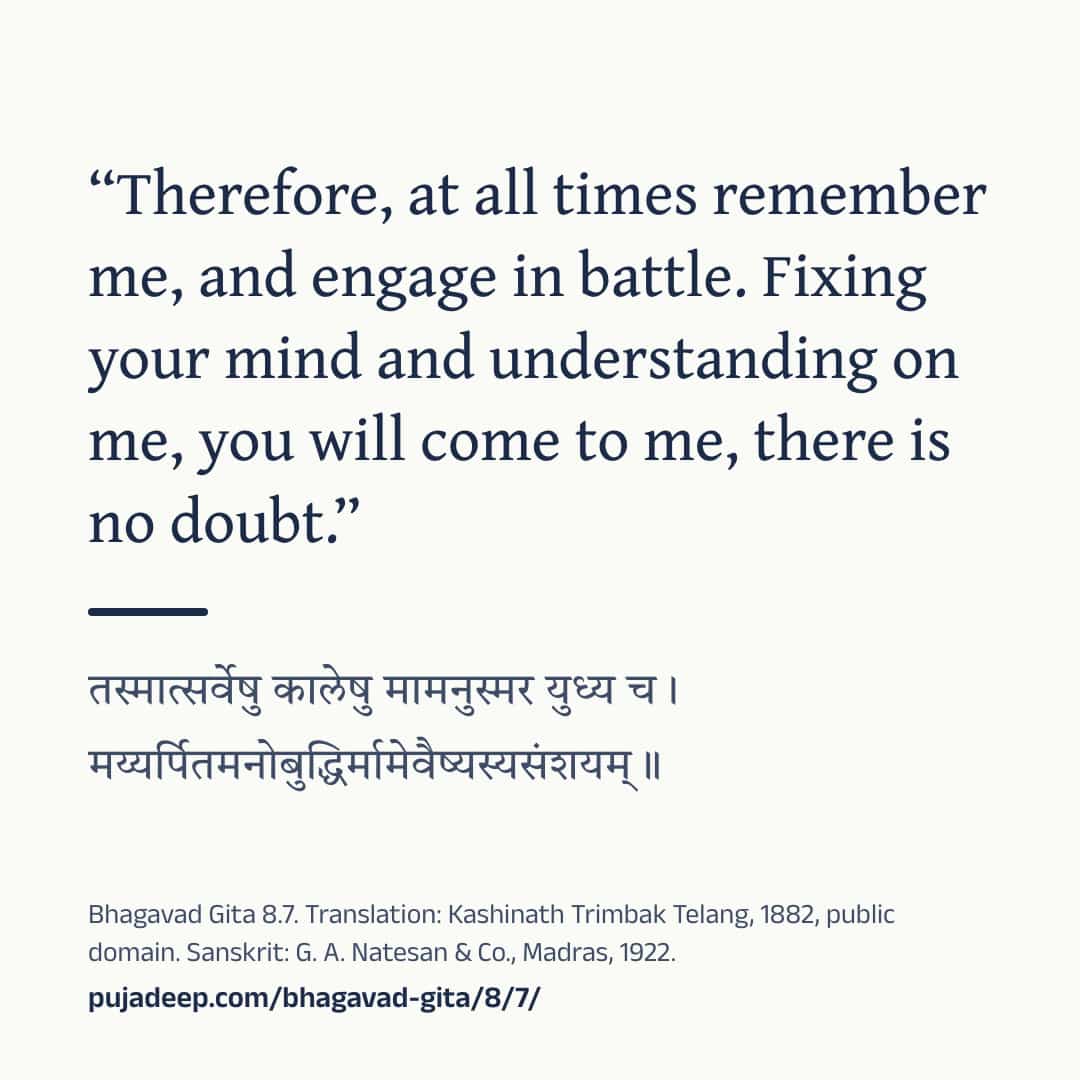
Drawing the picture
See the words
Bhagavad Gita 8.7

तस्मात्सर्वेषु कालेषु मामनुस्मर युध्य च ।
मय्यर्पितमनोबुद्धिर्मामेवैष्यस्यसंशयम् ॥

“Therefore, at all times remember me, and engage in battle. Fixing your mind and understanding on me, you will come to me, there is no doubt.”
(K. T. Telang, The Bhagavadgîtâ (The Sacred Books of the East, vol. VIII, Oxford: Clarendon Press, 1882), p. 78, public domain)

“Therefore at all times remember Me exclusively, and fight. With Manas and Buddhi set on Me, without doubt thou shalt come to Me.”
(Annie Besant, The Bhagavad Gîtâ, or The Lord's Song (London: Theosophical Publishing Society, 1895), p. 82, public domain)

“Therefore, at all times, constantly remember Me and fight. With mind and intellect absorbed in Me, thou shalt doubtless come to Me.”
(Swami Swarupananda, Srimad-Bhagavad-Gita (Mayavati: Prabuddha Bharata Press, 1909; first printed in Prabuddha Bharata, 1907–1909), p. 60; 77, public domain)

Sanskrit: G. A. Natesan & Co., Madras, 1922.
https://pujadeep.com/bhagavad-gita/8/7/ Nothing is sent from this site. Your own app sends it, to the chat you choose. The picture quotes the translation you chose on this page, with its name and year.
Sanskrit text: The Bhagavad-Gita, or The Lord's Song, with the text in Devanagari and an English translation, 1922. Meanings: written for Pujadeep and checked against the cited edition. Source and changes
Questions families ask
Who speaks Bhagavad Gita 8.7?
Krishna speaks this verse, in chapter 8 (Akshara Brahma Yoga).
Where does the Sanskrit text come from?
Sanskrit text: The Bhagavad-Gita, or The Lord's Song, with the text in Devanagari and an English translation, 1922. Meanings: written for Pujadeep and checked against the cited edition. See the source
Is the meaning on this page a translation?
Explanation written for this site from the sources listed here, and checked against the cited edition. It is not a translation and not the only way to read the text. Free to quote with credit.
Source and licence
- Sanskrit text
- The Bhagavad-Gita, or The Lord's Song, with the text in Devanagari and an English translation (Annie Besant, G. A. Natesan & Co., Madras, 1922). Public domain. The Sanskrit on these pages was read from this printing’s page images.
- Translation
- The Bhagavadgîtâ with the Sanatsugâtîya and the Anugîtâ, translated by Kâshinâth Trimbak Telang (The Sacred Books of the East, vol. VIII, ed. F. Max Müller) (Kashinath Trimbak Telang, F. Max Müller, Clarendon Press, Oxford, 1882). Public domain. Shown verbatim, as printed.
- Translation
- The Bhagavad Gîtâ, or The Lord's Song, translated by Annie Besant (Annie Besant, Theosophical Publishing Society, London, 1895). Public domain. Shown verbatim, as printed.
- Translation
- Srimad-Bhagavad-Gita, with Sanskrit Text; Paraphrase with Word-by-word Literal Translation; English Rendering and Comments, Index, &c., by the Swami Swarupananda (Himalayan Series, No. XX) (Swami Swarupananda, The Editors and Publishers, Advaita Ashrama, Mayavati, Prabuddha Bharata Press, Mayavati, Almora, Himalayas, 1909). Public domain. Shown verbatim, as printed.
- Common wording
- In this text, 32 words follow today's common wording, checked against sanskritdocuments.org; Sanskrit Wikisource; Gita Press, Gorakhpur; GRETIL, Göttingen and Bhaktivedanta Book Trust.
- Our explanation
- Explanation written for this site from the sources listed here, and checked against the cited edition. It is not a translation and not the only way to read the text. Free to quote with credit.
- Checked
- Checked against the cited edition, October 27, 2026.