Bhagavad Gita 7.16: meaning and translation
Chapter 7: Jnana Vijnana Yoga. Krishna says
Four kinds of good people worship him, Krishna tells Arjuna: the one in distress (ārta), the one who wants to know (jijñāsu), the one who seeks wealth (arthārthī), and the wise one (jñānī).
Click or tap a word for its meaning and its dictionary page.
Text and layers
Text and layers
These choices stay in this browser.
Bhagavad Gita 7.16
चतुर्विधा भजन्ते मां जनाः सुकृतिनोऽर्जुन ।आर्तो जिज्ञासुरर्थार्थी ज्ञानी च भरतर्षभ ॥
Chaturvidha bhajante mam janah sukritinorjunaArto jijnasurartharthi jnani cha bharatarshabha
caturvidhā bhajante māṃ janāḥ sukṛtino’rjuna |ārto jijñāsurarthārthī jñānī ca bharatarṣabha ||
Our explanation Four kinds of good people worship him, Krishna tells Arjuna: the one in distress (ārta), the one who wants to know (jijñāsu), the one who seeks wealth (arthārthī), and the wise one (jñānī). The commentators describe the four in different ways (see the views).
हिंदी अर्थ कृष्ण अर्जुन से कहते हैं कि चार प्रकार के पुण्य करने वाले लोग उन्हें भजते हैं: आर्त (संकट में पड़ा हुआ), जिज्ञासु (जानना चाहने वाला), अर्थार्थी (धन चाहने वाला) और ज्ञानी। टीकाकार इन चारों का वर्णन अलग-अलग ढंग से करते हैं।
Word by word
Every word, with its dictionary page
Word by word
- चतुर्विधाः caturvidhāḥ · of four kinds (adjective (masculine), nominative plural) Dictionary: catur-vidha, Monier-Williams 1899, p. 385, col. 1 “fourfold, of 4 sorts or kinds”
- भजन्ते bhajante · worship (present, 3rd person plural) Dictionary: bhaj, Monier-Williams 1899, p. 743, col. 1 “to serve, honour, revere, love, adore”
- माम् mām · "me" (Krishna) (pronoun, accusative singular) Dictionary: 1. mad, Monier-Williams 1899, p. 777, col. 2 “base of the first pers. pron. in the sg. number (esp. in comp.)”
- जनाः janāḥ · people (noun (masculine), nominative plural) Dictionary: jana, Monier-Williams 1899, p. 410, col. 1 “creature, living being, man, person, race”
- सुकृतिनः sukṛtinaḥ · doers of good (noun (masculine), nominative plural) Dictionary: su-kṛtin, Monier-Williams 1899, p. 1220, col. 2 “doing good actions, virtuous”
- अर्जुन arjuna · O Arjuna (noun (masculine), vocative singular) Dictionary: arjuna, Monier-Williams 1899, p. 90, col. 1
- आर्तः ārtaḥ · one in distress (past participle (masculine), nominative singular) Dictionary: ārta, Monier-Williams 1899, p. 149, col. 2 “oppressed, suffering, sick, unhappy”
- जिज्ञासुः jijñāsuḥ · one who wants to know (adjective (masculine), nominative singular) Dictionary: jijñāsu, Monier-Williams 1899, p. 421, col. 1 “desirous of knowing, inquiring into, examining, testing”
- अर्थार्थी arthārthī · one who seeks wealth (compound (masculine), nominative singular) Dictionary: artha, Monier-Williams 1899, p. 90, col. 3 “substance, wealth, property, opulence, money”; arthin, Monier-Williams 1899, p. 91, col. 3 “one who wants or desires anything”
- ज्ञानी jñānī · the wise one (noun (masculine), nominative singular) Dictionary: jñānin, Monier-Williams 1899, p. 426, col. 2 “knowing, endowed with knowledge or intelligence, wise”
- च ca · and (indeclinable) Dictionary: 2. ca, Monier-Williams 1899, p. 380, col. 1 “and, both, also, moreover, as well as”
- भरतर्षभ bharatarṣabha · O best of the Bharatas (noun (masculine), vocative singular) Dictionary: bharata-ṛṣabha, Monier-Williams 1899, p. 747, col. 3 “the best or a prince (lit. ‘bull’) of the Bh°s”
Old translations
Kashinath Trimbak Telang, 1882. Public domain. Page 75.
But, O Arguna! doers of good (acts) of four classes worship me: one who is distressed, one who is seeking after knowledge, one who wants wealth, and one, O chief of the descendants of Bharata! who is possessed of knowledge.
Compare 3 translations
Kashinath Trimbak Telang, 1882. Public domain. Page 75.
But, O Arguna! doers of good (acts) of four classes worship me: one who is distressed, one who is seeking after knowledge, one who wants wealth, and one, O chief of the descendants of Bharata! who is possessed of knowledge.
You are reading this one
Annie Besant, 1895. Public domain. Page 77.
Fourfold in division are the righteous ones who worship Me, O Arjuna: the suffering, the seeker for knowledge, the strenuous, the wise, O Lord of the Bhâratas.
You are reading this one
Swami Swarupananda, 1909 (first printed 1907). Public domain. Page 152.
Four kinds of virtuous men worship Me, O Arjuna,—the distressed, the seeker for knowledge, the seeker for enjoyment, and the wise, O bull among the Bhâratas.
You are reading this one
Cite this verse
The translation: K. T. Telang, The Bhagavadgîtâ (The Sacred Books of the East, vol. VIII, Oxford: Clarendon Press, 1882), p. 75. Bhagavad Gita 7.16.
The translation: Annie Besant, The Bhagavad Gîtâ, or The Lord's Song (London: Theosophical Publishing Society, 1895), p. 77. Bhagavad Gita 7.16.
The translation: Swami Swarupananda, Srimad-Bhagavad-Gita (Mayavati: Prabuddha Bharata Press, 1909; first printed in Prabuddha Bharata, 1907–1909), p. 152. Bhagavad Gita 7.16.
Our explanation: “Bhagavad Gita 7.16: meaning and translation.” Pujadeep. Updated October 27, 2026. https://pujadeep.com/bhagavad-gita/7/16/
Pujadeep’s explanations are free to quote with credit: name Pujadeep and link to the page. How to credit
Classical readings, by school
Each reading is named by its school. None is presented as the only meaning.
What Advaita, Vishishtadvaita and Dvaita teach, in short
Shankara Advaita
Shankara gives examples: the one in distress is overcome by a robber, a tiger, illness and the like; the seeker wants to know the Lord's true nature; the wise one already knows the true nature of Vishnu.
Source: The Bhagavad-Gita, with the commentary of Sri Sankaracharya, translated by A. Mahadeva Sastri (2nd ed., Mysore: G. T. A. Printing Works, 1901), commentary on 7.16, p. 194. Summarised in our own words; none of its text is reproduced.
Ramanuja Vishishtadvaita
Ramanuja ranks the four, each higher than the one before: one who has lost wealth or power and wants it back; one who seeks wealth not had before; one who seeks to know the self (ātman) as free from matter; and the wise one, who knows the self as belonging to the Lord and seeks the Lord himself.
Source: Sri Bhagavad-Gita with Sri Ramanujacharya's Visishtadvaita commentary, translated by A. Govindacharya (Madras, 1898), commentary on 7.16, pp. 243–244. Summarised in our own words; none of its text is reproduced.
Share
Show the ways to share
Send one picture or the text to one chat. The picture names its source and the address of this page.
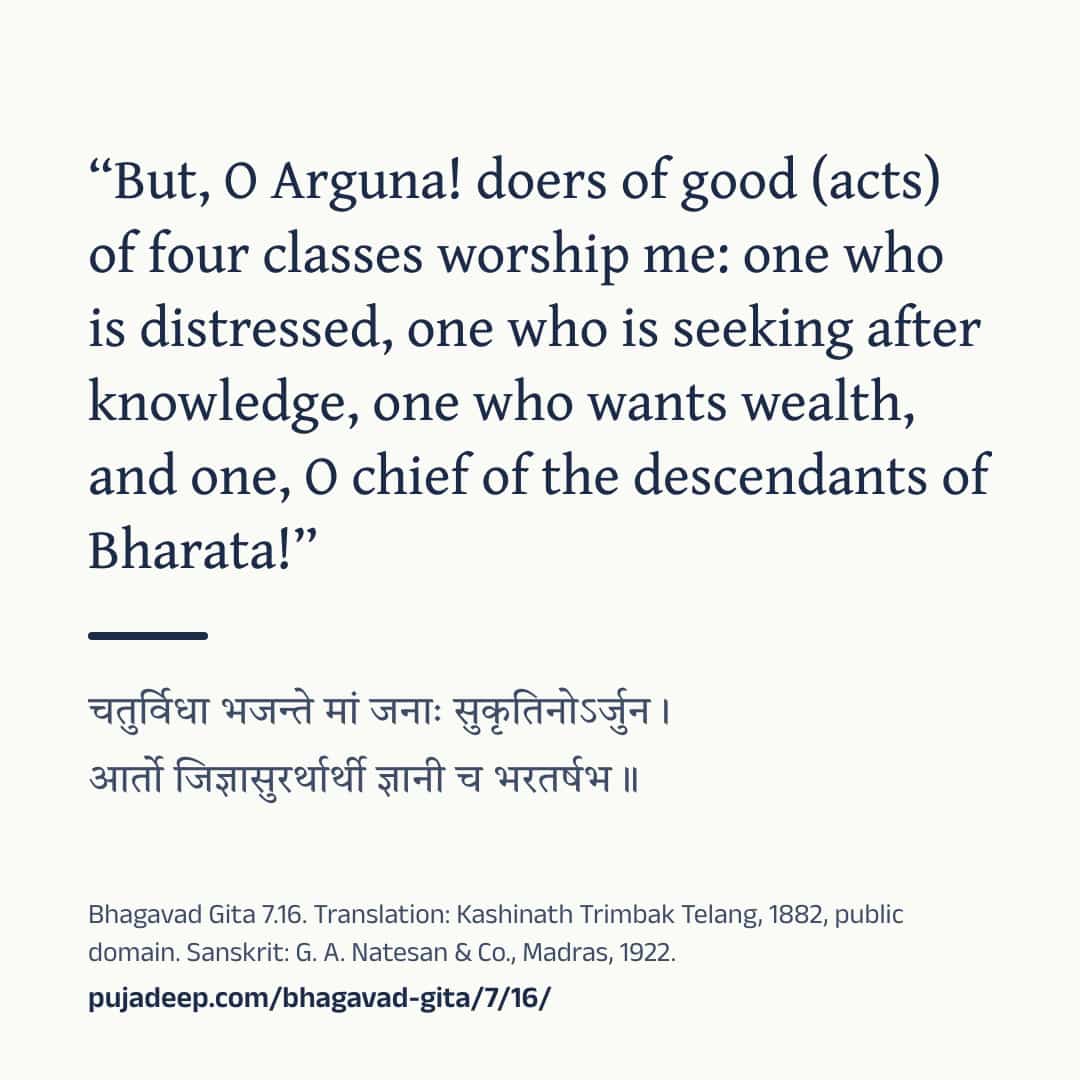
Drawing the picture
See the words
Bhagavad Gita 7.16

चतुर्विधा भजन्ते मां जनाः सुकृतिनोऽर्जुन ।
आर्तो जिज्ञासुरर्थार्थी ज्ञानी च भरतर्षभ ॥

“But, O Arguna! doers of good (acts) of four classes worship me: one who is distressed, one who is seeking after knowledge, one who wants wealth, and one, O chief of the descendants of Bharata! who is possessed of knowledge.”
(K. T. Telang, The Bhagavadgîtâ (The Sacred Books of the East, vol. VIII, Oxford: Clarendon Press, 1882), p. 75, public domain)

“Fourfold in division are the righteous ones who worship Me, O Arjuna: the suffering, the seeker for knowledge, the strenuous, the wise, O Lord of the Bhâratas.”
(Annie Besant, The Bhagavad Gîtâ, or The Lord's Song (London: Theosophical Publishing Society, 1895), p. 77, public domain)

“Four kinds of virtuous men worship Me, O Arjuna,—the distressed, the seeker for knowledge, the seeker for enjoyment, and the wise, O bull among the Bhâratas.”
(Swami Swarupananda, Srimad-Bhagavad-Gita (Mayavati: Prabuddha Bharata Press, 1909; first printed in Prabuddha Bharata, 1907–1909), p. 152, public domain)

Sanskrit: G. A. Natesan & Co., Madras, 1922.
https://pujadeep.com/bhagavad-gita/7/16/ Nothing is sent from this site. Your own app sends it, to the chat you choose. The picture quotes the translation you chose on this page, with its name and year.
Sanskrit text: The Bhagavad-Gita, or The Lord's Song, with the text in Devanagari and an English translation, 1922. Meanings: written for Pujadeep and checked against the cited edition. Source and changes
Questions families ask
Who speaks Bhagavad Gita 7.16?
Krishna speaks this verse, in chapter 7 (Jnana Vijnana Yoga).
Where does the Sanskrit text come from?
Sanskrit text: The Bhagavad-Gita, or The Lord's Song, with the text in Devanagari and an English translation, 1922. Meanings: written for Pujadeep and checked against the cited edition. See the source
Is the meaning on this page a translation?
Explanation written for this site from the sources listed here, and checked against the cited edition. It is not a translation and not the only way to read the text. Free to quote with credit.
Source and licence
- Sanskrit text
- The Bhagavad-Gita, or The Lord's Song, with the text in Devanagari and an English translation (Annie Besant, G. A. Natesan & Co., Madras, 1922). Public domain. The Sanskrit on these pages was read from this printing’s page images.
- Translation
- The Bhagavadgîtâ with the Sanatsugâtîya and the Anugîtâ, translated by Kâshinâth Trimbak Telang (The Sacred Books of the East, vol. VIII, ed. F. Max Müller) (Kashinath Trimbak Telang, F. Max Müller, Clarendon Press, Oxford, 1882). Public domain. Shown verbatim, as printed.
- Translation
- The Bhagavad Gîtâ, or The Lord's Song, translated by Annie Besant (Annie Besant, Theosophical Publishing Society, London, 1895). Public domain. Shown verbatim, as printed.
- Translation
- Srimad-Bhagavad-Gita, with Sanskrit Text; Paraphrase with Word-by-word Literal Translation; English Rendering and Comments, Index, &c., by the Swami Swarupananda (Himalayan Series, No. XX) (Swami Swarupananda, The Editors and Publishers, Advaita Ashrama, Mayavati, Prabuddha Bharata Press, Mayavati, Almora, Himalayas, 1909). Public domain. Shown verbatim, as printed.
- Commentary
- The Bhagavad-Gita, with the commentary of Sri Sankaracharya, translated by A. Mahadeva Sastri (2nd ed., Mysore: G. T. A. Printing Works, 1901) (Public-domain scan, University of California Libraries). Summarised in our own words; none of its text is reproduced.
- Commentary
- Sri Bhagavad-Gita with Sri Ramanujacharya's Visishtadvaita commentary, translated by A. Govindacharya (Madras, 1898) (Scan uploaded to archive.org (folkscanomy collection)). Summarised in our own words; none of its text is reproduced.
- Common wording
- In this text, 32 words follow today's common wording, checked against sanskritdocuments.org; Sanskrit Wikisource; Gita Press, Gorakhpur; GRETIL, Göttingen and Bhaktivedanta Book Trust.
- Our explanation
- Explanation written for this site from the sources listed here, and checked against the cited edition. It is not a translation and not the only way to read the text. Free to quote with credit.
- Checked
- Checked against the cited edition, October 15, 2026.
- Updated
- October 27, 2026